Ironclad is the best contract negotiation software for bankruptcy law firms, because its no-code Workflow Designer turns creditor agreements, settlement terms and repayment plans into repeatable approval flows. It holds a four point four out of five rating on G2, and most bankruptcy practices pair it with a cheaper repository for signed agreements.
How we make this list: we compare pricing pages, product documentation and public user reviews, then re-check every price before each update. No product paid for a place. Disclosure.
Ironclad is the best overall pick for contract negotiation, with no-code workflows and AI redlining, but it is quote only.
LinkSquares holds the highest G2 rating in this list at 4.7 out of 5 from 445 reviews.
PandaDoc is the cheapest published price at $19 a seat a month, with a free plan for five documents a month.
ContractSafe and Concord publish flat monthly prices of $450 and $499, the only fixed numbers in this list besides PandaDoc.
Enterprise platforms sell by quote, with buyer data putting medians from about $31,000 to $67,000 a year, so budget for implementation separately.
How do you choose contract negotiation software for a bankruptcy law firm?
Bankruptcy work runs on negotiated paper. Chapter 7 and Chapter 13 cases turn on creditor agreements, settlement terms, repayment plans and fee agreements, so the tool that wins is the one that gets a redline back fastest, not the one with the longest feature list.
Most bankruptcy firms are small. A solo attorney or a three-lawyer practice cannot absorb a quote-only enterprise platform that costs thirty thousand dollars a year before implementation, which is why the published-price tools in this list matter more than the enterprise names at the top.
Negotiation features decide the shortlist. In-browser redlining, clause libraries, version control and approval routing save more time than repository analytics, because a bankruptcy attorney negotiates with creditors and trustees daily and archives the result afterwards.
Price transparency is the honest split in this market. Three tools in this list publish prices before any sales call, while the enterprise platforms sell by quote, so ask for implementation as a separate line and get the total in writing before shortlisting.
The 9 best contract negotiation software for bankruptcy law firms tools
01
Ironclad
4.4/5on G2 (332 reviews, checked Nov 2026)
PricingCustom/yr
Best contract negotiation software overall
NegotiationIn-browser redlining and Word collaboration
WorkflowsNo-code Workflow Designer with approvals
AI reviewContract Review Agent flags risky clauses
E-signatureNative e-signature and Clickwrap included
ironcladapp.com
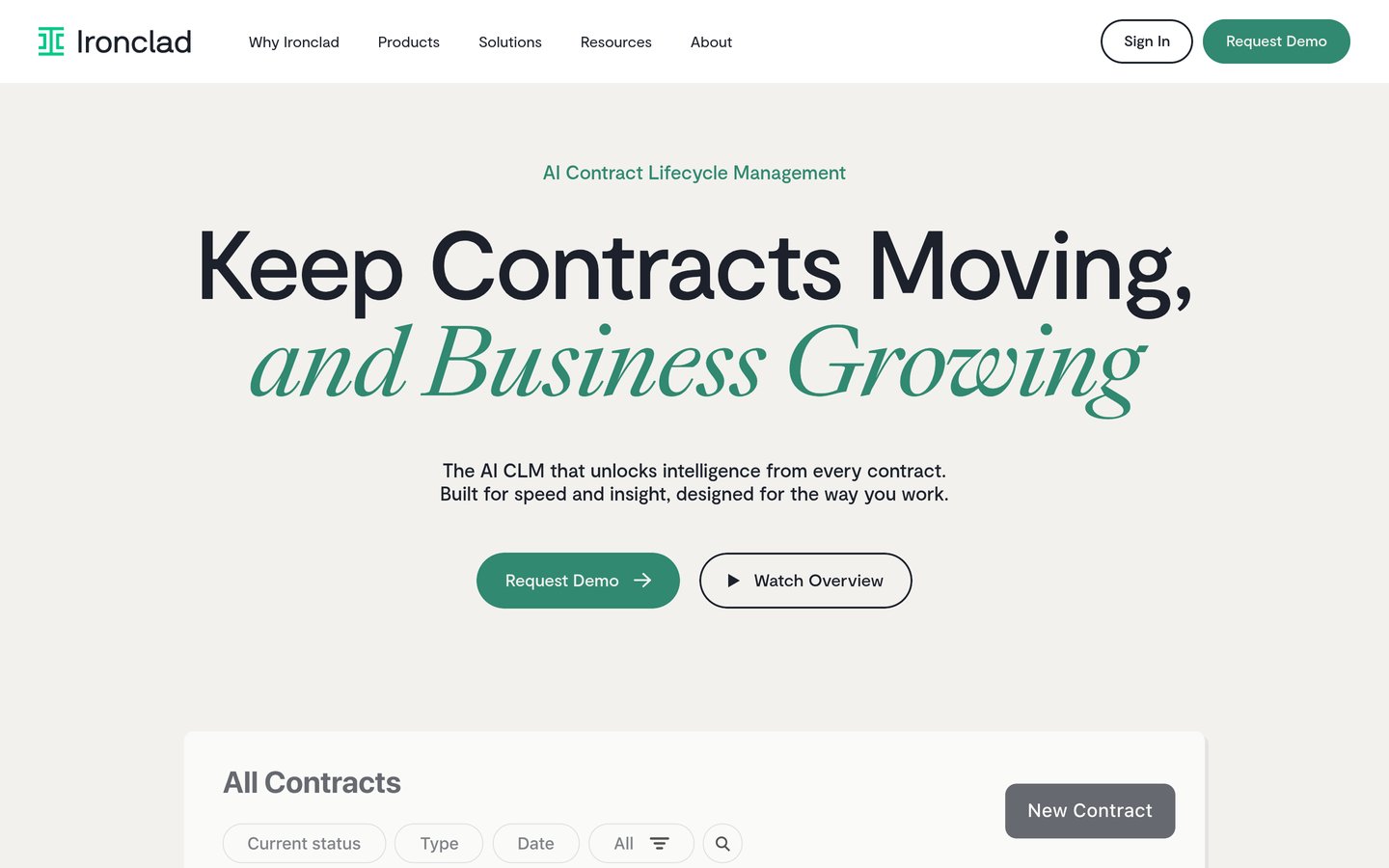
Ironclad homepage, captured Nov 2026.
Ironclad is a contract lifecycle platform built around a no-code Workflow Designer that lets legal teams route creditor agreements, settlement terms and repayment plans through approvals without engineering help. It pairs that with in-app redlining, a searchable repository and native e-signature, so a bankruptcy practice can draft, negotiate and sign in one place.
The trade off is price and weight. Ironclad publishes no list prices and sells by quote, with buyer data putting the median near forty thousand dollars a year and implementation commonly adding ten to forty thousand more, which is a lot for a solo bankruptcy practice, and setup takes weeks rather than days.
AnalyticsLinkAI extraction and post-signature reporting
RepositorySearchable contract store with obligation tracking
DraftingFinalize templates with approval workflows
IntegrationsSalesforce, Slack, DocuSign and HubSpot
linksquares.com
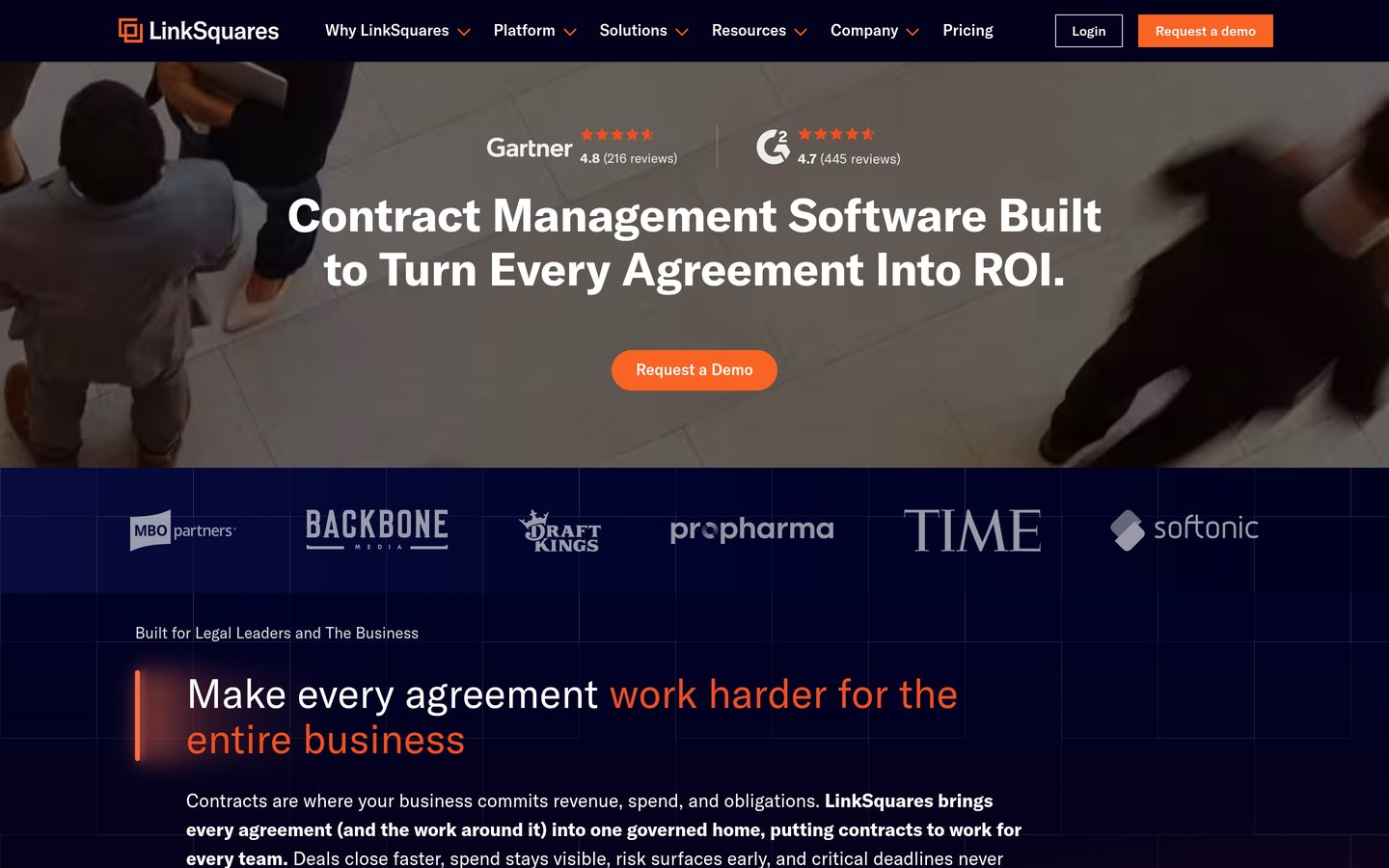
LinkSquares homepage, captured Nov 2026.
LinkSquares is an AI-powered contract platform whose LinkAI engine extracts terms, dates and obligations from signed agreements and turns them into searchable reports. A bankruptcy firm can use it to track creditor deadlines, repayment milestones and settlement obligations across every active case file, with drafting and approvals in the Finalize module.
The trade off is cost and scope. LinkSquares sells by quote with buyer data putting the median near thirty-one thousand dollars a year, and its analytics engine is built for teams managing hundreds of contracts, so a small bankruptcy practice may pay for reporting power it rarely uses.
Starting priceStarter, $19 per seat a month, billed annually
Free planFree plan covers 5 documents a month
E-signatureLegally binding e-signature included
DocumentsUnlimited documents on Starter via the web app
pandadoc.com
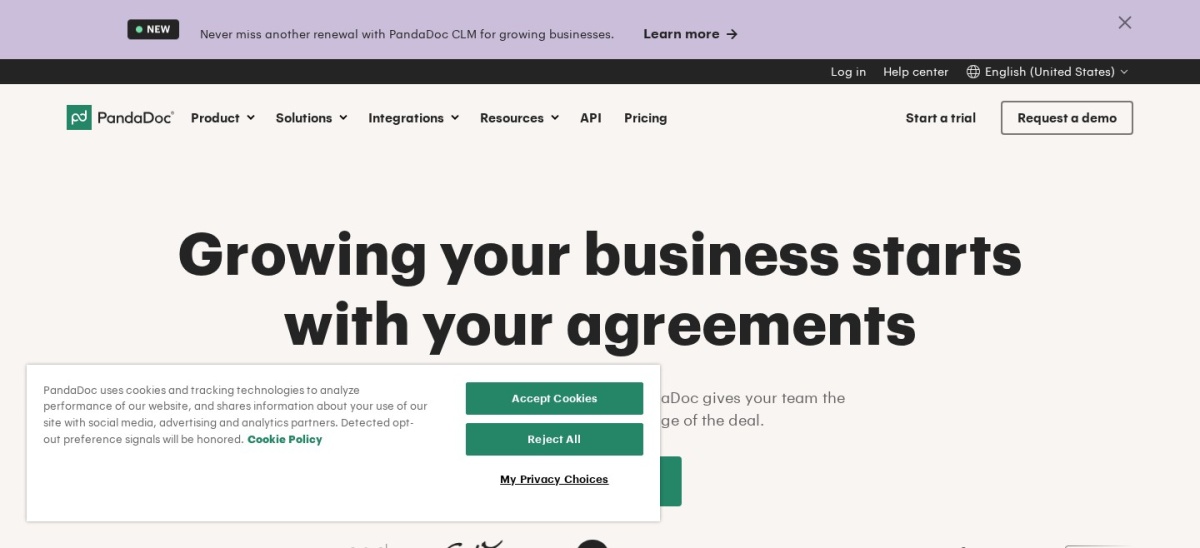
PandaDoc homepage, captured Nov 2026.
PandaDoc is a document platform that covers drafting, sending and signing agreements, with templates, a content library and legally binding e-signature. A bankruptcy practice can send fee agreements, settlement letters and repayment plans from one place, and the free plan covers five documents a month before Starter at nineteen dollars a seat.
The trade off is depth. PandaDoc is a sales document tool rather than a full contract lifecycle platform, so it has no clause library, obligation tracking or repository analytics, and documents created through the API or automations consume usage credits that can add cost.
What we like
Cheapest published price in this list at $19 a seat
Free plan covers five documents a month
Unlimited documents and e-signatures on Starter
Watch out for
API and automation creation uses usage credits
No full contract lifecycle management
Business plan needed for CRM and approvals
Starter $19 per seat a month billed annually; Business $49Visit pandadoc.com
04
Juro
4.5/5on G2 (248 reviews, checked Nov 2026)
PricingCustom/yr
Best for browser-native negotiation
EditorBrowser-native editor, no Word dependency
NegotiationIn-browser commenting and redlining
AI reviewAI agent reviews third-party paper
UsersNo per-user fees, unlimited users
juro.com
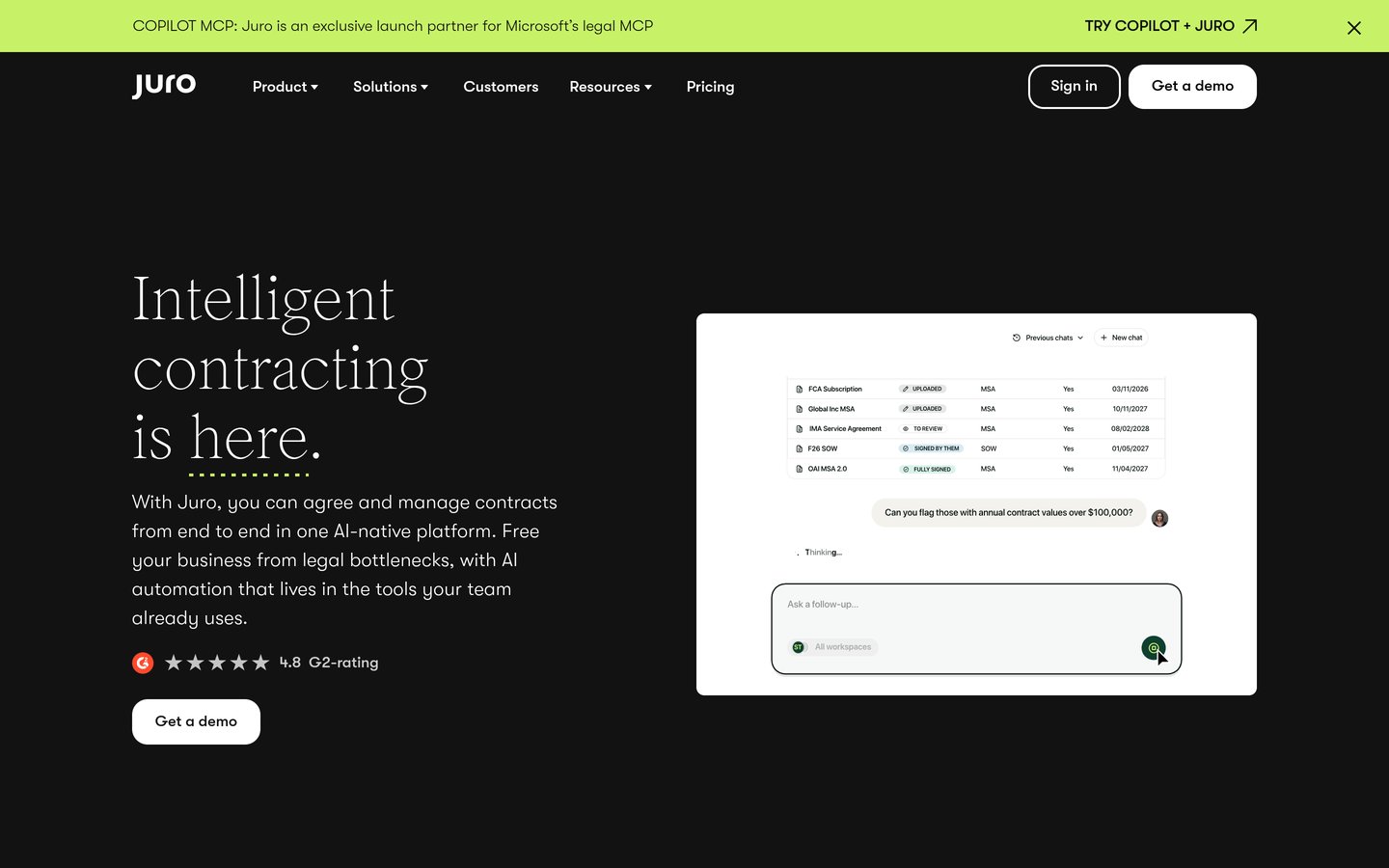
Juro homepage, captured Nov 2026.
Juro is an AI-native contract platform with a browser-native editor that lets teams draft, negotiate and sign contracts without Microsoft Word. Counterparties redline and comment in the browser, the AI review agent checks third-party paper against playbooks, and there are no per-user fees, which suits a small firm with many occasional users.
The trade off is price transparency. Juro publishes no list prices and builds a custom plan per customer, with buyer data putting the median near thirty-one thousand dollars a year, and some firms will miss Word-native workflows and the deep configurability of larger platforms.
What we like
Negotiate entirely in the browser, no Word needed
No per-user fees
Fast deployment, typically under a month
Watch out for
Quote-only pricing, no public list price
Buyer data puts the median near $31,164 a year
Smaller review base than Ironclad or DocuSign CLM
Vendor pricing page is custom-quote only; older $463 a month figure not confirmedVisit juro.com
05
Agiloft
4.5/5on G2 (112 reviews, checked Nov 2026)
PricingCustom/yr
Best for deep no-code customization
ConfigurationNo-code builder for custom workflows
AI assistantAstra AI with automated metadata extraction
Word add-inRedlining inside Microsoft Word
Integrations1,000+ integrations listed
agiloft.com
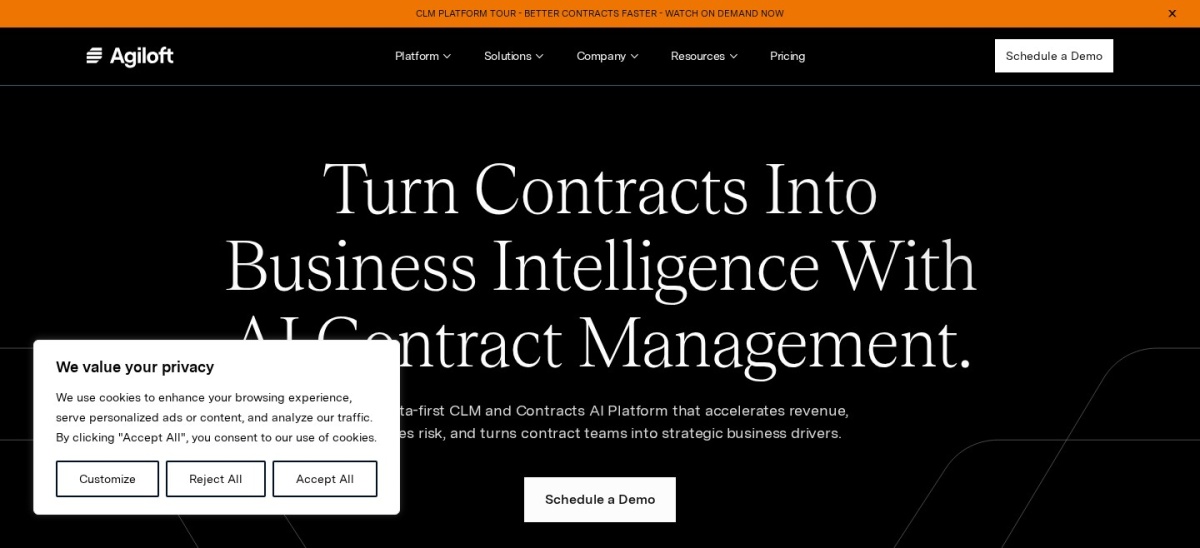
Agiloft homepage, captured Nov 2026.
Agiloft is a contract lifecycle platform built around a no-code workflow builder that handles complex, unusual contract processes without custom code. Its Astra AI assistant extracts metadata into your own data model, a Word add-in covers redlining, and more than a thousand integrations connect it to the tools a firm already uses.
The trade off is implementation. Agiloft publishes no prices and sells by quote, with buyer data putting the median near sixty-seven thousand dollars a year, and complex deployments are services-led, so a small bankruptcy firm should budget real admin time as well as licence cost.
What we like
Deepest no-code configurability in this list
AI metadata extraction tailored to your data model
Gartner Magic Quadrant Leader for six straight years
Watch out for
Quote-only pricing, no public list price
Buyer data puts the median near $67,132 a year
Complex deployments are services-led and slow
Vendr median about $67,132 a year; free-tier status conflicts between sourcesVisit agiloft.com
06
Malbek
4.5/5on G2 (87 reviews, checked Nov 2026)
PricingCustom/yr
Best for mid-market legal operations
WorkflowsConfigurable intake and approval workflows
AIAutonomous task execution and AI extraction
RepositoryCentral contract store with search
IntegrationsSalesforce, DocuSign and Microsoft 365
malbek.io
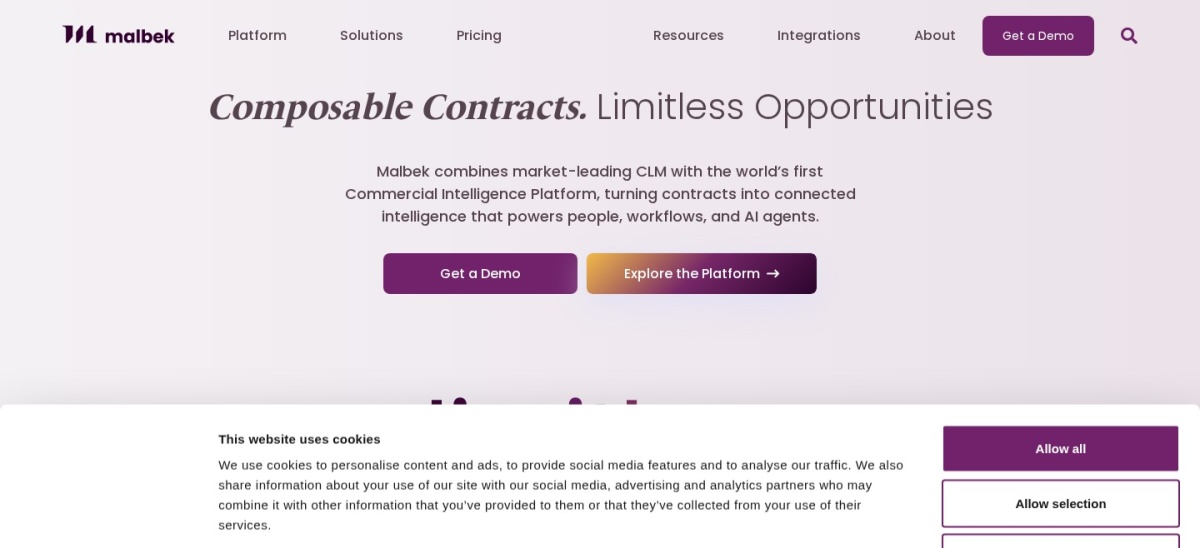
Malbek homepage, captured Nov 2026.
Malbek is a contract lifecycle platform for mid-market legal operations, built around configurable intake forms, approval workflows and a central repository. Its AI handles extraction and autonomous task execution, so routine steps such as routing a settlement draft for approval can run without manual chasing.
The trade off is scale and transparency. Malbek publishes no prices and sells by quote, with buyer data putting mid-market deals near fifteen to fifty thousand dollars a year, and its G2 review base is far smaller than LinkSquares or Ironclad, so diligence rests on a demo.
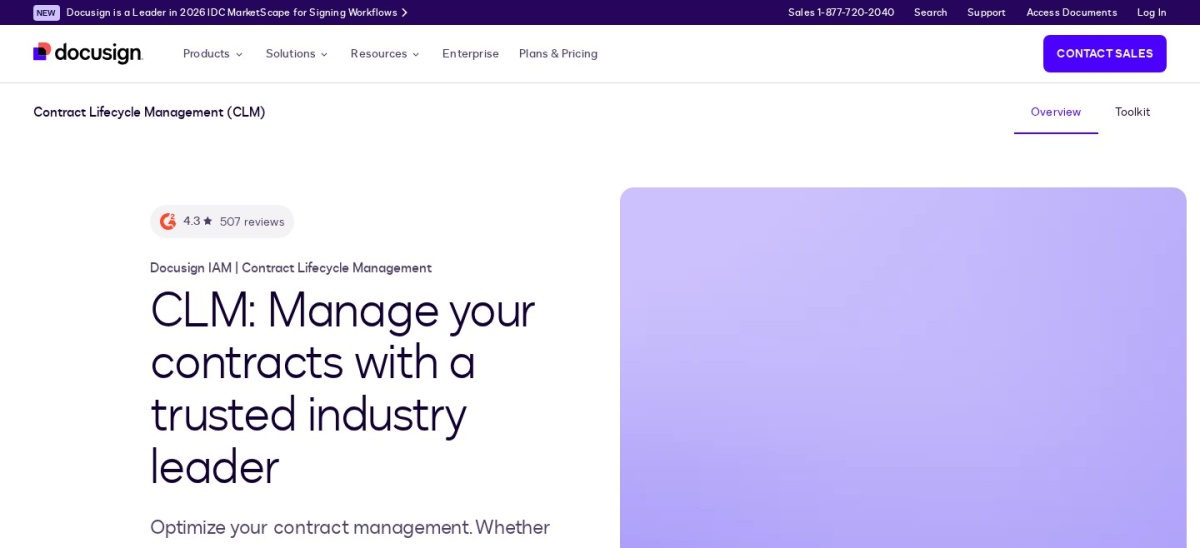
DocuSign CLM is the lifecycle extension of the best-known e-signature platform, adding drafting, negotiation, obligation tracking and reporting on top of native signing. A bankruptcy firm that already collects signatures in DocuSign gets the shortest path to lifecycle management, since users, templates and signing history already live in the ecosystem.
The trade off is cost and weight. Pricing is entirely quote-based, with third-party estimates ranging from about twenty thousand to over two hundred thousand dollars a year depending on seats and modules, and CLM is a separate product from eSignature, so existing eSignature spend does not cover it.
What we like
Shortest path if DocuSign is already the signing standard
Docusign Iris AI assists review and extraction
Largest install base of the enterprise tools here
Watch out for
Quote-only pricing, no public list price
Third-party estimates range from $20,000 to over $200,000 a year
CLM is a separate product from eSignature, not an add-on
Starting priceOrganize, $450 a month, prepaid annually
UsersUnlimited users on every plan
AIAI data extraction and contract chat
SearchOCR search across every stored contract
contractsafe.com
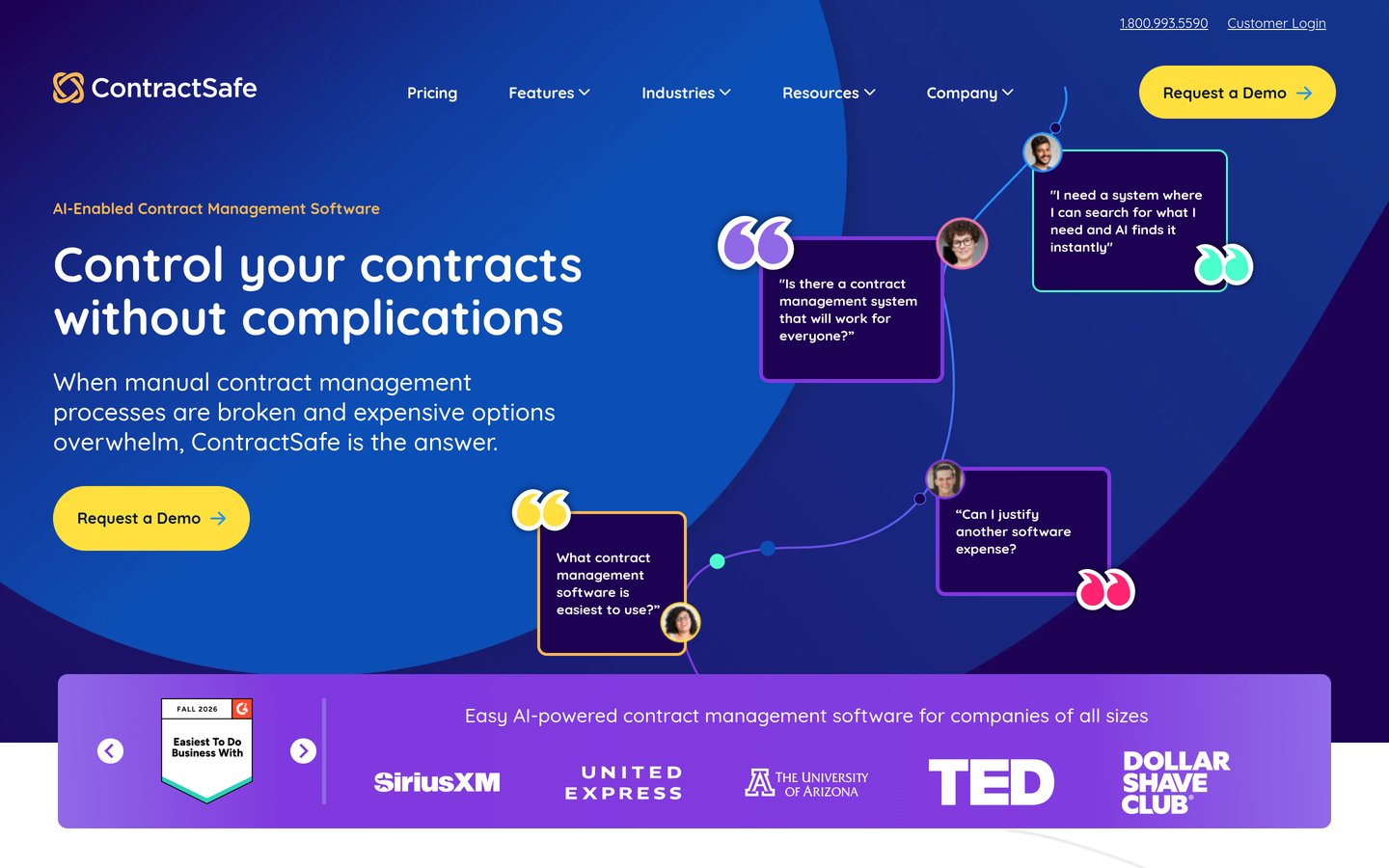
ContractSafe homepage, captured Nov 2026.
ContractSafe is a contract repository for small and mid-size teams, with unlimited users on every plan and AI data extraction from the entry tier. It stores every signed agreement in one searchable place, with OCR search, unlimited reminders and automated renewal alerts, and Organize starts at four hundred fifty dollars a month billed annually.
The trade off is negotiation depth. ContractSafe organises and tracks contracts rather than negotiating them, so redlining, approval workflows and e-signature sit in the higher Finalize plan, and the entry plan covers only one hundred active contracts, which a busy bankruptcy practice can outgrow.
Starting priceEssentials, $499 a month, paid annually
Users5 users included, unlimited viewers and guests
NegotiationOnline redlining and live co-editing
E-signatureUnlimited e-signatures on every plan
concordnow.com
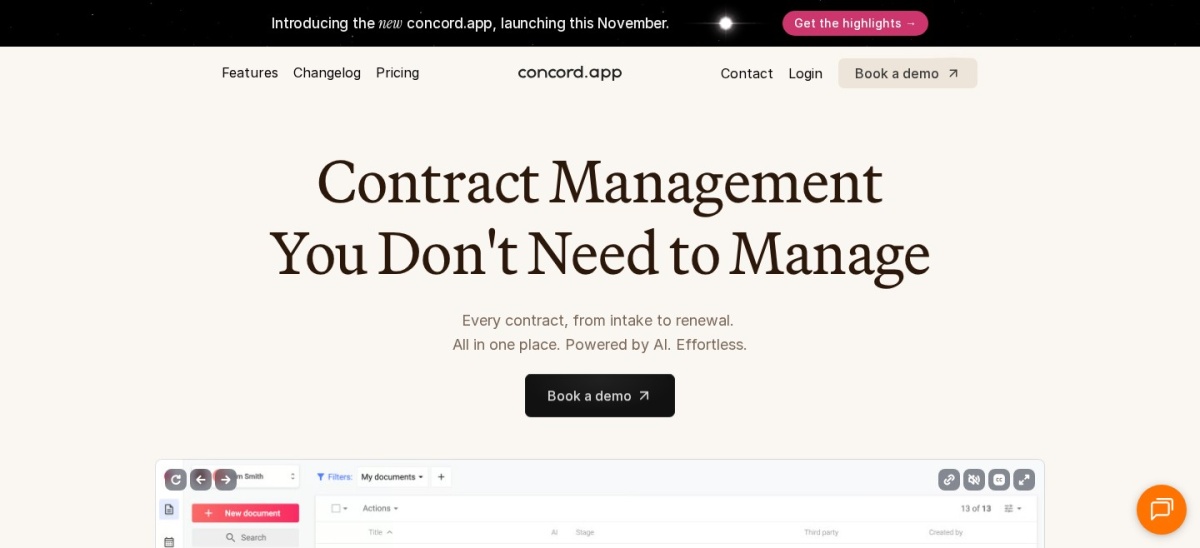
Concord homepage, captured Nov 2026.
Concord is a contract management platform that covers drafting, negotiation, e-signature and storage in one place. Essentials at four hundred ninety-nine dollars a month includes unlimited templates, e-signatures and approval workflows, with AI Copilot, deadline reminders and amendment management for a small team.
The trade off is rating depth. Its four point two out of five G2 rating is the lowest in this list, reviewers note a slower setup than simpler repositories, and every plan starts at five users, so a solo bankruptcy attorney pays for seats that sit empty.
What we like
Flat monthly price with unlimited documents and signatures
Real-time co-editing for collaborative negotiation
Why most bankruptcy firms should start with a published price
Six of the nine tools in this list sell by quote, and the buyer data behind them puts medians between about thirty-one thousand and sixty-seven thousand dollars a year before implementation. That is a procurement project, not a subscription, and a small bankruptcy firm should treat it as one, with a written total before any demo.
The three tools with published prices cover the whole job for a small firm: PandaDoc for drafting and signing, ContractSafe for the repository, Concord for negotiation plus e-signature. Start there, measure how many agreements you actually negotiate each month, and only then ask an enterprise vendor for a quote.
How we chose
We started from the contract lifecycle tools most often shortlisted for legal teams, then kept the nine with a numeric rating on G2. That rule left out newer or niche tools with no usable rating, and every tool here has at least eighty-seven G2 reviews.
Prices were checked on 30 November 2026. Ironclad, LinkSquares, Juro, Agiloft, Malbek and DocuSign CLM publish no list prices and sell by quote, while PandaDoc Starter costs nineteen dollars a seat a month, ContractSafe Organize starts at four hundred fifty dollars a month and Concord Essentials at four hundred ninety-nine dollars a month, all billed annually.
Ratings and review counts come from G2 on the same day, with LinkSquares at four point seven from four hundred forty-five reviews and Ironclad at four point four from three hundred thirty-two. Buyer medians come from Vendr purchasing data reported in November 2026. No vendor paid for a place, and we do not claim hands-on testing for this list.
How to choose contract negotiation software for bankruptcy law firms
Start from the negotiation, then check the bill.
Name the negotiation you run most. Creditor settlements, repayment plans and fee agreements each need different templates, so list your last ten negotiated documents before shortlisting.
Price the whole first year, not the licence. Quote-only tools add implementation, migration and training, so ask for each as a separate line and get the total in writing.
Test redlining with a real counterparty. A demo on your own settlement template shows whether creditors can redline in the browser or need Word, which decides adoption.
Check the repository before you sign. Every negotiated agreement becomes a stored contract, so confirm search, reminders and obligation tracking cover what the negotiation tool produces.
FAQ
What is the best contract negotiation software for bankruptcy law firms in 2026?
Ironclad is the best overall pick. Its no-code Workflow Designer routes creditor agreements, settlement terms and repayment plans through approvals, with in-app redlining and native e-signature, and it holds a four point four out of five rating on G2 from three hundred thirty-two reviews.
How much does contract negotiation software cost for a small bankruptcy firm?
Published prices start at nineteen dollars a seat a month for PandaDoc Starter, four hundred fifty dollars a month for ContractSafe Organize and four hundred ninety-nine dollars a month for Concord Essentials. Enterprise platforms sell by quote, with buyer data putting medians from about thirty-one thousand to sixty-seven thousand dollars a year.
Can a solo bankruptcy attorney use Ironclad or LinkSquares?
Yes, but the price is the problem. Both sell by quote with buyer medians near forty thousand dollars a year for Ironclad and thirty-one thousand for LinkSquares, plus implementation, so most solo practices start with PandaDoc, ContractSafe or Concord and move up only when volume justifies it.
What is the difference between contract negotiation software and a contract repository?
Negotiation software drafts, redlines and approves agreements before signing, while a repository stores and tracks signed contracts afterwards. Tools such as Juro and Concord cover negotiation, ContractSafe leans repository, and Ironclad and LinkSquares cover both ends of the lifecycle.
Do any of these tools offer a free plan?
PandaDoc offers a free plan covering five documents a month, and ContractSafe offers a seven-day trial. Ironclad, LinkSquares, Juro, Agiloft, Malbek, DocuSign CLM and Concord offer demos or trials rather than free plans, so confirm the trial length before committing.
Which tool is best for negotiating with creditors?
Juro is the strongest pure negotiation pick, because counterparties redline and comment in the browser without Word, and its AI agent reviews third-party paper against playbooks. Concord is the budget alternative, with live co-editing and unlimited e-signatures from four hundred ninety-nine dollars a month.
Is DocuSign CLM the same as DocuSign eSignature?
No. DocuSign CLM is a separate lifecycle product that adds drafting, negotiation, obligation tracking and reporting on top of eSignature. Existing eSignature spend does not cover it, and pricing is quote only, with third-party estimates ranging widely by seats and modules.
SaaS SEO and WordPress specialist with about 8 years of experience. Rakib compares WordPress plugins, themes, hosting and software using public pricing, documentation and user reviews. See how we rank.