Pipedream is the best of the Composio alternatives for most teams, giving AI agents managed auth and 10,000+ prebuilt tools across 3,000+ APIs from $99 a month. Zapier suits no-code teams with 9,000+ apps, while Nango suits developers who want code-first tools from $50 a month.
How we make this list: we compare pricing pages, product documentation and public user reviews, then re-check every price before each update. No product paid for a place. Disclosure.
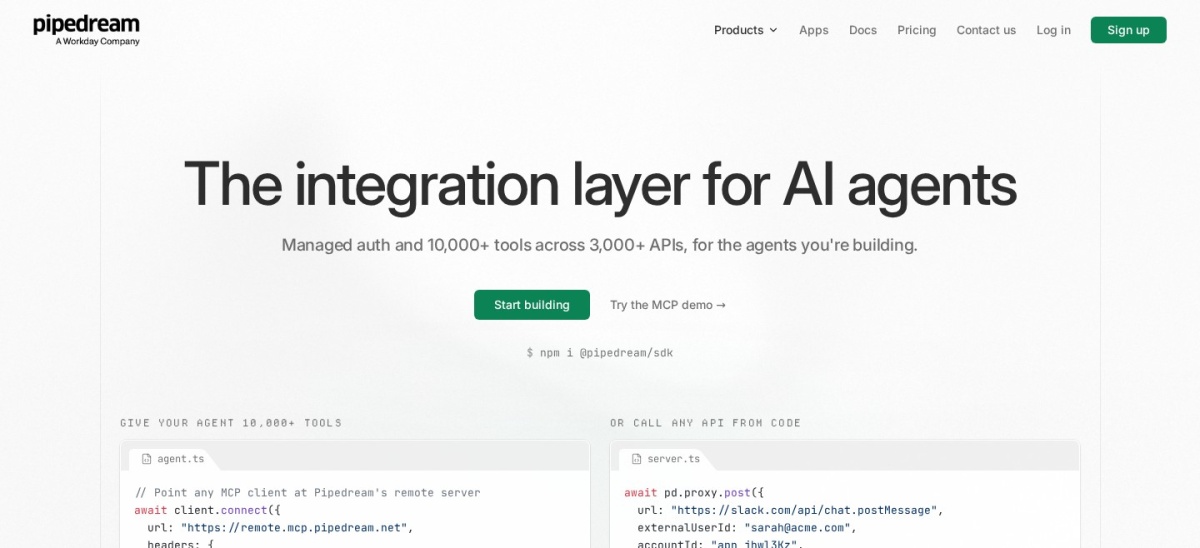
Pipedream is the closest direct match: 3,000+ APIs and 10,000+ prebuilt tools, with managed auth, from $99 a month.
Zapier connects 9,000+ apps, the widest library here, and its free plan covers 100 tasks a month.
Nango and n8n are the developer picks: Nango is code-first from $50 a month, and n8n self-hosts free.
Make is the cheapest paid start at $12 a month billed annually for 10,000 credits.
Merge and StackOne are the governance picks, but they start at $1,000 and $600 a month.
What should you look for in Composio alternatives?
Auth is the first thing to check. Composio manages OAuth and token refresh for agents, so a replacement should do the same for each user, not share one service account across everyone.
Catalog size matters only if it covers your apps. Pipedream lists 3,000+ APIs, Zapier 9,000+ apps, and Nango 1,500+ APIs, so check your own stack before counting totals.
Pricing models differ more than prices do. Some charge per tool call or credit, others per month, so model your expected call volume before picking a plan. Our guide on how to connect WordPress to AI agents with MCP shows how an agent reaches a real app through a standard protocol.
Governance decides whether agents can run in production. Audit logs, per-user permissions and data redaction matter most for teams whose agents act in customer accounts.
Pipedream is the closest direct replacement for Composio, built around Pipedream Connect for AI agents. It covers 3,000+ APIs with 10,000+ prebuilt tools, managed OAuth, per-user credentials and a remote MCP server, so agents call tools without holding provider tokens.
The trade off is price and a developer focus. The free plan is for development only, and production starts with Startup at $99 a month billed annually for 100 external users and 10,000 credits. It suits teams shipping agents to real users who need the widest catalog.
Zapier is the largest no-code integration platform, connecting more than 9,000 apps with Zaps that move data between them. The free plan covers 100 tasks a month with two-step Zaps, and paid plans add multi-step Zaps, premium apps, webhooks, AI fields and MCP access for agents.
The trade off is price. Professional starts at $19.99 a month billed annually for 750 tasks, or $29.99 billed monthly, so costs climb fast as volume grows. It suits teams that want the widest app library and the fastest setup.
What we like
Largest app library by far, at 9,000+ apps
AI agents, Copilot and MCP support included
Free plan and 14-day Professional trial
Watch out for
Task-based billing gets expensive as volume grows
750 tasks on the entry paid tier is thin for busy teams
Agent tool calls cost two tasks each
Team adds shared connections and SSO from $69 a monthVisit zapier.com
03
Nango
4.5/5on G2 (67 reviews, checked Nov 2026)
Paid from$50/mo
Best code-first pick for developers
APIs supported1,500+
Free plan10 connections
Cheapest paidPay-as-you-go, $50/mo
Self-hostingYes, source-available
nango.dev
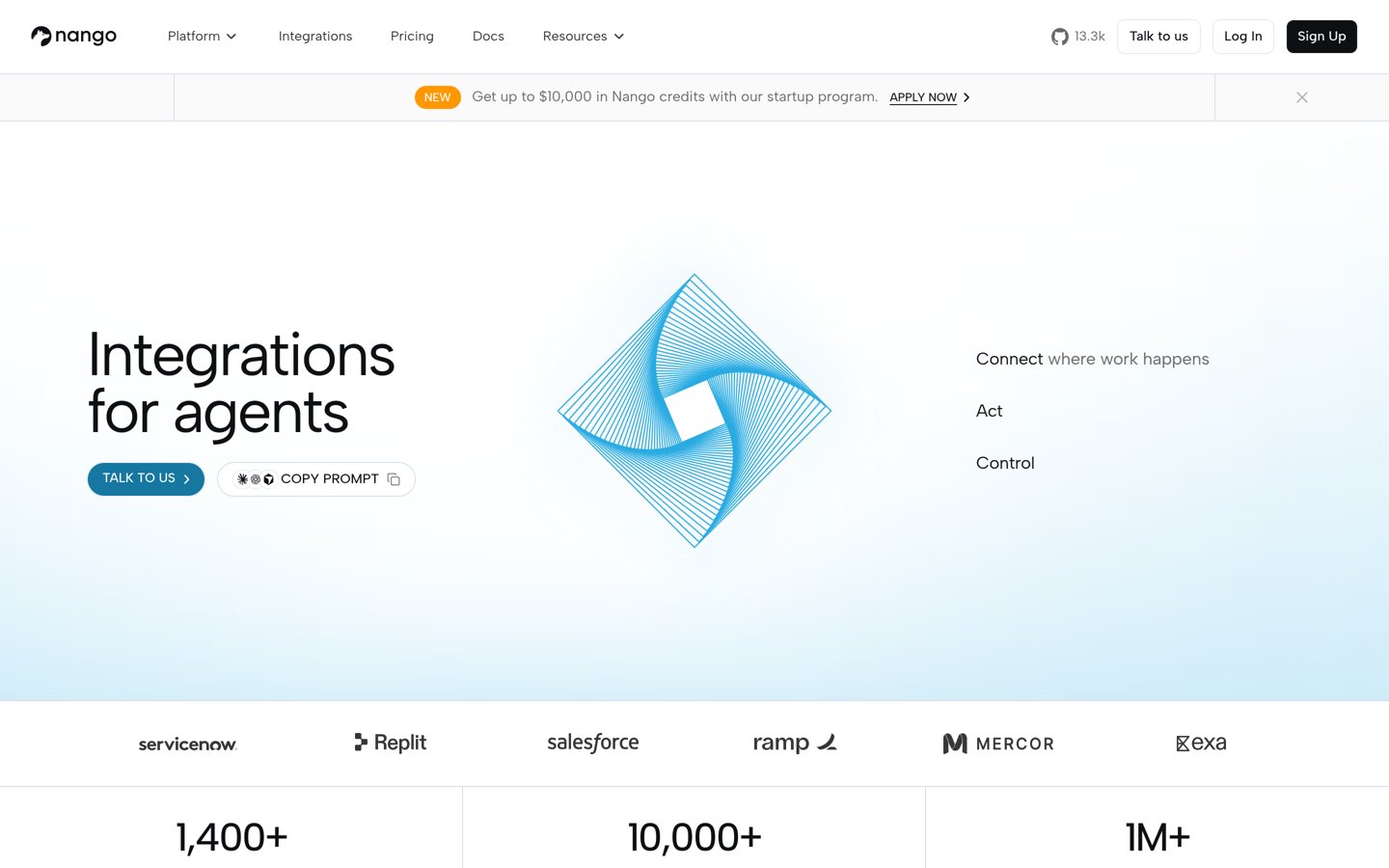
Nango homepage, captured Nov 2026.
Nango is a code-first integration platform for developers who would rather write their own agent tools than rely on prebuilt ones. It supports 1,500+ APIs with managed OAuth, token refresh, data syncs, webhooks, LLM tool calls and a built-in MCP server.
The trade off is that it assumes developer skills throughout. The free tier covers 10 connections and 100,000 proxy requests, while pay-as-you-go starts at $50 a month plus per-connection and compute charges. It suits engineering teams building custom tools.
What we like
Full control over each tool
Source-available and self-hostable
Generous free tier for testing
Built-in MCP server
Watch out for
No no-code builder
Usage charges add up at scale
Smaller catalog than Pipedream or Zapier
Pay-as-you-go adds unlimited connections and usage billingVisit nango.dev
04
Make
4.6/5on G2 (376 reviews, checked Nov 2026)
Paid from$12/mo
Best value visual builder
Free plan1,000 credits/mo
Cheapest paidCore, $12/mo
Credits on Core10,000/mo
AI featuresAI agents, MCP server
make.com
Make homepage, captured Nov 2026.
Make is a visual automation platform where you build scenarios that pass data between apps, with AI agents and an MCP server. The free plan covers 1,000 credits a month, and Core adds unlimited active scenarios, scheduling down to the minute and API access.
The trade off is the learning curve. Core costs $12 a month billed annually for 10,000 credits, or $16 billed monthly, and complex scenarios take time to design well. It suits teams that want visual building at a low monthly price.
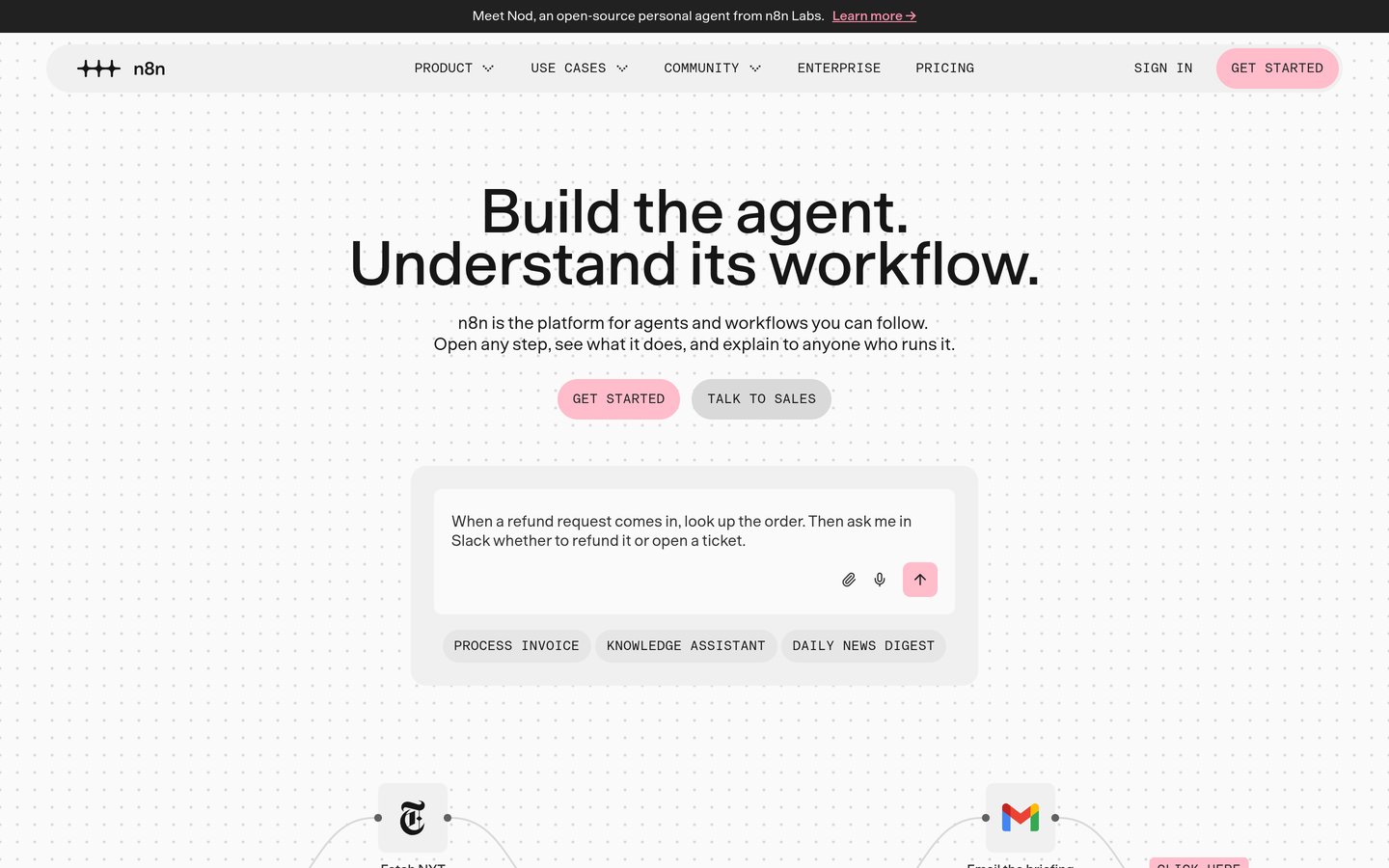
n8n is a node-based workflow automation tool with a visual canvas, code nodes and AI agent and MCP nodes. The Community Edition is free to self-host with no execution cap, and cloud Starter covers 2,500 executions a month with 1,600 Assistant credits.
The trade off is the learning curve. Starter costs $20 a month billed annually, or $24 billed monthly, and self-hosting needs someone to run and update the server. It suits technical teams that want deep control and no per-seat pricing.
What we like
Free self-hosted edition
No per-seat pricing
AI agent and MCP nodes built in
Strong G2 rating, 4.7 from 319 reviews
Watch out for
Steepest learning curve here
Self-hosting needs upkeep
Cloud pricing can show in euros, so check the dollar price
Pro adds 10,000 executions from $50 a monthVisit n8n.io
06
Merge
4.7/5on G2 (253 reviews, checked Nov 2026)
Paid from$1,000/mo
Best for governed enterprise agents
Free plan2,000 credits/mo
Cheapest paidPro, $1,000/mo
Credits on Pro25,000/mo
ComplianceSOC 2, ISO 27001, HIPAA
merge.dev
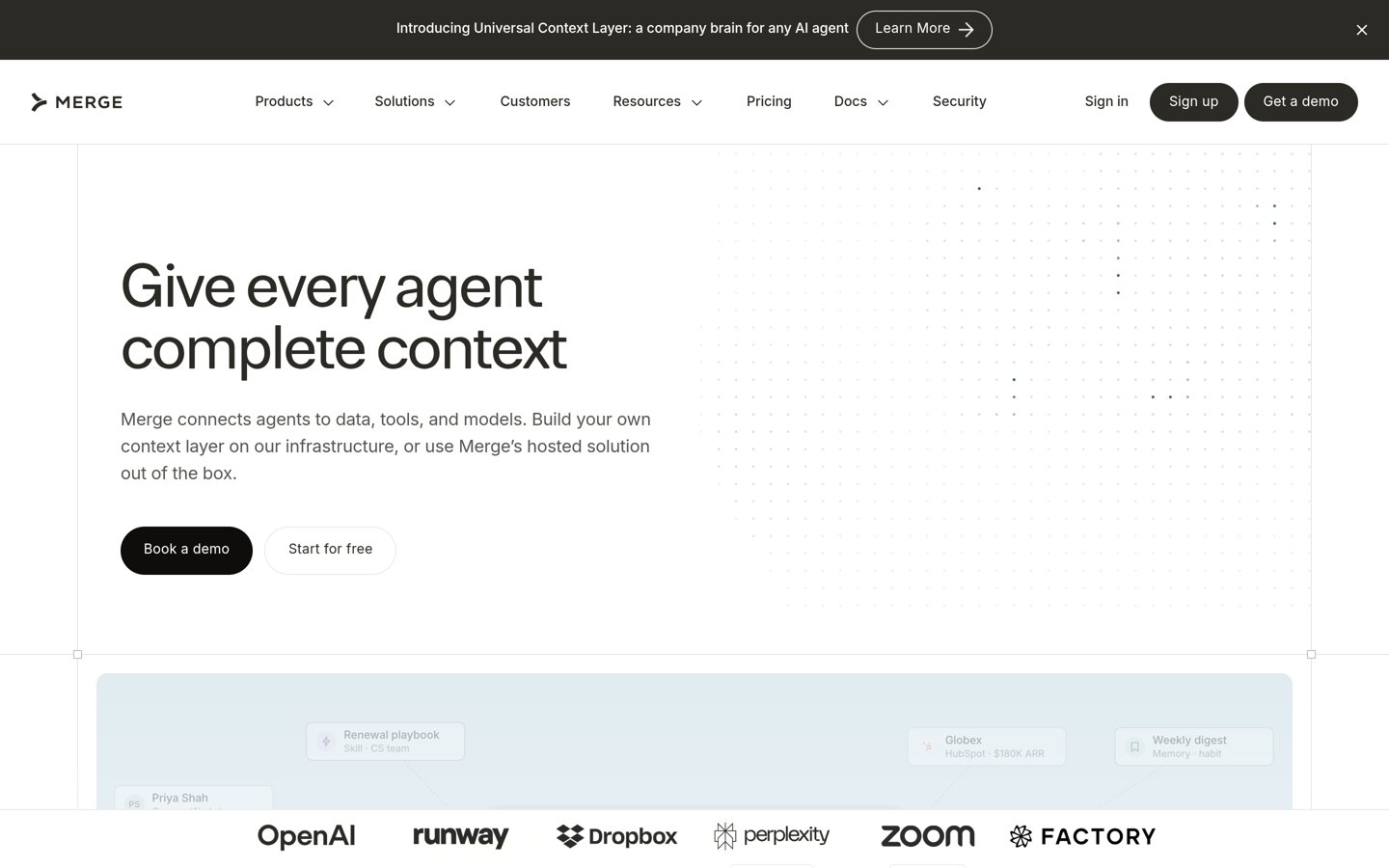
Merge homepage, captured Nov 2026.
Merge is an integration platform whose Agent Handler gives agents a governed MCP gateway to business apps. It adds per-user credentials, data-loss-prevention scanning, redaction rules and full audit logs, and it also offers a unified API for customer integrations.
The trade off is price. The free plan covers 2,000 credits a month, while Pro starts at $1,000 a month for 25,000 credits at one credit per tool call. It suits regulated teams and products whose agents act in customer accounts.
What we like
Strongest governance here
Full audit logs and DLP scanning
Unified API for customer integrations too
Free plan to start
Watch out for
Pro starts at $1,000 a month
G2 rating covers Merge Unified, not Agent Handler alone
Workato is an enterprise integration platform with a drag-and-drop recipe builder, AI agents called Genies and Enterprise MCP servers that expose recipes to agents. The free plan gives a one-time grant of 50,000 credits, and Pro is sold by credit tiers.
The trade off is cost and complexity. Pro starts at $75 a month for 2,500 credits, unused credits expire each month, and larger workspaces are quoted annual contracts. It suits large teams running automation across many departments.
StackOne is an AI agent integration platform that gives agents one governed MCP endpoint across more than 540 business apps. It signs each person in with OAuth, grants individual accounts and actions, and logs every call, with HR, finance, CRM and support coverage.
The trade off is price and log limits. Team costs $600 a month, the free Starter keeps action logs for one day only, and some advanced features are Enterprise only. It suits B2B teams whose staff agents need strict per-user control.
Activepieces is an open-source automation platform with a friendly builder, AI steps and agent pieces across more than 700 integrations. The free cloud plan covers 1,000 credits a month, and the Community Edition is free to self-host under an MIT licence.
The trade off is maturity. Plus costs $20 a month for 10,000 credits, extra credits cost $0.007 each, and AI steps use extra credits on top. It suits small teams that want open-source automation with no per-execution fee.
What we like
Highest G2 rating here, 4.8 from 142 reviews
Free self-hosted edition
No per-execution fee
Bring your own AI keys on Plus
Watch out for
Smaller catalog than Zapier or Make
AI steps cost extra credits
Annual billing terms are unclear on the pricing page
Free plans cover the basics well. Most include a free tier for building or self-hosting, and several include a small monthly allowance of calls or credits.
Paid plans mostly add production use and governance. You get more users, more calls, longer logs and support when agents act for real customers.
If your agents only run for one team, a free self-hosted option such as n8n or Activepieces can carry you far. If they act in customer accounts, budget for a governed plan such as Merge or StackOne.
How we chose
We started from the best-known agent tool layers and integration platforms named in 2026 Composio comparisons, then kept nine with published prices and a public G2 rating.
Prices come from each vendor's pricing page, checked on 29 November 2026. Ratings and review counts come from G2 on the same day. Where a vendor shows a monthly and an annual price, the list shows the annual-billing monthly price.
We left out Arcade.dev, the closest direct match in some comparisons, because we found no public G2, Capterra or Trustpilot rating to report, and Paragon because it publishes no prices. No vendor paid for a place, and we do not claim to have used these tools ourselves.
How to choose a Composio alternative
Start with who the agent acts for, then match the catalog and the billing model to that job.
List the apps your agents must reach. Check each catalog for your own stack. A 9,000-app library helps only if it covers the tools your team actually uses.
Check how auth works per user. Pick a platform that signs each user in with their own OAuth account, so an agent never acts with wider rights than its user.
Model your call volume before buying. Per-call and per-credit plans look cheap at low volume and climb fast. Estimate monthly tool calls, then compare yearly totals.
Match governance to the risk. Agents acting in customer accounts need audit logs and data redaction. Internal helpers can run on a simpler, cheaper plan.
FAQ
What is the best Composio alternative?
Pipedream is the best Composio alternative for most teams. It gives AI agents managed auth and 10,000+ prebuilt tools across 3,000+ APIs, with a remote MCP server, from $99 a month for production use.
Is there a free Composio alternative?
Yes. n8n and Activepieces both offer a free self-hosted edition, and Pipedream, Nango, Make, Zapier, Merge, Workato and StackOne all have a free plan or tier. Free plans cover building and light use; production use needs a paid plan.
What is the cheapest Composio alternative?
Make is the cheapest paid start at $12 a month billed annually for 10,000 credits. n8n cloud starts at $20 a month, and Zapier Professional starts at $19.99 a month billed annually. Self-hosted n8n and Activepieces cost nothing for the software itself.
Which Composio alternative is best for beginners?
Zapier is the easiest for beginners. It has the widest app library at 9,000+ apps, a no-code builder, a free plan and a 14-day Professional trial, so a first automation can run the same day.
Which Composio alternative is best for developers?
Nango is the best pick for developers. It is code-first across 1,500+ APIs, with managed OAuth, data syncs, webhooks and a built-in MCP server, from $50 a month. n8n is the stronger pick for developers who want a visual canvas and self-hosting.
Pipedream vs Zapier: which is better for AI agents?
Pipedream is better for AI agents that need a wide prebuilt tool catalog and managed per-user auth, with 10,000+ tools across 3,000+ APIs. Zapier is better for no-code teams that want the widest app library and the fastest setup, with 9,000+ apps.
SaaS SEO and WordPress specialist with about 8 years of experience. Rakib compares WordPress plugins, themes, hosting and software using public pricing, documentation and user reviews. See how we rank.