Browserless is the best of these browserbase alternatives for most teams, with hosted Chrome from $25 a month and a free plan of 1,000 units. Apify suits large scraping jobs, while Firecrawl is the cheapest way to turn pages into clean markdown for AI agents.
How we make this list: we compare pricing pages, product documentation and public user reviews, then re-check every price before each update. No product paid for a place. Disclosure.
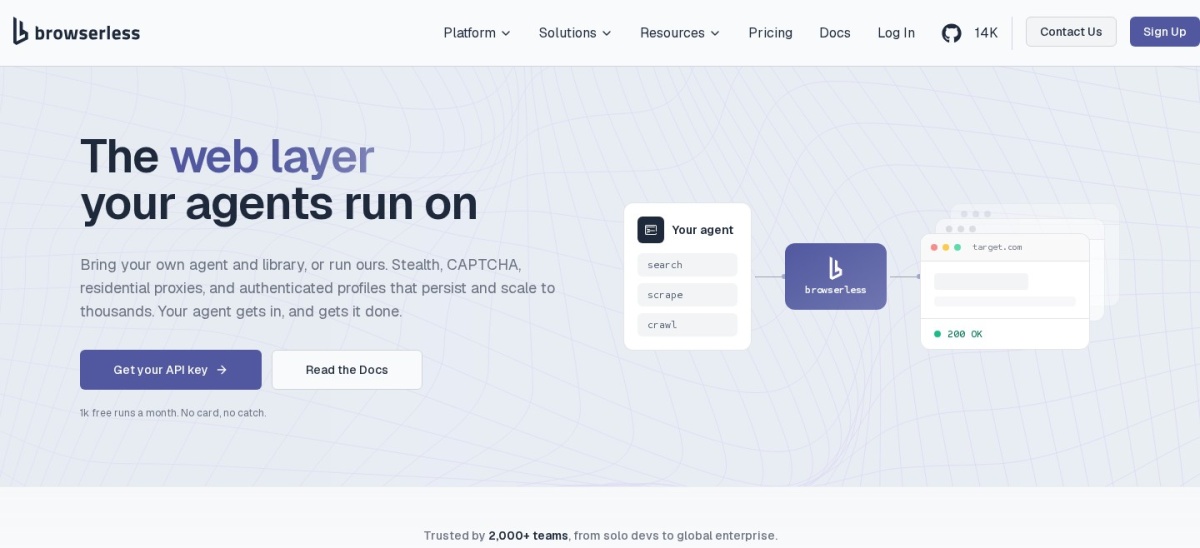
Browserless is the closest drop-in replacement: Playwright and Puppeteer connect over CDP, and paid plans start at $25 a month.
Apify has the largest review base here at 4.7/5 from 736 G2 reviews, and its Starter plan costs $29 a month.
Firecrawl and ZenRows are the cheapest paid starts at $16 a month, and both include a free plan.
Bright Data is the most expensive at $499 a month on Scale, but its proxy network tops 150 million IPs.
Hyperbrowser and Steel are missing from this list because neither has a public G2 or Capterra rating to check.
How do you choose the best browserbase alternatives?
A hosted browser is a Chrome instance running on someone else's servers that your code drives remotely. You start a session through an API, then connect Playwright or Puppeteer and run your existing scripts with little change.
Match the tool to the job, not the feature list. A cloud browser fits agents and automation that click, log in and fill forms, while a scraping API fits jobs that only need rendered HTML or structured data back.
Price is rarely one number. Most tools charge a monthly plan plus usage for browser time, credits or proxy traffic, so check what a typical month of sessions costs before you commit.
Bot blocking decides more jobs than price does. Our guide on blocking bad bots in WordPress shows how sites tell automated browsers apart, and the same checks apply to the targets your sessions visit.
Free plans are for proving the fit, not for production. Browserless gives 1,000 units a month, Apify gives $5 of credit, and Firecrawl gives 1,000 credits, which is enough to run a real trial before paying.
Browserless is a hosted headless-browser service that runs real Chrome, Firefox and WebKit so you do not manage browser installs or crashes. Your Playwright or Puppeteer scripts connect over CDP, and it adds REST endpoints, its BrowserQL query language, screenshots, PDFs and CAPTCHA solving.
The trade off is the unit meter. One unit covers 30 seconds of browser time, and residential proxy traffic costs 6 units per MB, so heavy proxy use burns the allowance fast. It suits teams that already have Playwright or Puppeteer code and want it hosted with little change.
What we like
Closest match to Browserbase for existing scripts
Chrome, Firefox and WebKit in one service
Self-host option with a Docker image
Working CAPTCHA solver on paid plans
Watch out for
Unit billing makes proxy-heavy costs hard to predict
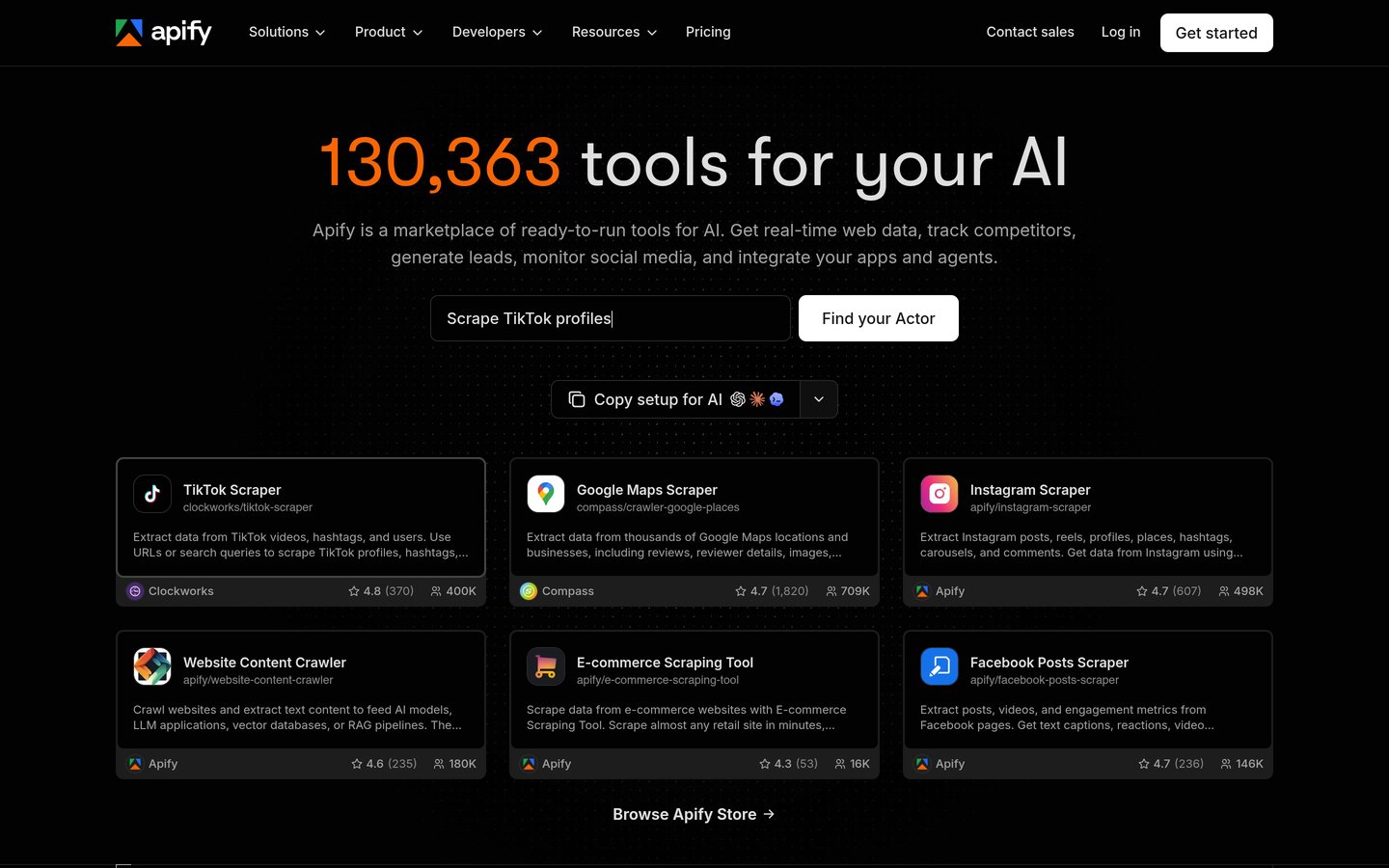
Apify is a cloud platform for running web scrapers, crawlers and browser-automation jobs at scale. Its Store holds thousands of ready-made Actors for common sites, and you can run them on a schedule or through an API and export results as JSON, CSV or into Google Sheets.
The trade off is billing. The $29 Starter plan includes $29 of prepaid credit, then compute units, proxy traffic and Actor rental fees stack on top, so costs are hard to forecast. It suits data teams that want repeatable scraping pipelines without running their own browsers.
What we like
Largest review base here: 4.7/5 from 736 G2 reviews
Thousands of ready-made Actors in the Store
Scheduling, queues, storage and proxies built in
Free $5 monthly credit with no card
Watch out for
Credit and compute-unit billing is hard to predict
Actor quality varies by third-party developer
Learning curve for first-time users
Paid plans add more credit, proxy IPs and priority supportVisit apify.com
03
Firecrawl
4.7/5on G2 (1,504 reviews, checked Nov 2026)
Paid from$16/mo
Cheapest for AI apps and RAG
Free credits1,000 a month
Hobby credits5,000 a month
Output formatsMarkdown and JSON
Paid planHobby, $16/mo
firecrawl.dev
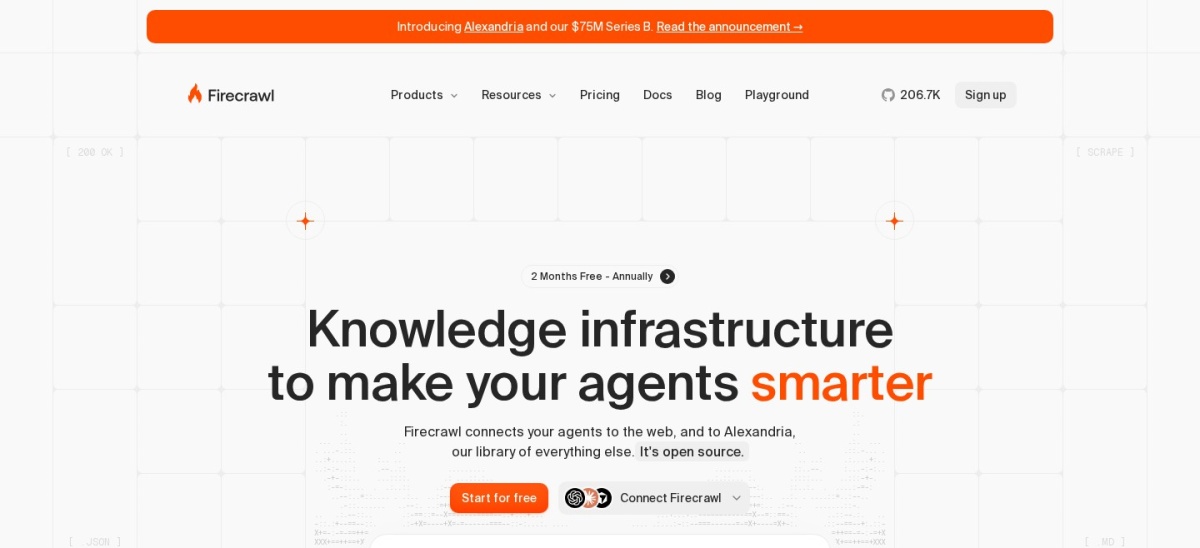
Firecrawl homepage, captured Nov 2026.
Firecrawl is a web data API that turns websites into clean markdown or structured JSON for AI tools, scripts and research apps. It covers search, scrape, crawl and site mapping behind one API key, renders JavaScript-heavy pages in Chromium, and its core is open source.
The trade off is credit burn. Hobby costs $16 a month on annual billing for 5,000 credits, and JSON extraction costs 4 extra credits per page, so large crawls use the allowance fast. It suits AI agent builders who want page content ready for a language model.
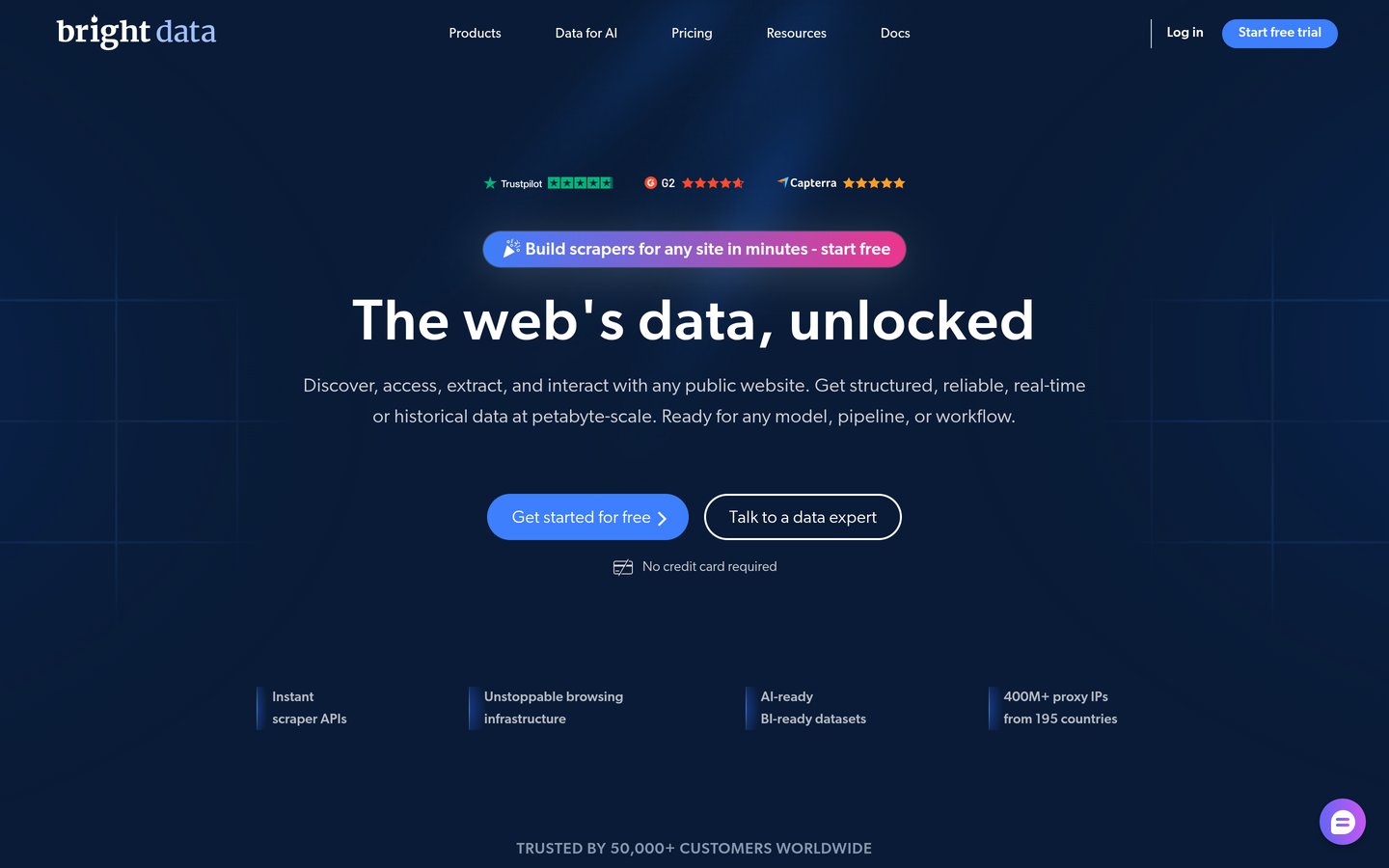
Bright Data is the largest web data platform in this list, with a proxy network of more than 150 million IPs, ready-made scrapers, datasets and a Scraping Browser that renders JavaScript like a real browser. Its free tier covers 5,000 records a month, and pay-as-you-go pricing starts at $1.50 per 1,000 records.
The trade off is price and setup. The Scale plan costs $499 a month, and proxy types, bandwidth and compute are billed separately, so small teams face a steep learning curve. It suits large teams with engineers and steady, high-volume data needs.
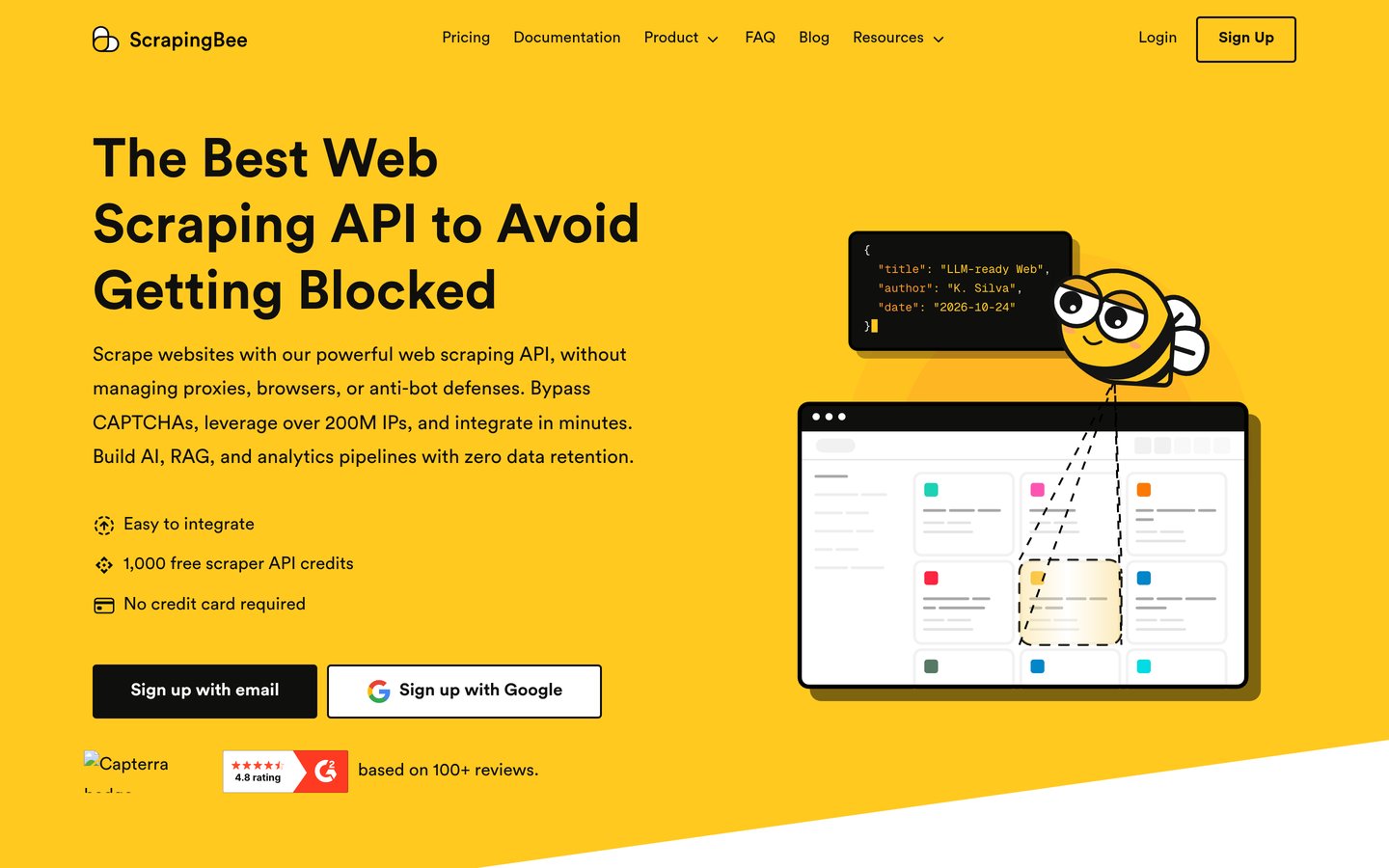
ScrapingBee is a managed fetching layer for developers: send a URL and it returns the HTML with proxies, headless browsers and CAPTCHA handling taken care of. Billing only counts successful responses, and it adds screenshots, geotargeting and AI extraction behind the same single endpoint.
The trade off is the credit system. A plain request costs 1 credit, but JavaScript rendering costs 5, premium proxies 10 to 25, and stealth proxies 75, so the Hobby plan's 75,000 credits cover far fewer real requests. It suits developers who want a simple API and already own the scraping logic.
What we like
Highest G2 rating here at 4.8/5
Success-only billing for returned requests
Clean documentation and a Python SDK
Screenshots, geotargeting and AI extraction
Watch out for
Credit multipliers make real costs hard to predict
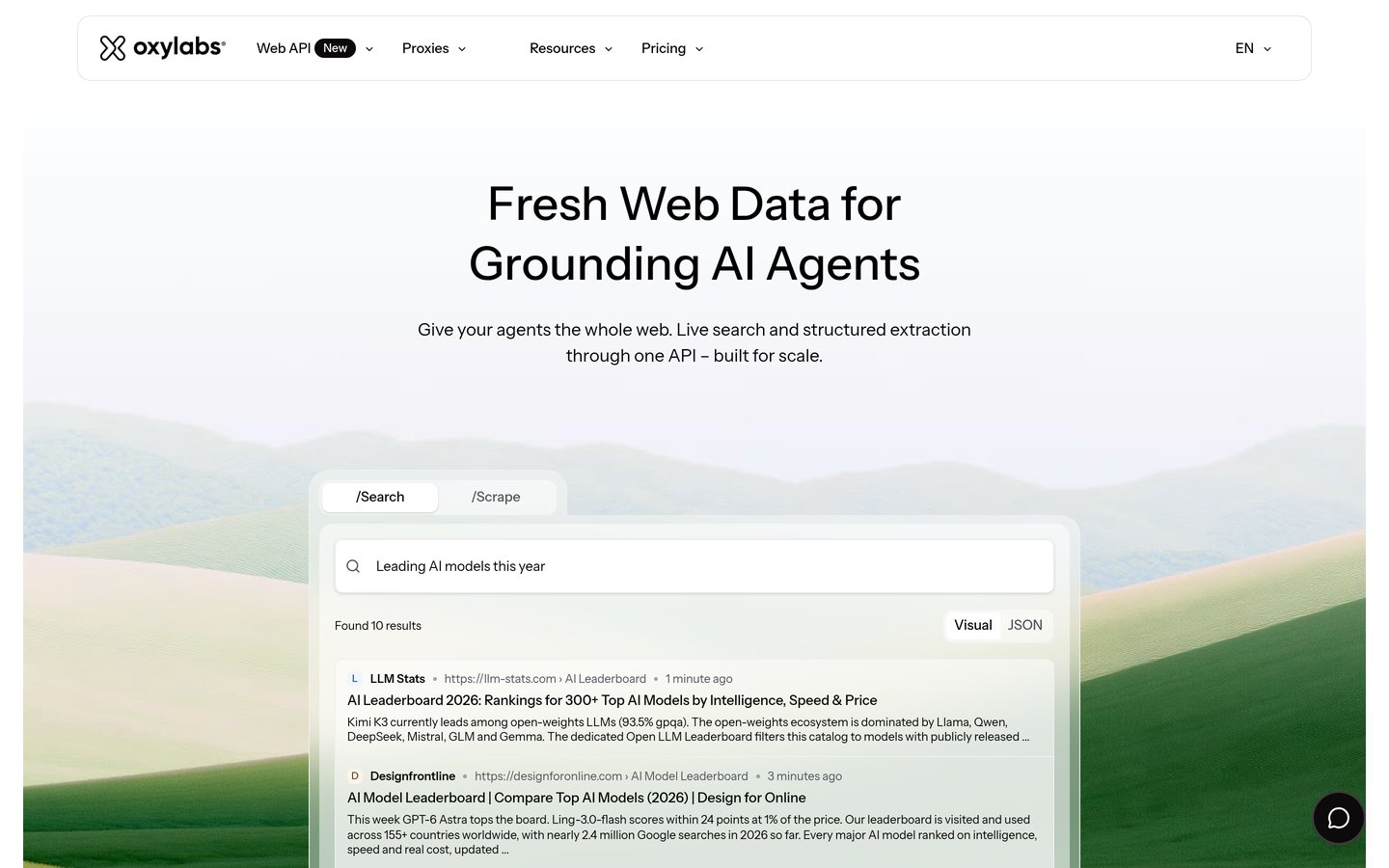
Oxylabs is premium web-data infrastructure with a Web Scraper API, a Web Unblocker and residential, datacenter, mobile and ISP proxies across 195+ countries. Its Scraper API handles JavaScript rendering, CAPTCHA handling and IP rotation, and its free trial covers up to 2,000 results with no card.
The trade off is price at small scale. The Web Scraper API starts at $49 a month, and G2 reviewers call pricing the most common drawback, so casual users pay a premium. It suits data-platform teams that need a large, compliant proxy network behind their extraction.
What we like
Large proxy network across 195+ countries
Scraper API with dedicated parsers per target
Free trial with up to 2,000 results
Strong compliance posture for a proxy vendor
Watch out for
Pricey for small or casual users
Dashboard can overwhelm first-time users
Costs climb fast once proxy meters stack up
Paid plans add more results, higher limits and supportVisit oxylabs.io
07
ZenRows
5/5on G2 (18 reviews, checked Nov 2026)
Paid from$16/mo
Best simple API for beginners
Free credits5,000 a month
Build credits45,000 a month
Concurrent requests20 on Build
Paid planBuild, $16/mo
zenrows.com
ZenRows homepage, captured Nov 2026.
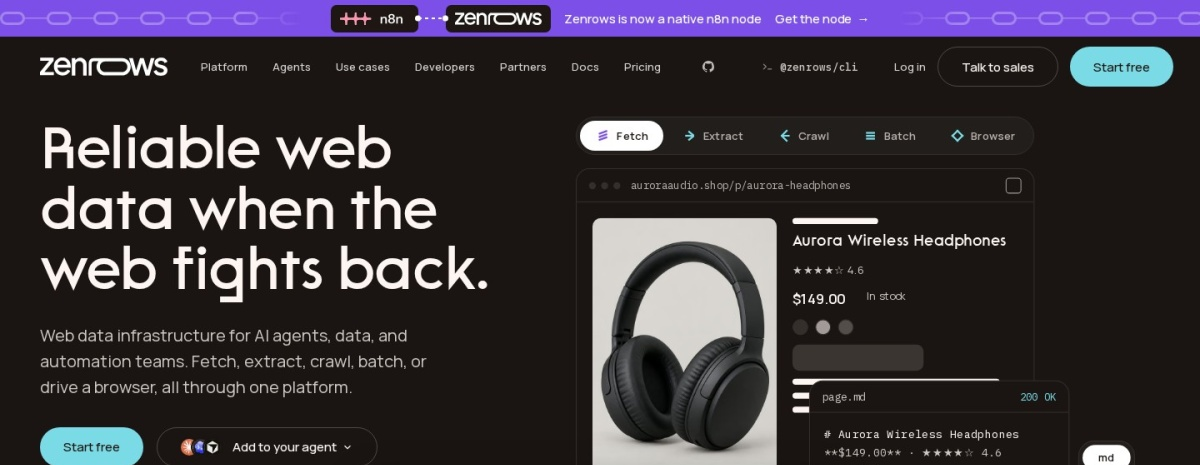
ZenRows is a web scraping API that handles proxy rotation, CAPTCHA solving, anti-bot bypass and JavaScript rendering behind a single endpoint. Its free plan gives 5,000 credits a month with no card, and the Build plan at $16 a month adds 45,000 credits and 20 concurrent requests.
The trade off is the credit math. JavaScript rendering and premium proxies multiply the cost per request, so the headline credit count buys fewer protected pages than it looks. It suits beginners and small projects that want clean docs and a simple SDK.
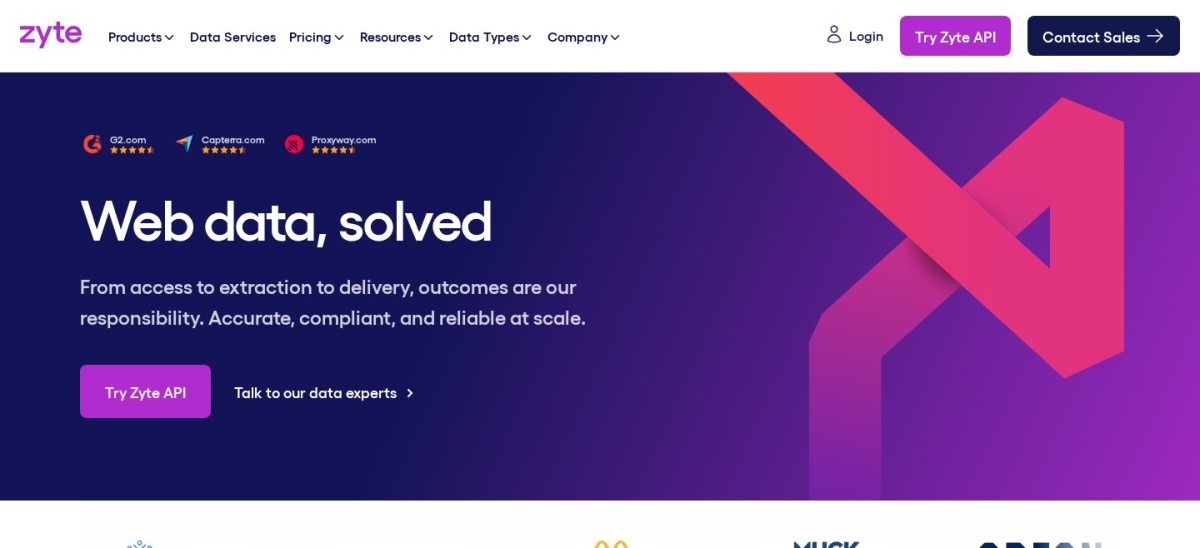
Zyte is a scraping platform from the team behind Scrapy, the open-source Python crawling framework. Its API returns product data from JavaScript-heavy stores at scale, handling proxies, retries and anti-bot measures, and you pay only for successful responses, from $0.13 per 1,000.
The trade off is forecasting. Zyte sets each site's price tier, and browser-rendered requests cost about 8 to 13 times the plain HTTP rate, so costs are hard to estimate in advance. It suits data teams with engineers and big catalogues, not casual sellers.
What we like
Cheapest per-record price at $0.13 per 1,000
Pay only for successful responses
Built by the team behind Scrapy
Fits existing Python and Scrapy pipelines
Watch out for
Zyte sets each site's price tier
Browser rates run far above HTTP rates
No simple no-code builder
Paid plans add volume discounts and higher rate limitsVisit zyte.com
09
ScraperAPI
4.3/5on G2 (15 reviews, checked Nov 2026)
Paid from$49/mo
Best for simple, fast API scraping
Free credits1,000
Hobby credits100,000 a month
Concurrent threads20 on Hobby
Paid planHobby, $49/mo
scraperapi.com
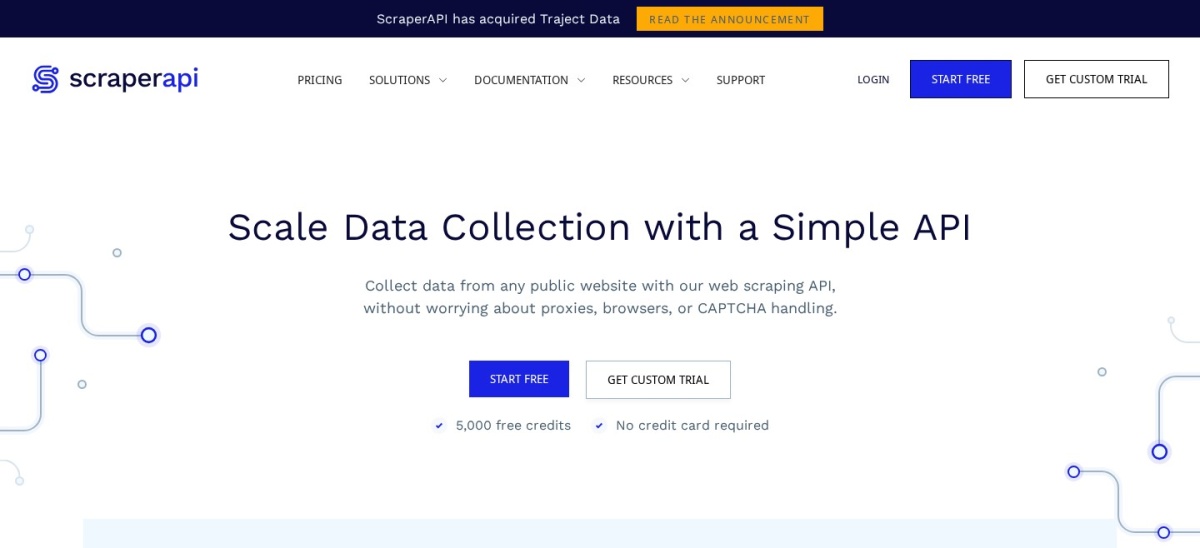
ScraperAPI homepage, captured Nov 2026.
ScraperAPI is a straightforward way to fetch easy and medium-difficulty pages: one GET endpoint, a 7-day trial with 5,000 credits and no card, and only 200 and 404 responses billed. The Hobby plan costs $49 a month for 100,000 credits across 20 threads, with geotargeting for the US and EU.
The trade off is credit math and hard targets. Rendering costs 10 credits and premium proxies with rendering cost up to 75, so the Hobby allowance can mean as few as 1,333 real requests, and it scored 0% on Kasada and Akamai sites in one 2025 benchmark. It suits simple jobs where speed matters.
A cloud browser gives you a live Chrome session you drive with code. You need one when the job clicks, logs in, fills forms or keeps state across pages.
A scraping API gives you the page back and hides the browser. You need one when the job only reads pages, pulls structured data or feeds an AI model.
Most teams start with the scraping API and add a cloud browser later. Browserless covers the browser side, while Firecrawl and ScrapingBee cover the API side for less money.
If the target blocks automation, neither option alone is enough. Check the vendor's anti-bot handling and CAPTCHA solving before you commit, because that is where cheap plans usually stop working.
How we chose
We started from every Browserbase alternative named in November 2026 roundups, then kept the nine with a verifiable rating and review count on G2 and a published price.
Prices come from each vendor's pricing page, checked on 29 November 2026. Ratings and review counts come from G2 on the same day. Where a vendor shows a sale or an annual-billing price, the list shows the regular price and notes the billing in the text.
We left out Hyperbrowser and Steel because neither has a public G2 or Capterra rating to check, so they need a ruling before they can join this list. No vendor paid for a place, and we do not claim hands-on testing for this list.
How to choose a Browserbase alternative
Start with what your code already does, then pick the cheapest tool that runs it without a rewrite.
Check what your scripts already use. If they use Playwright or Puppeteer, pick a cloud browser such as Browserless. If they only fetch URLs, a scraping API is cheaper.
Run the free plan against your hardest target. A tool that works on a plain page can still fail on a protected one. Test the site that blocks you most before paying.
Work out the real monthly cost. Multiply the plan price by your browser hours, credits or proxy gigabytes. A $16 plan with credit multipliers can cost more than a $29 plan.
Check the free plan limits before launch. Session length, concurrency and retention caps decide whether a free plan survives production or only a demo.
FAQ
What is the best Browserbase alternative in 2026?
Browserless is the best Browserbase alternative for most teams. It hosts real Chrome, Firefox and WebKit, connects to existing Playwright and Puppeteer scripts, and costs $25 a month on annual billing with a free plan of 1,000 units.
What is the cheapest Browserbase alternative?
Firecrawl and ZenRows are the cheapest paid starts at $16 a month. Firecrawl gives 5,000 credits on Hobby and ZenRows gives 45,000 credits on Build, and both include a free plan for testing first.
Is there a free Browserbase alternative?
Yes. Browserless, Apify, Firecrawl, ZenRows, Zyte and ScraperAPI all have a free plan or free credit, and Bright Data has a free tier of 5,000 records a month. ScrapingBee and Oxylabs offer a free trial instead of a recurring free plan.
Browserless vs Apify: which should I pick?
Pick Browserless if you have Playwright or Puppeteer scripts and want them hosted with little change. Pick Apify if you want ready-made scrapers, scheduling and storage for repeatable data jobs at scale.
Which Browserbase alternative is best for AI agents?
Firecrawl is the best fit for AI agents that read pages, because it returns clean markdown and JSON. Browserless and Hyperbrowser-style cloud browsers fit agents that must click, log in and fill forms in a live session.
Can I self-host a Browserbase alternative?
Yes. Browserless offers a Docker image you can run on your own machines, and Steel offers an open-source browser server, though Steel has no public G2 rating yet. Self-hosting saves the subscription but leaves scaling and blocking to you.
Do these alternatives handle CAPTCHAs and bot blocking?
Most do, on paid plans. Browserless, ScrapingBee, Oxylabs, ZenRows and Zyte all list CAPTCHA handling or anti-bot measures, but the strength varies by target, so test your hardest site on the free plan first.
SaaS SEO and WordPress specialist with about 8 years of experience. Rakib compares WordPress plugins, themes, hosting and software using public pricing, documentation and user reviews. See how we rank.