Kyriba is the best treasury software overall for multi-bank enterprises, backed by a 4.5-star G2 rating across 142 reviews and connectivity to over 10,000 banks on custom annual contracts. For mid-market teams that want transparent pricing, Trovata starts at $24,000/yr, while small businesses can forecast cash with Pulse starting at $348/yr or manage operating yield free on Ramp.
How we make this list: we compare pricing pages, product documentation and public user reviews, then re-check every price before each update. No product paid for a place. Disclosure.
Published entry pricing spans from $0/yr on Ramp Free and $348/yr on Pulse Basics up to $24,000/yr on Trovata.
Enterprise treasury management systems—Kyriba (4.5/5, 142 reviews), GTreasury (4.2/5, 32 reviews), and SAP Treasury and Risk Management (4.3/5, 68 reviews)—require custom annual quotes.
Trovata is the only full multi-bank treasury platform in this roundup that publishes an entry price on its site ($24,000/yr for 1 bank, 100 accounts, and 10 users).
Mid-market European and international finance teams frequently shortlist Agicap (4.4/5, 399 reviews) and Embat (4.3/5, 43 reviews) for fast bank-API setup over multi-month ERP builds.
Small businesses running Xero or QuickBooks Online can replace manual spreadsheets with Float ($1,260/yr billed annually) or Pulse ($348/yr) without enterprise implementation overhead.
How do you choose the best treasury software for your finance team?
Treasury software splits cleanly into three tiers based on how your company holds cash and connects to banks. Small businesses with one or two checking accounts only need ledger-synced cash forecasting or a high-yield operating account, while multi-entity enterprises need direct bank connectivity, foreign exchange hedging, and automated payment rails.
Pricing transparency drops sharply as soon as direct bank APIs or SWIFT connectivity enter the picture. Small-business cash tools like Pulse ($29/mo) and Float ($105/mo billed annually) publish flat monthly rates, whereas enterprise treasury management systems (TMS) price by bank count, entity count, and payment volume.
Implementation timelines matter as much as license fees when comparing treasury platforms. Modern API-first platforms such as Trovata and Embat connect banks in days or weeks, whereas full enterprise suites like Kyriba and SAP Treasury and Risk Management often take several months of configuration.
Core modulesCash, FX risk, payments, working capital
Pricing modelCustom annual quote by module & accounts
kyriba.com
Kyriba homepage, captured Nov 2026.
Kyriba is a cloud treasury management system built for mid-market and enterprise finance teams managing multi-bank liquidity, payments, and risk. Its core platform aggregates real-time cash positions across more than 10,000 banks and ERPs, combining AI-assisted cash forecasting, payment fraud screening, debt tracking, and foreign exchange exposure management in one consolidated database.
The trade off is high cost and implementation complexity, as Kyriba publishes no public price list and scales contracts by active bank accounts, modules, and transaction volume. Reviewers on G2 note lengthy setup timelines that often require external consultants, plus a dense interface. It suits global enterprises with dedicated treasury staff and multi-bank operations.
What we like
Connects to over 10,000 banks, ERPs, and payment networks out of the box
Covers cash visibility, AI forecasting, FX hedging, debt, and payments in one system
Strong payment security with anomaly detection and segregation-of-duties workflows
High G2 satisfaction (4.5/5 across 142 reviews) from enterprise treasury teams
Watch out for
No published pricing; contracts scale with bank accounts, modules, and payment volume
Multi-month implementation often requires outside consultants
Steep learning curve for occasional users
Custom annual licensing adds FX risk, debt, payment hub, and working capital modules.Visit kyriba.com
02
Trovata
4.5/5on G2 (34 reviews, checked Nov 2026)
Starts at$24,000/yr
Best mid-market treasury platform with published pricing
G2 rating4.5 / 5 (34 reviews)
Base plan$24,000/yr (1 bank, 100 accounts, 10 users)
Data capacityUp to 1,000,000 transactions included
OnboardingWeeks via managed bank APIs
trovata.io
Trovata homepage, captured Nov 2026.
Trovata is an API-first cash and treasury management platform that automates multibank data aggregation, cash positioning, and machine-learning cash forecasting without heavy IT work. Its published base package starts at $24,000/yr and includes 1 managed bank connection, up to 100 accounts, storage for 1,000,000 transactions, 10 users, natural-language Trovata AI insights, and 3 to 5 hours of live training.
The trade off is that the $24,000/yr entry tier covers only a single bank connection, so companies banking with multiple institutions must pay for custom expansion tiers. Advanced treasury modules like FX derivatives, intercompany banking, and full treasury sub-ledgers also require higher packages. It suits mid-market finance teams wanting fast setup and transparent entry pricing.
What we like
Publishes clear $24,000/yr starting pricing with 100 accounts and 1 million transactions
Onboards in weeks via managed bank APIs rather than lengthy IT projects
Includes natural-language AI cash queries and machine-learning forecast models
High G2 ease-of-use score (8.9/10) compared to legacy treasury suites
Watch out for
Base $24,000/yr plan includes only 1 bank connection
FX hedging, intercompany loans, and sub-ledger accounting require upper-tier quotes
Fewer G2 reviews (34) than long-standing incumbents
Higher custom tiers add multiple bank connections, FX/IR derivatives, and in-house banking.Visit trovata.io
Agicap is a cash and treasury management platform used by over 8,000 companies to centralize bank balances, build rolling cash forecasts, and automate payables and receivables. It connects directly to more than 300 international banks and 150 accounting or ERP systems, supporting multi-entity consolidation, cash pooling, intragroup financing, and FX tracking across daily, weekly, and monthly horizons.
The trade off is quote-only annual pricing with a 12-month minimum commitment and no permanent free plan. G2 reviewers also note that modules such as debt management or multi-entity consolidation can require higher tiers or add-on fees. It suits mid-sized companies that want real-time bank visibility paired with built-in AP and AR workflows.
What we like
Largest G2 review volume among dedicated cash-treasury tools (399 reviews, 4.4/5)
Combines direct Open Banking feeds with accounts payable and receivable automation
Supports multi-entity consolidation, cash pooling, and scenario modeling
Faster rollout than traditional enterprise treasury workstations
Watch out for
No published price list; requires a custom annual quote with a 12-month commitment
Multi-company consolidation and debt modules sit on higher tiers
Less depth in complex derivatives accounting than Kyriba or SAP
Enterprise and Premium quotes add multi-company consolidation, multi-currency, and custom ERP sync.Visit agicap.com
04
Ramp
4.8/5on G2 (2,578 reviews, checked Nov 2026)
PriceFree
Best free operating cash & yield management
G2 rating4.8 / 5 (2,578 reviews)
Free plan$0/mo/user (checking, cards, bill pay)
Paid plan$15/mo/user + platform fee (Ramp Plus)
Cash yield2% checking & 4.59% investment account
ramp.com
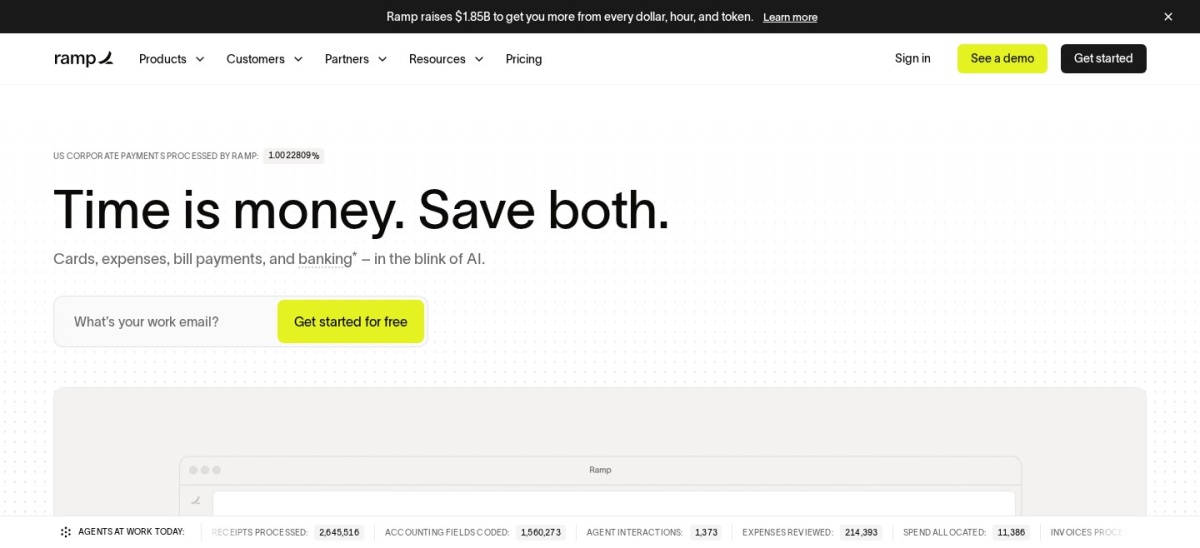
Ramp homepage, captured Nov 2026.
Ramp combines corporate cards, bill pay, and Ramp Treasury into a finance operations platform used by over 30,000 businesses. Its $0/mo/user Free plan includes FDIC-insured Ramp Checking earning 2% on operating cash, access to a Ramp Investment Account earning 4.59% with no minimum deposits or transfer caps, and free wires and same-day ACH via Bill Pay.
The trade off is that Ramp is a cash-yield, spend, and payments platform rather than a multi-bank treasury workstation with FX hedging or debt schedules. Unlocking multi-entity controls, custom roles, and direct ERP integrations with NetSuite or Sage Intacct requires Ramp Plus at $15/mo/user plus a team-size platform fee (20% off annually). It suits startups and mid-market companies optimizing idle cash yield.
What we like
Generous $0/mo/user plan includes 2% checking yield and 4.59% money-market access
Waives domestic wire, international wire, and same-day ACH fees from Ramp Checking
Highest G2 rating in this list (4.8/5 across 2,578 reviews) for usability and automation
Unifies corporate cards, bill pay, and idle-cash yield in one login
Watch out for
Not a traditional multi-bank TMS; lacks FX derivatives and debt-facility accounting
Multi-entity support and direct NetSuite/Intacct sync require paid Ramp Plus
Platform fee on Ramp Plus scales dynamically by team size
Ramp Plus ($15/mo/user + platform fee) adds multi-entity management, custom approvals, and direct ERP sync.Visit ramp.com
05
SAP Treasury and Risk Management
4.3/5on G2 (68 reviews, checked Nov 2026)
PricingCustom (custom pricing)
Best for enterprises running SAP S/4HANA
G2 rating4.3 / 5 (68 reviews)
ERP architectureNative to SAP S/4HANA general ledger
SAP Treasury and Risk Management homepage, captured Nov 2026.
SAP Treasury and Risk Management is an enterprise module embedded inside SAP S/4HANA for automating financial transactions, liquidity forecasting, and market-risk hedging. Because it shares the S/4HANA general ledger, deal capture for foreign exchange, interest-rate derivatives, debt, and money-market investments posts directly to financial accounting without third-party middleware.
The trade off is high enterprise licensing cost and a steep configuration curve that makes little sense outside an SAP ERP environment. G2 reviewers consistently praise its real-time general-ledger integration and support quality while flagging complex setup and an unintuitive interface. It suits large enterprises already standardized on SAP S/4HANA.
What we like
Direct, real-time integration with the SAP S/4HANA general ledger
Deep support for complex debt instruments, derivatives, and hedge accounting
High G2 quality-of-support score (8.7/10) for enterprise deployments
Eliminates middleware sync errors for existing SAP finance organizations
Watch out for
Custom enterprise pricing with high licensing and implementation costs
Steep learning curve and dated user interface compared to cloud-native tools
Impractical if your core ERP is not SAP
Enterprise S/4HANA contracts scale by user seats, modules, and deployment edition.Visit sap.com
06
GTreasury
4.2/5on G2 (32 reviews, checked Nov 2026)
PricingCustom (custom pricing)
Best for customizable corporate risk & hedge accounting
G2 rating4.2 / 5 (32 reviews)
Core modulesCash, payments, debt, FX risk, hedge accounting
Bank connectivitySWIFT, host-to-host, and API integrations
Pricing modelCustom modular enterprise quote
gtreasury.com
GTreasury homepage, captured Nov 2026.
GTreasury (listed on G2 as Ripple Treasury, powered by GTreasury) is a modular treasury and risk management system built for mid-market and enterprise corporations. It unifies global cash visibility, bank reconciliation, multi-rail payment execution, debt and investment tracking, and hedge accounting across SWIFT, host-to-host, and API bank connections.
The trade off is opaque custom pricing and a reporting interface that some reviewers find less intuitive than newer cloud competitors. While users praise its configurability and customer support turnaround, initial deployment requires structured treasury scoping. It suits corporate treasury teams needing tailored workflows and hedge accounting.
What we like
Comprehensive coverage across cash positioning, payments, debt, and hedge accounting
Supports SWIFT, host-to-host, and modern API bank connectivity
Highly configurable workflows tailored to complex multi-entity structures
Strong G2 reviewer marks for support responsiveness and ease of daily navigation
Watch out for
No published pricing; requires custom scoping and vendor negotiation
Reporting module can feel clunky for ad-hoc custom views
Smaller public review footprint (32 G2 reviews) than Kyriba
Forecasting13-week rolling + 36-month forecast, 8 scenarios
floatapp.com
Float homepage, captured Nov 2026.
Float is a visual cash flow forecasting and scenario planning tool built on top of Xero and QuickBooks Online for more than 8,000 finance teams. Starting at $105/mo billed annually ($130/mo monthly) for companies under £2m in revenue, its Essentials plan includes unlimited users, 8 what-if scenarios, a 13-week operational cash view, and 36-month forecasting.
The trade off is that Float syncs from your accounting ledger rather than connecting directly to bank APIs, and its pricing jumps once annual revenue crosses £2m ($215/mo billed annually on Growth). Multi-entity consolidation requires the Scale plan at $315/mo billed annually. It suits small and growing businesses on Xero or QuickBooks that prioritize visual scenario modeling.
What we like
Unlimited users and 8 visual what-if scenarios included on every plan
Fast 5-minute setup directly from reconciled Xero or QuickBooks Online data
Combines 13-week tactical cash tracking with 36-month strategic forecasts
14-day free trial with no credit card required
Watch out for
Price jumps sharply once revenue exceeds £2m or when adding multi-entity consolidation
Integrates only with Xero and QuickBooks Online (no direct bank feeds)
Lacks payment execution, debt management, and FX hedging tools
Best low-cost cash flow tracker for small businesses
G2 rating4.2 / 5 (10 reviews)
Entry price$29/mo (Pulse Basics)
QuickBooks tier$59/mo (Small Business Plan)
Free trial30-day free trial on all plans
pulseapp.com
Pulse homepage, captured Nov 2026.
Pulse is a lightweight web-based cash flow management tool designed for small businesses, agencies, and service providers replacing spreadsheet cash trackers. Its $29/mo Basics plan covers daily, weekly, monthly, and yearly cash views, recurring income and expense rules, multi-currency display, and toggleable what-if scenarios, backed by a 30-day free trial.
The trade off is that QuickBooks Online integration and multi-account tracking require upgrading to the $59/mo Small Business plan, and Pulse offers no direct bank API feeds or treasury execution features. Its interface is also simpler than modern mid-market platforms. It suits solo founders and small teams needing an affordable, straightforward cash calendar.
What we like
Lowest published paid starting price in this list at $29/mo ($348/yr)
Generous 30-day free trial across all subscription tiers
Simple toggle-based scenario testing without spreadsheet formula errors
Supports multi-currency conversion and invoice attachments on the $89/mo Premium tier
Watch out for
QuickBooks Online sync requires the $59/mo Small Business plan
No direct bank API connections, payment initiation, or risk modules
Small review sample on G2 (10 reviews)
Small Business ($59/mo) adds QuickBooks Online sync and team seats; Premium ($89/mo) adds unlimited accounts.Visit pulseapp.com
Enterprise TMS vs. cash flow software: which tier do you need?
Buyer confusion around treasury software usually comes from mixing up true treasury management systems (TMS) with SMB cash flow forecasters. A full TMS like Kyriba, GTreasury, or SAP Treasury and Risk Management connects directly to banks via SWIFT or host-to-host protocols, initiates cross-border payments, tracks debt covenants, and accounts for foreign exchange hedges.
By contrast, mid-market cash platforms like Trovata and Agicap focus on real-time API bank aggregation, automated transaction tagging, and liquidity forecasting without multi-month ERP deployments. Small-business tools like Float and Pulse sit one layer lighter, pulling reconciled data from Xero or QuickBooks Online so founders can model hiring or cash runway at a fraction of enterprise cost.
How we chose
We built this list by evaluating established treasury management systems, mid-market cash visibility platforms, and small-business cash forecasting tools across G2 user reviews and official vendor documentation.
Every rating, review count, feature limit, and regular plan price was verified directly against G2 product profiles and official vendor pricing pages on 29 Nov 2026.
We excluded discontinued products, tools with fewer than 10 public reviews, and pure personal-budgeting apps that lack multi-account business cash management. No vendor paid for a place, and we do not claim testing for this list.
How to pick the right treasury platform in 4 steps
Audit your banking footprint, ERP stack, and risk exposure before requesting enterprise demos.
Count your banks, entities, and currencies. If you operate one or two domestic accounts in a single currency, an accounting-synced tool like Float or a free Ramp Treasury account covers daily liquidity. Once you exceed five bank relationships or multiple subsidiaries, prioritize direct bank APIs from Trovata, Agicap, or Kyriba.
Separate cash visibility from risk and debt management. Teams that only need consolidated balances and 13-week forecasts overpay when buying a full enterprise TMS. Only shortlist Kyriba, GTreasury, or SAP TRM if you actively manage FX derivatives, interest-rate swaps, debt facilities, or in-house banking.
Check how pricing scales with growth. Ask vendors whether contracts scale by bank account count, legal entity, annual revenue, or payment volume. For example, Float jumps from $105/mo to $215/mo billed annually above £2m in revenue, while enterprise TMS contracts charge extra when acquisitions add new bank accounts.
Match implementation time to your IT bandwidth. Accounting-integrated apps like Float and Pulse launch in minutes, and API-first tools like Trovata typically deploy in weeks. Full enterprise TMS platforms require three to six months and dedicated IT or consultant support.
FAQ
What is the best treasury software in 2026?
Kyriba is the best overall treasury software for global enterprises, holding a 4.5-star G2 rating across 142 reviews and connecting to over 10,000 banks. Mid-market teams seeking transparent pricing should look at Trovata ($24,000/yr), while small businesses can start free on Ramp or at $29/mo with Pulse.
How much does treasury management software cost?
Small-business cash flow tools cost $348/yr (Pulse) to $1,260/yr (Float billed annually), while Ramp offers free operating cash accounts. Mid-market API treasury platforms start around $24,000/yr with Trovata, whereas enterprise TMS suites like Kyriba, GTreasury, and SAP TRM use custom annual quotes.
Is there free treasury software for businesses?
Yes, Ramp offers a $0/mo/user plan that includes Ramp Treasury checking at 2% interest, access to a 4.59% money-market investment account, and waived wire and same-day ACH fees. However, traditional multi-bank treasury management systems do not offer permanent free tiers.
What is the best treasury software for small businesses?
Pulse ($29/mo) and Float ($105/mo billed annually) are the strongest treasury-adjacent cash tools for small businesses because they set up in minutes and publish flat pricing. Companies wanting yield on idle operating cash without paying software fees can pair them with Ramp's free plan.
Kyriba vs Trovata: which treasury software is better?
Kyriba is better for large global enterprises needing FX hedging, debt management, payment fraud controls, and 10,000+ bank connections, though setup takes months. Trovata is better for mid-market teams that want fast API onboarding in weeks, natural-language AI insights, and published $24,000/yr entry pricing.
SaaS SEO and WordPress specialist with about 8 years of experience. Rakib compares WordPress plugins, themes, hosting and software using public pricing, documentation and user reviews. See how we rank.