Best Search Engine Software in 2026: 9 Tools Compared
WLWPLegible EditorsLast verified 23 Nov 2026How we rank13 min read
★ Short answer
Luigi's Box is the best search engine software for online stores, with the highest G2 rating in this list and pricing quoted on usage. Pick Meilisearch for a small team or Typesense if your query volume is high and you want a flat cluster bill.
How we make this list: we compare pricing pages, product documentation and public user reviews, then re-check every price before each update. No product paid for a place. Disclosure.
Luigi's Box leads this list at 4.8 out of 5 on G2 from 438 reviews, with usage-based pricing quoted per store.
Meilisearch Cloud is the cheapest hosted option at $20 a month, with a free self-hosted engine.
Typesense Cloud bills by cluster size from about $22 a month, with no per-search charge.
AddSearch is the only packaged website search here with a published flat price: $119 a month.
Coveo is the enterprise platform in this list at $600 a month, with generative answers on top of search.
What search engine software does
Search engine software indexes your content or products and answers queries, with ranking, typo tolerance, facets and filters. It is the layer behind a site search box, an app search bar, or a product catalog.
Three buying models dominate. Hosted services like Algolia and Luigi's Box run the engine for you and bill by usage; open source engines like Typesense, Meilisearch and OpenSearch are free to license and bill by the cluster you run; packaged products like AddSearch and Coveo sell a finished search with support.
The meter matters more than the sticker price. Per-search billing punishes success, capacity billing punishes overprovisioning, and quote-only enterprise pricing punishes weak negotiation. Model your real query volume before you pick.
Vector and hybrid search now matter for AI answers. Elastic, OpenSearch, Typesense, Meilisearch and Azure AI Search all offer vector retrieval, so the search layer you pick often becomes the foundation for chatbots and answer features.
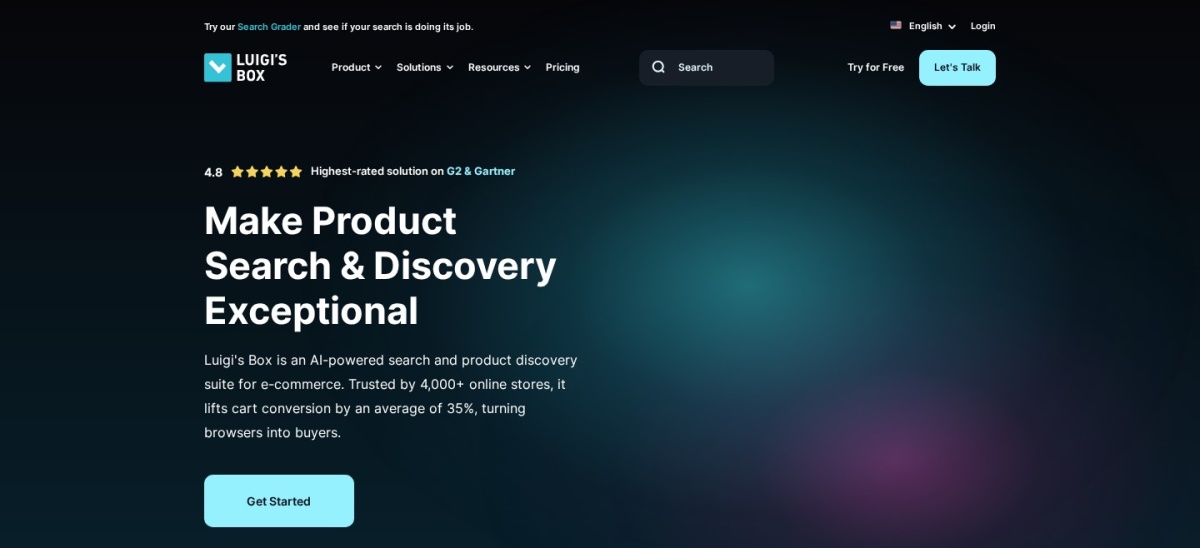
Luigi's Box is an AI search and discovery platform for online stores, combining site search, recommendations, product listings, a conversational agent and analytics in one engine. It is rated 4.8 out of 5 on G2 from 438 reviews, the highest rating in this list, and every plan includes the full feature set.
The trade off is the quote. Pricing is based on usage units counted from pageviews, catalog size, searches and recommendations, and the main platform publishes no dollar figure, with a reported entry point near $85 a month. It suits retailers who want one engine for search and merchandising.
What we like
Highest G2 rating in this list at 4.8 out of 5
Full feature set on every plan, no tier gating
Search plus recommendations and analytics in one engine
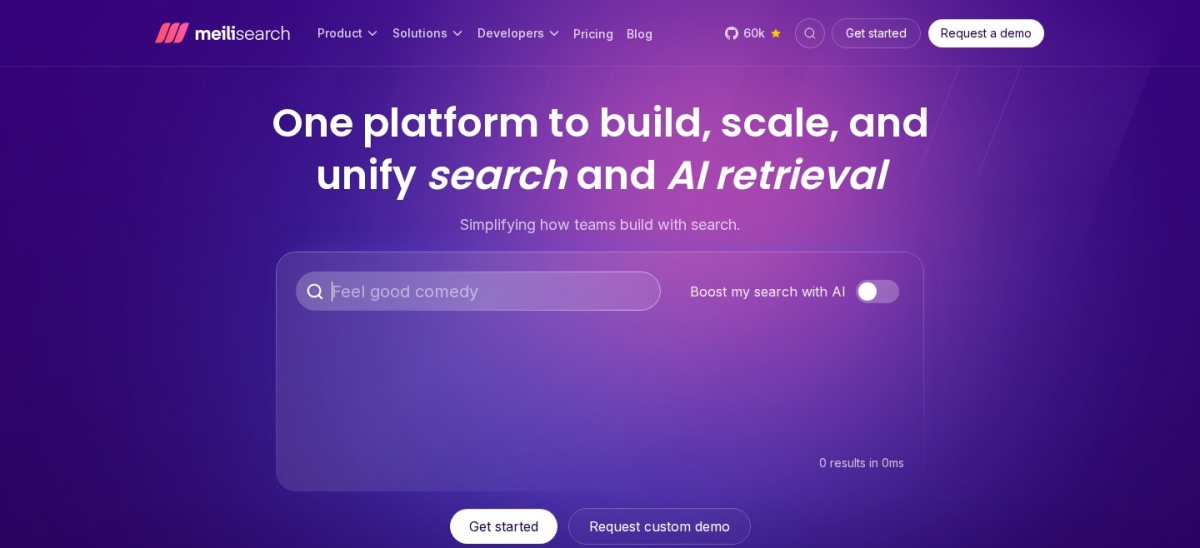
Meilisearch is an open source search engine with a polished hosted cloud, offering typo-tolerant keyword search, semantic and hybrid modes, facets, filters and geo search. Cloud starts at $20 a month for an XS instance, and self-hosting the engine is free under the MIT license.
The trade off is the thin review record. Its 4.8 G2 rating rests on only 7 reviews, and analytics, merchandising tools and enterprise features trail Algolia. It suits small developer teams that want a simple engine at a fixed monthly price.
What we like
Rated 4.8 out of 5 on G2
Fixed monthly price, no per-search billing
Setup measured in minutes
Free self-hosted engine under MIT license
Watch out for
G2 rating rests on only 7 reviews
Analytics and merchandising trail Algolia
Cloud runs on the enterprise edition, not the open source one
Free planSelf-host free; first 720 Cloud hours free
Paid planCloud, $264/yr
Smallest cluster$0.03/hr, about $22/mo
High availabilityPaid add-on
typesense.org
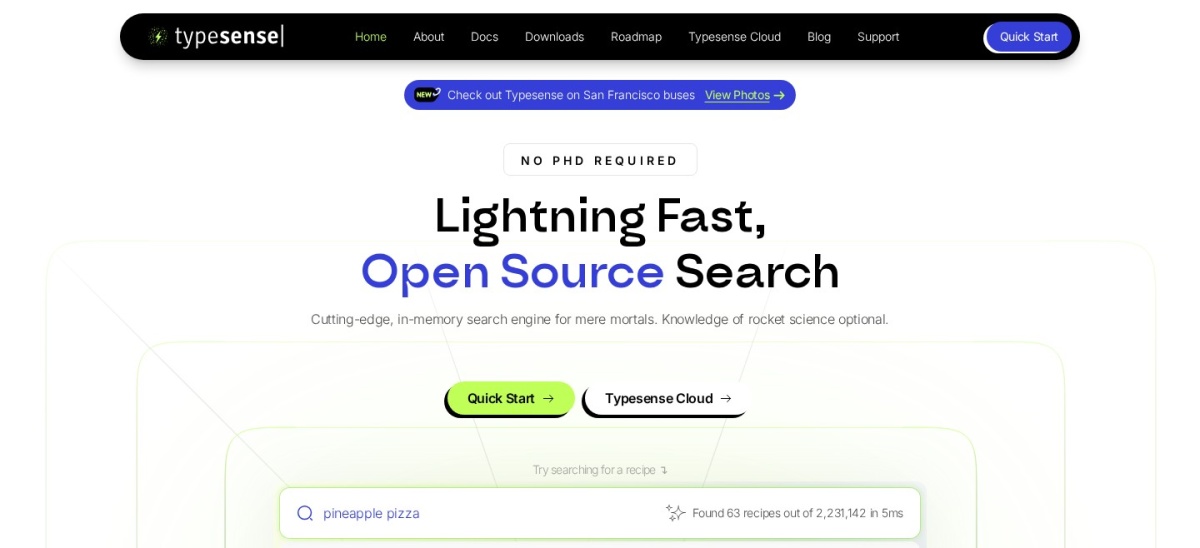
Typesense homepage, captured Nov 2026.
Typesense is an open source search engine built for instant, typo-tolerant search, with vector and hybrid search, filters, facets, geo search and built-in RAG for conversational answers. Cloud bills by cluster size from about $22 a month, with no per-search charge and no limits on records.
The trade off is the thin review record and the memory model. Its 4.7 G2 rating rests on only 5 reviews, and the in-memory index means RAM sizing drives both performance and cloud cost. It suits teams with high query volume that want a bill based on hardware.
AddSearch is website search as a finished product: it crawls and indexes your site, including gated content, and provides the search interface, analytics and now grounded AI answers, live in days without a search team. Core costs $119 a month billed annually, with a 14-day trial.
The trade off is the AI layer pricing. The attractive $119 covers keyword search, while AI answers start at a further $8,400 a year and conversational search is quoted, so the full modern package costs materially more. It suits content-rich organizations that want search live with the least internal effort.
What we like
Rated 4.6 out of 5 on G2 from 106 reviews
Live in days with no search team
Published flat pricing, no usage meter
SOC 2 and GDPR credentials
Watch out for
AI answers cost $8,400 a year extra
Crawled indexing gives less control than API-fed indexes
Algolia is the hosted search benchmark, with millisecond responses, typo tolerance, ranking tools a merchandiser can adjust without engineering tickets, and analytics showing what visitors searched and failed to find. The free Build tier covers 10,000 search requests a month.
The trade off is the usage meter. Paid Grow pricing runs about $0.50 per 1,000 extra searches, and busy sites routinely report bills that outgrow early estimates, with small teams reporting around $51 a month. It suits product and content search where relevance tooling matters most.
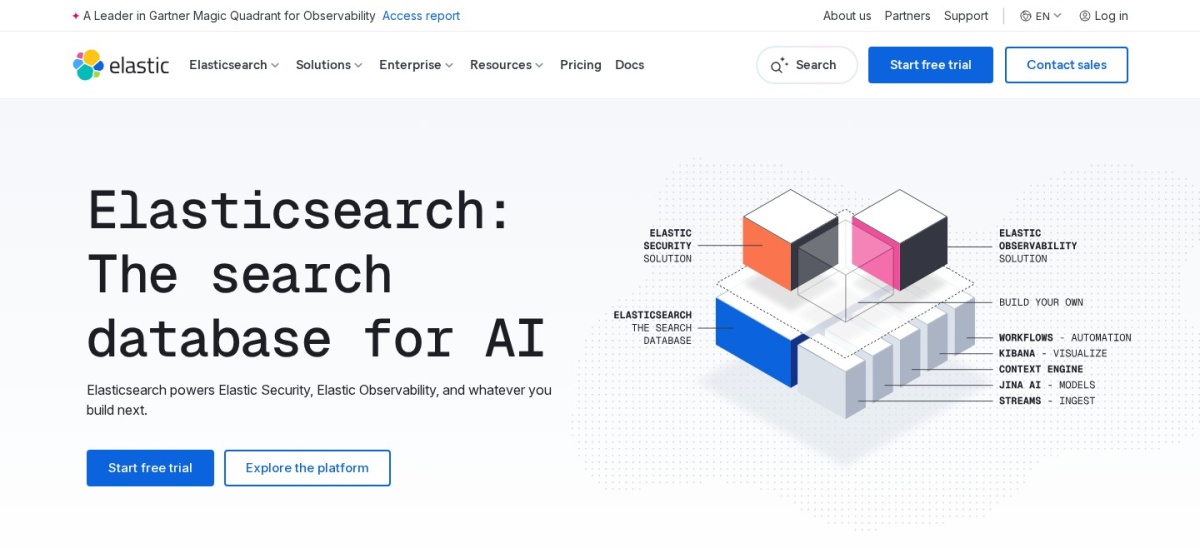
Elastic, built on Elasticsearch, is the heavyweight engine: full-text search, vector search, log and observability data and security analytics on one stack, deployable self-hosted, on Elastic Cloud or inside marketplaces. Elastic Cloud starts at about $99 a month, billed by resources rather than per query.
The trade off is the operations burden. Cluster sizing, upgrades, index lifecycle and relevance tuning are engineering work, and a small team buying Elastic for a website search box has bought a second job. It suits engineering teams that want to own the search stack at scale.
What we like
Rated 4.5 out of 5 on G2 from 110 reviews
Resource pricing makes huge query loads predictable
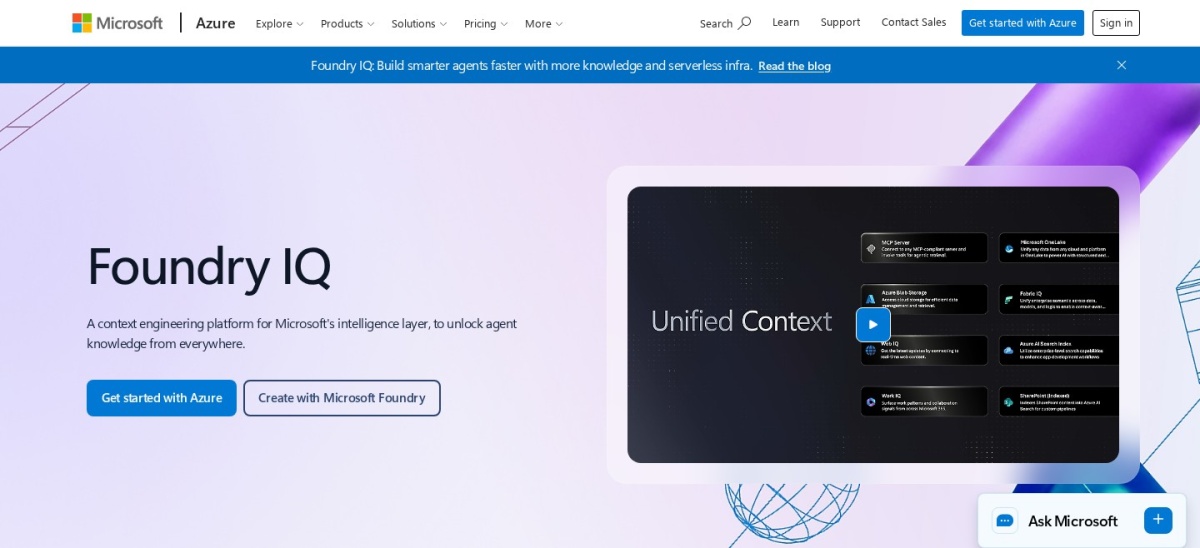
Azure AI Search is Microsoft's managed search service, offering keyword, vector and hybrid retrieval, semantic ranking, and indexers that pull from Azure data sources. The free tier supports development, and the Basic tier costs $73.73 a month per search unit.
The trade off is the platform shape. It is a service, not a finished website search, so interfaces, relevance tuning and analytics are your project, and pay-as-you-go pricing by tier and capacity still needs modelling at scale. It suits teams already inside the Azure estate.
What we like
Rated 4.4 out of 5 on G2 from 34 reviews
Keyword, vector and hybrid retrieval in one service
Security and compliance inherited from Azure
Free tier for development
Watch out for
A platform service, not a finished search product
Semantic ranker billed separately per 1,000 queries
OpenSearch is the community fork of Elasticsearch, maintained under the Linux Foundation with AWS as the largest backer, offering search, vector search and observability under a permissive Apache license with no feature gating by license tier. The engine itself is free to license and run.
The trade off is the operations burden. It demands the same maturity as any distributed engine: cluster design, tuning and upgrades are yours, and managed offerings soften that only at cloud prices. It suits teams with license concerns about Elastic or existing OpenSearch estates.
Coveo is the enterprise platform in this list, unifying search across commerce, service, workplace and website content, with relevance tuned by machine learning and generative answering that drafts responses from indexed content with citations. The Basic tier starts at $600 a month.
The trade off is cost and complexity. Real deployments are custom-quoted, with mid-market deals commonly running $10,000 to $20,000 a month and enterprise contracts carrying six-figure annual minimums before services. It suits organizations where search quality measurably moves revenue or support costs.
What we like
Rated 4.3 out of 5 on G2 from 141 reviews
Generative answers with citations
One engine for commerce, service and workplace
Machine learning tunes ranking on usage
Watch out for
Lowest G2 rating in this list
Real deployments cost far more than the $600 entry
Implementation takes 1 to 6 months
Mid-market deals commonly run $10,000-plus a monthVisit coveo.com
Hosted vs self-hosted search
Hosted search rents you relevance tooling and uptime. Algolia, Luigi's Box, AddSearch and Meilisearch Cloud handle indexing, scaling and upgrades, and you pay by usage or by instance size.
Self-hosted engines rent you nothing and invoice you in engineering time. Typesense, Meilisearch, OpenSearch and Elastic are free to license, but cluster sizing, upgrades, backups and availability are yours.
At small scale, hosted wins on total cost. A $20 a month Meilisearch Cloud instance or a $22 a month Typesense cluster costs less than the engineer hours a self-hosted cluster consumes.
At very high query volumes, or where data cannot leave your infrastructure, the equation reverses. Capacity billing with no per-search charge makes Typesense and Elastic the cheaper route at scale.
How we chose
We started from the search tools teams actually run in production, then kept the nine with an active release, a clear hosting model, and a published or widely reported price.
Prices come from each vendor's pricing page or vendor-supplied G2 listings, checked on 23 November 2026. Ratings and review counts come from G2 on the same day. Where a vendor bills by usage or quote, the list says so instead of inventing a flat figure.
This list is based on pricing, docs and reviews, not on using the tools ourselves. No vendor paid for a place in it.
How to choose search engine software
Start with the build-versus-buy decision, because it decides your real cost.
Decide build versus buy first. If no one on your team wants to run a search cluster, the self-hosted engines are not cheaper; they are unpaid engineering. Hosted services convert that work into a subscription.
Model the meter. Take your real monthly searches and records, then price each option at that volume. Per-search plans punish growth; capacity plans punish idle clusters.
Run your real queries. Take fifty searches your users actually run, including misspellings and hopeless ones, and run them on free tiers and trials. Relevance on your content beats any feature matrix.
Check the exit terms. Confirm you can export your index configuration and data if you leave, and check whether vector features need a separate license.
FAQ
What is the best search engine software?
Luigi's Box is the best pick for online stores. It is rated 4.8 out of 5 on G2 from 438 reviews, and it combines search, recommendations, product listings and analytics in one engine.
How much does search engine software cost?
Open source engines cost $0 to license; hosted plans start at $20 a month for Meilisearch Cloud and $22 a month for Typesense Cloud; packaged website search starts at $119 a month with AddSearch; enterprise platforms like Coveo start at $600 a month.
What is the cheapest search engine software?
Meilisearch Cloud at $20 a month, or self-hosted Meilisearch, Typesense or OpenSearch for $0 in license fees, where you pay only for the server.
Is Algolia free?
Algolia has a free Build tier with 10,000 search requests a month. Paid Grow pricing is usage-based at about $0.50 per 1,000 extra searches, with small teams reporting around $51 a month.
What is the difference between a search engine and a hosted search service?
The engine is the software that indexes documents and answers queries, such as Elastic, OpenSearch, Typesense and the Meilisearch core. A hosted service runs that machinery for you behind an API and adds dashboards, analytics and support.
Can these tools power AI answers as well as search?
Yes. Vector and hybrid retrieval in Elastic, OpenSearch, Typesense, Meilisearch and Azure AI Search grounds chatbots and answer features in your content, and AddSearch and Coveo sell the answer layer directly.