HubSpot Sales Hub is the best sales pipeline management tool for most growing businesses, offering a free plan for up to two users and a 4.4/5 G2 rating. Choose Close for outbound sales involving frequent calls and emails, or monday CRM for customizable visual pipelines and collaborative sales workflows.
How we make this list: we compare pricing pages, product documentation and public user reviews, then re-check every price before each update. No product paid for a place. Disclosure.
HubSpot Sales Hub offers a free plan for 2 users and has 14,412 G2 reviews.
Close earns 4.7/5 on G2 and starts at $108 per year for independent sellers.
monday CRM Basic starts at $144 per seat annually and supports 1,000 active contacts and deals.
Nutshell starts at $156 per user annually and includes unlimited contacts and storage.
Salesforce Starter Suite costs $300 per user annually and connects sales, marketing and service activities.
What makes a good sales pipeline management tool?
Sales pipeline management software helps businesses organize prospects, monitor opportunities and track deals from initial contact to closing. Unlike spreadsheets, dedicated platforms connect pipeline stages with customer records, communication histories and sales activities.
Look for customizable deal stages, activity reminders, opportunity ownership and reporting. These features help sales managers identify stalled deals, distribute workloads and maintain a consistent sales process.
Automation becomes important as sales volume increases. Automatic task creation, email synchronization and lead assignment can reduce administrative work, but these capabilities often require more expensive subscriptions.
Compare annual subscription costs, minimum seat requirements and contact limits. An inexpensive entry plan may become costly when your team needs advanced forecasting, additional pipelines or automated follow-up sequences.
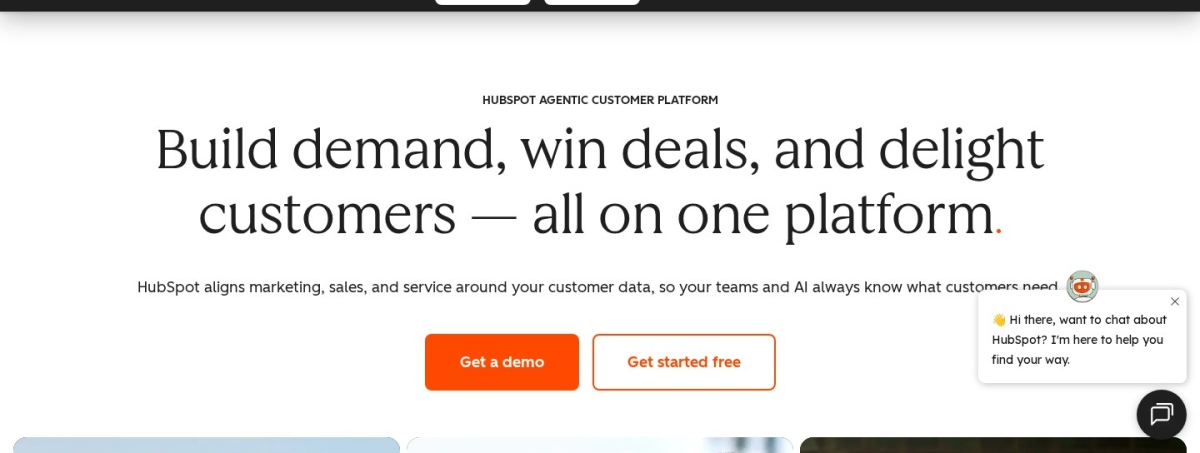
HubSpot Sales Hub is a sales management platform that connects customer records, deal pipelines and communication tools. Its free plan supports two users, making it suitable for businesses establishing their first structured sales process.
The trade off is the cost of advanced automation and forecasting. Starter regularly costs $20 per seat monthly, while Professional requires a larger subscription and a $1,500 onboarding fee. It suits businesses planning to connect sales and marketing within one platform.
What we like
Permanent free CRM plan
Connected customer and deal records
Integrated sales engagement features
Extensive integration marketplace
Watch out for
Advanced forecasting requires Professional
Higher plans have mandatory onboarding fees
Starter expands sales capabilities, with temporary discounts for eligible new customers.Visit hubspot.com
02
Close
4.7/5on G2 (2,169 reviews, checked Nov 2026)
Starts at$9/mo
Best for outbound sales teams
Entry planSolo
Lead capacity10,000 leads
CommunicationCalling, email and SMS
Entry users1 user
close.com
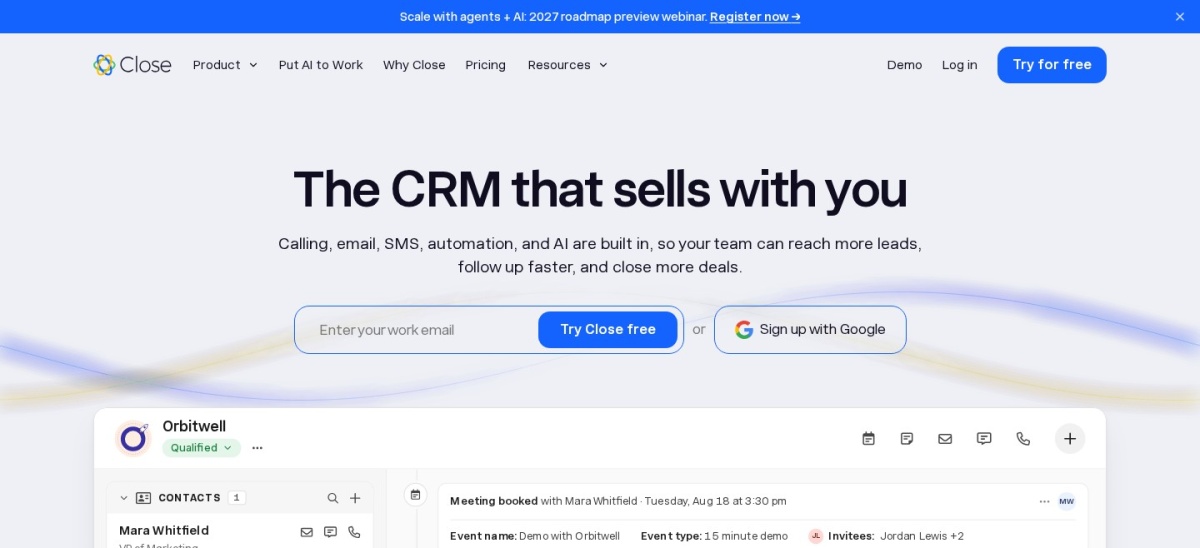
Close homepage, captured Nov 2026.
Close is a sales CRM designed around prospect communication and opportunity tracking. Its Solo plan supports one user and up to 10,000 leads, with integrated calling, email, SMS and pipeline management.
The trade off is that the $9 monthly rate requires annual billing, and Solo cannot accommodate multiple sales representatives. Teams must purchase a higher subscription. It suits independent sellers and outbound businesses that want communication tools connected directly to their pipelines.
What we like
Integrated calling and messaging
Affordable annual Solo subscription
Centralized prospect communication
High G2 user rating
Watch out for
No permanent free plan
Solo subscription limited to one user
Paid team plans extend collaboration, automation and sales communication capabilities.Visit close.com
03
monday CRM
4.5/5on G2 (2,037 reviews, checked Nov 2026)
Starts at$12/mo
Best for customizable visual pipelines
Entry planBasic
Active contacts and deals1,000
Custom dashboards1
Minimum seats3
mondaycrm.ai
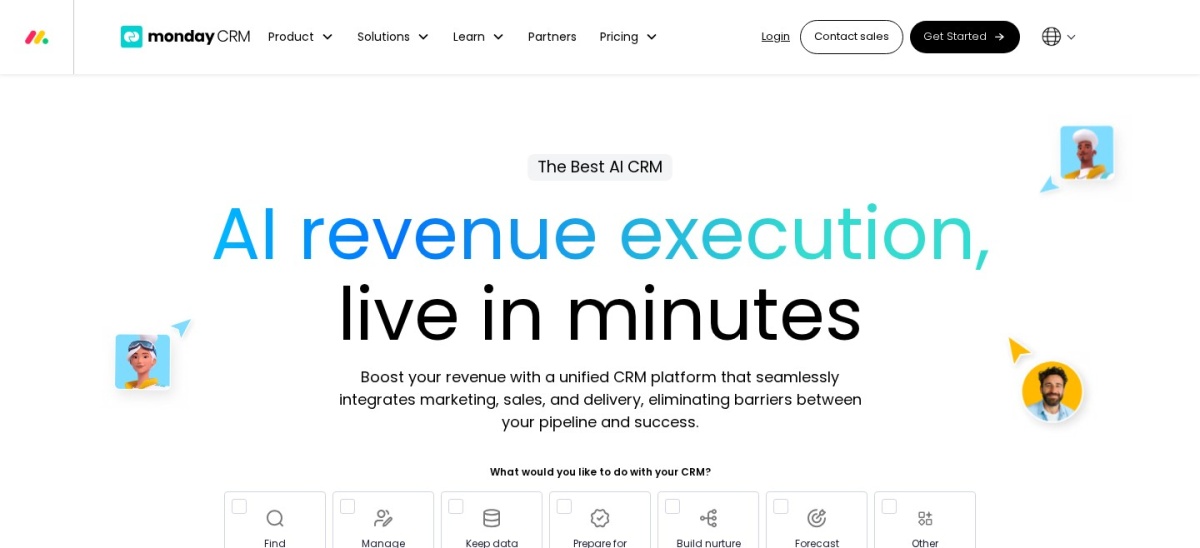
monday CRM homepage, captured Nov 2026.
monday CRM is a visual sales management platform built around configurable boards and dashboards. Its Basic plan supports 1,000 active contacts and deals, one workspace and one custom dashboard.
The trade off is the minimum seat requirement and entry-level feature restrictions. Basic costs $12 per seat monthly with annual billing, while custom sales automations require Standard or above. It suits collaborative teams that prefer visual workflows over traditional CRM interfaces.
What we like
Flexible visual pipeline layouts
Customizable sales dashboards
Collaborative deal management
Integrated quote and invoice features
Watch out for
Minimum purchase of three seats
Basic limits board columns and automation
Standard adds more workspaces, higher record limits and custom automations.Visit mondaycrm.ai
04
Nutshell
4.3/5on G2 (1,465 reviews, checked Nov 2026)
Starts at$13/mo
Best for small B2B sales teams
Entry planFoundation
ContactsUnlimited
StorageUnlimited
Email synchronizationIncluded
nutshell.com
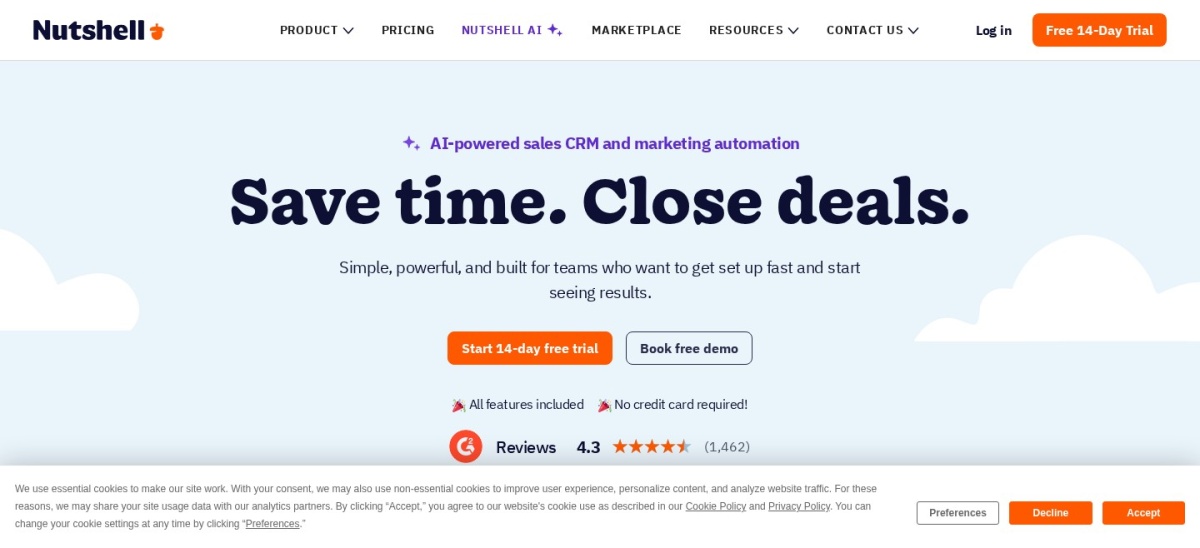
Nutshell homepage, captured Nov 2026.
Nutshell is a B2B sales CRM that combines opportunity management, customer records and sales communication. Foundation costs $13 per user monthly with annual billing and includes unlimited contacts, unlimited storage and email synchronization.
The trade off is that advanced reporting, sales quotas and lead assignment rules require a higher subscription. Foundation covers everyday CRM requirements without charging according to contact volume. It suits smaller B2B teams seeking predictable subscription costs.
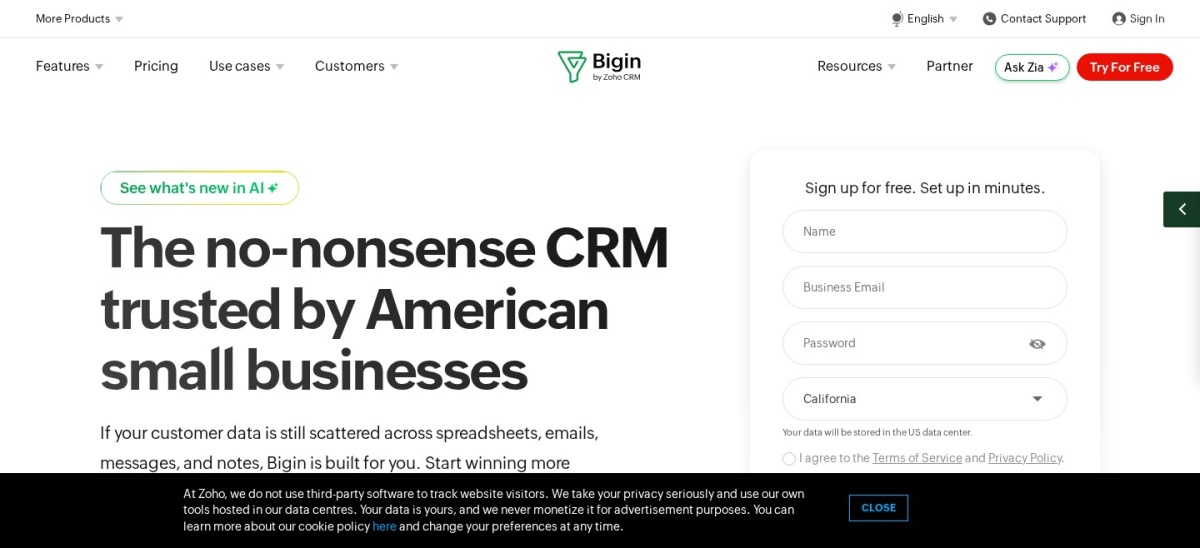
Bigin is a simplified CRM from Zoho designed for smaller businesses managing customer-facing workflows. Its free edition includes one customizable pipeline, 500 records, three automations and access to mobile applications.
The trade off is the limited capacity of the free edition. Growing businesses need a paid subscription for additional records and more complex pipeline requirements, with pricing available through its plan selector. It suits independent businesses moving away from spreadsheets.
What we like
Permanent single-user free plan
Customizable pipeline stages
Built-in workflow automation
Integration with Zoho applications
Watch out for
Free edition has limited record capacity
Less suitable for complex enterprise workflows
Paid editions increase record capacity and expand pipeline management features.Visit bigin.com
06
Copper
4.5/5on G2 (1,158 reviews, checked Nov 2026)
Starts at$23/mo
Best for Google Workspace users
Entry planBasic
Contact limit2,500
Task automationIncluded
Project managementIncluded
copper.com
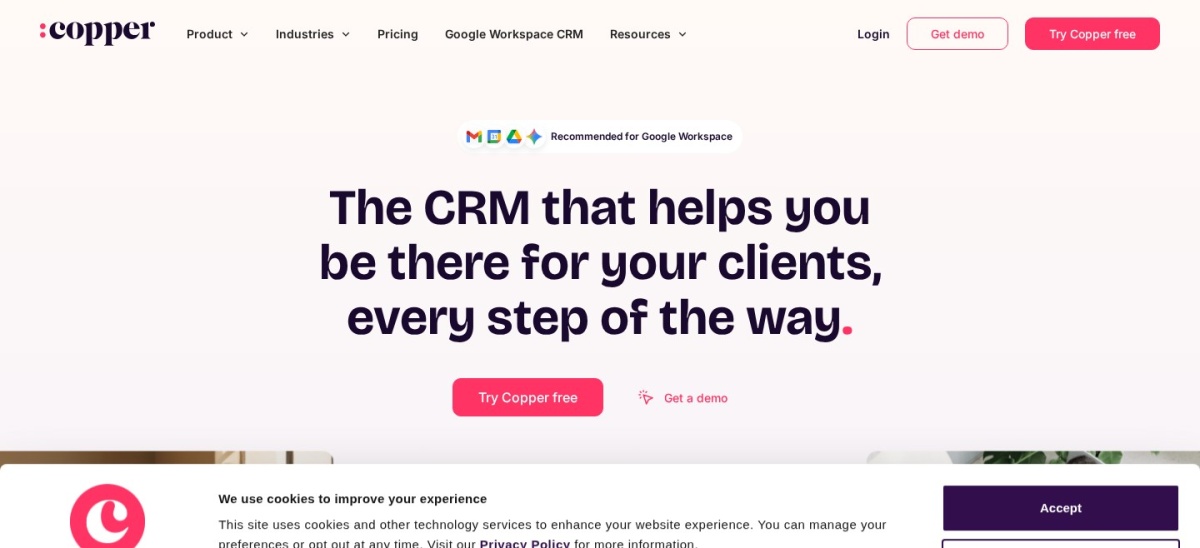
Copper homepage, captured Nov 2026.
Copper is a relationship management CRM designed for agencies, consultants and professional service businesses. Its Basic subscription includes 2,500 contacts, sales pipelines, project management and task automation.
The trade off is that reporting, bulk email and advanced workflow automation require Professional. Basic costs $23 per seat monthly with annual billing or $29 with monthly billing. It suits businesses that rely on Google Workspace and manage ongoing client relationships.
What we like
Google Workspace integration
Combined sales and project pipelines
Task automation on Basic
Useful for relationship-driven sales
Watch out for
Entry subscription has a contact limit
Reporting requires a higher subscription
Professional adds reporting, workflow automation, bulk email and higher contact capacity.Visit copper.com
07
Salesforce Sales Cloud
4.4/5on G2 (27,596 reviews, checked Nov 2026)
Starts at$25/mo
Best for complex sales organizations
Entry planStarter Suite
Opportunity trackingIncluded
Lead routingIncluded
Billing optionsMonthly or annually
salesforce.com
Salesforce Sales Cloud homepage, captured Nov 2026.
Salesforce Sales Cloud is a CRM platform covering lead management, account records and sales opportunities. Starter Suite costs $25 per user monthly and includes sales flows, lead routing and synchronization of customer communication records.
The trade off is the administrative effort required when implementing complex sales workflows. Advanced customization and enterprise capabilities require more expensive editions. It suits organizations expecting their pipeline management requirements to expand alongside their sales operations.
What we like
Comprehensive opportunity management
Built-in lead routing
Extensive customization options
Established integration ecosystem
Watch out for
Complex implementations require more administration
Track opportunity value, deal conversion rates, average deal size and time spent in each pipeline stage. These measurements help managers understand where opportunities stall and whether the current pipeline can support revenue targets.
Monitor pipeline coverage by comparing open opportunity value with the remaining sales target. Review overdue activities and expected closing dates regularly to prevent inaccurate forecasts caused by neglected deals.
CRM software vs. sales pipeline management software
CRM software manages customer relationships across contact records, communication and business activities. Sales pipeline management focuses specifically on opportunities, deal progression and expected revenue.
Most dedicated sales CRMs include pipeline management. Choose a focused CRM when opportunity tracking is your main requirement, or a broader customer platform when sales must work closely with marketing and customer service.
How we chose
We selected established CRM products offering dedicated opportunity tracking, configurable sales workflows and customer relationship management. Rankings prioritize pipeline usability, entry-level functionality, subscription costs and suitability for different sales teams.
Pricing pages and G2 ratings were checked on 25 Nov 2026. Annual costs reflect regular subscription rates, excluding introductory promotions, optional add-ons and additional seats.
We excluded generic task managers without dedicated sales features, discontinued products and platforms with insufficient public reviews. No vendor paid for a place, and we do not claim testing for this list.
How to choose a sales pipeline management tool
Compare your existing sales process with each platform's pipeline features, pricing structure and automation limits before purchasing a subscription.
Define your sales stages. Identify the steps prospects follow from qualification to closing. Choose software that accommodates these stages without forcing your team to redesign its entire sales process.
Calculate the complete subscription cost. Multiply the annual per-user price by the required number of seats. Include onboarding charges, communication costs and additional subscriptions needed for essential features.
Check automation and reporting requirements. Determine whether your team needs automatic lead assignment, follow-up reminders, deal forecasting or advanced performance dashboards. Confirm which subscription includes these capabilities.
Review integrations and migration options. Check compatibility with your email provider, calendar, accounting software and lead generation systems. Confirm that existing customer records and sales opportunities can be imported and exported.
FAQ
What is the best sales pipeline management software?
HubSpot Sales Hub is the best overall choice for growing teams that need connected customer records and sales engagement features. Close is better for outbound communication, while monday CRM suits teams prioritizing customizable visual workflows.
What is the best free sales pipeline management tool?
HubSpot provides a free sales CRM for up to two users. Bigin also offers a permanent free edition for one user, including a customizable pipeline, 500 records and three automations.
How much does sales pipeline management software cost?
Public entry-level subscriptions in this comparison range from $9 to $25 per user or seat monthly, depending on billing terms. Actual costs increase with additional users, premium automation, onboarding and advanced reporting requirements.
Can I manage multiple sales pipelines in a CRM?
Many CRM platforms support multiple pipelines for different products, customer segments or sales processes. However, entry-level subscriptions may restrict pipeline quantities, so review plan limits before purchasing software for several departments.
Is sales pipeline management software suitable for small businesses?
Yes. Small businesses can use sales pipeline software to organize prospects, schedule follow-ups and monitor expected revenue. Affordable options such as Nutshell, Close and Bigin help smaller teams establish structured sales processes.
What is the difference between a sales pipeline and a sales funnel?
A sales pipeline describes the stages individual opportunities move through during a sales process. A sales funnel measures how prospects progress toward becoming customers, typically focusing on conversion rates and prospect volume.
SaaS SEO and WordPress specialist with about 8 years of experience. Rakib compares WordPress plugins, themes, hosting and software using public pricing, documentation and user reviews. See how we rank.