WLWPLegible EditorsLast verified 22 Nov 2026How we rank8 min read
★ Short answer
OPNsense is the best router software overall, offering a free, open-source FreeBSD platform with frequent security updates and optional Business Edition subscriptions starting around $162/yr (€149 (about $171)/yr). Choose Netgate pfSense for broad commercial support starting at $129/yr, or MikroTik RouterOS for a $45 one-time perpetual license on x86 hardware.
How we make this list: we compare pricing pages, product documentation and public user reviews, then re-check every price before each update. No product paid for a place. Disclosure.
OPNsense offers free community releases and a €149 (about $171)/yr (~$162/yr) Business Edition with a 4.6/5 rating on G2.
Netgate pfSense holds a 4.7/5 G2 rating across 327 reviews, with commercial pfSense Plus subscriptions starting at $129/yr.
MikroTik RouterOS sells perpetual licenses starting at $45 one-time (Level 4) with a 4.6/5 rating across 30 G2 reviews.
Tailscale and ZeroTier provide software-defined mesh routing with free tiers and paid plans starting at $96/yr and $216/yr.
Enterprise cloud and virtual routing options like Cloudflare One ($84/yr per user) and Netgate TNSR ($999/yr) scale to high-throughput networks.
What to look for in router software
Modern router software turns standard x86 mini-PCs, rack servers, or cloud virtual machines into dedicated gateways. Instead of relying on locked-down consumer firmware, these platforms give IT teams and homelab builders direct control over stateful packet filtering, VLAN segmentation, and multi-WAN failover.
Licensing models split into three distinct camps. Open-source firewall distributions like OPNsense and pfSense Community Edition let you run core routing and VPN features at zero cost, charging only when you want curated update channels, centralized management, or vendor support tickets.
Proprietary router operating systems and software-defined overlays price differently. MikroTik RouterOS uses one-time perpetual keys tied to storage or hypervisor IDs, whereas mesh routing platforms such as Tailscale, ZeroTier, and Cloudflare One bill monthly per seat or per connected device.
OPNsense is an open-source firewall and routing operating system built on FreeBSD that runs on standard x86 hardware and virtual machines. The free community edition includes stateful inspection, traffic shaping, WireGuard and OpenVPN tunnels, Suricata intrusion detection, and a modern web interface with regular bi-annual major releases.
The trade off is that production teams needing delayed, battle-tested updates and centralized multi-firewall management must pay €149 (about $171)/yr (roughly $162/yr) per installation for the Business Edition, while advanced threat feeds like Proofpoint ET Pro cost extra. It suits homelabs, SMBs, and engineers who want transparent open-source networking.
What we like
Full-featured free community edition with no throughput or VLAN caps
Clean, API-driven web GUI with built-in WireGuard and Suricata IDS/IPS
Predictable release schedule with frequent security patches
Watch out for
Hardware compatibility is narrower than Linux due to FreeBSD drivers
Business Edition pricing is billed in Euros per single installation
Business Edition (€149 (about $171)/yr) adds commercial firmware repos, GeoIP database, OVA images, and OPNcentral.Visit opnsense.org
02
Netgate pfSense
4.7/5on G2 (327 reviews, checked Nov 2026)
Paid from$129/yr
Best for mature ecosystem & vendor support
Base OSFreeBSD
VPN supportIPsec, OpenVPN, WireGuard
Add-on packagesSnort, HAProxy, pfBlockerNG
Entry paid tierpfSense+ TAC Lite ($129/yr)
pfsense.org
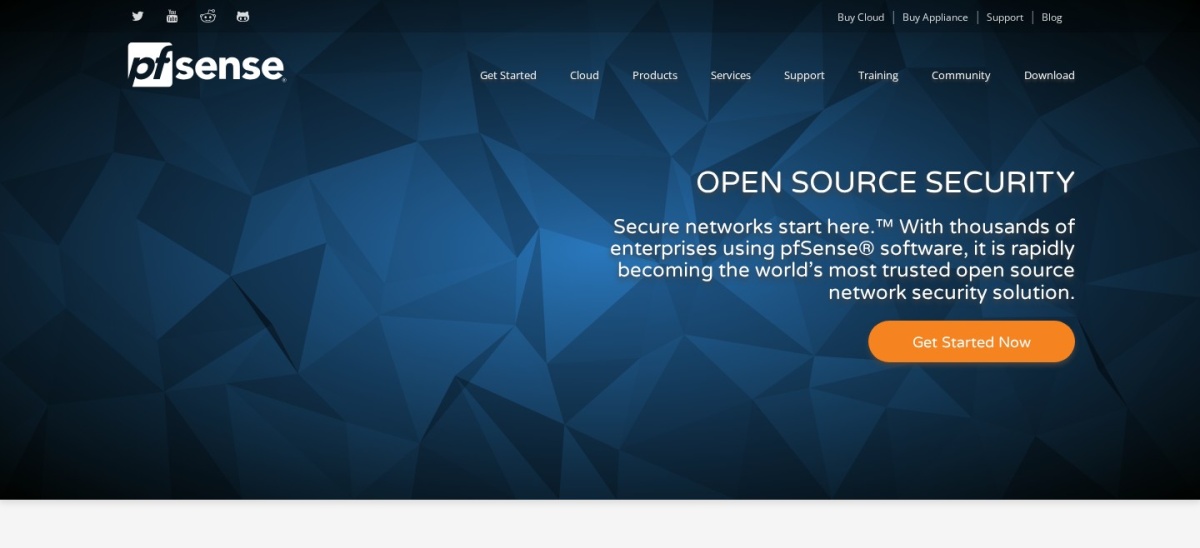
Netgate pfSense homepage, captured Nov 2026.
Netgate pfSense is a veteran FreeBSD routing and firewall platform available as the free open-source pfSense Community Edition (version 2.9.x) or the commercial pfSense Plus branch. Even the free edition delivers multi-WAN load balancing, CARP high availability, captive portal, and mature packages like pfBlockerNG and HAProxy.
The trade off is that commercial use and white-box upgrades to pfSense Plus require a paid subscription starting at $129/yr with TAC Lite support, and the web interface feels more dated than OPNsense. It suits businesses and IT admins who value extensive documentation and optional 24/7 vendor support.
What we like
Massive library of battle-tested packages including HAProxy and pfBlockerNG
Backed by Netgate appliances and optional 24/7 TAC support plans
Strong multi-WAN failover and CARP high-availability clustering
Watch out for
Commercial environments require a paid pfSense Plus license
Community Edition release cadence is slower than pfSense Plus
pfSense+ TAC Lite ($129/yr) unlocks commercial licensing, ZFS boot environments, and 24/7 support.Visit pfsense.org
03
MikroTik RouterOS
4.6/5on G2 (30 reviews, checked Nov 2026)
Paid from$45 one-time
Best one-time perpetual license value
Base OSLinux kernel (proprietary)
RoutingBGP, OSPF, MPLS, VRF
ManagementWinbox, WebFig, CLI, API
Entry paid tierLevel 4 / CHR P1 ($45 one-time)
mikrotik.com
MikroTik RouterOS homepage, captured Nov 2026.
MikroTik RouterOS is a Linux-based routing operating system that powers MikroTik RouterBOARD hardware and also installs on x86 servers or Cloud Hosted Router (CHR) virtual machines. It includes full BGP, OSPF, MPLS, VLANs, queue trees, and WireGuard, with a free CHR tier capped at 1 Mbps per interface for lab testing.
The trade off is a steep learning curve and a perpetual license key bound to a single disk or hypervisor UUID, starting at $45 one-time for Level 4 (up to 200 PPPoE/VPN tunnels) or CHR P1 (1 Gbps). It suits ISPs, WISPs, and network engineers seeking deep packet control without recurring fees.
What we like
Perpetual one-time licensing with no annual renewal fees
Full dynamic routing stack (BGP, OSPF, MPLS) even on entry tiers
Fast desktop Winbox utility with Safe Mode rollback protection
Watch out for
Steep configuration learning curve for newcomers
Licenses are locked to specific drive or hypervisor IDs
Level 4 ($45 one-time) unlocks up to 200 tunnels and wireless AP mode; CHR P1 ($45) removes the 1 Mbps cap.Visit mikrotik.com
Tailscale is a software-defined mesh network built on WireGuard that lets Linux boxes, routers, and cloud VMs act as subnet routers and exit nodes without manual port forwarding. Its free Personal plan covers up to 6 users, unlimited user devices, 3 ACL groups, and 50 tagged resources indefinitely.
The trade off is that Tailscale operates strictly at Layer 3 rather than providing a traditional hardware perimeter firewall, and team plans scale per active seat at $8/user/mo ($96/yr) on Standard. It suits distributed engineering teams and homelabs connecting multi-cloud VPCs and home subnets.
What we like
Generous free tier supporting up to 6 users and unlimited devices
NAT traversal and subnet routing work without opening firewall ports
Kernel WireGuard performance on Linux with MagicDNS hostnames
Watch out for
Layer 3 only, so Layer 2 broadcast and multicast traffic do not traverse
Per-user pricing adds up quickly for larger organizations
Standard ($8/user/mo) adds unlimited users, SCIM provisioning, 10 ACL groups, and MDM posture checks.Visit tailscale.com
ZeroTier is an open-source software-defined networking platform that emulates a global Layer 2 Ethernet switch alongside Layer 3 IP routing. It installs directly onto Linux servers, OpenWrt, OPNsense, and MikroTik routers, offering a free Personal tier for up to 10 devices on a single non-commercial network.
The trade off is that commercial usage and fleets above 10 devices require the Essential plan at $18/mo ($216/yr) plus $2/mo per extra node, and userspace encryption caps raw throughput below kernel WireGuard. It suits industrial networks, remote site bridging, and apps needing multicast or static IP assignment.
What we like
Supports true Layer 2 bridging, broadcast, and multicast across sites
Runs natively on popular router platforms including MikroTik and OPNsense
Fine-grained programmable flow rules and static managed IP ranges
Watch out for
Free Personal tier caps out at 10 devices and 1 network
Userspace encryption yields lower max throughput than kernel WireGuard
Essential ($18/mo) grants commercial licensing, 10 networks, OIDC SSO, API access, and 30-day audit logs.Visit zerotier.com
06
Cloudflare One
4.6/5on G2 (106 reviews, checked Nov 2026)
Paid from$7/mo
Best for cloud-native Zero Trust routing
ArchitectureCloud SASE / ZTNA / Magic WAN
Free allowanceUp to 50 users, 24-hr logs
Connectorscloudflared tunnel, WARP client
Entry paid tierPay-as-you-go ($7/user/mo)
cloudflare.com
Cloudflare One homepage, captured Nov 2026.
Cloudflare One (Zero Trust) replaces traditional branch VPN concentrators and edge routing with cloud-enforced Zero Trust Network Access, Secure Web Gateway filtering, and lightweight `cloudflared` connectors. Its free plan covers up to 50 users with L4-7 network filtering, DNS policies, and 24 hours of log retention.
The trade off is that it relies on Cloudflare's global edge rather than running as a standalone local router OS, and exceeding 50 seats or needing 30-day logs moves you to the $7/user/mo ($84/yr) Pay-as-you-go tier. It suits remote-first companies replacing legacy VPN appliances.
What we like
Free plan covers up to 50 users with ZTNA and DNS/HTTP filtering
Exposes internal services safely without inbound public firewall ports
Month-to-month Pay-as-you-go billing with no annual lock-in
Watch out for
Not a standalone local LAN router operating system
Full Magic WAN, Remote Browser Isolation, and long log retention cost extra
Pay-as-you-go ($7/user/mo) removes the 50-user cap and extends log retention to 30 days with chat/ticket support.Visit cloudflare.com
07
Arista NG Firewall
4.7/5on G2 (18 reviews, checked Nov 2026)
Starts at$25/mo
Best for app-based UTM & web filtering
Base OSDebian Linux
Security modulesWeb Filter, IPS, Application Control
Deploymentx86 bare metal, VMware, cloud
Entry paid tierNG Firewall Complete (from $25/mo)
edge.arista.com
Arista NG Firewall homepage, captured Nov 2026.
Arista NG Firewall (formerly Untangle NGFW) is a Debian-based unified threat management and routing platform designed around a visual, app-style dashboard. It combines policy-based routing, WAN balancer, WireGuard and OpenVPN, intrusion prevention, and granular web content filtering on standard x86 hardware or VMs.
The trade off is that Arista retired its low-cost home license and free feature tier, with commercial subscriptions starting from $25/mo ($300/yr) and scaling up by connected device count. It suits schools, clinics, and SMBs that prioritize readable web filtering reports over CLI routing.
What we like
Intuitive visual rack interface with detailed per-user web activity reports
Strong policy routing, WAN failover, and application-level bandwidth shaping
Deploys easily on commodity x86 boxes or virtual hypervisors
Watch out for
No free tier or low-cost home license available
Device-count licensing gets expensive on networks with guest Wi-Fi
NG Firewall Complete (from $25/mo) unlocks Web Filter, Virus Blocker, IPS, Application Control, and WAN Balancer.Visit edge.arista.com
08
Netgate TNSR
3.5/5on G2 (1 reviews, checked Nov 2026)
Starts at$999/yr
Best for 100 Gbps+ carrier edge routing
Data planeFD.io VPP + Intel DPDK
RoutingBGP, OSPF, VXLAN, IPsec, NAT
AutomationRESTCONF API, CLI
Entry paid tierTNSR Software ($999/yr per instance)
netgate.com
Netgate TNSR homepage, captured Nov 2026.
Netgate TNSR is a high-speed virtual router built on Intel DPDK and FD.io Vector Packet Processing (VPP) to bypass the standard OS kernel for packet forwarding. Designed for data centers, service providers, and cloud edge deployments, it handles multi-gigabit BGP routing, IPsec VPNs, and NAT on commodity x86 servers.
The trade off is a starting subscription of $999/yr per instance, a steeper CLI- and API-first workflow, and fewer Layer 7 firewall features than pfSense Plus. It suits ISPs, cloud architects, and enterprises moving 10 Gbps to 100 Gbps+ traffic.
What we like
Kernel-bypass VPP and DPDK architecture delivers massive packet-per-second rates
Full RESTCONF API and vendor-style CLI built for infrastructure automation
Runs on bare-metal x86 servers, KVM/VMware VMs, AWS, and Azure
Watch out for
Starts at $999/yr per instance with no free community edition
Lacks the beginner-friendly web UI and L7 UTM packages of pfSense
TNSR subscription ($999/yr) includes commercial software updates, VPP/DPDK routing, and Netgate TAC support.Visit netgate.com
Hardware requirements for router software
For gigabit home or branch connections running OPNsense, pfSense, or RouterOS, a dual- or quad-core x86 mini-PC with 4 GB to 8 GB of RAM and Intel I225/I226 2.5 GbE NICs handles routing and WireGuard comfortably. Avoid Realtek network adapters on FreeBSD-based systems when possible, as Intel NICs offer more predictable driver stability under sustained load.
If you enable inline intrusion prevention (Suricata or Snort) or deep packet inspection across multi-gigabit links, prioritize higher single-thread CPU clock speeds and at least 8 GB of RAM. For 10 Gbps+ data center routing, kernel-bypass platforms like Netgate TNSR or MikroTik CHR on DPDK-capable NICs prevent standard OS interrupt bottlenecks.
How we chose
We evaluated actively maintained router operating systems, virtual routers, and software-defined routing overlays capable of running on standard x86 hardware, hypervisors, or cloud instances. Each candidate was assessed on routing protocol support, VPN throughput, licensing transparency, and update cadence.
All prices, rating scores, and review counts were verified directly against vendor pricing pages and G2 listings on 22 Nov 2026. Where a platform offers a free community edition alongside a paid commercial tier, we listed the lowest regular annual price for a single instance or entry seat.
We excluded discontinued projects, consumer-only Wi-Fi firmwares without broad x86/VM support, and enterprise routers that refuse to publish starting software prices without a custom sales quote. No vendor paid for a place, and we do not claim testing for this list.
How to choose router software
Match your network topology, throughput targets, and maintenance budget to the right routing architecture:
Decide between a full perimeter OS and a mesh overlay. If you need DHCP, VLANs, multi-WAN failover, and a stateful WAN firewall on dedicated hardware, pick OPNsense, pfSense, or RouterOS. If you just need encrypted peer-to-peer access between existing servers and laptops without opening firewall ports, Tailscale or ZeroTier is faster to deploy.
Check NIC driver compatibility before buying hardware. FreeBSD platforms like OPNsense and pfSense perform best on Intel Ethernet controllers, whereas Linux-based options like RouterOS and Arista NG Firewall support a wider range of commodity chipsets.
Calculate multi-year licensing costs at your actual scale. One-time keys like MikroTik RouterOS ($45) stay flat forever, while per-user tools like Tailscale ($8/user/mo) and Cloudflare One ($7/user/mo) scale linearly as your team grows.
Verify update cadence and support SLAs for production. Home labs can run free community builds, but business gateways benefit from staged commercial repositories and vendor support tickets like OPNsense Business Edition (€149 (about $171)/yr) or pfSense+ TAC Lite ($129/yr).
FAQ
What is the best free router software?
OPNsense and Netgate pfSense Community Edition are the strongest free router operating systems for x86 hardware and virtual machines. Both provide full stateful firewalling, VLANs, multi-WAN failover, and WireGuard or OpenVPN tunnels without bandwidth caps.
Is OPNsense better than pfSense in 2026?
OPNsense offers a cleaner web interface, built-in REST APIs, and predictable twice-yearly major releases, making it easier to navigate for most admins. pfSense remains stronger if you rely on specific packages like pfBlockerNG or want Netgate hardware appliances.
Can I run router software on a regular PC or mini-PC?
Yes. Any x86-64 mini-PC or server with at least two Ethernet ports can run OPNsense, pfSense, MikroTik RouterOS, or Arista NG Firewall. You can also virtualize them inside Proxmox or VMware ESXi using virtual NICs.
What is the difference between RouterOS and OPNsense?
MikroTik RouterOS is a proprietary Linux-based OS focused on carrier-grade routing protocols like BGP, OSPF, and MPLS with a $45 one-time license. OPNsense is an open-source FreeBSD platform geared toward next-generation firewalling, IDS/IPS, and VPN gateway duties.
When should I use Tailscale or ZeroTier instead of a traditional router OS?
Use Tailscale or ZeroTier when your servers are spread across home labs, cloud VPCs, and mobile laptops behind restrictive NATs. They create encrypted mesh networks without requiring static public IPs or manual port forwarding on your ISP router.