Best Master Data Management Tools in 2026: 7 Tools Compared
WLWPLegible EditorsLast verified 22 Nov 2026How we rank11 min read
★ Short answer
Pimcore is the best master data management tool for most organizations, pairing an open-source Community tier with commercial plans starting at $9,900/yr and a 4.7/5 rating on Capterra. Teams needing cloud-native entity resolution at scale can evaluate Senzing from $58,560/yr, while smaller SQL teams can manage master tables in Excel via SQL Spreads from $468/yr.
How we make this list: we compare pricing pages, product documentation and public user reviews, then re-check every price before each update. No product paid for a place. Disclosure.
Pimcore offers unlimited products, assets, and user seats starting at $9,900/yr for its self-hosted Professional edition, plus a free Community edition.
IBM InfoSphere Master Data Management publishes transparent cloud tiers starting at $31,000/mo ($372,000/yr) for up to 5 million party records.
Senzing provides real-time AI entity resolution starting at $58,560/yr for 10 million data source records with support included.
AWS Entity Resolution charges $0.25 per 1,000 records processed for rule-based or ML matching, keeping pay-as-you-go entry costs predictable.
SQL Spreads gives finance and operations teams a governed Excel front end for SQL Server and PostgreSQL master data starting at $468/yr.
What to look for in master data management software
Master data management (MDM) creates a single, governed source of truth for core business entities—such as customers, products, suppliers, and locations—across disconnected ERPs, CRMs, and data warehouses. Without a central hub, duplicate records and conflicting attributes stall reporting and operational workflows.
When comparing platforms, check whether the tool handles multiple data domains or focuses strictly on product catalogs or entity matching. Multi-domain hubs like Pimcore and IBM InfoSphere govern relationships across customers, vendors, and SKUs, whereas specialized engines like Senzing and AWS Entity Resolution focus on linking duplicate identities across messy source tables.
Deployment and pricing transparency also separate modern options from legacy enterprise suites. While many traditional vendors hide costs behind custom quotes, several established platforms publish clear annual, monthly, or per-record pricing so IT teams can model total cost of ownership before scheduling a sales call.
Budget tool for governed master data entry in Excel
$468/yr
No free plan
4.9/5
Price ladder: cheapest paid plan per year
List prices, USD, checked Nov 2026
AWS ER$300
SQL Spreads$468
PlytixFREE$5,988
PimcoreFREE$9,900
Pimberly$36,000
SenzingFREE$58,560
IBM MDM$372,000
The 7 best master data management tools
01
Pimcore
4.7/5on Capterra (23 reviews, checked Nov 2026)
Paid from$9,900/yr
Best for multi-domain MDM and open-source flexibility
DeploymentSelf-hosted or managed PaaS
User seatsUnlimited ($0 per-user fees)
DomainsCustomer, product, supplier, asset
Entry paid tier$9,900/yr (Professional)
pimcore.com
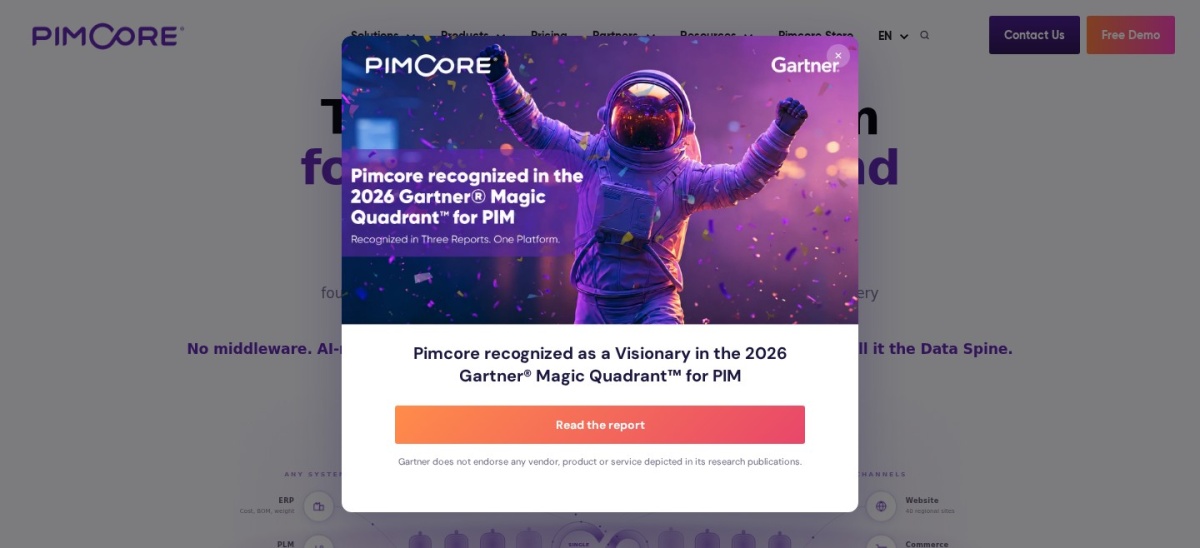
Pimcore homepage, captured Nov 2026.
Pimcore is an open-core data and experience management platform that combines MDM, PIM, DAM, and DXP in one codebase. Its free Community Edition supports unlimited entities, products, and users for non-profits, academics, and businesses under $5 million in annual revenue.
The trade off is that self-hosting requires your own infrastructure and developers, while the commercial Professional Edition starts at $9,900/yr without a vendor support SLA. It suits mid-market and enterprise teams wanting full data-model control without per-seat fees.
What we like
No per-user fees or record caps across any edition
Covers MDM, PIM, DAM, and customer data in one platform
Free Community Edition available under the Pimcore Open Core License
Supports over 45 customizable data components for complex hierarchies
Watch out for
Professional plan ($9,900/yr) excludes SLA support and data quality workflows
Enterprise features and managed PaaS jump to $29,900/yr and $39,900/yr
Requires PHP and Symfony engineering skills for custom deployments
Professional ($9,900/yr) unlocks commercial POCL licensing for companies above $5M revenue.Visit pimcore.com
02
Senzing
4.7/5on G2 (25 reviews, checked Nov 2026)
Paid from$58,560/yr
Best for real-time AI entity resolution
DeploymentSelf-hosted SDK / AWS
Free evaluationUp to 500 records
Entry paid tier$58,560/yr (10M records)
SupportIncluded on all paid tiers
senzing.com
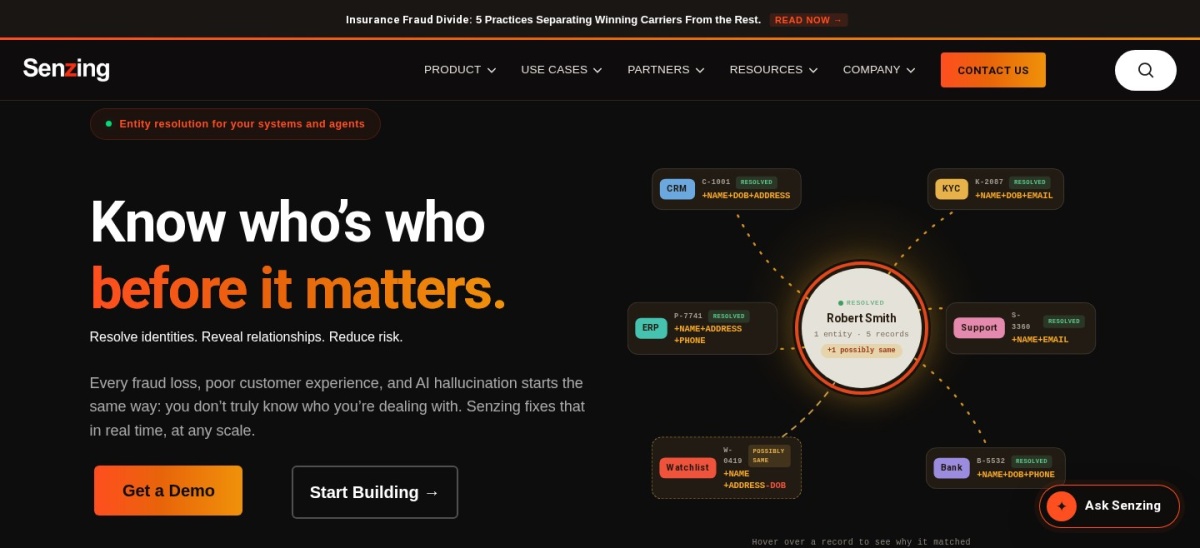
Senzing homepage, captured Nov 2026.
Senzing is a real-time entity resolution SDK that matches and links duplicate person and organization records across disparate databases without manual rule tuning. Developers can evaluate the engine free of charge on datasets up to 500 records.
The trade off is a steep jump from the free evaluation cap to production pricing, which starts at $58,560/yr for 10 million data source records. It suits engineering teams building KYC, fraud detection, or customer 360 pipelines on their own infrastructure.
Sub-second transactional matching with explainable audit trails
Vendor technical support is included in every paid subscription
Watch out for
Focused on entity resolution rather than full stewardship UIs or PIM
High entry cost at $58,560/yr for organizations with smaller databases
Paid subscriptions scale from 10M to 1B+ data source records with full support included.Visit senzing.com
03
IBM InfoSphere MDM
4/5on G2 (48 reviews, checked Nov 2026)
Starts at$31,000/mo
Best for regulated enterprises needing high-availability hubs
DeploymentManaged cloud or hybrid
Record capacity5M party records (base tier)
Storage included2 TB object storage
Entry paid tier$31,000/mo ($372,000/yr)
ibm.com
IBM InfoSphere MDM homepage, captured Nov 2026.
IBM InfoSphere Master Data Management is an operational MDM hub built to reconcile customer, party, and account records in banking, insurance, and healthcare. Its entry managed cloud tier starts at $31,000/mo and covers 5 million party records, 2 TB of object storage, and 35 steady-state transactions per second.
The trade off is enterprise-level cost, with annual spend starting at $372,000/yr before adding disaster recovery at $17,200/mo. It suits large, compliance-heavy enterprises requiring high-availability transactional hubs.
What we like
Transparently published capacity tiers for records, storage, and throughput
High-availability operational architecture built for mission-critical workloads
Strong probabilistic matching and governance controls for regulated sectors
Watch out for
Starts at $31,000/mo, placing it out of reach for mid-market budgets
Disaster recovery and extra test environments carry substantial monthly add-on fees
Base cloud plan includes 5M individual party records, 2 TB storage, and HA configuration.Visit ibm.com
04
AWS Entity Resolution
4.4/5on G2 (32 reviews, checked Nov 2026)
Starts at$0.25/1k records
Best for pay-as-you-go record matching on AWS
DeploymentManaged AWS cloud service
Matching modesRule-based, ML, data providers
Entry rate$0.25 per 1,000 records
Billing modelPay-as-you-go, no minimums
aws.amazon.com
AWS Entity Resolution homepage, captured Nov 2026.
AWS Entity Resolution is a managed service that links and deduplicates customer, product, and supplier records stored in Amazon S3 and AWS Glue. Pricing is strictly usage-based at $0.25 per 1,000 records processed for rule-based or machine-learning workflows—meaning 100,000 monthly records costs $25/mo ($300/yr).
The trade off is that it functions as a matching pipeline rather than a full multi-domain stewardship portal with manual approval workflows. It suits AWS-centric data engineering teams that want pay-as-you-go deduplication without upfront license commitments.
What we like
Zero upfront commitment with transparent $0.25 per 1,000 records pricing
Supports incremental rule-based matching so previously processed rows are not re-billed
Connects directly to AWS Glue, S3, and AWS Clean Rooms
Watch out for
Lacks built-in business stewardship UIs and golden-record approval workflows
Third-party data service provider workflows require separate AWS Data Exchange subscriptions
Pay $0.25 per 1,000 records processed with no minimum monthly fee.Visit aws.amazon.com
05
Plytix
4.7/5on G2 (140 reviews, checked Nov 2026)
Paid from$5,988/yr
Best for product master data and SMB retail catalogs
DeploymentManaged SaaS
Free tierUp to 500 SKUs, unlimited seats
API limits2,000 to 25,000 calls/hour
Entry paid tier$499/mo ($5,988/yr) for 50k SKUs
plytix.com
Plytix homepage, captured Nov 2026.
Plytix is a cloud product information and master data hub built to centralize SKU attributes, digital assets, and channel feeds. Its free Standard tier supports up to 500 SKUs, unlimited user seats, unlimited file storage, and 2,000 API calls per hour.
The trade off is that it focuses exclusively on product and digital asset domains rather than customer or supplier hierarchies, and scaling past 500 SKUs moves you to the Pro plan at $499/mo ($5,988/yr). It suits e-commerce brands and distributors.
What we like
Generous forever-free plan with unlimited user seats and API access
Built-in syndication feeds for Shopify, BigCommerce, and marketplaces
Fast SaaS onboarding without external implementation partners
Watch out for
Limited to product and asset domains rather than customer or vendor MDM
Large jump from the free 500-SKU cap to the $499/mo Pro tier
Pro ($499/mo) expands capacity to 50,000 SKUs, 750 GB CDN traffic, and 15,000 API calls/hr.Visit plytix.com
06
Pimberly
4.3/5on G2 (40 reviews, checked Nov 2026)
Starts at$36,000/yr
Best for mid-market product and supplier data automation
DeploymentManaged SaaS
Base capacity50,000 SKUs, 20 users, 3 TB
ChannelsUnlimited import/export channels
Entry paid tier$36,000/yr (Regular)
pimberly.com
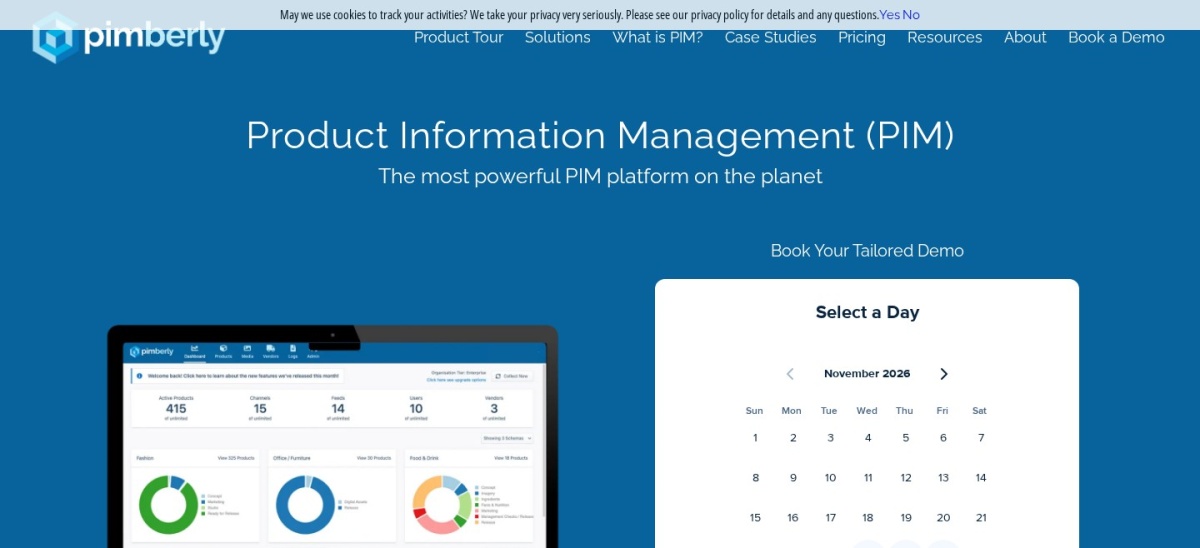
Pimberly homepage, captured Nov 2026.
Pimberly is a cloud-based product master data and digital asset management platform engineered for manufacturers, wholesalers, and multi-brand retailers. Its Regular tier costs $36,000/yr and includes 50,000 SKUs, 20 user seats, 3 TB of storage, and unlimited import and export channels.
The trade off is that optional modules like AI enrichment ($7,500/yr) and automated catalog publishing ($30,000/yr) sit outside the base subscription, and there is no free tier. It suits mid-market commerce teams managing complex supplier feeds.
What we like
Published annual pricing across Regular ($36k), Pro ($60k), and Corporate ($90k) tiers
Unlimited import channels, export channels, languages, and currencies included
Automated rule-based data enrichment and supplier onboarding workflows
Watch out for
No free plan or low-cost starter tier for smaller catalogs
AI tools and automated data sheets require paid annual add-ons
Best budget tool for governed master data entry in Excel
DeploymentOn-prem / Desktop Excel add-in
DatabasesSQL Server, Azure SQL, PostgreSQL
GovernanceDesigner and Data Editor roles
Entry paid tier$39/mo billed annually ($468/yr)
sqlspreads.com
SQL Spreads homepage, captured Nov 2026.
SQL Spreads is an Excel add-in that lets non-technical business stewards update, validate, and govern master data tables stored in SQL Server, Azure SQL, and PostgreSQL. Plans start at $39/mo billed annually ($468/yr) for a Designer seat, with Data Editor seats at $19/mo ($228/yr).
The trade off is that it lacks automated probabilistic entity resolution and relies on your existing relational database for storage and security. It suits finance and operations teams that already maintain master tables in SQL and want governed spreadsheet editing.
What we like
Lowest annual entry cost on this list at $468/yr with a 14-day free trial
Separates schema Designer permissions from everyday Data Editor roles
Built-in data validation, column locking, and change tracking in higher tiers
Watch out for
Requires an existing SQL Server, Azure SQL, or PostgreSQL backend
No built-in AI matching, survivorship rules, or multi-channel syndication
Entry plan ($468/yr) covers one Designer seat with SQL Server, Azure SQL, and PostgreSQL support.Visit sqlspreads.com
Why most MDM vendors hide pricing behind sales quotes
Roughly two-thirds of legacy enterprise MDM vendors—including Informatica, SAP MDG, Reltio, Profisee, and Semarchy—do not publish list prices on their websites. Their contracts typically bundle record-volume tiers, processing units, and mandatory implementation services that land between $40,000 and $150,000+ per year.
Every tool ranked above publishes verifiable baseline rates on its official pricing page. That transparency lets architecture and procurement teams benchmark license costs upfront before committing engineering hours to a proof of concept.
How we chose
We built this shortlist by reviewing master data management platforms, entity resolution engines, and product MDM hubs across G2, Capterra, and vendor technical documentation. Unlike roundups dominated by opaque enterprise contracts, we required every ranked tool to publish verifiable baseline pricing on its official website.
All ratings, review counts, and regular subscription prices were verified directly against official vendor pricing pages and public review directories on 22 Nov 2026. Where vendors bill monthly or by usage volume, we standardized annual figures to show comparable yearly entry budgets.
We excluded pure mobile device management (MDM) endpoint tools as well as legacy data suites that hide all pricing behind custom enterprise quotes. No vendor paid for a place, and we do not claim testing for this list.
How to choose a master data management tool
Start by mapping where your duplicate records originate and which teams need to approve changes before golden records sync downstream.
Identify your core data domains first. If your primary bottleneck is customer and household deduplication across CRMs and billing systems, prioritize entity-resolution engines like Senzing or AWS Entity Resolution. If you need to govern SKUs, supplier attributes, and digital assets together, look at Pimcore, Plytix, or Pimberly.
Check how pricing scales with records and seats. Per-seat tools punish you as more business stewards join, whereas record-based pricing spikes when you ingest raw event logs. Pimcore and Plytix include unlimited user seats, while AWS Entity Resolution charges strictly per 1,000 records processed.
Separate matching engines from stewardship workflows. API-first services like AWS Entity Resolution link records programmatically inside your cloud data lake, but they do not give business analysts a visual UI to review borderline matches. If non-technical staff must approve changes, choose a hub with role-based stewardship workflows.
Run a proof of concept on messy production rows. Clean sample CSVs hide formatting drift, missing keys, and multi-language edge cases. Use Pimcore's Community Edition, Senzing's 500-record free tier, or SQL Spreads' 14-day trial to test match accuracy and schema rules against real exports.
FAQ
What is the difference between MDM and PIM software?
Master data management (MDM) governs multiple core business domains—including customers, suppliers, employees, locations, and products—across the entire enterprise. Product information management (PIM) is a subset focused specifically on enriching and syndicating product catalog data and media assets to e-commerce and retail channels.
Are there free or open-source master data management tools?
Yes. Pimcore offers a free open-source Community Edition under the Pimcore Open Core License for non-profits, academics, and businesses under $5 million in annual revenue. Plytix also provides a forever-free cloud tier for up to 500 SKUs, and Senzing includes a free evaluation mode up to 500 records.
How much does master data management software cost per year?
Published entry pricing spans from $300/yr for light pay-as-you-go matching on AWS Entity Resolution and $468/yr for SQL Spreads up to $9,900/yr for Pimcore Professional and $372,000/yr for IBM InfoSphere MDM Cloud. Custom-quoted enterprise suites frequently exceed $50,000 to $150,000 annually.
Do I need a dedicated MDM tool if I already have a data warehouse?
A data warehouse like Snowflake or BigQuery stores and queries analytical tables, but it does not natively resolve fuzzy duplicate identities, enforce field-level stewardship approvals, or push real-time golden records back into operational CRMs and ERPs. MDM sits upstream or alongside your warehouse to keep records clean.
Which MDM tool is best for small or mid-sized businesses?
Pimcore fits mid-sized teams with in-house developers thanks to its free Community tier and $9,900/yr Professional plan with unlimited users. Smaller operations that already store master tables in SQL Server or PostgreSQL can use SQL Spreads from $468/yr to let business users edit data safely in Excel.