Best AI Decisioning Platforms in 2026: 9 Tools Compared
WLWPLegible EditorsLast verified 22 Nov 2026How we rank12 min read
★ Short answer
Taktile is the best AI decisioning platform for most teams, rated 4.7 out of 5 from 99 G2 reviews, with low-code decision flows banks and insurers use for credit, fraud and onboarding. Camunda suits process teams that need DMN decision tables, while FICO Platform fits regulated lenders that need auditable credit decisions.
How we make this list: we compare pricing pages, product documentation and public user reviews, then re-check every price before each update. No product paid for a place. Disclosure.
Taktile leads on user ratings at 4.7/5 from 99 G2 reviews, ahead of Camunda at 4.5/5 from 328.
Eight of the nine platforms publish no price at all; only Camunda offers a free tier for development.
FICO Platform, SAS and IBM were named Leaders in Gartner's first Magic Quadrant for Decision Intelligence Platforms in January 2026.
Camunda has the largest review base here with 328 G2 reviews, while FICO Platform has only 13, so its 4.0 rating is the thinnest evidence in the list.
Expect a sales conversation everywhere: every platform except Camunda's free development tier is sold on a custom quote.
What an AI decisioning platform should cover
AI decisioning platforms turn data and models into actions: approve a loan, flag a payment, or offer the next best step to a customer. They combine business rules, machine learning models and decision tables in one flow, then record why each decision was made.
The category has two roots. Rules engines such as IBM Operational Decision Manager and Progress Corticon come from business rules management, while newer tools such as Taktile and InRule add low-code flows and machine learning. For a smaller-scale example of AI making decisions on a site, see our guide on adding an AI chatbot to WordPress.
Pricing is the hardest part of this market to compare. Eight of the nine tools publish no price and sell on a custom quote, so the price ladder below shows Custom for most entries. Budget for implementation and training as well as the licence, because G2 reviewers report setup times of two to five months.
Ratings here come from G2, checked on 22 November 2026. Review counts range from 13 for FICO Platform to 328 for Camunda, so treat the smaller samples with more caution.
Taktile is a low-code decisioning platform built for banks, fintechs and insurers. It combines decision flows, AI agents and a data marketplace with more than 100 pre-built integrations, and its customers run more than 30 million decisions a week on the platform. It is rated 4.7 out of 5 from 99 G2 reviews, the highest score in this list.
The trade off is price and scale. Taktile publishes no pricing and sells on a custom quote, and it is built for financial institutions rather than general business use. It suits lenders, insurers and fintechs that need risk teams to change decision logic without waiting on engineers.
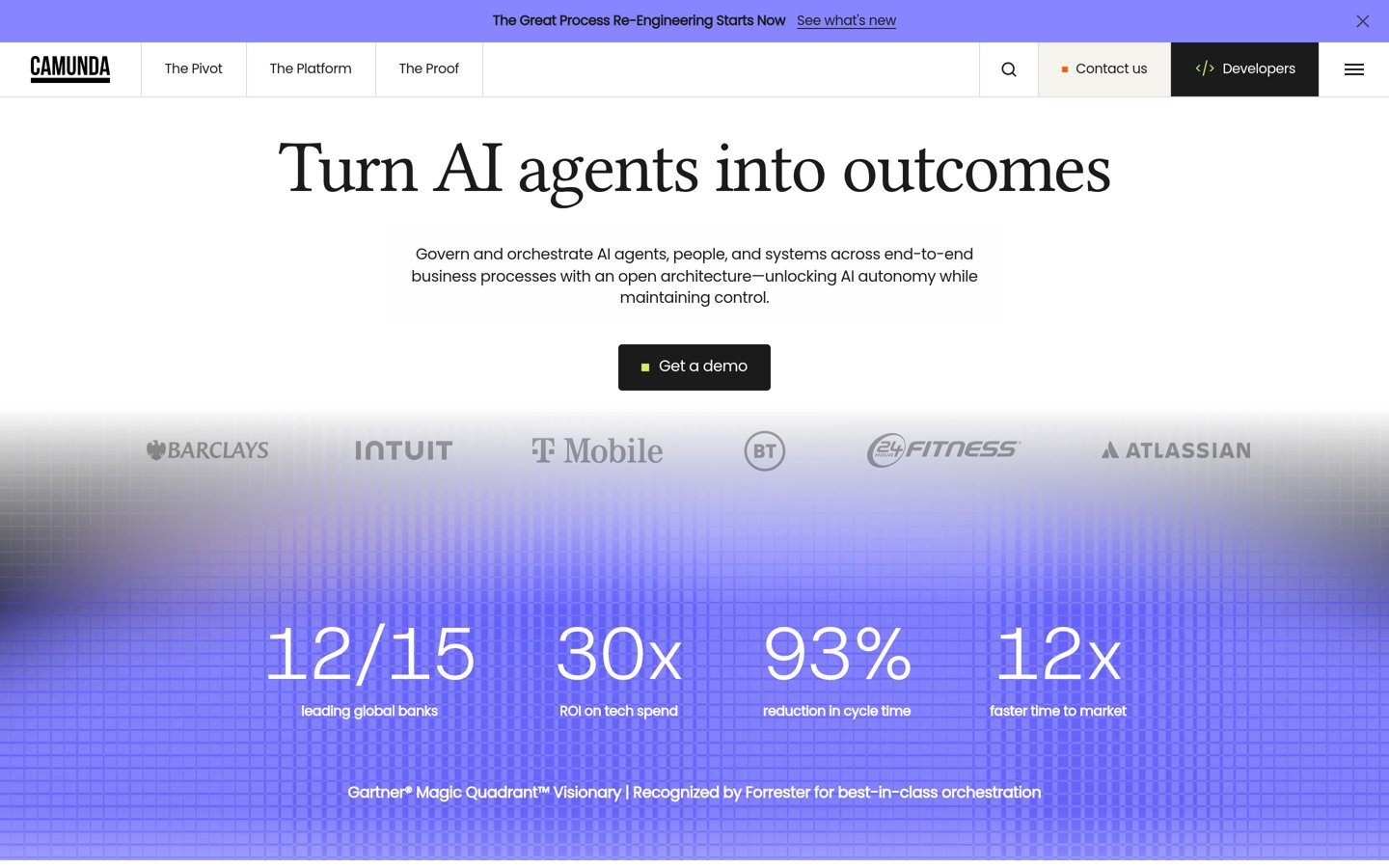
Camunda is a process orchestration platform with DMN decision tables at its core, used by more than 750 organizations including 9 of the top 10 US banks. The free self-managed tier covers development, with BPMN processes and DMN decisions, while production use needs an Enterprise licence. It is rated 4.5 out of 5 from 328 G2 reviews.
The trade off is complexity. Camunda is a developer-friendly platform with a steep learning curve, and G2 reviewers cite high costs and complex licensing for production use. It suits teams that already model processes in BPMN and want decisions executed inside those processes.
What we like
Largest review base in this list
Free tier for development
Open standards: BPMN and DMN
30-day free SaaS trial
Watch out for
Production needs a custom Enterprise licence
Steep learning curve for non-developers
Free for development; production is a custom Enterprise licenceVisit camunda.com
03
FICO Platform
4/5on G2 (13 reviews, checked Nov 2026)
PricingCustom/yr
Best for regulated credit decisions
Free planNo
G2 rating4.0/5 (13 reviews)
Customers650+ clients (FICO-wide)
Gartner 2026Leader, Decision Intelligence
fico.com
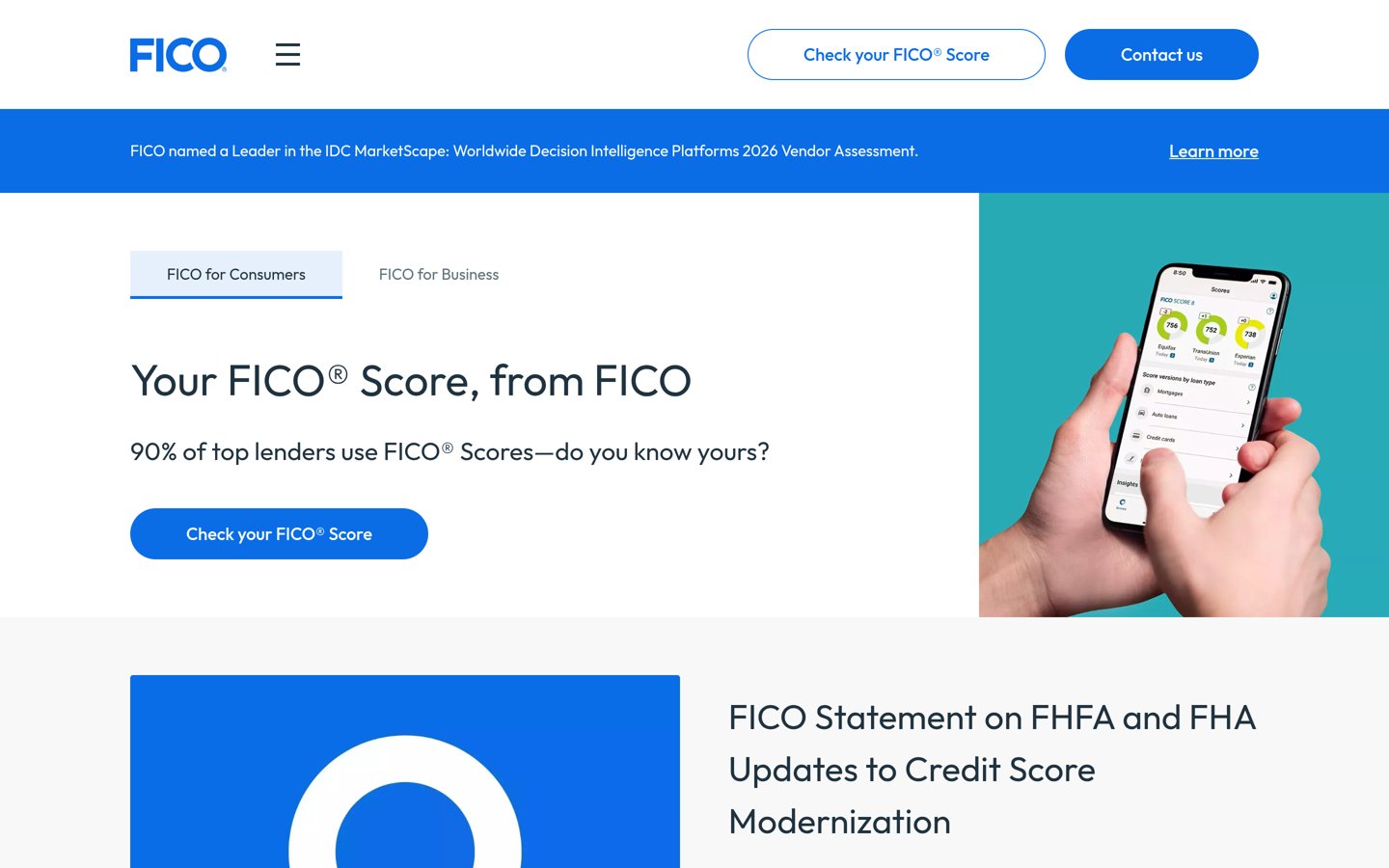
FICO Platform homepage, captured Nov 2026.
FICO Platform is the decisioning environment behind the company that created the FICO Score. It combines business rules, machine learning models, optimization and simulation in one place, so lenders can run credit, fraud and collections decisions from a single system. FICO's decisioning tools are used by more than 650 clients, including nine of the top 10 US banks.
The trade off is evidence and price. FICO Platform has only 13 G2 reviews and a 4.0 rating, the thinnest review base in this list, and it publishes no pricing. It suits large regulated lenders that already run FICO products and need auditable, explainable credit decisions.
What we like
Category-defining credit decisioning
Rules, models and optimization in one place
Named a Gartner Leader in 2026
Watch out for
Only 13 G2 reviews
No published pricing
Custom quote only; sold as a multi-year subscriptionVisit fico.com
04
SAS Intelligent Decisioning
4.3/5on G2 (30 reviews, checked Nov 2026)
PricingCustom/yr
Best for model-driven decisions in SAS shops
Free planNo, trial available
G2 rating4.3/5 (30 reviews)
Customers83K+ sites (SAS-wide)
Gartner 2026Leader, Decision Intelligence
sas.com
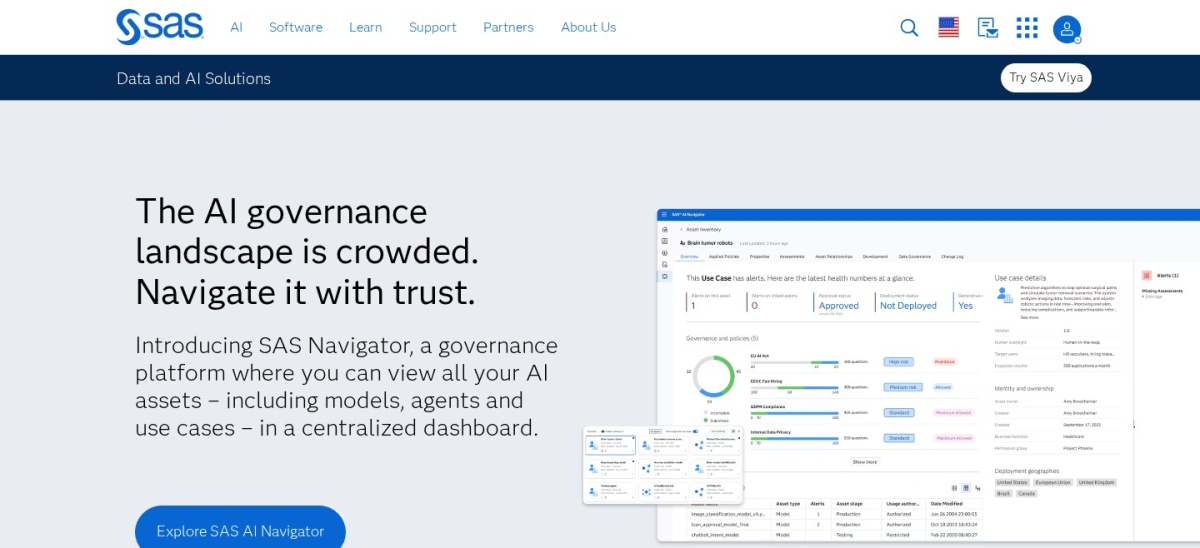
SAS Intelligent Decisioning homepage, captured Nov 2026.
SAS Intelligent Decisioning is the decision layer of SAS Viya, combining business rules with predictive models and machine learning in a single decision flow. It targets risk, fraud and customer decisions in regulated industries, with testing and monitoring built in. SAS software is used at more than 83,000 business, government and university sites.
The trade off is the learning curve. G2 reviewers praise its handling of large data sets but report complex setup and difficult navigation, and pricing is by quote only. It suits organizations already running SAS Viya that want governed, auditable decisions on top of their models.
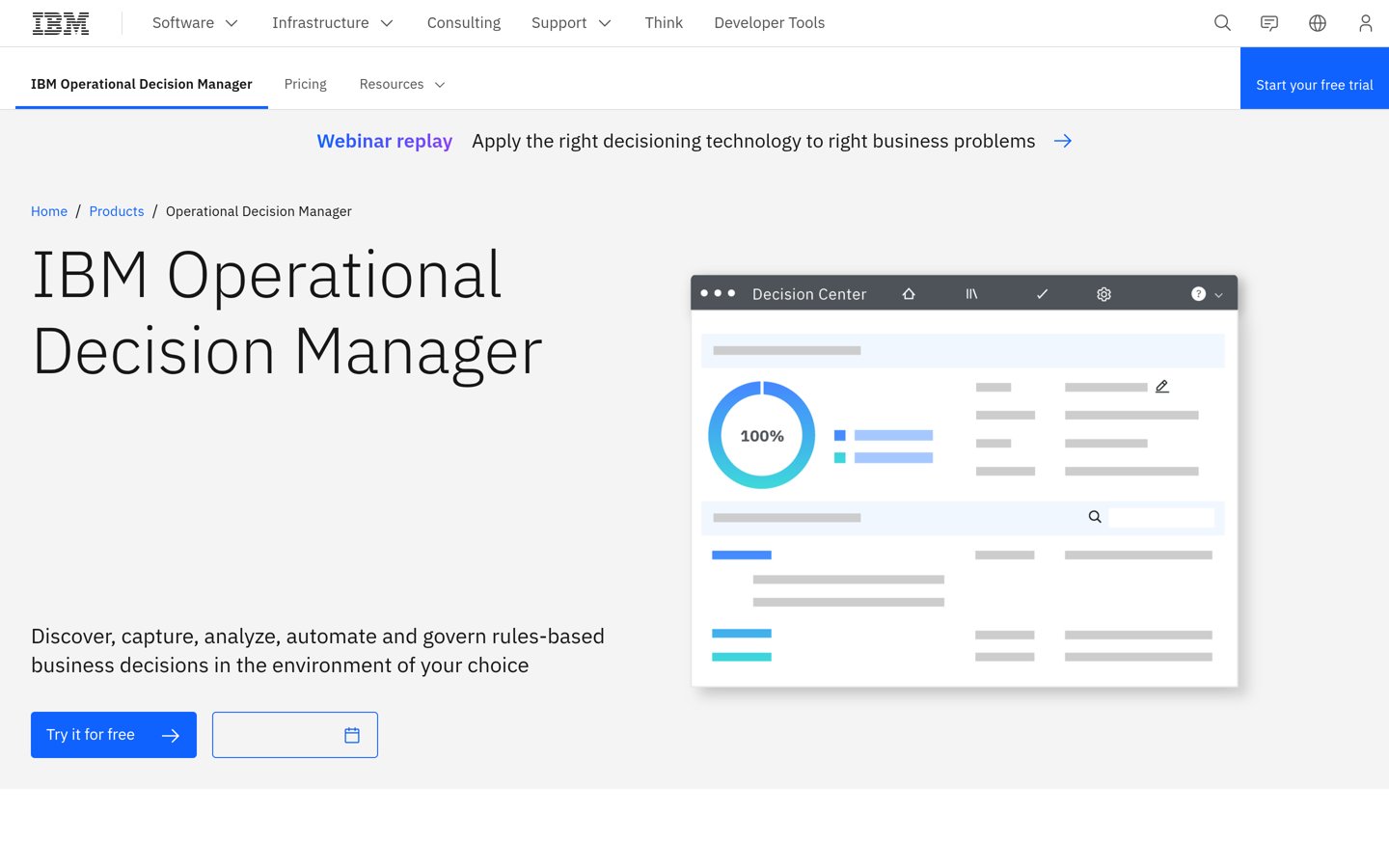
IBM Operational Decision Manager homepage, captured Nov 2026.
IBM Operational Decision Manager is the long-established business rules engine for large enterprises, now sold as part of IBM Decision Intelligence. Business users author rules in Decision Center, test them with simulation, and deploy them on premises, in Kubernetes or as a service. It is rated 4.3 out of 5 from 65 G2 reviews.
The trade off is cost. G2 reviewers call it expensive, and IBM publishes no price for it. It suits regulated enterprises with high-volume, policy-based decisions that must be audited and changed without code releases.
What we like
Mature rules engine with Decision Center
Strong audit and compliance features
Support quality rated 9.1/10 on G2
Watch out for
Expensive, say G2 reviewers
No published pricing
Custom quote; on-premises, Kubernetes or SaaSVisit ibm.com
06
Pega Platform
4.2/5on G2 (278 reviews, checked Nov 2026)
PricingCustom/yr
Best for real-time next-best-action
Free planNo, free trial
G2 rating4.2/5 (278 reviews)
CustomersNot published
Best forNext-best-action
pega.com
Pega Platform homepage, captured Nov 2026.
Pega Platform is a unified low-code platform where business rules, predictive models and process automation share one governance model. Its decisioning hub runs real-time next-best-action across customer journeys, from service calls to marketing offers. It is rated 4.2 out of 5 from 278 G2 reviews.
The trade off is size and cost. Pega is built for large enterprises, G2 reviewers cite high licensing costs, and pricing is by quote only. It suits big banks, insurers and health plans that want decisions, workflows and customer engagement on one platform.
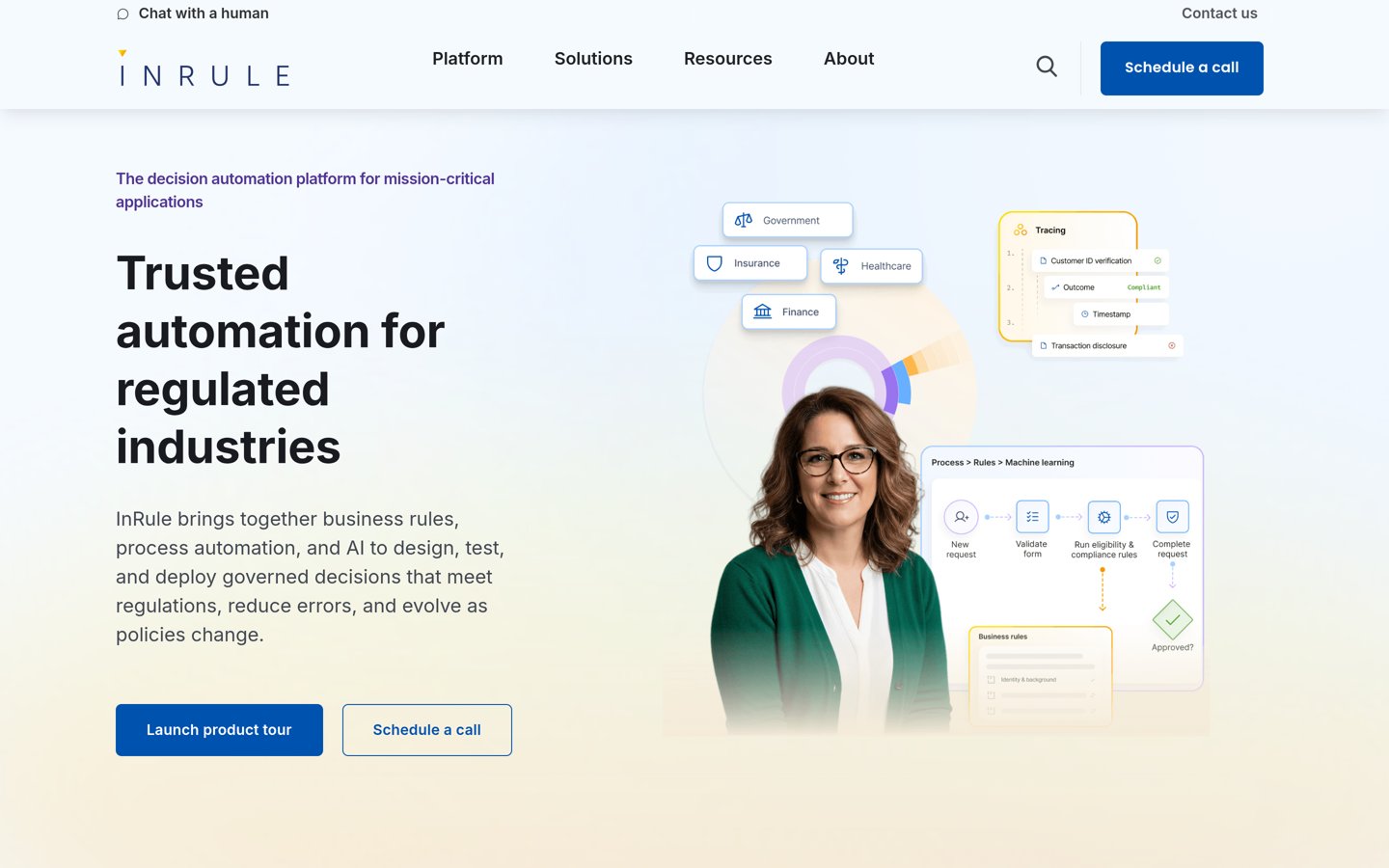
InRule is a decision automation platform that lets business users author rules in plain language, with a DMN modeler and explainable machine learning. It serves finance, insurance, healthcare and government, where audit trails matter. More than 500 organizations worldwide rely on it, and it is rated 4.4 out of 5 from 69 G2 reviews.
The trade off is price. InRule publishes no pricing on its own site, and its G2 profile lists a vendor-provided Commercial plan at $9,500 a month, with Enterprise by contact. It suits mid-sized regulated teams that want business users, not developers, owning the decision logic.
What we like
Plain-language rule authoring
Explainable machine learning output
DMN decision modeling built in
Watch out for
No pricing on its own website
Implementation averages five months on G2
Paid plans are custom quotes; Enterprise is by contactVisit inrule.com
08
DataRobot
4.4/5on G2 (54 reviews, checked Nov 2026)
PricingCustom/yr
Best for governed ML models
Free planNo
G2 rating4.4/5 (54 reviews)
CustomersNot published
StrengthAutoML leaderboard
datarobot.com
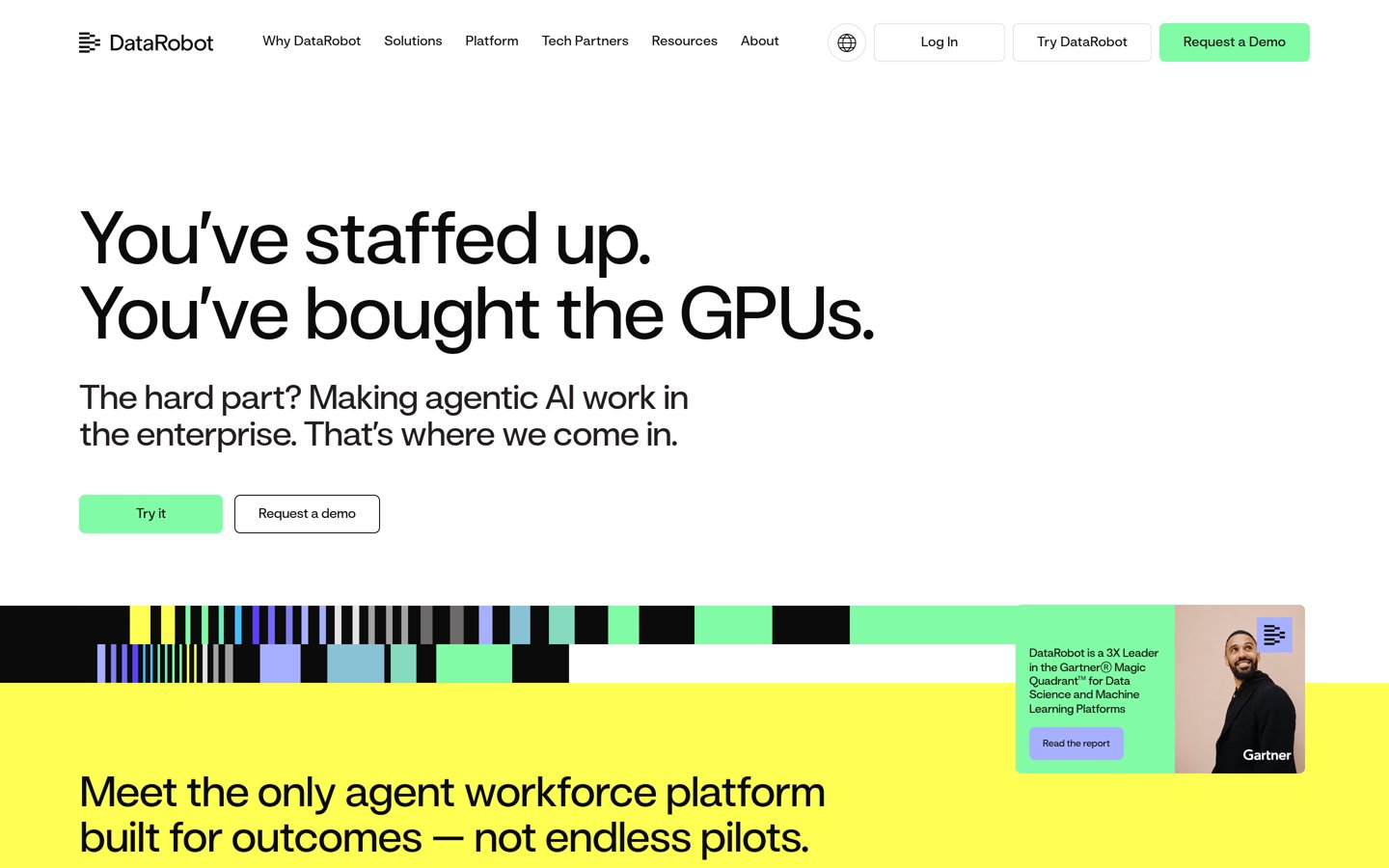
DataRobot homepage, captured Nov 2026.
DataRobot is an enterprise AI platform that builds, compares and governs machine learning models, then puts them into production decisions. Its automated leaderboard tests dozens of models side by side, and model monitoring tracks them after deployment. It is rated 4.4 out of 5 from 54 G2 reviews.
The trade off is fit and price. DataRobot is a model platform first, not a rules engine, so policy-heavy decisions need another tool beside it, and pricing is by quote only. It suits data teams that want governed models driving decisions at scale.
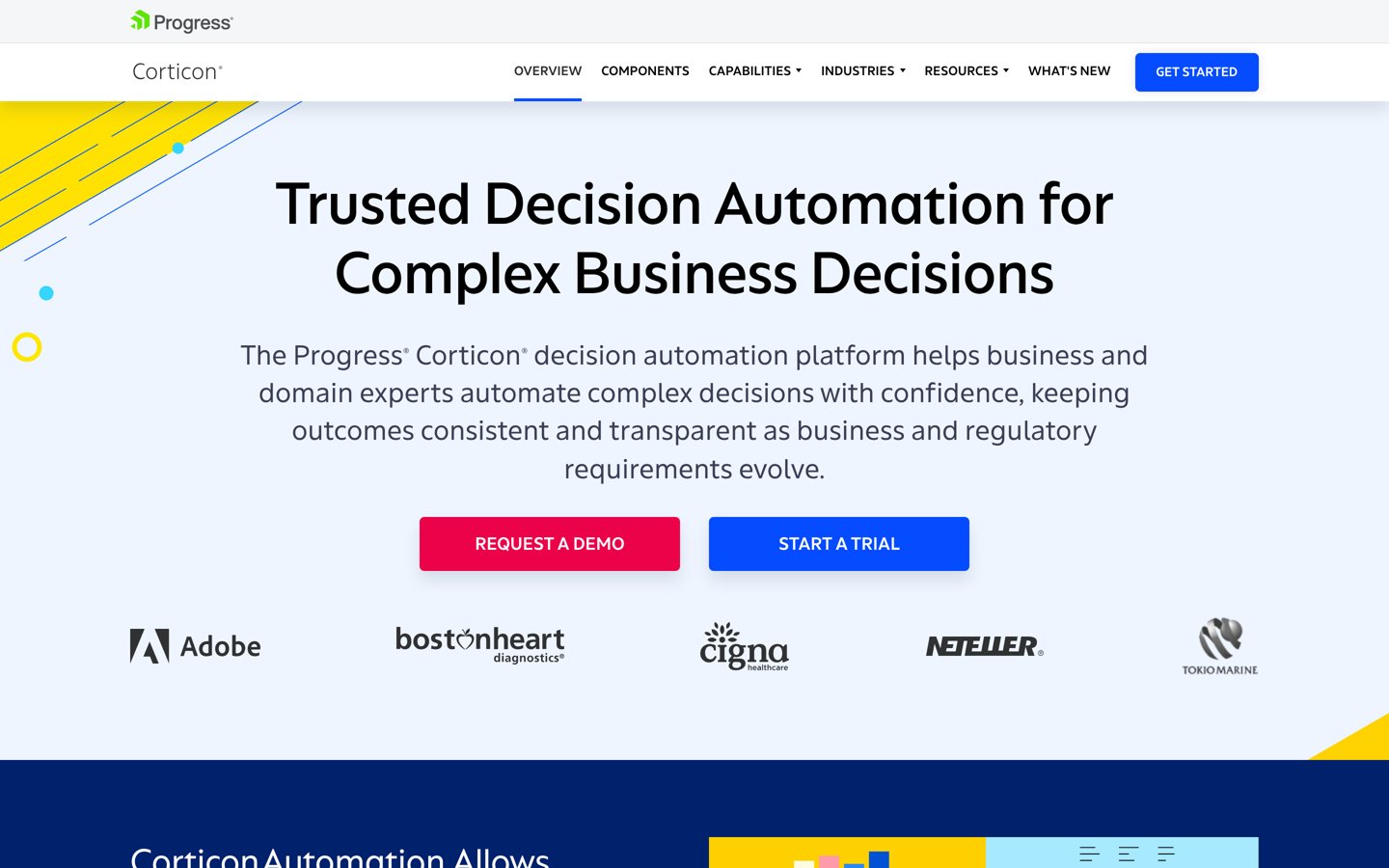
Progress Corticon is a business rules engine that separates decision logic from application code, so analysts can change rules without a release. Its studio supports rule sheets, testing and simulation, with version control and auditing of every change. It is rated 4.2 out of 5 from 17 G2 reviews.
The trade off is the interface and the review base. G2 reviewers praise its rule handling but call the studio technical and hard to navigate, and 17 reviews is a small sample. It suits mid-sized teams in insurance and healthcare that need strict, auditable rules.
Rules suit decisions that must be explained to a regulator: a credit policy, an eligibility check, a pricing rule. The logic is written down, versioned and auditable.
Models suit decisions where patterns matter more than written policy, such as fraud scoring or churn prediction. Most platforms in this list combine both, with rules guarding the model's output.
If your decisions are mostly written policy, start with a rules-first tool such as Corticon or InRule. If models drive the decision, look at DataRobot or SAS first.
How we chose
We started from the vendors named in Gartner's first Magic Quadrant for Decision Intelligence Platforms, published in January 2026, plus established decision management tools such as InRule, Corticon and Camunda.
Prices come from each vendor's pricing page or homepage, checked on 22 November 2026. Eight of the nine publish no price and sell on a custom quote; Camunda is the exception, with a free tier for development. Ratings and review counts come from G2 on the same day.
We left out tools with no verifiable rating on G2, Capterra or Trustpilot, including Zest AI, Experian PowerCurve and Sparkling Logic. No vendor paid for a place, and we do not claim hands-on testing for this list.
How to choose an AI decisioning platform
Start with the decisions you need to automate, not the vendor list.
List the decisions first. Write down the five decisions that cost the most time or carry the most risk, such as credit approvals or fraud checks. A platform that cannot model those exact decisions is the wrong shortlist.
Check the audit trail. Regulated decisions need a record of every rule, model version and outcome. Ask each vendor to show how a single decision is explained after the fact.
Test with your own data. A demo on sample data hides integration work. Run a pilot on real cases with your own data sources before signing a multi-year deal.
Price the whole project. Licences are custom quotes, so compare implementation, training and support as well. G2 reviewers report setup times of two to five months for these tools.
FAQ
What is the best AI decisioning platform?
Taktile is the best pick for most teams. It is rated 4.7 out of 5 from 99 G2 reviews, the highest score in this list, and its low-code flows let risk teams change credit, fraud and onboarding decisions without engineering help. Camunda is the runner-up for process-driven teams.
How much does an AI decisioning platform cost?
Most vendors publish no price and sell on custom quotes, so expect a sales conversation and a multi-year subscription. Camunda is the exception, with a free tier for development and a 30-day SaaS trial. InRule lists a Commercial plan at $9,500 a month on its G2 profile, the only published figure we found.
What is the difference between decisioning and decision intelligence?
Decisioning is the older term for automating a decision with rules and models, such as approving a loan. Decision intelligence is the newer label Gartner uses for the full cycle: designing, running, monitoring and improving decisions, including the data and governance around them.
Do I need data scientists to use these tools?
Not for the rules-first tools. Taktile, InRule and Corticon are built so business users can author and change decision logic, with testing built in. Model-heavy tools such as DataRobot and SAS still need data teams to build and monitor the models behind the decisions.
Which platform is best for credit decisions?
FICO Platform is the classic choice for regulated credit decisions, with rules, models and optimization in one place. Taktile is the higher-rated option for lenders that want low-code flows and fast changes, while InRule suits smaller regulated teams that want business users owning the logic.
Are there free AI decisioning platforms?
There is no full free platform in this list. Camunda offers a free self-managed tier for development, and Pega, Corticon and Camunda all offer free trials. The open-source rules engine Drools is free, but it needs developers to build and run it.