Best Accounting Software for Hotel Industry in 2026: 7 Tools Compared
WLWPLegible EditorsLast verified 22 Nov 2026How we rank6 min read
★ Short answer
QuickBooks Online leads for independent hotels thanks to wide bank feed and accountant support, starting at $38/mo on Simple Start. Xero suits teams wanting flat-rate pricing at $27/mo on Early, while Zoho Books fits budget-minded operators at $20/mo on Standard.
How we make this list: we compare pricing pages, product documentation and public user reviews, then re-check every price before each update. No product paid for a place. Disclosure.
QuickBooks Online Simple Start lists at $38/mo ($456/yr) in the US with 1 user and 2 accountant seats.
Xero Early lists at $27/mo ($324/yr) in the US after its October 2026 price update and caps invoices at 20 per month.
Zoho Books offers a free tier for small businesses and a Standard plan at $20/mo ($240/yr) billed monthly.
Wave provides a free accounting and invoicing tier and a Pro plan at $19/mo ($228/yr) billed monthly.
Odoo offers a free single-app plan and a Standard plan at US$31.10/user/mo ($373.20/yr per user).
What to look for in hotel accounting software
Hotels rarely run a single revenue stream. Room nights, food and beverage outlets, spa services, banquet deposits, and occupancy taxes all flow through the general ledger, often alongside third-party property management systems and payment processors.
For single-property inns and smaller hotels, general ledger tools with automated bank feeds, bill tracking, and sales tax reporting often cover core bookkeeping without heavy hospitality overhead. That approach works best when your property management system handles guest folios and daily night-audit summaries.
Larger properties and multi-property groups need stronger controls. Multi-entity consolidation, department or location tracking, stricter user permissions, and approval workflows matter much more once several outlets or properties share books.
Always check plan limits on monthly invoices, bill counts, and user seats before committing. A low entry tier can become restrictive quickly if front-desk billing, vendor bills, and multiple managers need access every month.
4.3/5on Capterra (8,555 reviews, checked Nov 2026)
Starts at$38/mo
Best overall for small hotels
Entry planSimple Start ($38/mo)
Users included1 user + 2 accountants
Higher tiersEssentials $85, Plus $140, Adv $340
Review score4.3/5 on Capterra
quickbooks.intuit.com
QuickBooks Online homepage, captured Nov 2026.
QuickBooks Online is a cloud accounting platform that tracks income, expenses, bank feeds, and financial reports for small businesses. Its US Simple Start plan costs $38/mo at regular list price and includes 1 user plus accountant access, while promotional discounts are sometimes offered for the first few months.
The trade off is that Simple Start is $456/yr and omits recurring transactions, multi-user seats, and class or location tracking until Essentials ($85/mo) or Plus ($140/mo). It suits independent hotels that want wide third-party integrations and easy CPA handoffs.
What we like
Widely supported by bookkeepers and tax preparers
Automated bank feeds and standard financial reports
Clear upgrade path into inventory and class tracking on Plus
Watch out for
Entry plan limits access to one regular user
Key operational features sit on higher-priced tiers
Higher plans add more users, recurring transactions, bills, inventory, and location tracking.Visit quickbooks.intuit.com
02
Xero
4.4/5on Capterra (3,341 reviews, checked Nov 2026)
Starts at$27/mo
Best for flat-rate team access
Entry planEarly ($27/mo US)
Invoice limit20 invoices/mo on Early
Higher tiersGrowing $59/mo, Established $97/mo
Review score4.4/5 on Capterra
xero.com
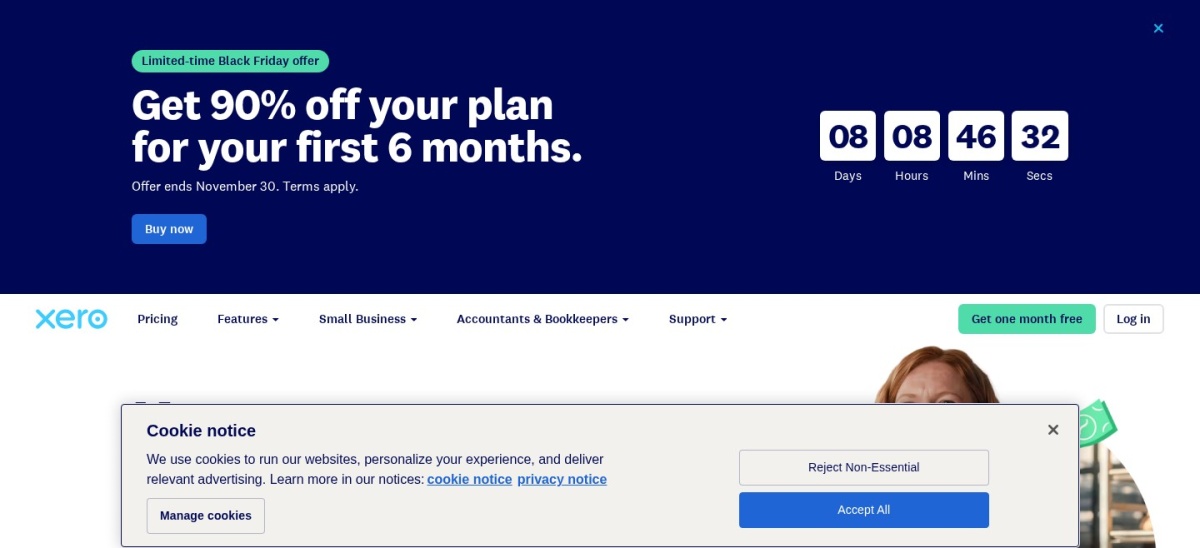
Xero homepage, captured Nov 2026.
Xero is an online accounting platform offering bank reconciliation, invoicing, bill tracking, and cash-flow reporting. Its US Early plan lists at $27/mo regularly after its October 2026 price update, with promotional offers occasionally available for new accounts.
The trade off is that Early costs $324/yr and caps invoicing at 20 invoices and 5 bills per month before Growing ($59/mo) is needed. It suits small properties that want flat-rate pricing across team members rather than per-seat fees.
What we like
No per-user fee across its core monthly plans
Clean bank reconciliation and cash-flow visibility
Includes document capture and sales tax tools
Watch out for
Early plan caps monthly invoices and bill entries
Multi-currency requires the top Established tier
Growing and Established remove invoice and bill caps and add longer cash-flow forecasts and multi-currency.Visit xero.com
03
Zoho Books
4.4/5on Capterra (683 reviews, checked Nov 2026)
Paid from$20/mo
Best low-cost entry plan
Free planAvailable ($0/mo)
Paid entryStandard ($20/mo US)
Higher tiersProfessional $50, Premium $70
Review score4.4/5 on Capterra
zoho.com
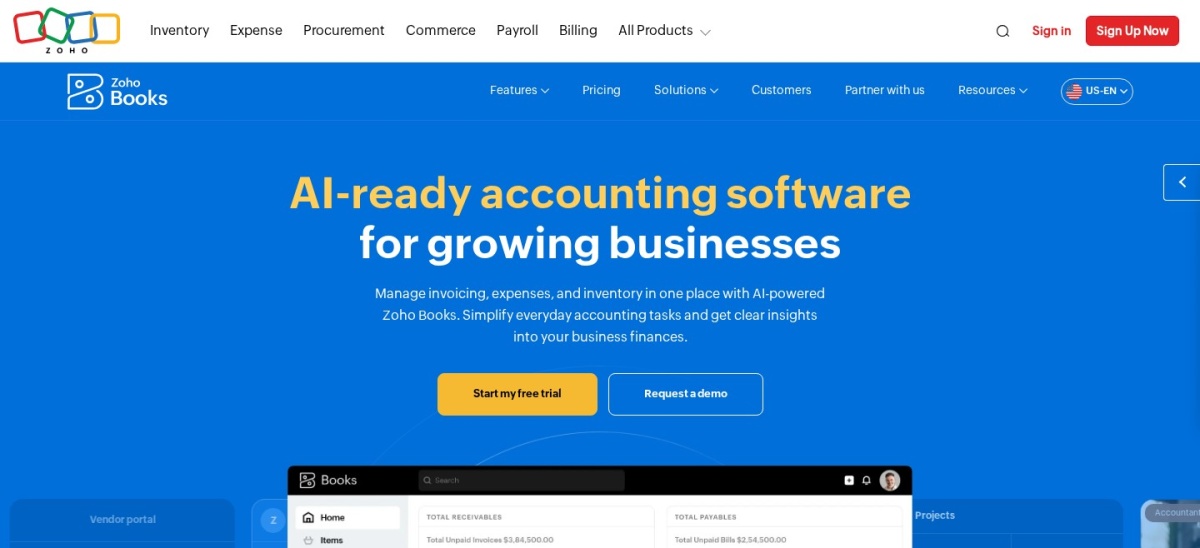
Zoho Books homepage, captured Nov 2026.
Zoho Books is a cloud accounting application covering invoices, expenses, journals, bank reconciliation, and financial statements. It offers a $0/mo free plan for qualifying small businesses and a US Standard plan at $20/mo billed monthly.
The trade off is that Standard comes to $240/yr and lacks built-in inventory and purchase-order workflows found on Professional ($50/mo) and above. It suits smaller hospitality businesses watching monthly software spend.
What we like
Low monthly entry price with a free starting tier
Covers core bookkeeping, invoicing, and expense tracking
Scales into inventory and automation on upper plans
Watch out for
Inventory and purchase workflows require higher tiers
4.4/5on Capterra (1,726 reviews, checked Nov 2026)
Paid from$19/mo
Best for free core bookkeeping
Free planStarter ($0/mo)
Paid entryPro ($19/mo USD)
Annual optionPro at $190/yr USD
Review score4.4/5 on Capterra
waveapps.com
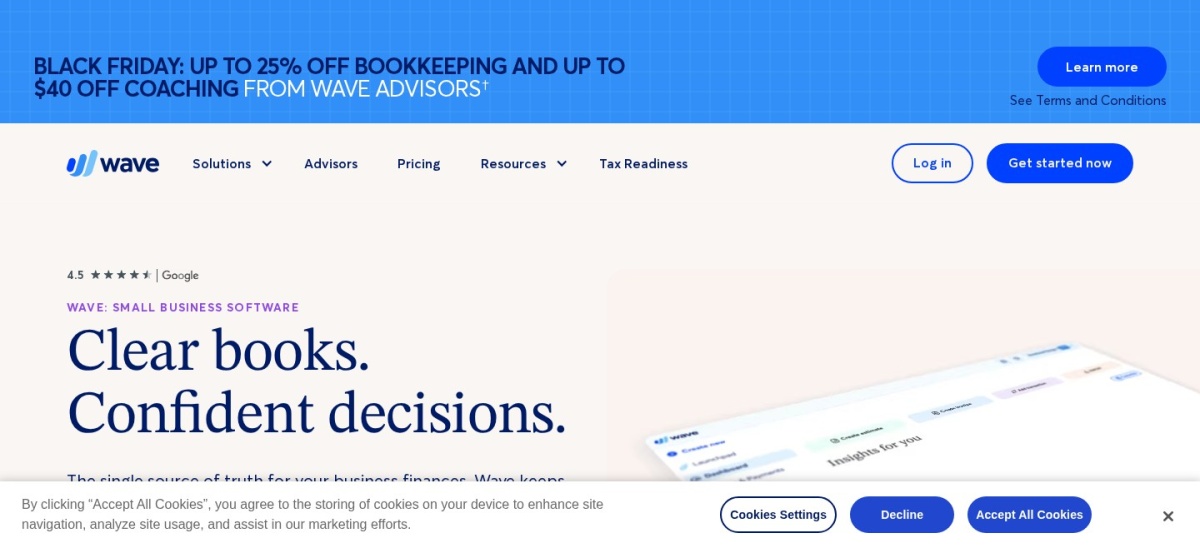
Wave homepage, captured Nov 2026.
Wave is a bookkeeping and invoicing tool for small businesses with a $0/mo Starter plan for basic accounting and invoicing. Its Pro plan costs $19/mo billed monthly (or $190/yr billed annually) and adds automatic bank transaction imports and receipt capture.
The trade off is that Pro runs $228/yr on monthly billing and remains focused on straightforward small-business books rather than complex multi-outlet hotel controls. It suits very small inns or bed-and-breakfasts with simple accounting needs.
What we like
Free Starter plan covers basic invoicing and bookkeeping
Pro automates bank feeds and receipt capture
Straightforward setup for non-accountants
Watch out for
Lacks deep multi-property or complex ERP accounting
Payroll and bookkeeping advisory cost extra
Pro adds automated bank transaction imports, auto-categorization, receipt scanning, and payment reminders.Visit waveapps.com
05
Odoo
4.3/5on G2 (75 reviews, checked Nov 2026)
Paid from$31.10/mo
Best modular ERP and accounting
Free planOne App Free ($0)
Paid entryStandard (US$31.10/user/mo)
Higher tierCustom (US$61.00/user/mo)
Review score4.3/5 on G2
odoo.com
Odoo homepage, captured Nov 2026.
Odoo is a modular business suite where Accounting can run standalone on its free single-app tier or alongside other apps on paid plans. Standard lists at US$31.10 per user per month, while promotional pricing or multi-app bundles vary by configuration.
The trade off is that Standard equals $373.20/yr per user and configuration takes more work than plug-and-play small-business tools. It suits operators that want accounting connected with broader operational modules.
What we like
Free single-app tier available for Accounting
Connects accounting with inventory, sales, and other modules
Supports multi-company setups on higher tiers
Watch out for
Per-user pricing adds up across larger teams
Initial setup requires more configuration effort
Paid plans expand access across the full app suite, multi-company management, and custom workflows.Visit odoo.com
06
NetSuite
4.2/5on Capterra (2,085 reviews, checked Nov 2026)
PricingCustom/yr
Best for multi-entity hotel groups
Pricing modelCustom quote
Core strengthMulti-entity ERP
Best scaleMid-market and enterprise
Review score4.2/5 on Capterra
netsuite.com
NetSuite homepage, captured Nov 2026.
NetSuite is a cloud ERP system built for multi-entity financial consolidation, general ledger control, accounts payable and receivable, and reporting. It does not publish a standard public entry price and uses custom quotes based on modules, users, and implementation scope.
The trade off is that custom licensing, implementation effort, and ongoing administration make it heavy for single-property operators. It suits larger hospitality groups managing multiple entities, currencies, and complex reporting.
What we like
Strong multi-entity consolidation and audit controls
Handles complex reporting and ERP workflows at scale
Wide third-party connector and integration ecosystem
Watch out for
No public list pricing; requires custom quote
Steep learning curve and implementation overhead
Custom modules and add-ons expand multi-subsidiary consolidation, planning, and specialized workflows.Visit netsuite.com
07
Acumatica
4.4/5on Capterra (244 reviews, checked Nov 2026)
PricingCustom/yr
Best mid-market cloud ERP alternative
Pricing modelCustom quote
Core strengthCloud ERP financials
Best scaleSmall to mid-market
Review score4.4/5 on Capterra
acumatica.com
Acumatica homepage, captured Nov 2026.
Acumatica is a cloud ERP platform covering general ledger, accounts payable and receivable, cash management, inventory, and multi-entity reporting. It relies on custom vendor and partner quotes rather than a published self-serve entry price.
The trade off is that quote-based ERP licensing and partner implementation are overkill for small inns with straightforward books. It suits growing hospitality operators that want cloud ERP financials and customizable inquiries.
What we like
Cloud ERP with multi-entity and multi-currency support
Customizable dashboards and inquiry reporting
Broad financial and inventory controls in one system
Watch out for
Pricing requires a custom quote rather than public tiers
Implementation and reporting setup take planning
Additional ERP modules and partner configurations expand reporting, workflows, and operational depth.Visit acumatica.com
Pairing accounting software with your hotel PMS and POS
Most hotels separate guest-facing reservation and check-in operations from back-office accounting. Your property management system and point-of-sale tools handle room folios, deposits, and outlet checks, while your accounting platform records summaries, vendor bills, payroll entries, and financial statements.
Before choosing a plan, map how daily revenue and tax totals move into your ledger. Check whether your preferred accounting tool supports the integrations, user roles, and monthly document limits your front office and finance team need.
How we chose
We shortlisted established cloud accounting and ERP platforms used across small businesses and multi-entity organizations, focusing on tools with active public review profiles and clear product positioning.
All ratings, review counts, and US plan prices were checked on 22 Nov 2026 from vendor pricing pages and major review directories, noting regular list prices separately from promotional offers or custom quotes.
We excluded products without verified public pricing or current review data on our checked pages, as well as tools better suited to unrelated niches or lacking clear commercial viability for hotel bookkeeping.
No vendor paid for a place, and we do not claim testing for this list.
How to choose accounting software for a hotel
Follow four practical steps to match a platform to your property's workflow and budget.
Map your property count and entity structure. Decide whether you run one standalone property or multiple entities that need consolidated reporting and separate location tracking.
Count monthly invoices, bills, and active users. Compare your busiest month's transaction volume and staff seat needs against entry-tier caps so you do not outgrow a plan immediately.
Check how daily sales and taxes enter the ledger. Confirm how room, food and beverage, and tax figures feed into your accounting system without creating duplicate manual work.
Price the true annual cost, not just a promo rate. Calculate regular monthly or annual renewal rates plus required add-ons so your first-year discount does not surprise your budget later.
FAQ
What is the cheapest accounting software option for a small hotel?
If you qualify for a free tier, Zoho Books and Wave both offer $0/mo starting options, while Odoo offers a free single-app tier. Among paid entry plans we checked, Wave Pro is $19/mo and Zoho Books Standard is $20/mo.
Do hotels need specialized hotel accounting software or general accounting?
Many small hotels pair a property management system for guest folios and reservations with general accounting software for ledgers, bills, and financial statements. Larger multi-property groups often prefer broader ERP platforms with multi-entity consolidation.
Why do entry plans often restrict invoice or user counts?
Lower-priced plans are typically sized for solo operators or very light transaction volume. Hotels with frequent vendor bills, multiple staff members, or high monthly billing counts often need a mid-tier plan or flat-rate user structure.
Should I budget using promotional pricing or regular list prices?
Always budget around regular list prices and annual renewal costs. Introductory discounts only apply for a limited period, and add-ons such as extra users, payroll, or payment processing can raise your ongoing spend.
When does a cloud ERP make more sense than small-business accounting?
A cloud ERP such as NetSuite or Acumatica makes more sense when you manage multiple legal entities, need consolidated reporting across locations, or require heavier financial controls than small-business tools provide.
Can one accounting tool handle both single-property and multi-property growth?
Some platforms let you upgrade tiers or add entities over time, while others require separate company files or custom ERP configurations. Reviewing multi-location and user limits early helps avoid a disruptive migration later.