Meilisearch is the best Algolia alternative for most teams, with Cloud from $20 a month at a fixed price per instance and a free open source engine to self-host. Pick Typesense for high query volume with no per-search fees, or Luigi's Box for store search with merchandising built in.
How we make this list: we compare pricing pages, product documentation and public user reviews, then re-check every price before each update. No product paid for a place. Disclosure.
Meilisearch is the cheapest hosted option at $20 a month, with a free self-hosted engine and no per-search billing.
Typesense Cloud starts near $22 a month and never charges per search, so heavy query volume stays predictable.
Luigi's Box has the highest G2 rating here at 4.8 out of 5 from 438 reviews, but its main platform pricing is quote-only.
Site Search 360 is the cheapest packaged search at $9 a month, with a free plan for small sites.
Coveo is the enterprise pick at $600 a month, with generative AI answers on top of search.
Why teams leave Algolia, and what replaces it
Algolia is a strong hosted search service, but its usage meter is the reason most teams look elsewhere. Every extra thousand searches adds to the bill, so a busy month costs more than a quiet one.
The alternatives split into three groups. Open source engines such as Meilisearch, Typesense, Elastic and OpenSearch are free to run yourself and charge for the server, not the search. Packaged products such as AddSearch and Site Search 360 sell a finished search box with support. Enterprise platforms such as Coveo and Luigi's Box add merchandising, recommendations and AI answers.
Match the billing model to your traffic before you match features. A flat monthly price suits spiky traffic, capacity billing suits steady high volume, and quote-only enterprise pricing suits stores where search drives revenue. Our guide on adding a search bar in WordPress covers the site-side setup once you pick an engine.
Relevance tooling is where the gap shows. Algolia's merchandising and analytics are hard to match, so check whether each alternative covers typo tolerance, facets, synonyms and result ranking before you commit.
Meilisearch is an open source search engine with a polished hosted cloud, offering typo-tolerant keyword search, semantic and hybrid modes, facets, filters and geo search. Cloud starts at $20 a month for an XS instance with 0.5 vCPU and 1 GB of RAM, and self-hosting the engine is free under the MIT license.
The trade off is the thin review record and the extras. Its 4.8 G2 rating rests on only 7 reviews, and analytics, merchandising and enterprise features trail Algolia. It suits small developer teams that want a simple engine at a fixed monthly price.
What we like
Rated 4.8 out of 5 on G2
Fixed monthly price, no per-search billing
Free self-hosted engine under MIT license
Setup measured in minutes
Watch out for
G2 rating rests on only 7 reviews
Analytics and merchandising trail Algolia
Cloud runs on the enterprise edition, not the open source one
Typesense is an open source search engine built for instant, typo-tolerant search, with vector and hybrid search, filters, facets, geo search and built-in RAG for conversational answers. Cloud bills by cluster size from about $22 a month, with no per-search charge and no limits on records, and self-hosting is free under GPL-3.0.
The trade off is the thin review record and the memory model. Its 4.7 G2 rating rests on only 5 reviews, and the in-memory index means RAM sizing drives both performance and cloud cost. It suits teams with high query volume that want a bill based on hardware.
Luigi's Box is an AI search and discovery platform for online stores, combining site search, recommendations, product listings, a conversational agent and analytics in one engine. It is rated 4.8 out of 5 on G2 from 438 reviews, the highest rating in this list, and every plan includes the full feature set.
The trade off is the quote. Pricing is based on usage units counted from pageviews, catalog size, searches and recommendations, and the main platform publishes no dollar figure, with a reported entry point near $85 a month. It suits retailers who want one engine for search and merchandising.
What we like
Highest G2 rating in this list at 4.8 out of 5
Full feature set on every plan, no tier gating
Search plus recommendations and analytics in one engine
Site Search 360 is packaged website search: it crawls and indexes your site, then provides the search box, results page, filters and analytics with no engine to run. The free plan covers small sites, and the cheapest paid plan, Columbo, costs $9 a month for 1,500 pages and 2,000 queries with weekly re-crawls.
The trade off is control. Crawled indexing gives you less control than API-fed indexes, and higher plans are needed for branding removal, FAQ search and ecommerce feeds. It suits small businesses and content sites that want search live with almost no setup.
What we like
Rated 4.7 out of 5 on G2 from 35 reviews
Cheapest packaged search in this list
Free plan for small sites
Highly rated customer support
Watch out for
Crawled indexing gives less control than API-fed indexes
AddSearch is website search as a finished product: it crawls and indexes your site, including gated content, and provides the search interface, analytics and grounded AI answers, live in days without a search team. Core costs $119 a month billed annually, with a 14-day trial.
The trade off is the AI layer pricing. The $119 covers keyword search, while AI answers start at a further $8,400 a year and conversational search is quoted, so the full modern package costs materially more. It suits content-rich organizations that want search live with the least internal effort.
What we like
Rated 4.6 out of 5 on G2 from 106 reviews
Live in days with no search team
Published flat pricing, no usage meter
SOC 2 and GDPR credentials
Watch out for
AI answers cost $8,400 a year extra
Crawled indexing gives less control than API-fed indexes
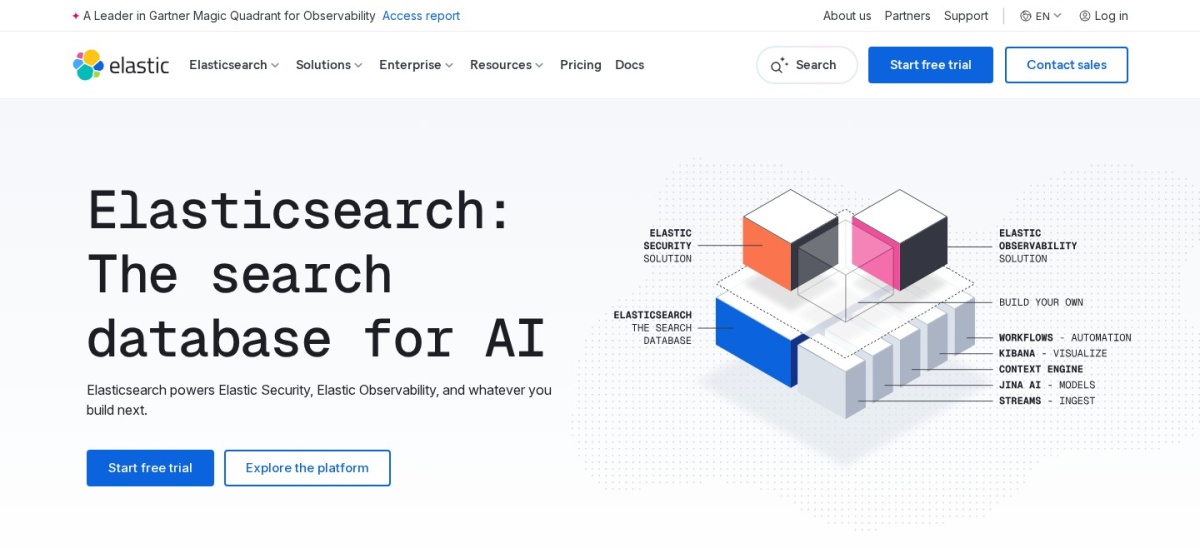
Elastic is the heavyweight engine, built on Elasticsearch: full-text search, vector search, log and observability data and security analytics on one stack, deployable self-hosted, on Elastic Cloud or inside marketplaces. Elastic Cloud starts at about $99 a month, billed by resources rather than per query, and self-hosting the Basic tier is free.
The trade off is the operations burden. Cluster sizing, upgrades, index lifecycle and relevance tuning are engineering work, and a small team buying Elastic for a website search box has bought a second job. It suits engineering teams that want to own the search stack at scale.
What we like
Rated 4.5 out of 5 on G2 from 110 reviews
Resource pricing makes huge query loads predictable
Azure AI Search is Microsoft's managed search service, offering keyword, vector and hybrid retrieval, semantic ranking, and indexers that pull from Azure data sources. The free tier supports development with 3 indexes and 50 MB, and the Basic tier costs $73.73 a month per search unit.
The trade off is the platform shape. It is a service, not a finished website search, so interfaces, relevance tuning and analytics are your project, and pay-as-you-go pricing by tier and capacity still needs modelling at scale. It suits teams already inside the Azure estate.
What we like
Rated 4.4 out of 5 on G2 from 34 reviews
Keyword, vector and hybrid retrieval in one service
Security and compliance inherited from Azure
Free tier for development
Watch out for
A platform service, not a finished search product
Semantic ranker billed separately per 1,000 queries
OpenSearch is the community fork of Elasticsearch, maintained under the Linux Foundation with AWS as the largest backer, offering search, vector search and analytics under an Apache 2.0 license. The engine itself costs nothing to license; you pay only for the servers you run it on, or for the managed AWS service.
The trade off is that nothing is packaged for you. There is no finished search box, no hosted free tier and no vendor support unless you buy it, so setup, upgrades and tuning are your team's work. It suits teams that want a free engine with no licence limits.
Coveo is an enterprise AI search and discovery platform, combining search, recommendations, personalization and generative answers across websites, support portals and intranets. It is rated 4.3 out of 5 on G2 from 141 reviews, and the reported entry point is about $600 a month.
The trade off is cost and setup. Pricing is consumption-based and hard to predict, reviewers cite high cost for smaller organizations, and G2 reports an average implementation time of 4 months. It suits large organizations where search spans many content sources.
Flat price vs per-search billing: the real cost gap
Per-search billing punishes success. A content spike or a sale doubles your searches and your bill in the same week.
Flat instance pricing caps the surprise. Meilisearch Cloud and Typesense Cloud charge for the server size, so the bill stays the same whether you serve 10,000 searches or 100,000.
Packaged search sits in between. Site Search 360 and AddSearch charge a flat monthly rate with page and query limits, so check the cap on the plan you buy.
Model one busy month before you sign up. Take your highest-traffic week, multiply it by four, and price each option at that volume.
How we chose
We started from the search engines most often named as Algolia replacements in 2026 comparisons, then kept the nine with a published price or a reported entry point and a public G2 rating.
Prices come from vendor pricing pages and vendor-supplied G2 listings, checked on 29 November 2026. Ratings and review counts come from G2 on the same day. Where a vendor shows a sale, the list shows the regular price.
We left out tools with no public rating and tools priced only in euros. No vendor paid for a place, and we do not claim to have used these tools ourselves.
How to choose an Algolia alternative
Start with your traffic pattern, then match the billing model to it.
Count your searches and records. Take your busiest month, not the average. Per-search billing hurts most exactly when traffic spikes.
Decide whether to self-host. Meilisearch, Typesense, Elastic and OpenSearch are free to run yourself if you have the server skills. Otherwise pick a managed cloud plan.
Check the relevance features you actually use. Typo tolerance, facets, synonyms and result pinning matter more than AI extras for most sites. Confirm each one is included, not an add-on.
Trial the top two side by side. Index the same content in both and compare result quality on your ten most common queries before you migrate.
FAQ
What is the best Algolia alternative?
Meilisearch is the best Algolia alternative for most teams. Its Cloud plan starts at $20 a month with a fixed price per instance, the open source engine is free to self-host, and it is rated 4.8 out of 5 on G2. It covers typo tolerance, facets and hybrid search.
Is there a free Algolia alternative?
Yes. Meilisearch, Typesense, Elastic and OpenSearch are all free to self-host under open source licences, so you pay only for the server. Site Search 360 also has a free plan for small sites, and Azure AI Search has a free tier for development.
Why do teams leave Algolia?
Cost is the main reason. Algolia bills per search request, so busy months cost far more than quiet ones. Teams also leave for self-hosting, data control and flat pricing they can predict before the bill arrives.
Which Algolia alternative has no per-search fees?
Typesense never charges per search; its Cloud plans bill by cluster size from about $22 a month. Meilisearch Cloud also charges a fixed price per instance, and OpenSearch costs nothing to license at all.
Which Algolia alternative is best for ecommerce?
Luigi's Box is the strongest pick for stores, rated 4.8 out of 5 on G2 from 438 reviews, with search, recommendations and merchandising in one engine. Doofinder is another store-focused option, but it publishes prices in euros.
Can I migrate from Algolia to Typesense easily?
Yes, Typesense was built as an Algolia-style engine and ships an InstantSearch adapter, so many front ends need little change. Meilisearch also publishes an official Algolia migration guide. Export your records through the Algolia API first, since the dashboard does not export them.
SaaS SEO and WordPress specialist with about 8 years of experience. Rakib compares WordPress plugins, themes, hosting and software using public pricing, documentation and user reviews. See how we rank.