Apache Kafka is the best RabbitMQ alternative for most teams, rated 4.5 out of 5 on G2 from 132 reviews, free and open source with a replayable event log. Pick Amazon SQS for serverless queues on AWS, or CloudAMQP to keep RabbitMQ itself without running the broker.
How we make this list: we compare pricing pages, product documentation and public user reviews, then re-check every price before each update. No product paid for a place. Disclosure.
Apache Kafka is the top pick: 4.5 out of 5 on G2 from 132 reviews, free and open source, with a replayable event log.
Amazon SQS is the cheapest managed start: 1 million requests free a month, then $0.40 per million. Pub/Sub gives 10 GiB free a month, then $40 per TiB.
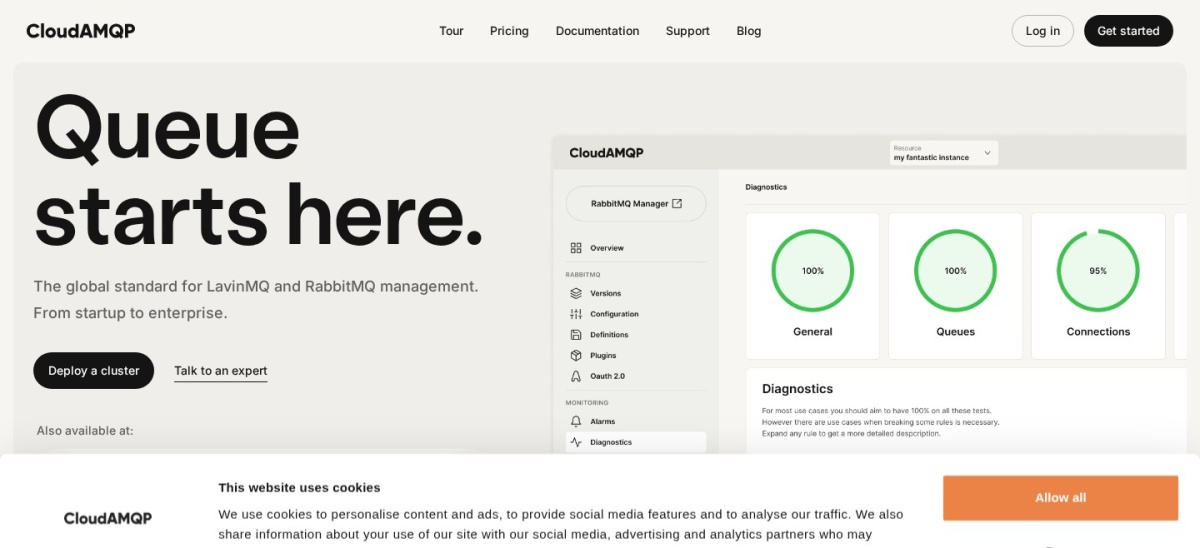
CloudAMQP keeps RabbitMQ itself: a free plan with 1 million messages a month, and $19 a month for 10 million.
Azure Service Bus Standard starts at about $9.86 a month in base charges, while IBM MQ starts at $312 a month for enterprise messaging.
Apache Pulsar and NATS were left out because neither has a public G2 or Capterra rating, so no score was invented for them.
How do you choose the best RabbitMQ alternative?
RabbitMQ is a broker, not a log. It hands each message to one worker and deletes it once the worker confirms it, which is ideal for task queues and work distribution.
The first split is whether you need replay. Kafka keeps events so many readers can re-read them, while SQS, Pub/Sub and Service Bus are closer to RabbitMQ: a message is delivered, confirmed, and gone.
The second split is who runs the broker. Self-hosted Kafka and ActiveMQ cost nothing in licences but need engineers to run them, while SQS, Pub/Sub and CloudAMQP remove the broker entirely.
Price is mostly usage, not a flat plan. SQS bills per million requests, Pub/Sub bills per TiB, and Service Bus bills a small base charge plus operations, so model your monthly volume before you compare headline prices.
Apache Kafka is a free, open-source distributed event log that stores messages in topics split into partitions, so many consumers can read the same events and replay them later. It is rated 4.5 out of 5 on G2 from 132 reviews, and its ecosystem covers connectors, stream processing and schema tools that smaller brokers cannot match.
The trade off is operations. Running a production cluster means sizing brokers, watching consumer lag and handling upgrades, which is real engineering work. It suits teams that need high throughput, replay and long retention, and managed Kafka from Aiven starts at $35 a month for teams that want the log without the cluster.
Amazon SQS is a fully managed queue service on AWS with no broker to install, patch or scale. It offers standard queues for high throughput and FIFO queues for ordered, exactly-once delivery, and the first 1 million requests a month are free before the $0.40 per million rate applies.
The trade off is that it only runs on AWS and speaks the AWS API, not AMQP, so code written for RabbitMQ needs changes. It suits teams already on AWS that want a queue that scales to millions of messages with no servers to watch.
Google Cloud Pub/Sub is a serverless messaging service where publishers send to topics and each subscription gets its own copy, delivered by pull, push to HTTPS, or export to BigQuery and Cloud Storage. The first 10 GiB of throughput a month is free, then it bills $40 per TiB, with no partitions or capacity to size.
The trade off is the meter. The $40 per TiB rate applies on publish and again on every subscription delivery, so fan-out multiplies the bill. It suits Google Cloud teams that want messaging with no cluster and direct delivery into BigQuery.
CloudAMQP is a managed hosting service for RabbitMQ and LavinMQ, so teams keep the same broker, exchanges and AMQP code with no server to run. The free Little Lemur plan covers 1 million messages a month, 100 queues and 20 connections, and Tough Tiger costs $19 a month for 10 million messages and 100 connections.
The trade off is that the $19 plan still runs on shared broker infrastructure, and costs rise with throughput on larger plans. It suits teams that like RabbitMQ itself and only want the operations, patching and monitoring handed to someone else.
4.6/5on Capterra (1,935 reviews, checked Nov 2026)
Starts at$9.86/mo
Best enterprise queue for Microsoft shops
DeploymentFully managed on Azure
Free tierNo free tier
TiersBasic, Standard, Premium
Paid planStandard base $0.0135 an hour
azure.microsoft.com
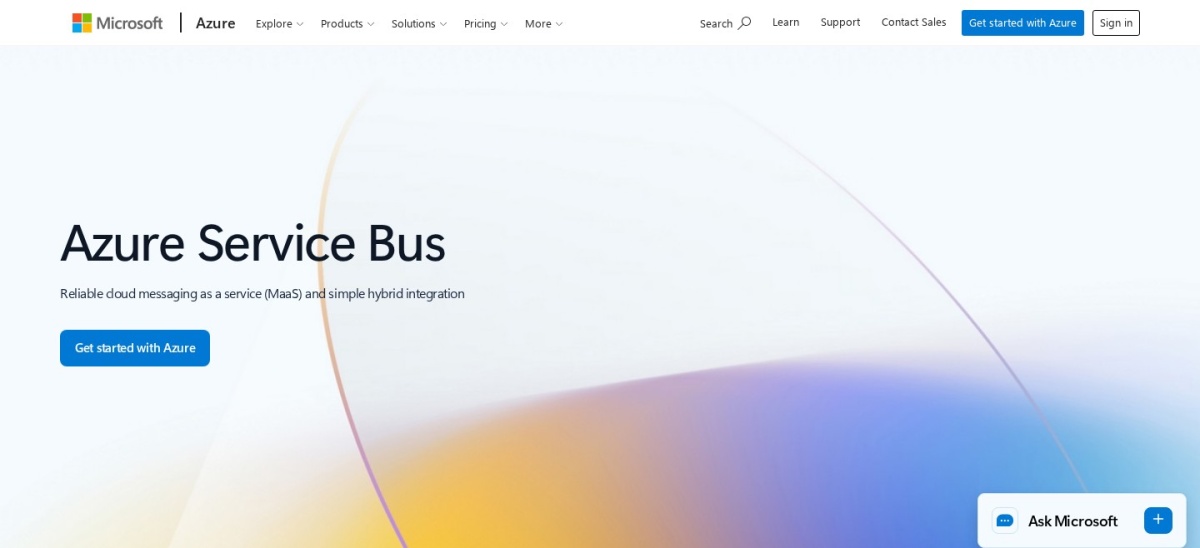
Azure Service Bus homepage, captured Nov 2026.
Azure Service Bus is Microsoft's enterprise messaging service with queues, topics, sessions, transactions and duplicate detection for microservices on Azure. The Standard tier charges a base of $0.0135 an hour, about $9.86 a month, and includes 13 million operations a month before tiered per-operation charges apply.
The trade off is billing with several meters: base charge, operations and brokered connections all count, so a busy month costs more than the base figure. It suits teams already on Azure, especially .NET shops, that need enterprise messaging features RabbitMQ does not include.
What we like
Queues, topics, sessions and transactions in one service
Largest review base in this list on Capterra
Low base charge for modest volumes
Deep integration with Azure services
Watch out for
No free tier
Billing has several meters to track
Azure only, with a 256 KB message limit on Standard
Redis is an in-memory data store that also works as a fast queue: Streams support consumer groups with acknowledgement, lists work as simple queues, and Pub/Sub covers fan-out. Redis Cloud has a free tier up to 30 MB, and the Essentials plan starts at about $5 a month on shared infrastructure.
The trade off is that Redis is memory-first, not a dedicated broker. Durable delivery needs careful configuration, and there are no exchanges, routing keys or dead-letter queues like RabbitMQ. It suits teams already running Redis that need a fast, simple queue beside their cache.
What we like
Very low latency for queues and streams
Free tier and a $5 a month starting plan
One system for caching, queues and sessions
Rated 4.4 out of 5 on G2
Watch out for
No exchanges or routing keys like RabbitMQ
Durability needs extra configuration
Memory costs grow with queue depth
Pro plans add dedicated deployments from $200 a monthVisit redis.io
07
IBM MQ
4.3/5on G2 (174 reviews, checked Nov 2026)
Starts at$312/mo
Best for enterprise and hybrid messaging
DeploymentCloud and self-hosted
Free tierNo free plan
DeliveryExactly-once, assured
Paid planStandard from $312 a month
ibm.com
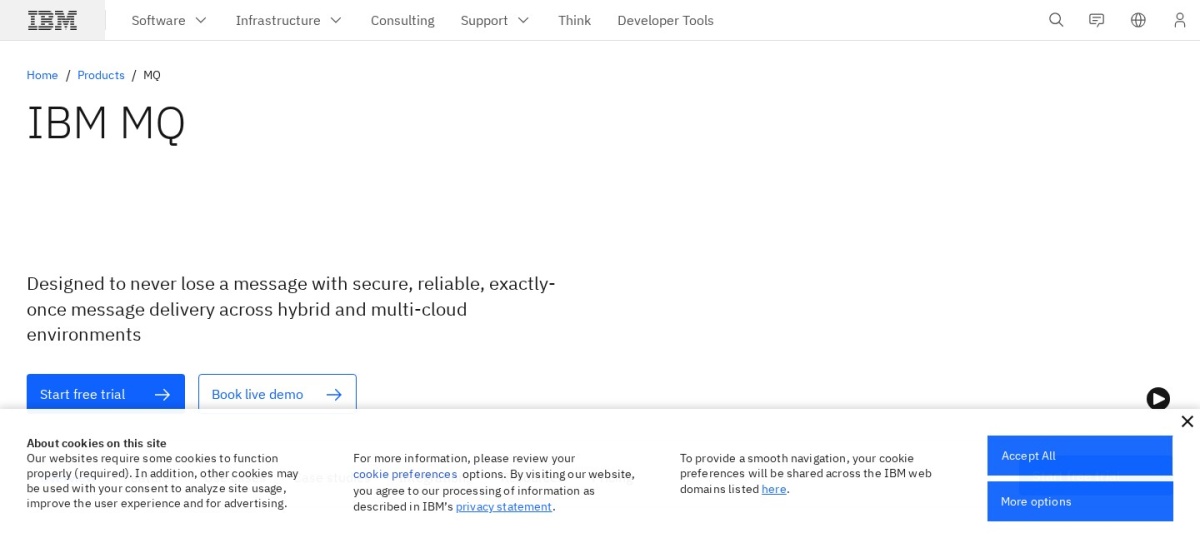
IBM MQ homepage, captured Nov 2026.
IBM MQ is enterprise messaging software for connecting distributed applications across cloud and self-hosted environments, with assured, exactly-once delivery and mainframe integration. It is rated 4.3 out of 5 on G2 from 174 reviews, and the standard Virtual Processor Core subscription starts at $312 a month with a 1-year minimum commitment.
The trade off is cost and complexity. Licensing is priced for large organisations, and the Advanced offering starts at $583 a month, so small teams pay far more than for an open-source broker. It suits banks, insurers and regulated teams where guaranteed delivery justifies the price.
What we like
Assured, exactly-once delivery
Mainframe and hybrid-cloud integration
Large G2 review base of 174 reviews
Managed service option from $727 a month
Watch out for
No free plan
Licensing cost is high for small teams
Setup is heavier than a cloud queue
Advanced adds file transfer and encryption from $583 a monthVisit ibm.com
08
Apache ActiveMQ
4.3/5on G2 (16 reviews, checked Nov 2026)
PriceFree
Best free Java-friendly broker
DeploymentSelf-hosted
ProtocolsJMS, AMQP, MQTT, STOMP
Free tierFree, open source
Paid planSupport via vendors
activemq.apache.org
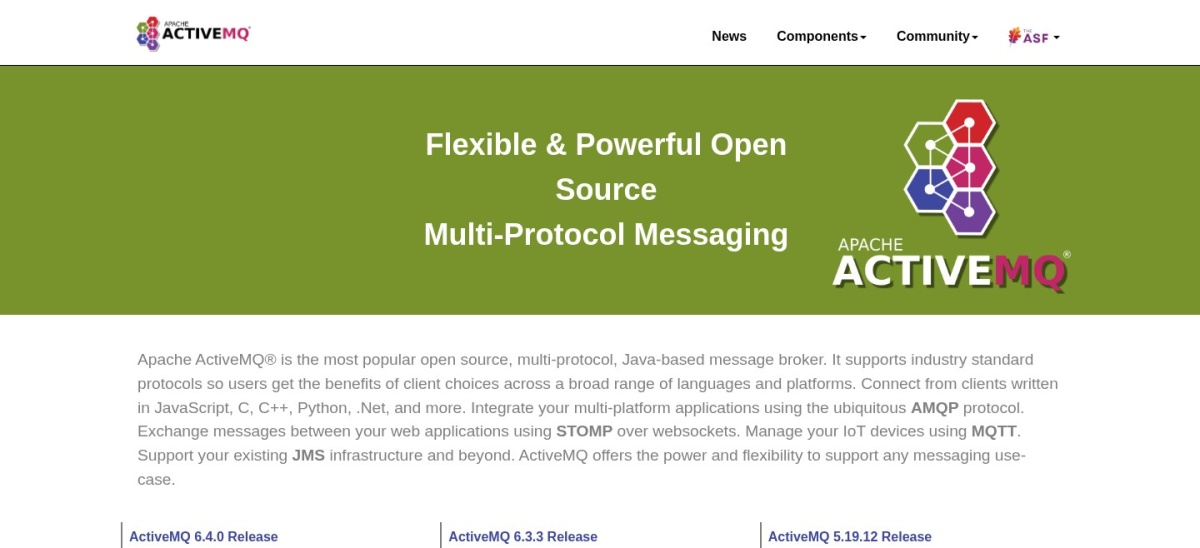
Apache ActiveMQ homepage, captured Nov 2026.
Apache ActiveMQ is a free, open-source message broker that speaks JMS, AMQP, MQTT and STOMP, so Java applications and mixed-protocol clients can share one broker. It is rated 4.3 out of 5 on G2 from 16 reviews, and its newer Artemis codebase is the line to pick for new deployments.
The trade off is age. ActiveMQ Classic is a mature broker, but its clustering and failover are weaker than newer systems, and reviewers note occasional delivery delays. It suits Java teams that want a free broker with broad protocol support and no licence cost.
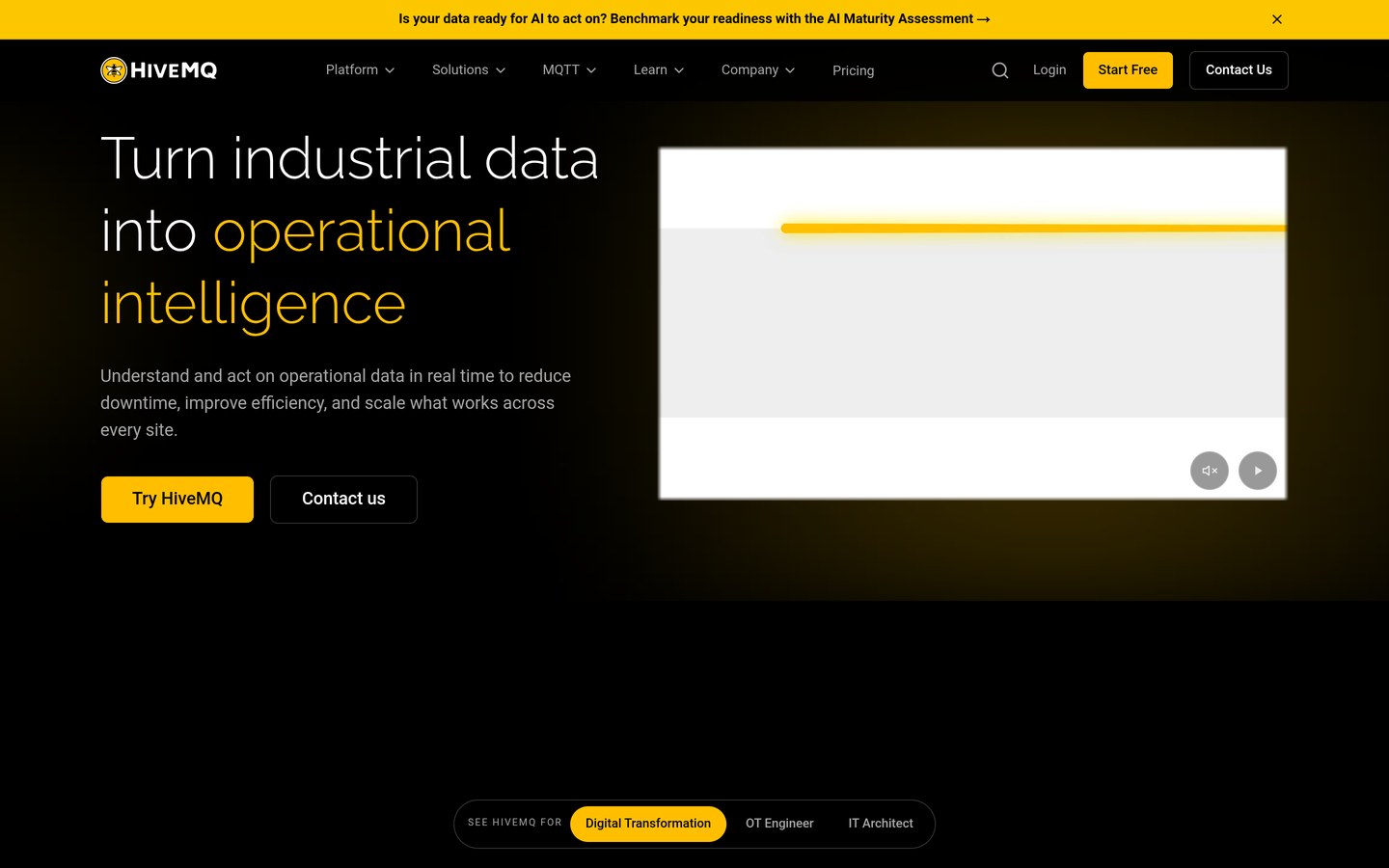
HiveMQ is an MQTT broker for connecting devices and enterprise systems, with clustering, monitoring and enterprise extensions around a Java core. Cloud Starter costs $0.34 an hour, about $248 a month, plus $0.80 per million messages, and covers 10,000 connections, while Community Edition is free and open source.
The trade off is focus. HiveMQ is built for MQTT and IoT, not as a general AMQP replacement, and its free Cloud Serverless plan retires on 31 December 2026. It suits teams with device fleets or IoT workloads that need MQTT at scale.
Stay with RabbitMQ if your code already speaks AMQP and your queues work well. Exchanges, routing keys, quorum queues and the management UI are the reasons teams pick it, and moving to SQS or Pub/Sub means rewriting that routing.
Stay if your volume is modest and your broker is stable. A small RabbitMQ cluster on a single server handles many workloads, and the cost of a migration is often larger than a year of hosting.
Move when the broker itself is the bottleneck: when you need replay, when throughput outgrows one cluster, or when your team no longer wants to run a broker at all. That is when Kafka, a cloud queue, or a managed host such as CloudAMQP earns its keep.
How we chose
We started from the messaging tools buyers compare against RabbitMQ, then kept the nine with a public rating on G2 or Capterra and a live homepage and pricing page.
Prices come from each vendor's pricing page, checked on 29 November 2026. Ratings and review counts come from G2 or Capterra on the same day. Where a vendor shows a sale, the list shows the regular price.
We left out tools with no public rating, including Apache Pulsar and NATS, rather than scoring them on no evidence. No vendor paid for a place, and we do not claim to have used these tools ourselves.
How to choose a RabbitMQ alternative
Start with what RabbitMQ does for you today, then match the model before the price.
Decide if you need replay. If many readers must re-read old events, you need a log such as Kafka. If each message goes to one worker, a queue such as SQS or Service Bus is enough.
Check protocol compatibility. CloudAMQP and ActiveMQ speak AMQP, so existing RabbitMQ code moves with little change. SQS, Pub/Sub and Service Bus need code changes.
Model the bill on your volume. Usage pricing looks cheap at low volume and climbs fast. Work out your monthly messages and bytes first, then compare the meter, not the headline price.
Plan the migration queue by queue. Move one queue at a time and run both brokers during the switch, so a bad deploy can roll back to RabbitMQ without losing messages.
FAQ
What is the best RabbitMQ alternative?
Apache Kafka is the best RabbitMQ alternative for most teams. It is rated 4.5 out of 5 on G2 from 132 reviews, is free and open source, and its replayable event log suits teams that have outgrown a plain queue.
What is the cheapest RabbitMQ alternative?
Apache Kafka and Apache ActiveMQ are the cheapest, because both are free and open source with no licence cost. Among managed services, Amazon SQS starts at $0.40 per million requests after 1 million free a month, and CloudAMQP costs $19 a month.
Is there a free RabbitMQ alternative?
Yes. Kafka, ActiveMQ, Redis and HiveMQ Community Edition are all free and open source. CloudAMQP, SQS and Pub/Sub also have free tiers, with 1 million messages, 1 million requests and 10 GiB of throughput a month respectively.
What is the best RabbitMQ alternative for AWS?
Amazon SQS is the best RabbitMQ alternative on AWS. It is fully managed, rated 4.4 out of 5 on G2 from 146 reviews, and connects directly to Lambda and EC2. CloudAMQP is the better pick if you want to keep RabbitMQ itself on AWS.
RabbitMQ vs Kafka: which should I choose?
Choose RabbitMQ for task queues where each message goes to one worker and routing matters. Choose Kafka when many readers must replay the same events, when you need long retention, or when throughput outgrows a single broker.
Can I keep using RabbitMQ without managing it myself?
Yes. CloudAMQP hosts RabbitMQ for you from a free plan, with paid plans from $19 a month, and Amazon MQ is the managed RabbitMQ option inside AWS. Both keep your AMQP code working while AWS or CloudAMQP runs the broker.
Which RabbitMQ alternative is best for small teams?
CloudAMQP is the best pick for small teams that want to stay on RabbitMQ, with a free plan and a $19 a month paid plan. Amazon SQS is the best pick for small AWS teams, since the first 1 million requests a month are free.
SaaS SEO and WordPress specialist with about 8 years of experience. Rakib compares WordPress plugins, themes, hosting and software using public pricing, documentation and user reviews. See how we rank.