Oracle NetSuite is the best QuickBooks Enterprise alternative for most growing companies, with unified financials, inventory and CRM and a 4.1 out of 5 G2 rating from 4,963 reviews. Pick Sage Intacct for finance-led multi-entity reporting, or QuickBooks Online Advanced at $340 a month if you want to stay with Intuit.
How we make this list: we compare pricing pages, product documentation and public user reviews, then re-check every price before each update. No product paid for a place. Disclosure.
NetSuite leads with unified ERP financials and a 4.1 out of 5 G2 rating from 4,963 reviews.
Sage Intacct is the finance-led pick: dimensional reporting and native consolidation, rated 4.3 out of 5 on G2.
Acumatica charges by computing resources, not seats, so every user logs in without per-seat fees.
Business Central is the clearest published ERP price here: $80 per user a month for Essentials.
Xero is the cheapest entry at $27 a month, with unlimited users on every plan.
Four of the nine tools publish no price at all, so budget for a written quote plus implementation.
How do you choose the best QuickBooks Enterprise alternatives?
QuickBooks Enterprise is desktop accounting for larger companies, not a cloud ERP. A company that outgrows it usually needs cloud access, multi-entity books or more than 40 users, and that is where the alternatives in this list start.
Multi-entity consolidation is the first thing to check. NetSuite, Sage Intacct, Acumatica, Business Central and SAP Business One all consolidate subsidiaries in the system, while Xero, Zoho Books and QuickBooks Online are built for simpler, single-entity books.
Pricing is the hardest part of this market. Four of the nine tools here publish no price, and the published ones range from $20 a month for Zoho Books Standard to $110 per user a month as the reported starting point for SAP Business One.
Migration effort matters as much as the monthly fee. Our guide on integrating WooCommerce with QuickBooks shows how tightly accounting can tie into sales, and the same care applies when moving years of QuickBooks history to a new ledger.
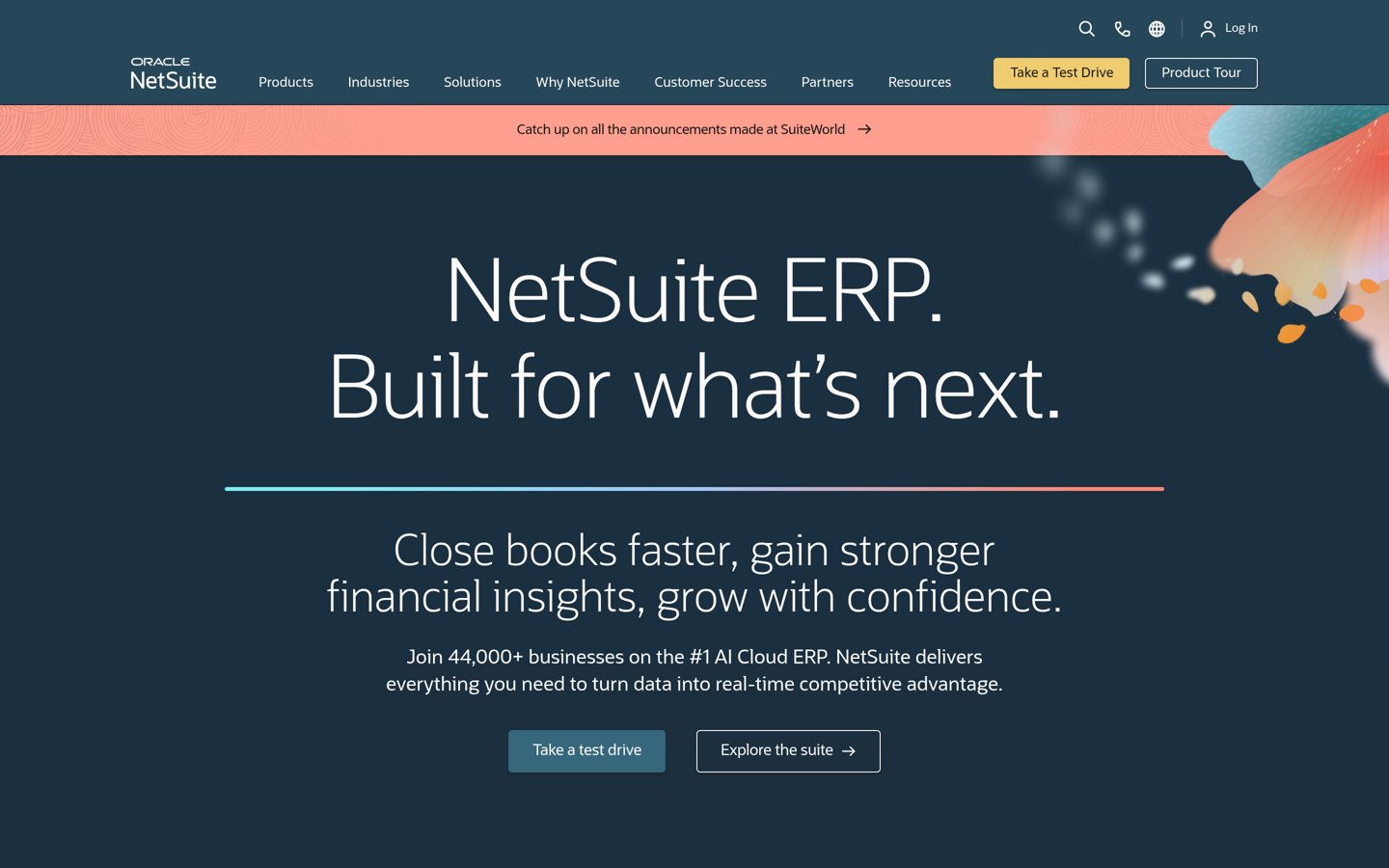
Oracle NetSuite is a cloud ERP that runs accounting, inventory, order management, CRM and HR in one system. Its OneWorld subsidiaries handle multi-entity consolidation across currencies, with automated elimination journals and period locks per subsidiary.
The trade off is price and setup. NetSuite publishes no price, and implementation usually needs a partner and several months. It suits growing companies that have outgrown QuickBooks and want one system for finance and operations.
What we like
Unified financials, inventory, CRM and HR in one system
Multi-subsidiary consolidation across currencies
Largest review base among the full ERPs here
Watch out for
No published price; every deal is a quote
Implementation usually needs a partner and months of work
Per-user fees add up as the team grows
Paid modules add planning, budgeting and advanced revenue managementVisit netsuite.com
02
Sage Intacct
4.3/5on G2 (4,574 reviews, checked Nov 2026)
PricingCustom/yr
Best for multi-entity finance teams
Entry planQuote only
Multi-entityYes, native consolidation
DimensionsDepartment, project, location
Free trialNo, demo only
sageintacct.com
Sage Intacct homepage, captured Nov 2026.
Sage Intacct is a cloud financial management platform built for finance teams, not general operations. Its dimensional reporting tags each transaction by department, location, project and customer, so reports can be cut any way the board asks without a rigid chart of accounts.
The trade off is cost and setup. Sage publishes no price, and partner estimates put entry subscriptions near $9,000 to $12,000 a year before implementation. It suits mid-size companies with several entities that need consolidation and audit trails.
What we like
Dimensional reporting without a rigid chart of accounts
Native multi-entity consolidation and inter-entity entries
Strong audit trails and approval workflows
Watch out for
No published price; quotes vary by modules and entities
Implementation often costs as much as a year of subscription
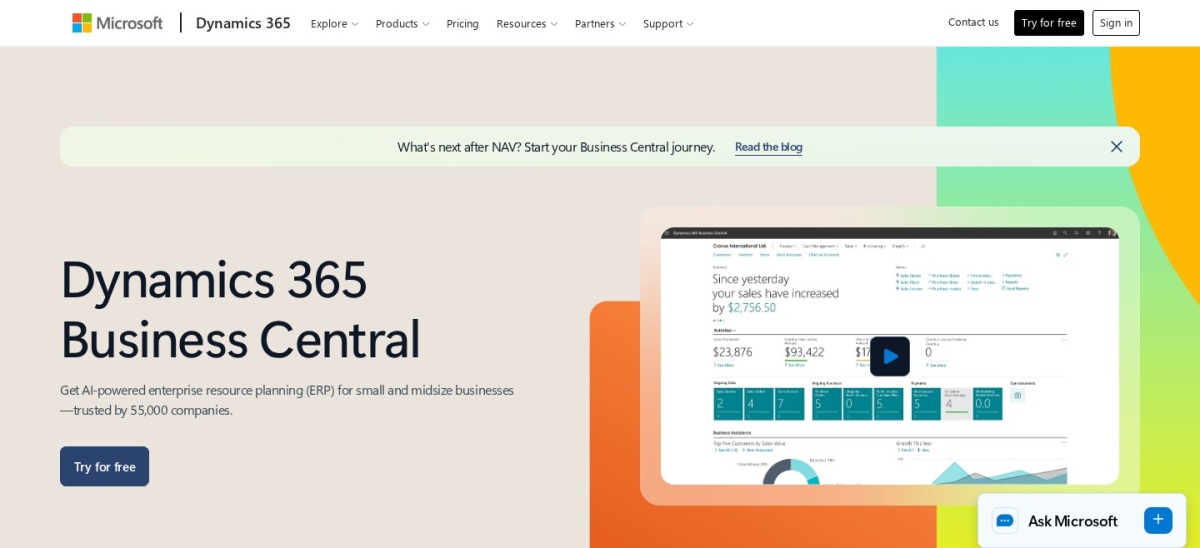
Microsoft Dynamics 365 Business Central homepage, captured Nov 2026.
Microsoft Dynamics 365 Business Central is a cloud ERP for finance, sales, purchasing, inventory and projects. Essentials at $80 per user a month covers core financials, multi-currency and job costing, and it links to Outlook, Excel, Teams and Power BI.
The trade off is per-user cost at scale. A 10-user finance team pays $800 a month before implementation, and manufacturing needs Premium at $110 per user a month. It suits companies whose staff already live in Microsoft tools.
What we like
Clear published per-user pricing
Deep links to Microsoft 365, Excel and Power BI
Covers finance, inventory, sales and projects in one system
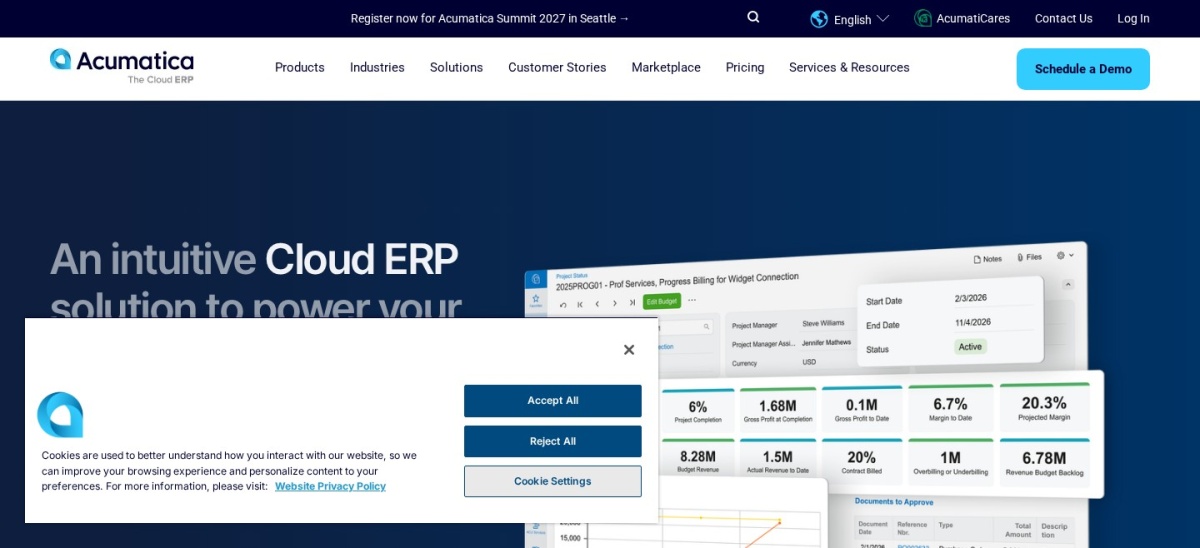
Acumatica is a cloud ERP that prices by the computing resources used, not by named users. The warehouse team, the office and the accountants can all log in without per-seat maths, and one environment holds unlimited related companies with intercompany accounting.
The trade off is that the price is still a quote. Acumatica publishes no list price, and the resource-based model needs a partner to size. It suits distribution, manufacturing and services firms that want many users in the system.
What we like
Unlimited users with no per-seat fees
Highest G2 rating in this list at 4.4 out of 5
Unlimited related companies in one environment
Watch out for
No published price; quotes need partner sizing
Smaller partner network than NetSuite or SAP
Industry editions add cost on top of the base
Paid editions add construction, distribution and manufacturing depthVisit acumatica.com
05
QuickBooks Online
4/5on G2 (3,870 reviews, checked Nov 2026)
Paid from$38/mo
Best if you want to stay with Intuit
Cheapest paid planSimple Start, $38/mo
Advanced$340/mo, 25 users
Users on Simple Start1
Free planYes, basic tracking
quickbooks.intuit.com
QuickBooks Online homepage, captured Nov 2026.
QuickBooks Online is the most widely used small-business accounting software in the US, with the largest network of accountants who know it. Simple Start costs $38 a month for one user, with invoicing, expenses, bank feeds and basic reports, and a free plan covers basic income and expense tracking.
The trade off is price and scale. Simple Start covers only one user, Essentials at $85 adds three users, and Advanced at $340 a month is the plan closest to QuickBooks Enterprise, with 25 users. It suits businesses that want their accountant on the same system.
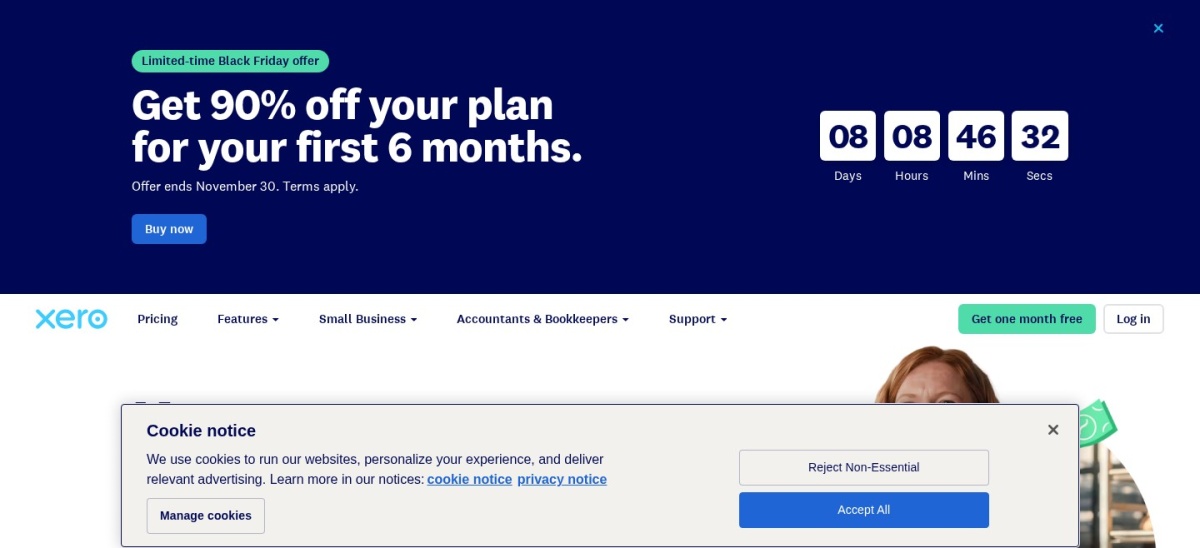
Xero is cloud accounting for small and growing businesses, with invoicing, bills, bank reconciliation and reporting. Early at $27 a month covers 20 invoices and 5 bills a month, and every plan includes unlimited users, so the whole team can log in without seat fees.
The trade off is scope. Xero is not an ERP: there is no native multi-entity consolidation, and multi-currency needs Established at $97 a month. It suits service-heavy firms with simple structures that want low-cost cloud books.
What we like
Cheapest entry price in this list at $27 a month
Unlimited users on every plan
Highest G2 rating here at 4.4 out of 5
Watch out for
No native multi-entity consolidation
Multi-currency only on the $97 a month plan
Payroll needs a paid integration in the US
Established adds multi-currency, projects and expenses at $97 a monthVisit xero.com
07
Odoo
4.2/5on G2 (355 reviews, checked Nov 2026)
Paid from$31.10/user/mo
Best modular ERP on a budget
Starting price$31.10/user/mo
Free planOne app, free
Light User$8.90/user/mo
Free trialYes
odoo.com
Odoo homepage, captured Nov 2026.
Odoo is a modular ERP where every app, from accounting and sales to inventory, HR and manufacturing, shares one database and one per-user price. One app is free for unlimited users, and Standard with all apps costs $31.10 per user a month at the regular yearly rate.
The trade off is the first-year discount. New customers pay $24.90 per user a month for Standard in year one, then the regular $31.10 rate applies. It suits small companies that want to start with one app and add modules as they grow.
What we like
Free one-app plan with unlimited users
Lowest regular per-user price in this list
One fee covers all apps, not one module
Watch out for
First-year price rises by about 25% at renewal
Multi-company and Studio need the $61 Custom plan
Custom adds Studio, multi-company and the external APIVisit odoo.com
08
Zoho Books
4.4/5on G2 (329 reviews, checked Nov 2026)
Paid from$20/mo
Best free tier for small teams
Cheapest paid planStandard, $20/mo
Free planYes, under $50K revenue
Users on free1
Invoices on free1,000/yr
zoho.com
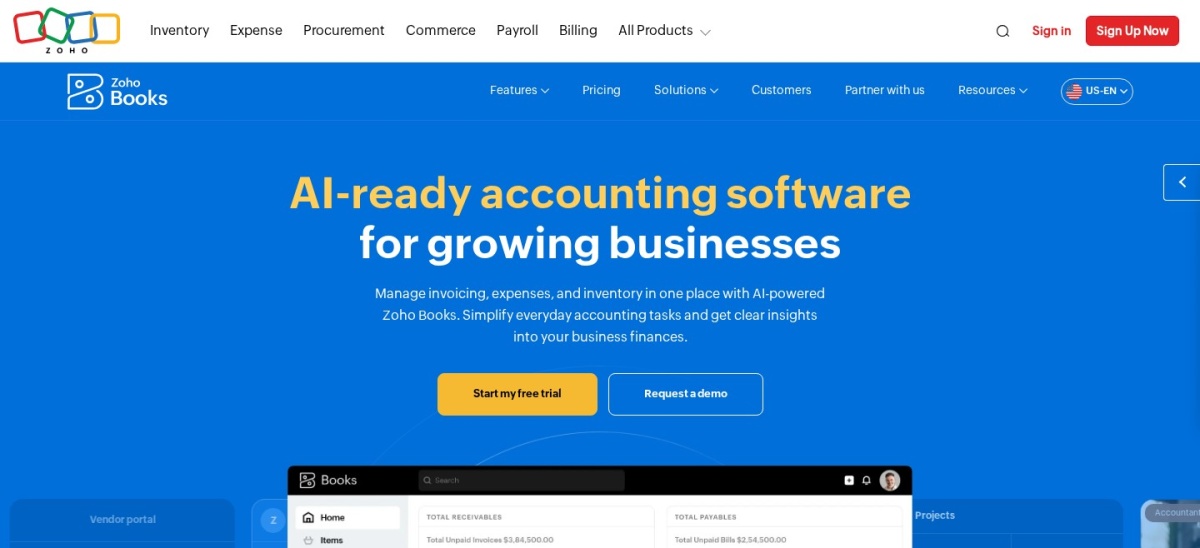
Zoho Books homepage, captured Nov 2026.
Zoho Books is a full double-entry ledger with invoicing, expenses and bank reconciliation. The free plan covers businesses under $50,000 a year in revenue with 1 user and 1,000 invoices a year, and Standard costs $20 a month billed monthly, or $15 billed yearly.
The trade off is the free plan limit. One user and a revenue cap mean growing firms pay quickly, and the interface is busier than Xero. It suits bootstrapped founders already using Zoho apps.
What we like
Best free tier for tiny businesses
Low paid entry at $20 a month
Deep Zoho ecosystem integration
Watch out for
Free plan limited to 1 user
Revenue cap of $50,000 a year
Interface is busy next to Xero
Standard adds 3 users and 5,000 invoices a yearVisit zoho.com
09
SAP Business One
4.3/5on G2 (542 reviews, checked Nov 2026)
Starts at$110/user/mo
Best for smaller enterprises on SAP
Starting priceFrom $110/user/mo
Pricing modelQuote-based
DeploymentCloud or on-premise
Free planNo
sap.com
SAP Business One homepage, captured Nov 2026.
SAP Business One is SAP's system for smaller enterprises, covering accounting, inventory, manufacturing and CRM in one package. It runs in the cloud or on premise, which suits companies that need to keep data on their own servers.
The trade off is that every quote is custom, so the reported starting point of about $110 per user a month is only a guide, and customisation adds cost. It suits smaller enterprises that want the SAP name without S/4HANA scale.
What we like
Accounting, inventory and CRM in one system
Cloud or on-premise deployment
Rated 4.3 out of 5 on G2
Watch out for
No published list price; quotes come through SAP or a partner
Less depth than S/4HANA for very large groups
Partner-led setup is the norm
Add-ons cover industry packs and advanced reportingVisit sap.com
Four tools publish no price: what to ask for
NetSuite, Sage Intacct, Acumatica and SAP Business One publish no price. Each quote depends on users, entities, modules and implementation, so two companies rarely pay the same amount.
Ask for the quote in writing with the subscription, the implementation fee and the renewal terms separated. Partner estimates put Sage Intacct entry subscriptions near $9,000 to $12,000 a year, and implementation often costs as much as the first year of subscription.
For the tools with published prices, the entry figure is only the start. Business Central Essentials is $80 per user a month, so a 10-user team pays $800 a month, and QuickBooks Online Advanced at $340 a month covers 25 users.
Get the renewal cap in the contract. Reviewers report annual increases on several of these tools, and a cap of 3 to 5 percent a year is a common negotiating point.
How we chose
We started from the enterprise accounting systems with the largest G2 review bases and the clearest multi-entity support, then kept nine that cover the full range from cloud ERP suites to a low-cost cloud ledger.
Prices come from each vendor's pricing page or, where the vendor publishes no price, from the vendor's own pricing page stating that pricing is by quote, checked on 29 November 2026. Ratings come from G2 on the same day. Where a vendor shows a sale, the list shows the regular price.
We left out tools with no usable review base or no enterprise accounting core. No vendor paid for a place, and we do not claim to have used these tools ourselves.
How to choose a QuickBooks Enterprise alternative
Start with how many entities you run, then work out what the quote has to include.
Count your entities and currencies. If you consolidate several companies in more than one currency, you need NetSuite, Sage Intacct, Acumatica, Business Central or SAP Business One. A single-entity firm can use Xero, Zoho Books or QuickBooks Online.
Decide between finance-led and operations-led. Sage Intacct leads with reporting and the close. NetSuite, Acumatica and Business Central add inventory, sales and operations to the same system.
Get the full quote in writing. Ask for the subscription, implementation and renewal terms as separate lines, and check whether support, training and data migration are included.
Check the ecosystem you already use. Microsoft 365 shops fit Business Central, Oracle shops fit NetSuite, and SAP shops fit Business One.
FAQ
What is the best QuickBooks Enterprise alternative in 2026?
Oracle NetSuite is the best QuickBooks Enterprise alternative for most growing companies. It unifies financials, inventory, order management and CRM in one cloud ERP, and it holds a 4.1 out of 5 G2 rating from 4,963 reviews.
How much do QuickBooks Enterprise alternatives cost?
Published prices here run from $20 a month for Zoho Books Standard to $110 per user a month as the reported starting point for SAP Business One. Four tools publish no price at all, and partner estimates put Sage Intacct entry subscriptions near $9,000 to $12,000 a year.
What is the difference between NetSuite and Sage Intacct?
NetSuite is a full cloud ERP that adds inventory, CRM and HR to the ledger. Sage Intacct is finance-led, with dimensional reporting and consolidation as its core, and it suits teams that need reporting depth more than operational modules.
Is there a free QuickBooks Enterprise alternative?
Yes, Zoho Books has a free plan for businesses under $50,000 a year in revenue, and Odoo offers one app free for unlimited users. Both are single-entity ledgers, so they suit small teams rather than multi-entity groups.
Which QuickBooks Enterprise alternative is best for small teams?
Xero is the best pick for small teams, at $27 a month with unlimited users on every plan. It covers invoicing, bills and bank reconciliation, but it has no native multi-entity consolidation, so growing groups need a different tool.
NetSuite vs Sage Intacct: which is better?
NetSuite is better for companies that want one system for finance and operations, with inventory and CRM beside the ledger. Sage Intacct is better for finance-led teams that need dimensional reporting and consolidation, and it is rated 4.3 out of 5 on G2 against NetSuite at 4.1.
SaaS SEO and WordPress specialist with about 8 years of experience. Rakib compares WordPress plugins, themes, hosting and software using public pricing, documentation and user reviews. See how we rank.