Ramp is the strongest overall privacy.com alternative for businesses in 2026, offering unlimited virtual cards, merchant controls, and automated receipt matching on a $0/user/month base plan (4.8/5 across 2,587 G2 reviews). For individual shoppers, Revolut offers disposable single-use cards free on Standard, while Cloaked pairs masked cards with identity aliases from $119.99/year.
How we make this list: we compare pricing pages, product documentation and public user reviews, then re-check every price before each update. No product paid for a place. Disclosure.
Privacy.com limits free personal users to 12 new cards per month and caps single-user tiers at 60 cards for $25/month ($300/year).
Ramp, Brex, BILL Spend & Expense, Mercury, Slash, and Relay all issue unlimited or high-cap virtual corporate cards on $0/month starter tiers.
Revolut provides disposable virtual cards that regenerate after every single online purchase on its $0/month Standard account (4.2/5 on Trustpilot).
Wise charges a one-time card issuance fee (such as £7 in the UK) with zero monthly subscription fees and free virtual cards for multi-currency spending.
Cloaked bundles invite-only Cloaked Pay virtual cards with unlimited email and phone aliases starting at $119.99/year billed annually.
Why do people look for privacy.com alternatives?
Privacy.com works well for solo shoppers masking a personal debit card, yet its monthly card caps and single-user design break down quickly. The free Personal tier stops at 12 new virtual cards per month, and even the $25/month Premium tier caps creation at 60 cards without team approval workflows or accounting sync.
Businesses need multi-user permissions, department budgets, and direct QuickBooks, Xero, or NetSuite integrations that Privacy.com does not offer. Modern corporate card platforms issue unlimited virtual cards at $0/month and enforce merchant or category rules at the point of swipe.
International buyers and travelers also outgrow Privacy.com because it links strictly to US bank accounts and debit cards. Multi-currency alternatives let individuals and global teams hold dozens of currencies, avoid steep foreign exchange markups, and generate disposable cards for cross-border checkouts.
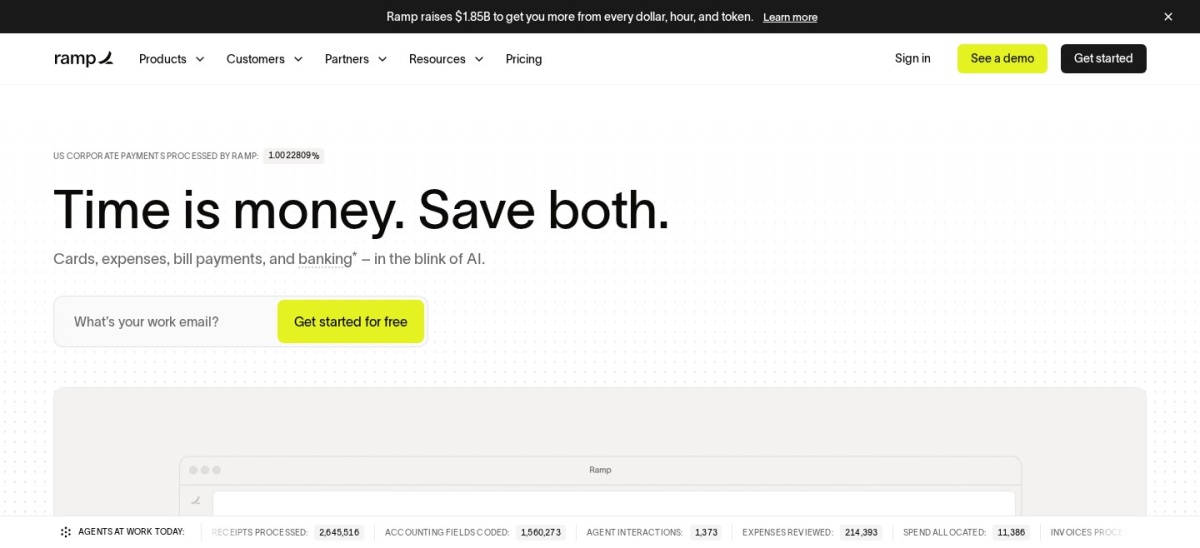
Ramp is a corporate card and spend management platform that replaces single-user virtual card tools for growing teams. Its $0/user/month free tier includes unlimited virtual and physical cards, vendor and category locks, automated receipt matching via SMS or Slack, and QuickBooks Online or Xero sync.
The trade off is that Ramp requires a registered business entity and reserves multi-entity workflows, custom roles, and NetSuite or Sage Intacct integrations for Ramp Plus at $15/user/month ($180/year per user) plus a platform fee. It suits US companies outgrowing Privacy.com card caps.
What we like
Unlimited virtual cards with vendor and category locks on the $0 plan
Automatic receipt collection and real-time accounting sync
Cards auto-lock if required receipts are missing
4.8 out of 5 on G2 across 2,587 verified reviews
Watch out for
Not available for personal consumer spending
Ramp Plus adds a platform fee on top of $15/user/month
NetSuite and multi-entity tools require upgrading
Ramp Plus ($15/user/mo) adds AI review automation, multi-entity support, and ERP integrations.Visit ramp.com
02
Revolut
4.2/5on Trustpilot (501,000+ reviews, checked Nov 2026)
Paid from$9.99/mo
Best for disposable personal virtual cards
Trustpilot rating4.2 out of 5 (501K+ reviews)
Free planYes (Standard $0/month)
Virtual cardsMulti-use + single-use disposable
Currencies36+ supported currencies
revolut.com
Revolut homepage, captured Nov 2026.
Revolut is a global digital banking app offering both multi-use virtual cards and disposable single-use cards whose details refresh immediately after every transaction. The $0/month Standard plan supports Apple Pay and Google Pay, instant card freezing, per-card spending limits, and weekday currency exchange up to $1,000/month.
The trade off is that Revolut operates as a prepaid digital wallet rather than pulling directly from an external checking account, and upgrading to US Premium costs $9.99/month ($119.88/year; Plus starts at £3.99/month in the UK). It suits individual shoppers seeking free burner cards.
What we like
Disposable virtual cards auto-regenerate after a single charge
Free Standard account with Apple Pay and Google Pay support
Multi-currency balances with competitive weekday FX rates
Instant freeze, unfreeze, and monthly spend limits in-app
Watch out for
Must top up your Revolut balance rather than funding via ACH pull
1% fee applies on currency exchanges outside market hours on Standard
Account verification holds are cited in negative Trustpilot reviews
Premium ($9.99/mo in US) raises fee-free FX limits to $10,000/month and includes partner subscriptions.Visit revolut.com
03
Wise
4.3/5on Trustpilot (307,000+ reviews, checked Nov 2026)
PriceFree
Best for international multi-currency spending
Trustpilot rating4.3 out of 5 (307K+ reviews)
Monthly fee$0 (pay-as-you-go)
Virtual cardsUp to 3 active digital cards
FX pricingMid-market rate + from 0.24% fee
wise.com
Wise homepage, captured Nov 2026.
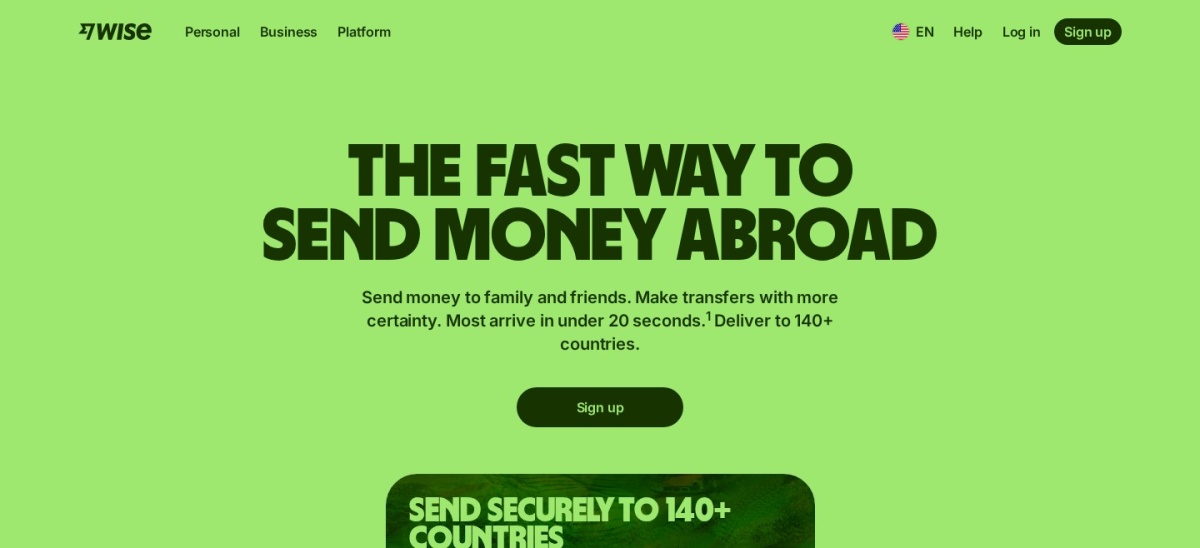
Wise is a multi-currency account provider that lets users hold over 40 currencies and generate up to three free digital virtual cards once a physical debit card is ordered (a one-time fee such as £7 in the UK). There are no monthly subscriptions, and spending balances already held in a matching currency is free.
The trade off is that Wise caps active digital cards at three simultaneously, lacks merchant-locking rules, and requires pre-funding your Wise balance before checkout. It suits travelers, expats, and freelancers paying international vendors without hidden exchange rate markups.
What we like
Zero monthly subscription fees across personal and business accounts
True mid-market exchange rates with transparent conversion fees from 0.24%
Instant freeze, delete, and card number replacement inside the app
4.3 out of 5 on Trustpilot across more than 307,000 reviews
Watch out for
Limited to 3 active virtual cards at a time
No merchant-locked or auto-expiring single-use card rules
Virtual card availability varies by country after ordering a physical card
Pay-as-you-go pricing only; no monthly subscription tiers exist.Visit wise.com
04
Brex
4.8/5on G2 (1,667 reviews, checked Nov 2026)
Paid from$12/mo
Best for venture-backed startups and global entities
G2 rating4.8 out of 5 (1,667 reviews)
Free planYes (Essentials $0/user/month)
Acceptance210+ countries and territories
Local cardsLocal-currency cards in 50+ countries
brex.com
Brex homepage, captured Nov 2026.
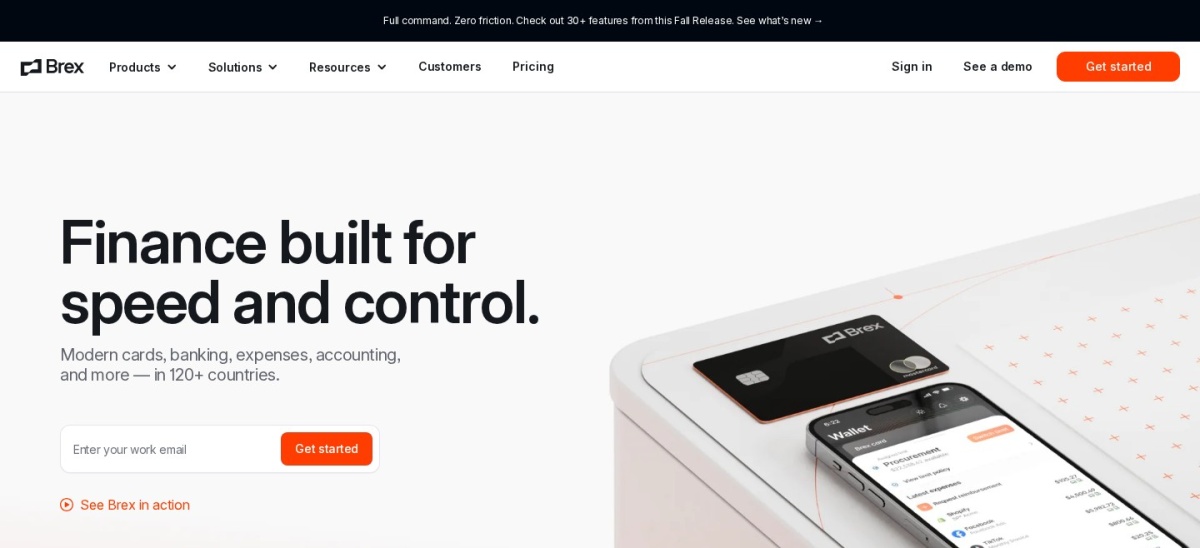
Brex is an integrated corporate card, expense, and travel platform designed for startups and multi-entity businesses. Its Essentials plan costs $0/user/month and provides unlimited virtual corporate cards, merchant controls, real-time receipt capture, and AI-assisted spend rules.
The trade off is that custom multi-step approval chains, role-based policy exceptions, and multi-entity support require Brex Premium at $12/user/month ($144/year per user), and underwriting favors funded or higher-revenue companies. It suits scaling startups needing global card acceptance.
What we like
Unlimited virtual corporate cards on the $0 Essentials tier
Local-currency card issuance across 50+ countries
Automated receipt matching and ERP accounting integrations
4.8 out of 5 on G2 from 1,667 verified reviews
Watch out for
Underwriting criteria can exclude sole proprietors and small LLCs
Dynamic approval chains require Premium at $12/user/month
All users on an account must sit on the same paid plan
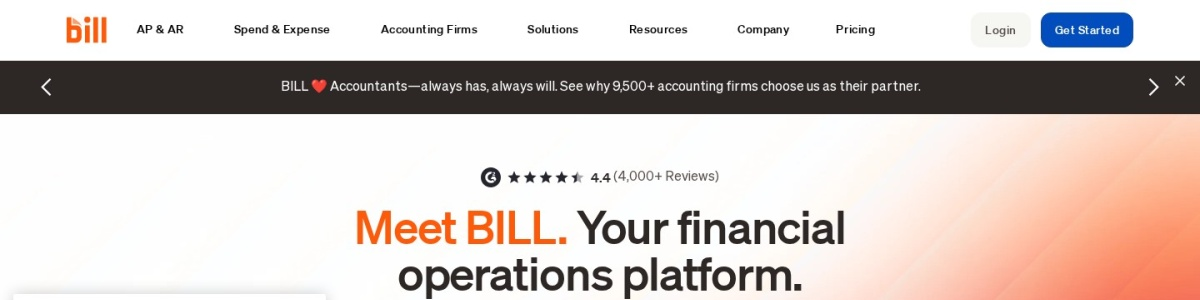
BILL Spend & Expense (formerly Divvy) pairs free expense management software with virtual and physical corporate cards tied directly to department budgets. At $0/user/month, admins can spin up unlimited virtual cards for recurring software subscriptions or ad accounts so charges never exceed an assigned budget.
The trade off is that standalone Spend & Expense lacks full accounts payable and receivable automation unless you add BILL AP/AR plans starting at $49/user/month ($588/year per user). It suits small and mid-sized businesses wanting strict pre-spend budget caps.
What we like
Free $0/user/month software with unlimited virtual cards
Cards draw directly from hard-capped department or vendor budgets
Credit lines ranging from $1,000 up to $5M with rewards
Direct integrations with QuickBooks, Xero, and NetSuite
Watch out for
Full AP/AR invoice workflows start at $49/user/month
Requires credit underwriting to establish a business credit line
Some G2 reviewers report clunky bulk transaction reviews
BILL AP/AR Essentials ($49/user/mo) adds full accounts payable and invoicing automation.Visit bill.com
Mercury is a business banking platform that includes virtual debit and corporate credit cards on its $0/month base account with no minimum balances or overdraft fees. Teams can issue merchant-locked virtual cards, set custom spend limits, flag duplicate subscriptions, and send free ACH and domestic wires.
The trade off is that Mercury charges a 3% foreign currency fee on non-USD card transactions, and recurring invoicing or expanded expense seats require Mercury Plus at $35/month ($29.90/month billed annually). It suits US startups wanting banking and virtual cards under one roof.
What we like
Merchant-locked virtual cards and duplicate subscription detection at $0/month
1.5% cashback on eligible corporate credit card spend
Free domestic wires, ACH transfers, and USD international wires
Up to $5M in FDIC insurance through partner bank sweep networks
Watch out for
3% foreign transaction fee on non-USD card purchases
Only available to US-registered businesses
Mercury Plus costs $35/month ($420/year) for recurring invoicing
Mercury Plus ($35/mo) adds recurring invoicing, more expense seats, and 1099 e-filing.Visit mercury.com
07
Cloaked
4.2/5on Trustpilot (1,000+ reviews, checked Nov 2026)
Starts at$119.99/yr
Best for full personal identity and payment masking
Trustpilot rating4.2 out of 5 (1K+ reviews)
Free planNo (starts at $119.99/year)
Privacy toolsCard, email, and phone aliases
Protection$1M identity theft insurance
cloaked.com
Cloaked homepage, captured Nov 2026.
Cloaked is a consumer privacy suite that pairs Cloaked Pay virtual cards with unlimited masked email addresses, phone numbers, data broker removal, and $1 million in identity theft insurance. Unlike Privacy.com, which only hides your card number, Cloaked lets you check out without exposing your real email or phone number either.
The trade off is that there is no free tier—Individual plans cost $119.99/year billed annually ($14.99/month monthly)—and Cloaked Pay virtual cards remain invite-only for eligible US subscribers. It suits privacy-focused individuals wanting complete identity isolation.
What we like
Masks card numbers alongside email addresses and phone numbers
Zero card creation fees and no foreign transaction fees on Cloaked Pay
Includes automated data broker removal and $1M identity theft insurance
Supports Apple Pay and Google Pay mobile wallets
Watch out for
No free tier; requires at least $119.99/year upfront
Cloaked Pay virtual card access is invite-only for US users
No physical card option available
Couple ($174.99/yr) and Family ($299.99/yr) plans extend aliases and protection to household members.Visit cloaked.com
08
Slash
4.3/5on Trustpilot (455 reviews, checked Nov 2026)
Paid from$25/mo
Best for high-volume agencies and media buyers
Trustpilot rating4.3 out of 5 (455 reviews)
Free planYes ($0/month Free plan)
Virtual cardsUnlimited on all plans
API & cryptoRead/write API + USDC/USDT ramps
slash.com
Slash homepage, captured Nov 2026.
Slash is a business banking and corporate card platform built for e-commerce operators, agencies, and high-volume media buyers. Both the $0/month Free plan and the $25/month Pro plan include unlimited virtual cards, granular spend controls, read/write API access, and multi-entity account switching.
The trade off is that the Free plan charges $1 for same-day ACH and $6 for domestic wires, whereas Slash Pro eliminates those domestic transfer fees for a flat $25/month ($300/year) per entity with no per-seat charges. It suits teams issuing hundreds of ad or vendor cards.
What we like
Unlimited virtual cards on both $0 Free and $25/month Pro tiers
Flat $25/month entity pricing with zero per-user seat fees
Built-in read/write API and USDC/USDT stablecoin conversion
Over 5 million virtual cards issued across 10,000+ businesses
Watch out for
1% foreign transaction fee (minimum $0.40) on card spend
Free tier charges $6 per outgoing domestic wire
Designed strictly for business entities rather than personal use
Slash Pro ($25/mo per entity) waives same-day ACH, domestic wire, and RTP fees.Visit slash.com
09
Relay
4.3/5on G2 (32 reviews, checked Nov 2026)
Paid from$30/mo
Best for multi-account cash flow budgeting
G2 rating4.3 out of 5 (32 reviews)
Free planYes (Starter $0/month)
Virtual cardsUp to 50 debit cards per account
Checking accountsUp to 20 accounts on Starter
relayfi.com
Relay homepage, captured Nov 2026.
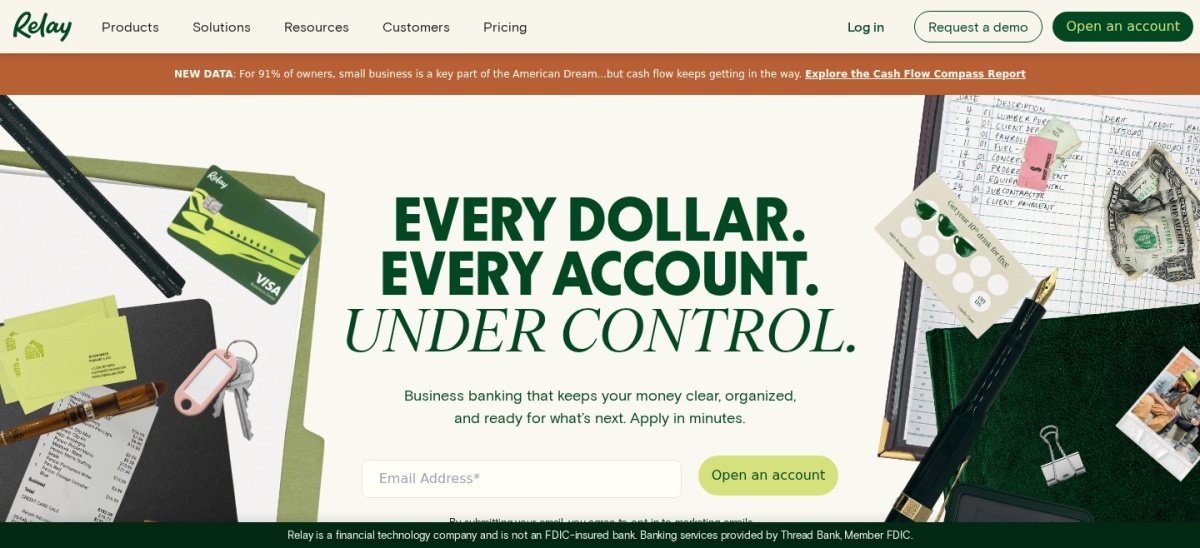
Relay is an online business banking platform designed around envelope-style cash management. Its $0/month Starter plan lets small businesses open up to 20 separate checking accounts and issue up to 50 virtual or physical debit cards per checking account, isolating vendor and software charges by dedicated account.
The trade off is that multi-step approval workflows, recurring invoices, and 1.25% credit card cashback require Relay Grow at $30/month ($360/year). It suits small businesses and Profit First practitioners who want virtual cards tied to isolated checking buckets.
What we like
Up to 20 separate checking accounts and 50 debit cards per account at $0/month
Direct receipt capture and QuickBooks Online or Xero integrations
1% credit card cashback on Starter, rising to 1.5% on Scale
Granular team member permission controls included free
Watch out for
Outgoing domestic wires cost $8 on Starter ($5 on Grow and Scale)
Multi-step bill approval rules require Grow at $30/month
Privacy.com remains a solid browser extension for solo US consumers, but its four-tier pricing structure limits scale. The free Personal plan caps you at 12 new cards per month, Plus ($5/month) allows 24 cards, Pro ($10/month) allows 36 cards with 1% cashback up to $4,500/month, and Premium ($25/month) tops out at 60 cards.
Because Privacy.com is built around a single personal login and US debit funding source, it cannot issue cards to employees, enforce multi-step approvals, sync receipts to accounting software, or hold multi-currency balances. Switching to a dedicated business card platform or multi-currency account removes those ceilings without requiring a monthly subscription.
How we chose
We evaluated virtual card issuers, digital banks, and corporate spend platforms that provide merchant locking, spending limits, or single-use card numbers similar to Privacy.com. Every candidate had to support active virtual card issuance for either personal buyers or business teams.
All pricing tiers, card creation limits, and user review scores were verified on 29 Nov 2026 directly from official vendor pricing pages, help centers, G2, and Trustpilot. Where a platform offers a free base tier alongside paid upgrades, we list both the $0 entry option and the regular rate of the cheapest paid tier.
We excluded standard consumer credit cards that only generate static virtual numbers inside a bank app without per-card spending caps, as well as unverified offshore prepaid card resellers without transparent public fee schedules. No vendor paid for a place, and we do not claim testing for this list.
How to choose the right privacy.com alternative
Match your funding source, team size, and currency needs before picking a virtual card provider.
Separate personal privacy from business spend. If you are masking personal subscriptions or online shopping, choose a consumer tool like Revolut, Wise, or Cloaked. If employees or contractors need cards, choose a business platform like Ramp, Brex, or Relay that includes receipt capture and accounting sync.
Check card creation limits and per-seat fees. Privacy.com charges up to $25/month for 60 cards, whereas Ramp, Brex, BILL Spend & Expense, Mercury, and Slash issue unlimited virtual cards on $0/month starter tiers. Watch whether paid upgrades charge per user or a flat monthly fee.
Verify funding method and foreign exchange fees. Privacy.com pulls directly from a linked US bank account or debit card, while Revolut and Wise require pre-funding a wallet balance. If you pay international vendors, compare Wise's mid-market conversion fees against Mercury's 3% non-USD card fee.
Confirm card lock and expiration granularity. Decide whether you need cards that auto-close after one swipe (Revolut disposable cards), lock to a single merchant (Ramp, Mercury), or draw from an isolated checking balance (Relay).
FAQ
What is the best privacy.com alternative in 2026?
Ramp is the best overall privacy.com alternative for businesses, offering unlimited virtual cards, merchant locks, and receipt matching on a $0/user/month plan. For personal users, Revolut is the top free choice thanks to single-use disposable cards that refresh after every purchase.
Is there a free alternative to Privacy.com for personal use?
Yes, both Revolut and Wise offer $0/month personal accounts with virtual cards. Revolut Standard includes single-use disposable cards and multi-use virtual cards for free, while Wise provides up to three free digital cards after a one-time physical card order fee.
Which privacy.com alternative allows unlimited virtual cards?
Ramp, Brex, BILL Spend & Expense, Mercury, and Slash all allow businesses to create unlimited virtual cards on their $0/month starter plans. Relay also includes up to 50 virtual debit cards per checking account across 20 accounts on its $0/month Starter tier.
What is the best privacy.com alternative outside the US?
Revolut and Wise are the strongest international options because Privacy.com only supports US residents and US bank accounts. Wise lets you hold over 40 currencies with mid-market exchange rates, while Revolut supports 36+ currencies and disposable cards across Europe, the UK, and beyond.
How do Ramp and Brex compare as Privacy.com replacements?
Both Ramp and Brex offer $0/user/month entry plans with unlimited virtual cards, merchant rules, and automated receipt matching. Ramp starts paid upgrades at $15/user/month plus a platform fee for multi-entity ERP workflows, while Brex Premium starts at $12/user/month and includes local-currency cards in 50+ countries.
Are virtual cards from these alternatives safe for free trials?
Yes, disposable and limit-capped virtual cards prevent unwanted recurring charges after a free trial ends. Setting a $1 spending limit or freezing the virtual card immediately after signup ensures merchants cannot bill your underlying account if you forget to cancel.
SaaS SEO and WordPress specialist with about 8 years of experience. Rakib compares WordPress plugins, themes, hosting and software using public pricing, documentation and user reviews. See how we rank.