Keyword Insights is the best keyword clustering tool for most SEO teams, with SERP-overlap grouping at $58 a month and a 4.9 out of 5 G2 rating from 11 reviews. KeyClusters is the cheapest pay-as-you-go option at $19 for 2,500 keywords, while Semrush suits teams that already pay for a full SEO suite.
How we make this list: we compare pricing pages, product documentation and public user reviews, then re-check every price before each update. No product paid for a place. Disclosure.
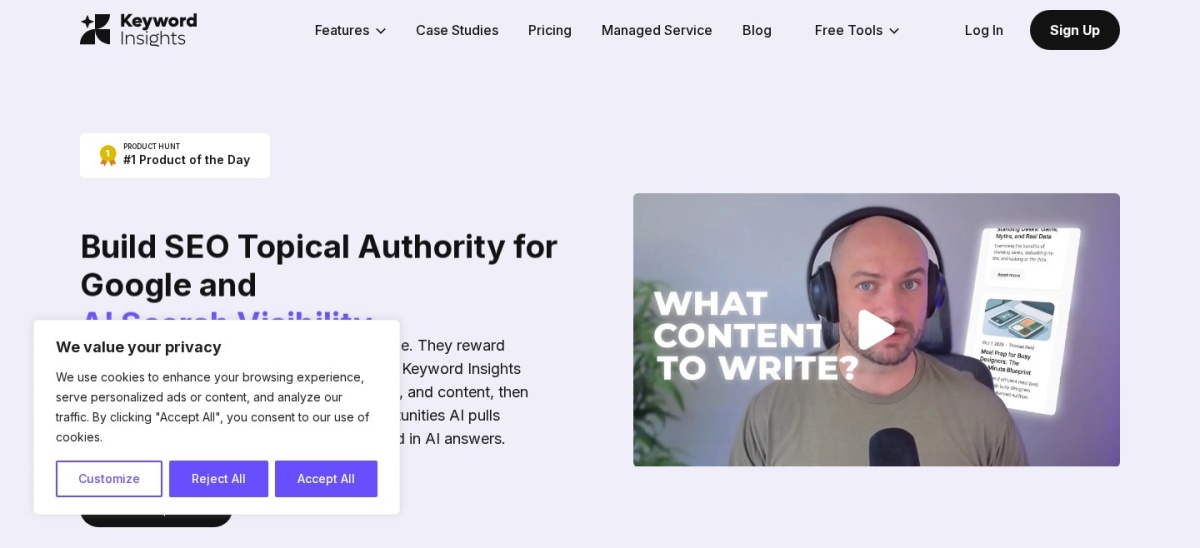
Keyword Insights groups keywords by live SERP overlap, with 1 credit per keyword and 10,000 credits a month on Basic at $58 a month.
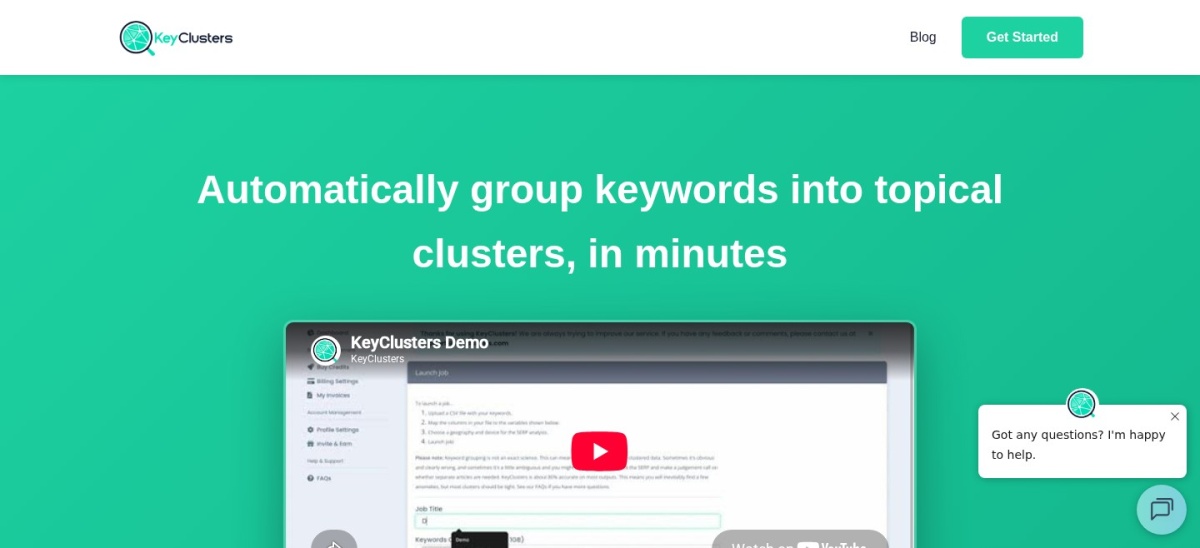
KeyClusters is the cheapest way to cluster one list: $19 for 2,500 keywords, with credits that never expire and no subscription.
Semrush and SE Ranking bundle clustering inside full SEO suites, so they only make sense if you also need tracking, audits and backlinks.
Ahrefs only shows keyword clusters on Standard at $249 a month, so its $29 Starter plan does not cover this job.
Keyword Cupid is the cheapest monthly plan here at $9.99 a month, but its only public rating is 4 out of 5 on Trustpilot from 3 reviews.
How do you choose the best keyword clustering tool?
SERP overlap is the grouping method to look for first. Keywords that share 3 or more of the same top 10 results usually belong on one page, while keywords grouped only by shared words often split pages that should rank together.
Credit and subscription models change the real cost fast. A $58 monthly plan with 10,000 credits suits a team clustering every week, while a one-off $19 pack suits a single list that may not need another run for months.
A clustering tool is only as useful as what happens next. Our guide on how to do keyword research for a WordPress blog shows how a grouped list turns into a page plan, and tools with briefs or mind maps shorten that step.
Thin review bases deserve caution, not dismissal. Two specialists here hold 4.9 out of 5 ratings from only 11 and 20 reviews, so their scores say less than the same rating from a suite with over 1,000 reviews.
Free options are limited in this niche. Only KeyClusters, Semrush and Ahrefs offer any free access, and none of them clusters a large list for free.
Keyword Insights is a dedicated keyword clustering platform that groups keywords by live SERP overlap, labels search intent and turns each cluster into a content brief. Basic costs $58 a month for 10,000 credits, 1 seat and 5 workspaces, with clustering at 1 credit per keyword and a $1 trial for 7 days with 5,000 credits.
The trade off is the credit meter. A large keyword list burns through the 10,000-credit Basic allowance fast, and the 4.9 out of 5 G2 rating rests on only 11 reviews. It suits SEO teams and agencies planning large sites from keyword lists.
What we like
Clusters by live SERP overlap, not word similarity
KeyClusters is a single-purpose keyword clustering tool that runs every keyword through Google, checks the top 10 results and groups keywords sharing 3 or more of the same pages. The smallest pack is $19 for 2,500 keywords, credits never expire, and new accounts get 100 free credits.
The trade off is scope. KeyClusters does one job and returns an Excel file, with no keyword discovery, briefs or writing, so you must bring your own list. It suits freelancers and small teams clustering occasional lists without a monthly bill.
Semrush is an all-in-one SEO suite whose Keyword Strategy Builder groups keywords into topic clusters inside its keyword research workflow. The SEO plan costs $139.95 a month for 5 projects, 500 tracked keywords a day, site audits and competitor research, with a limited free plan.
The trade off is price. At $139.95 a month it is hard to justify if you only need clustering, and annual billing drops the monthly rate to $117.33. It suits teams already paying for Semrush that want grouping without another subscription.
SE Ranking is a full SEO suite with a Keyword Grouper that clusters keywords by SERP overlap, plus rank tracking, site audits and backlink monitoring. Core costs $129 a month for 10 projects, 1 manager seat and 2,000 tracked keywords a day, or $103.20 a month billed yearly, with a 14-day free trial.
The trade off is depth. Its grouping is simpler than the dedicated specialists, and the Core plan changed in late 2026 from $52 a month billed yearly to the current Core pricing. It suits freelancers and small agencies that want one suite, not five tools.
Surfer is a content optimization platform whose Topical Map proposes content clusters from your domain and competitors, then scores each draft live in its Content Editor against the top-ranking pages. Discovery costs $49 a month for 120 documents a year, 1 seat and 1 brand workspace.
The trade off is the document cap. Discovery covers 10 documents a month, so teams publishing daily need Standard at $99 a month, and higher plans were on a Cyber Week sale when checked. It suits content teams that plan clusters and optimize drafts in one workflow.
Frase is an AI content workflow tool that scrapes the top search results, extracts competitor headings, spots content gaps and turns clusters into a structured brief, outline and first draft. Starter costs $49 a month for 1 seat, 1 site, 10 articles a month and 50 audit pages, or $39 a month billed yearly.
The trade off is the article cap. Starter stops at 10 articles a month with no overage option, so regular publishers need Professional at $129 a month, and older roundups still quote retired Solo and Basic plans. It suits solo writers and small teams that want briefs without Surfer prices.
What we like
Fastest SERP-to-brief workflow here
Briefs, drafts and optimization in one place
7-day free trial with no card required
Watch out for
Starter stops at 10 articles a month
Only 1 site on Starter
AI output still needs editing before publishing
Professional adds 40 articles and 5 sites at $129 a monthVisit frase.io
07
Ahrefs
4.5/5on G2 (713 reviews, checked Nov 2026)
Paid from$249/mo
Best for clustering with backlink data
Clustering featureKeyword clusters
Plan with clustersStandard, $249/mo
Tracked keywords2,000
Projects20 non-verified
ahrefs.com
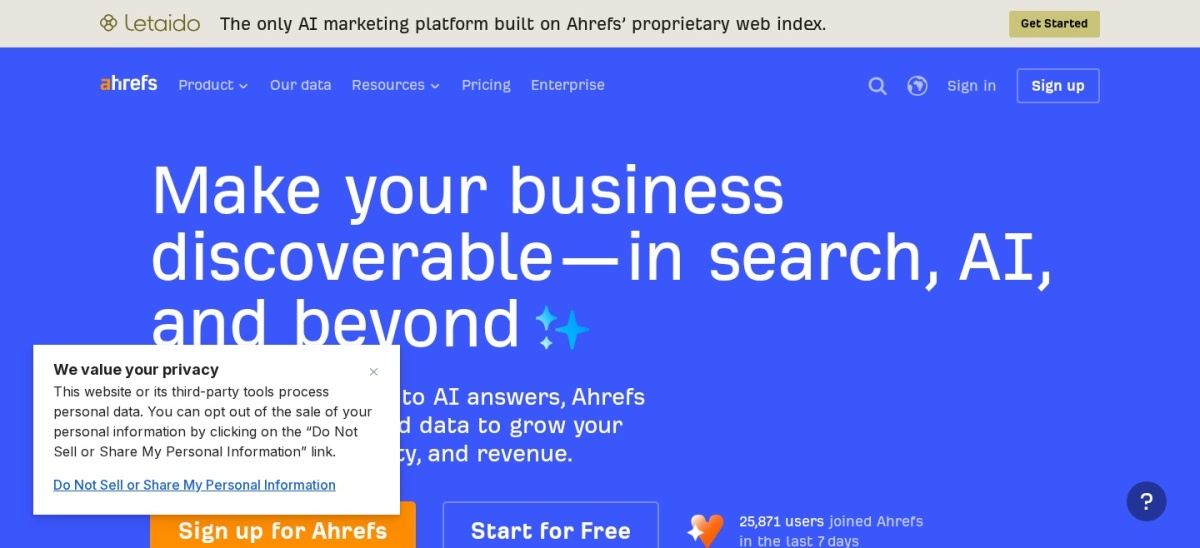
Ahrefs homepage, captured Nov 2026.
Ahrefs is a research platform whose Keywords Explorer groups keywords into clusters with search intent, backed by its backlink index and rank tracking. Keyword clusters are listed under Standard at $249 a month, which covers 20 non-verified projects, 2,000 tracked keywords and 2 years of history, with a free tier for your own verified sites.
The trade off is the entry price for this job. Starter at $29 a month and Lite at $129 a month do not list keyword clusters, so clustering costs $249 a month here. It suits teams that already need Ahrefs backlink and competitor data beside their clusters.
What we like
Clusters beside deep backlink data
Parent Topic shows the head term per group
Free tier for your own verified sites
Watch out for
Clusters need the $249 Standard plan
Credit limits apply per user
No refunds in general
Advanced adds 5,000 tracked keywords at $449 a monthVisit ahrefs.com
08
Keyword Cupid
4/5on Trustpilot (3 reviews, checked Nov 2026)
Starts at$9.99/mo
Best for visual cluster maps
Clustering methodSERP overlap plus machine learning
Credits on Starter500 a month
Keywords per reportUp to 2,000
Paid planStarter, $9.99/mo
keywordcupid.com
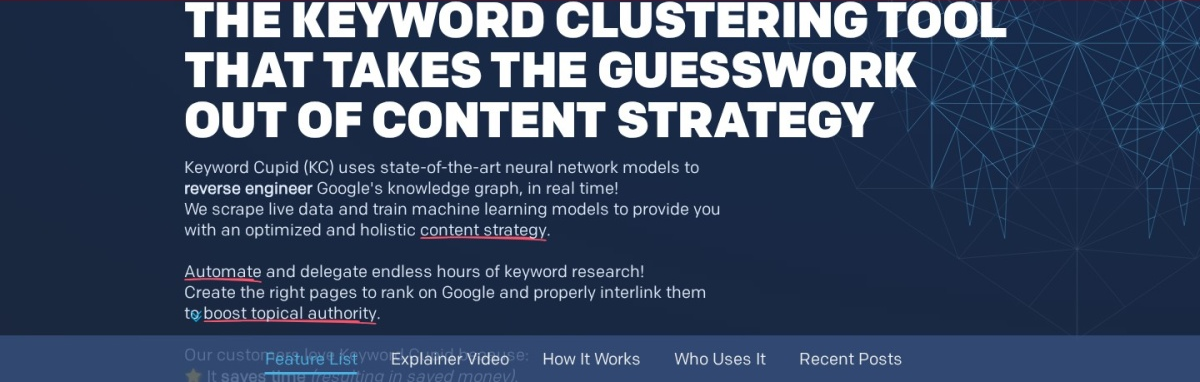
Keyword Cupid homepage, captured Nov 2026.
Keyword Cupid is a dedicated clustering tool that analyzes live Google results, groups keywords by shared search intent and shows the result as an interactive mind map with topical silos. Starter costs $9.99 a month for 1 user, 500 keyword credits a month and reports of up to 2,000 keywords, with a $1 trial for 7 days.
The trade off is proof. Its only public rating is 4 out of 5 on Trustpilot from 3 reviews, with no verified G2 or Capterra profile, and Starter credits reset each month. It suits strategists who think in maps and need a visual plan to share with clients or writers.
What we like
Cheapest monthly plan in this list
Interactive mind maps and topical silos
Excel export included on Starter
Watch out for
Only 3 Trustpilot reviews, so the rating says little
SERP overlap vs word matching: which grouping holds up?
SERP overlap groups keywords that rank for the same pages, so the groups match what Google already treats as one topic.
Word matching groups keywords that share words, which is fast and free but splits or merges pages on vocabulary alone.
If a cluster decides which pages you publish, use a SERP-based tool for that list and keep a free word-based grouper only as a first pass.
How we chose
We started from the dedicated clustering tools and the clustering features inside the main SEO suites, then kept 8 with a public rating and a published price.
Prices come from each vendor's pricing page, checked on 29 November 2026. Ratings and review counts come from G2, Capterra or Trustpilot on the same day. Where a vendor shows a sale, the list shows the regular price.
We left out tools with no public rating at all, including LowFruits, Cluster AI and Contadu, and tools whose pricing is now quote-led. No vendor paid for a place, and we do not claim to have used these tools ourselves.
How to choose a keyword clustering tool
Start with how often you cluster, then match the billing model to that rhythm.
Count how many keywords you cluster each month. A one-off list of a few thousand keywords suits a pay-as-you-go pack, while weekly lists suit a monthly credit plan.
Check whether the plan you pay for includes clustering. Ahrefs lists keyword clusters on Standard, so a cheaper Ahrefs plan does not cover this job, while Semrush and SE Ranking include grouping in their entry suites.
Pick SERP overlap for page decisions. Groups built from live results match what Google treats as one topic, so use them when a cluster decides which page to publish.
Try the cheapest path before you commit. Use the 100 free KeyClusters credits or a $1 trial to cluster a real list, then check the groups against pages you already rank for.
FAQ
What is the best keyword clustering tool in 2026?
Keyword Insights is the best keyword clustering tool for most SEO teams. It groups keywords by live SERP overlap, labels intent and turns clusters into briefs, starting at $58 a month, and it holds a 4.9 out of 5 G2 rating from 11 reviews.
How much does a keyword clustering tool cost?
Entry prices run from $9.99 a month for Keyword Cupid and $19 once for a KeyClusters pack of 2,500 keywords, to $58 a month for Keyword Insights and $139.95 a month for Semrush. Suites cost more because clustering is one feature inside a larger subscription.
Is there a free keyword clustering tool?
KeyClusters gives 100 free credits on signup, Semrush has a limited free plan and Ahrefs has a free tier for your own verified sites. No tool in this list clusters a large list for free, so a free option works best as a trial before a paid plan.
Which keyword clustering tool is best for beginners?
KeyClusters is the easiest starting point, because you upload a list and get an Excel file back with no subscription. Keyword Cupid is the next step up if you want the same groups shown as a mind map for $9.99 a month.
Which keyword clustering tool is best for small teams?
Keyword Insights on Basic at $58 a month suits small teams that cluster often, with 10,000 credits, 1 seat and 5 workspaces. SE Ranking Core at $129 a month suits teams that also want rank tracking, audits and backlinks in the same bill.
Keyword Insights vs KeyClusters: which is better?
Keyword Insights is better for ongoing work, because it adds intent labels, briefs and AI drafts to SERP-based clusters for $58 a month. KeyClusters is better for occasional lists, because a $19 pack clusters 2,500 keywords with no subscription and credits that never expire.
Keyword Insights vs Semrush: which is better?
Keyword Insights is better if clustering is the main job, because it is built for SERP-based grouping and briefs at $58 a month. Semrush is better if you also need research, tracking, audits and PPC data, because its Keyword Strategy Builder sits inside a $139.95 a month suite.
SaaS SEO and WordPress specialist with about 8 years of experience. Rakib compares WordPress plugins, themes, hosting and software using public pricing, documentation and user reviews. See how we rank.