Redpanda is the best Kafka alternative for most teams, rated 4.6 out of 5 on G2 from 66 reviews, with a free Serverless tier and full Kafka API compatibility. Pick Google Cloud Pub/Sub for a fully managed service with no cluster to run, or Confluent Cloud for the widest streaming ecosystem.
How we make this list: we compare pricing pages, product documentation and public user reviews, then re-check every price before each update. No product paid for a place. Disclosure.
Redpanda is the top pick: 4.6 out of 5 on G2 from 66 reviews, full Kafka API support and a Serverless tier with no base cost.
Confluent Cloud has the widest platform, with Flink and Schema Registry, but Standard starts at about $385 a month and bills by use.
Google Cloud Pub/Sub is the simplest fully managed pick: no partitions to size, 10 GiB free a month, then $40 per TiB.
Kinesis costs from $10.80 a month per shard, Aiven from $35 a month, and Event Hubs from $21.90 a month per throughput unit.
RabbitMQ and ActiveMQ are free and open source, but they are message brokers, not replayable event logs.
Apache Pulsar and NATS have no public G2, Capterra or Trustpilot rating, so they could not be scored for this list.
How do you choose the best Kafka alternative?
Kafka is hard to replace with one product, because teams use it for different jobs. Some need a replayable event log, some need a queue that hands each message to one worker, and some only need events to move between cloud services.
The first split is whether you need a replayable log. Redpanda, Confluent Cloud, Aiven and Kinesis keep events so many readers can replay them, while RabbitMQ and ActiveMQ delete a message once a worker takes it.
Price is the second split, and it is mostly usage, not a flat plan. Pub/Sub bills $40 per TiB, Kinesis bills per shard-hour, and Confluent bills in eCKUs, so the cheapest pick depends on how much data you move.
The third split is how much operating you want to keep. Fully managed services such as Pub/Sub, Kinesis and Event Hubs remove brokers and patching, while free brokers such as RabbitMQ and ActiveMQ leave the running to you.
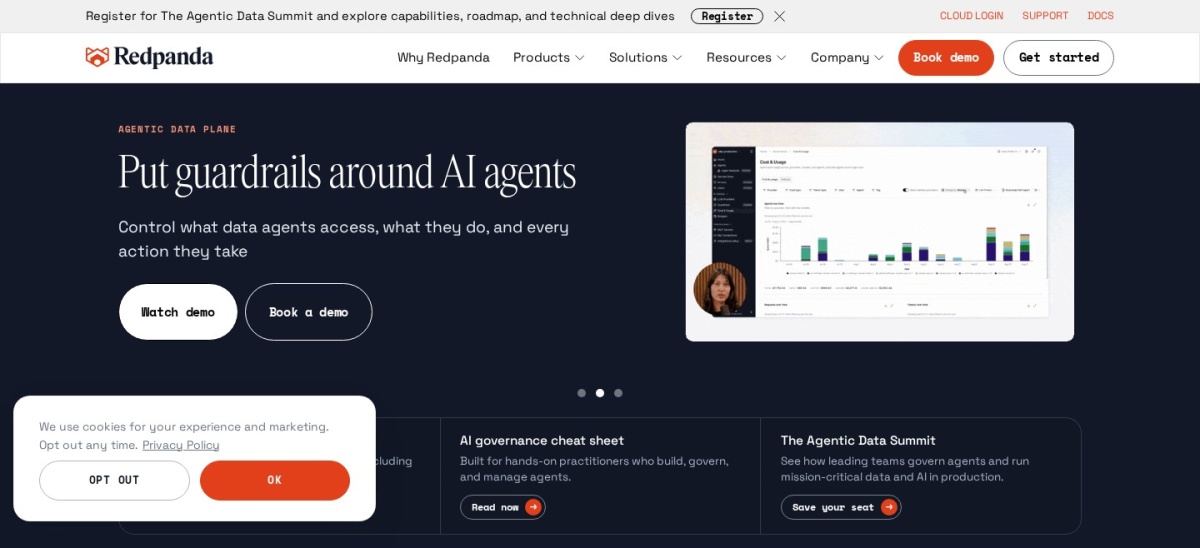
Redpanda is a Kafka-compatible streaming platform written in C++, so it runs as a single binary with no JVM and no ZooKeeper or KRaft quorum to manage. The Cloud Serverless tier has no base cost, and the platform includes a web console, more than 300 managed connectors and tiered storage.
The trade off is price transparency. Serverless is pay-as-you-go with no published unit rates, and Dedicated and BYOC clusters are quote-based. It suits teams that want Kafka clients to work unchanged with less infrastructure to run.
What we like
Highest G2 rating in this list at 4.6 out of 5
Single binary with no JVM to tune
Free Serverless tier with no base cost
More than 300 managed connectors
Watch out for
No published price for paid cloud clusters
Core is source-available under BSL, not open source
Some reviewers note the console is thin for advanced setup
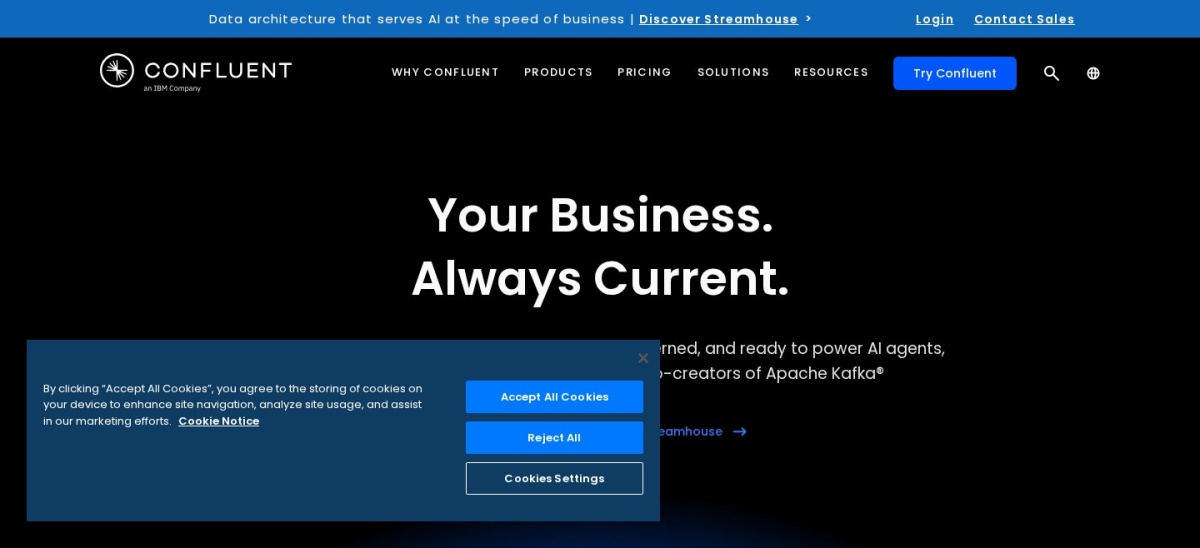
Confluent Cloud is the managed Kafka service from the company founded by Kafka's creators, built on Apache Kafka with a serverless model. The Basic cluster starts at $0, and Standard starts at about $385 a month with managed connectors, Schema Registry, stream governance and Flink for stream processing.
The trade off is the bill. Pricing is usage-based in eCKUs, so a Standard cluster running all month costs more than the $385 starting estimate, which assumes about 70% use. It suits teams that want the fullest streaming platform and can watch usage.
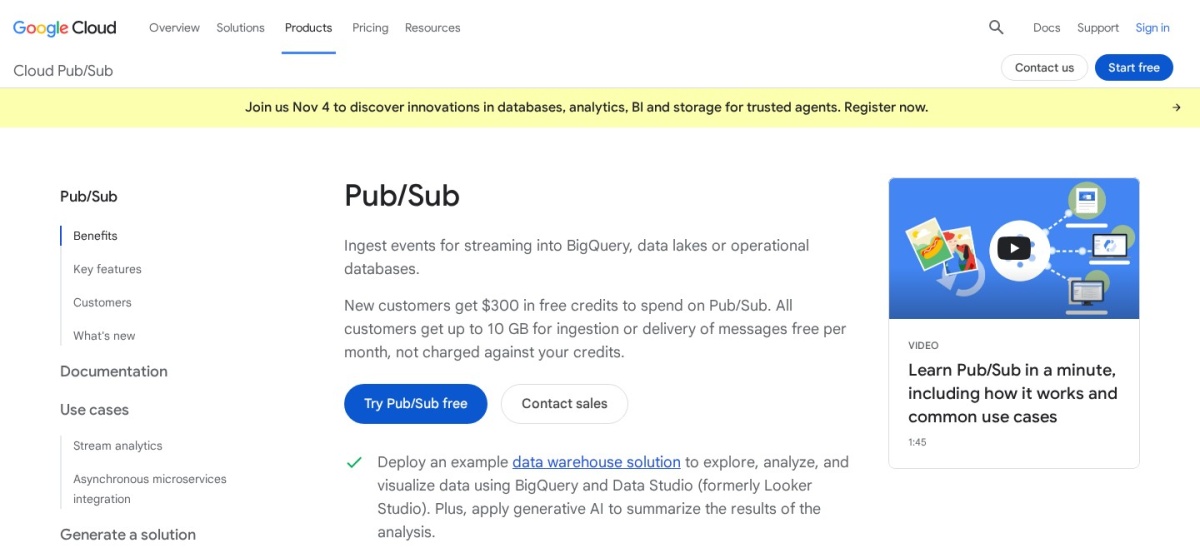
Google Cloud Pub/Sub is a fully managed messaging service from Google with no clusters or partitions to size. Publishers send to topics, subscribers pull or receive by push, and the first 10 GiB of throughput a month is free, with exactly-once delivery and 31 days of topic retention.
The trade off is the meter. After the free 10 GiB, throughput costs $40 per TiB on publish and again on every subscription delivery, so extra subscriptions raise the bill. It suits Google Cloud teams that want messaging with no operations.
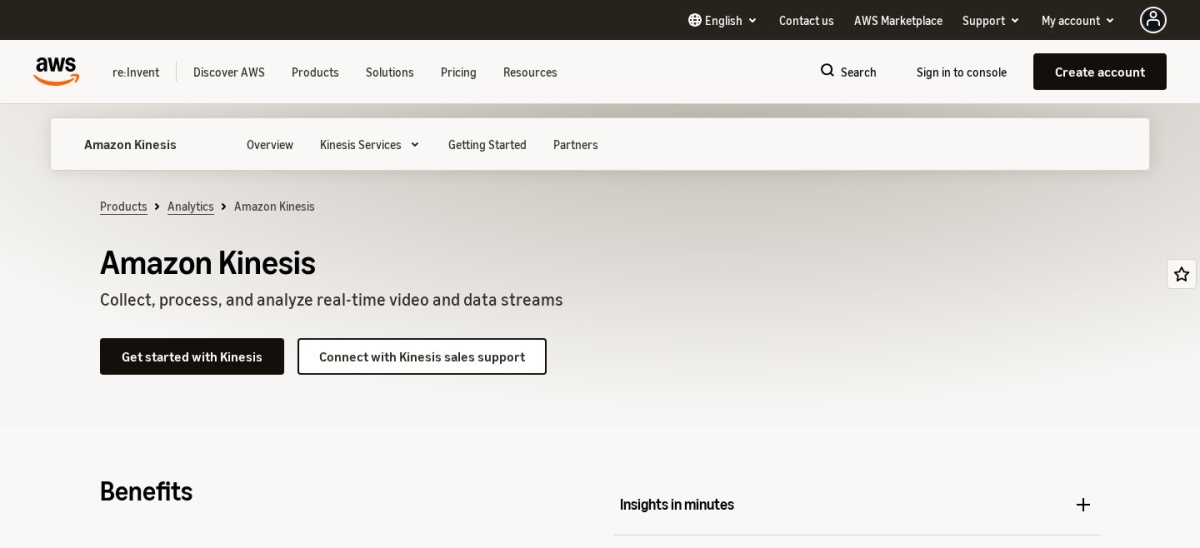
Amazon Kinesis Data Streams homepage, captured Nov 2026.
Amazon Kinesis Data Streams is AWS's managed service for real-time data ingestion, built for teams already on AWS. One shard takes 1 MB a second in and 2 MB a second out, data stays for 24 hours by default, and it plugs into Lambda, Firehose and Kinesis Data Analytics.
The trade off is cost control. Provisioned mode bills $0.015 per shard-hour plus $0.014 per million PUT units, so idle shards still cost money, and on-demand mode bills per GB instead. It suits AWS teams that want a replayable stream without running brokers.
What we like
Deep integration with Lambda and other AWS services
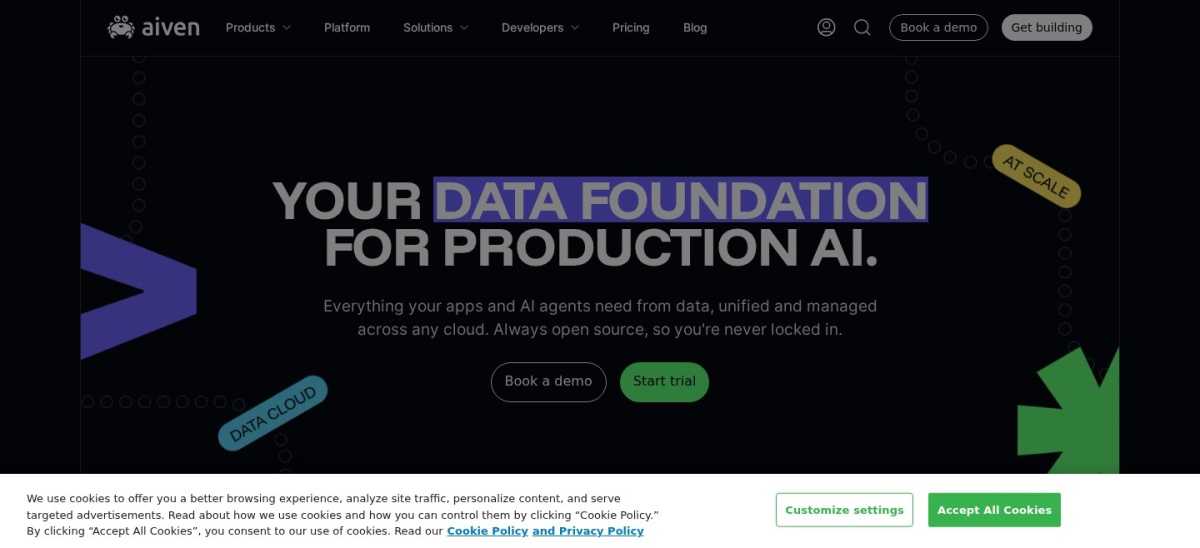
Aiven for Apache Kafka homepage, captured Nov 2026.
Aiven for Apache Kafka is a fully managed Kafka service that runs on AWS, Google Cloud and Azure, with built-in Schema Registry, Kafka Connect and multi-cloud VPC peering. The Free plan costs $0, Developer starts at $35 a month with 1 MB a second of throughput, and Professional starts at $180 a month with a 99.99% SLA.
The trade off is the ceiling on the cheaper plans. Developer caps throughput at 1 MB a second with up to 3 days of retention, so production workloads need Professional. It suits teams that want a predictable monthly price and no broker operations.
Zero-downtime upgrades and built-in Schema Registry
Watch out for
Developer plan caps throughput and retention
Professional costs $180 a month for full scale
Reviewers call it pricey for small workloads
Professional adds unlimited throughput and 99.99% SLAVisit aiven.io
06
Azure Event Hubs
4.2/5on G2 (13 reviews, checked Nov 2026)
Starts at$21.90/mo
Best Kafka endpoint on Azure
DeploymentManaged, Azure
Kafka endpointStandard plan and up
Throughput1 MB/s in per unit
Retention7 days on Standard
azure.microsoft.com
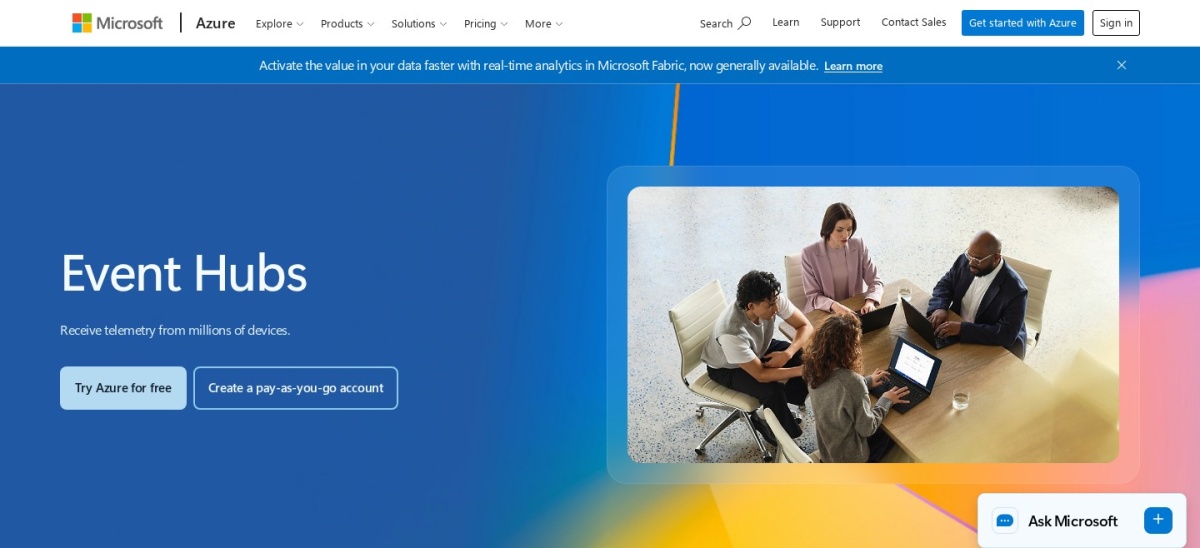
Azure Event Hubs homepage, captured Nov 2026.
Azure Event Hubs is Microsoft's managed event ingestion service, and its Standard plan exposes a Kafka endpoint, so Kafka producers and consumers can connect with little change. One throughput unit takes 1 MB a second in and 2 MB a second out.
The trade off is the tier. The cheaper Basic plan has no Kafka endpoint, and Standard retention is 7 days, so longer replay needs a higher tier or another store. It suits Azure teams that want Kafka compatibility without running brokers.
RabbitMQ is a free, open-source message broker that routes messages between services through exchanges and queues. It supports AMQP 1.0 and MQTT 5.0, ships with a management interface, and runs on Windows, macOS and Linux.
The trade off is the model. RabbitMQ is a queue, not a replayable log, so a message is gone once a worker takes it, and clustering takes care at scale. It suits teams that need task queues and flexible routing, not event replay.
Apache ActiveMQ is a free, open-source message broker from the Apache Software Foundation, built for Java teams. It speaks JMS plus AMQP, MQTT and STOMP, and reviewers praise its easy setup and broad protocol support.
The trade off is age and scope. ActiveMQ is a broker, not a streaming log, so there is no replay from a retained log, and its interface looks dated next to cloud services. It suits Java shops that need a simple, free broker.
Solace PubSub+ is an enterprise event broker that moves messages across cloud, on-premises and IoT on one bus, speaking MQTT, AMQP 1.0, JMS and REST. Its Standard software edition is free within capacity limits, and it also ships as a managed cloud service.
The trade off is price and weight. No dollar prices are published, so every production deployment needs a sales quote, and reviewers call the learning curve steep. It suits large teams building an event mesh across regions.
What we like
One bus for many protocols
Dynamic routing across regions
Hardware appliance option
Free Standard edition for development
Watch out for
No published prices, quote only
Steep learning curve, per G2 reviewers
Only 7 G2 reviews, the thinnest base here
Quote only; free Standard edition has capacity limitsVisit solace.com
When to stay with Kafka instead
Stay with Kafka if your producers and consumers already speak its protocol and you rely on its ecosystem. Connectors, stream processing and schema tools are built for Kafka first, and moving to Pub/Sub or Kinesis means rewriting that glue.
Stay if you need long retention with replay. Kafka keeps events for days or months by default, while Event Hubs Standard keeps 7 days and Kinesis keeps 24 hours unless you pay for more.
Move when the operating cost is the problem, not the protocol. If patching, scaling and ZooKeeper or KRaft care take more time than the streaming itself, a managed service or a simpler engine such as Redpanda is the honest fix.
How we chose
We started from the streaming and messaging tools buyers compare against Kafka, then kept the nine with a public rating on G2 and a live homepage and pricing page.
Prices come from each vendor's pricing page or its G2 pricing record, checked on 29 November 2026. Ratings and review counts come from G2 on the same day. Where a vendor shows a sale, the list shows the regular price.
We left out tools with no public rating, including Apache Pulsar and NATS, rather than scoring them on no evidence. No vendor paid for a place, and we do not claim to have used these tools ourselves.
How to choose a Kafka alternative
Start with what you need Kafka to do, then match the model before the price.
Decide if you need replay. If many readers must re-read old events, you need a log such as Redpanda, Kinesis or Confluent Cloud. If each message goes to one worker, a queue such as RabbitMQ is enough.
Check Kafka compatibility. Redpanda, Confluent Cloud, Aiven and Event Hubs speak the Kafka API, so existing producers and consumers connect with little change. Pub/Sub, Kinesis and RabbitMQ need code changes.
Model the bill on your volume. Usage pricing looks cheap at low volume and climbs fast. Work out your monthly GB and shards first, then compare the meter, not the headline free tier.
Run one real workload first. Move a single low-risk stream, watch latency and cost for a week, and only then move the rest. Our guide on adding a custom REST API endpoint shows the same small-first pattern for integrations.
FAQ
What is the best Kafka alternative?
Redpanda is the best Kafka alternative for most teams. It is rated 4.6 out of 5 on G2 from 66 reviews, speaks the full Kafka API so existing clients work unchanged, and its Cloud Serverless tier has no base cost.
What is the cheapest Kafka alternative?
RabbitMQ and ActiveMQ are the cheapest, because both are free and open source with no licence cost. Among managed services, Kinesis starts at $10.80 a month per shard, Aiven Developer at $35 a month, and Event Hubs at $21.90 a month per unit.
Is there a free Kafka alternative?
Yes. RabbitMQ and ActiveMQ are free and open source, Redpanda has a free Serverless tier, Confluent Cloud Basic starts at $0, Pub/Sub gives 10 GiB free a month, and Aiven has a free plan. Solace also offers a free Standard software edition.
Which Kafka alternative is best for beginners or small teams?
Google Cloud Pub/Sub is the easiest start, because there is no cluster or partition to size and the first 10 GiB a month is free. Aiven Developer at $35 a month is the best small-team pick if you want to keep the Kafka API.
Redpanda vs Confluent Cloud: which is better?
Redpanda is better for teams that want a simpler Kafka-compatible engine, with the highest G2 rating here at 4.6 out of 5 and a free Serverless tier. Confluent Cloud is better for teams that want the widest platform, with Flink, Schema Registry and the most connectors.
Why is Apache Pulsar not on this list?
Apache Pulsar has no public rating on G2, Capterra or Trustpilot, so it could not be scored on the same basis as the other nine. It is free and open source, and its managed service, StreamNative Cloud, starts at $73 a month for Serverless.
Can I migrate from Kafka without rewriting my producers?
Yes, if you pick a Kafka API compatible service. Redpanda, Confluent Cloud, Aiven and Azure Event Hubs speak the Kafka API, so existing producers and consumers connect with little change. Pub/Sub, Kinesis, RabbitMQ and ActiveMQ need code changes.
SaaS SEO and WordPress specialist with about 8 years of experience. Rakib compares WordPress plugins, themes, hosting and software using public pricing, documentation and user reviews. See how we rank.