RunMyJobs by Redwood is the best JAMS Scheduler alternative for most teams, rated 4.8 out of 5 on G2 from 314 reviews, with fully managed SaaS delivery and the deepest SAP automation. Pick Kestra if you want a free open-source scheduler, or Tidal Automation for centralised cross-application scheduling with SLA management.
How we make this list: we compare pricing pages, product documentation and public user reviews, then re-check every price before each update. No product paid for a place. Disclosure.
RunMyJobs leads on G2 at 4.8 out of 5 from 314 reviews, the highest rating and the largest review base in this list.
Kestra is the only free open-source pick here, with a Core edition under Apache 2.0 and more than 2,900 plugins.
Five of the nine tools publish no price, so expect a sales quote for RunMyJobs, Tidal, OpCon, ActiveBatch and Stonebranch.
Only three tools publish a price: Airflow is free, Prefect Starter is $100 a month, and Control-M starts at $29,000 a year.
Tidal, RunMyJobs and ActiveBatch are all Redwood products now, so a Redwood shop can cover most of this list with one vendor.
How do you choose a JAMS Scheduler alternative?
Start with where your jobs live. JAMS users usually run Windows, SQL Server and PowerShell heavily, so a replacement must cover those platforms before anything else matters.
Price is the hardest part to compare. Most enterprise schedulers in this list publish no price at all, so budget for a quote, implementation time and training, not just the licence.
Free and open-source options change the maths. Kestra and Apache Airflow cost nothing to licence, but you run the scheduler, the workers and the upgrades yourself, which is a real staffing cost.
SAP depth is the clearest dividing line. RunMyJobs is the only tool here that is an SAP Endorsed App with premium certification, so SAP-heavy teams should weigh that first.
Scheduling basics still decide most migrations. Our guide on fixing WP-Cron not running shows how often a missed schedule comes from the scheduler itself, not the job it runs.
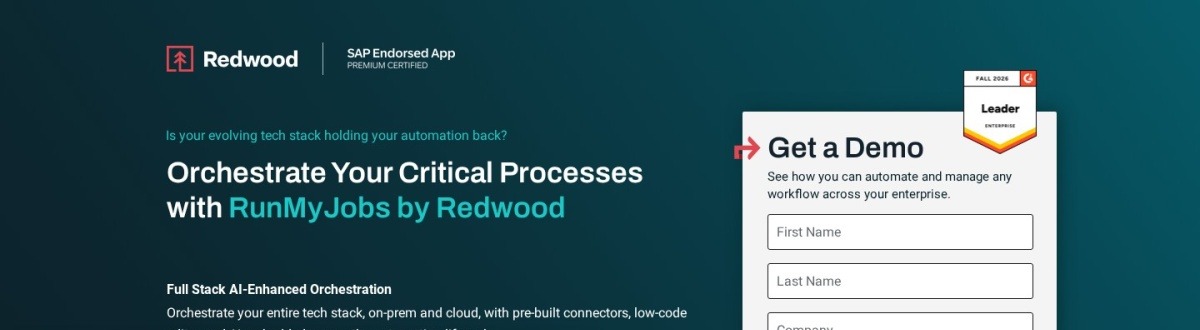
RunMyJobs by Redwood is a fully managed SaaS workload automation platform with the highest G2 rating in this list, 4.8 out of 5 from 314 reviews. It is the only workload automation tool that is an SAP Endorsed App with premium certification, and it is included in the RISE with SAP reference architecture.
The trade off is pricing. RunMyJobs charges a platform fee plus a fixed price per automation process run, and buyers request a personalised quote, so the cost scales with job volume. It suits SAP-heavy teams that want to stop running scheduler infrastructure themselves.
What we like
Highest G2 rating in this list, from the largest review base
Only SAP Endorsed App here, with premium certification
Fully managed SaaS, so no scheduler servers to run
Watch out for
No published price, so budgeting needs a quote
Per-run charges mean costs rise with job volume
Paid plans add SAP connector packs and higher run capacityVisit redwood.com
02
Kestra
4.6/5on G2 (25 reviews, checked Nov 2026)
PricingCustom/yr
Best free open-source alternative
Free planCore, open source
Cheapest paidCloud, usage-based
Plugins2,900+
Workflows defined asDeclarative YAML
kestra.io
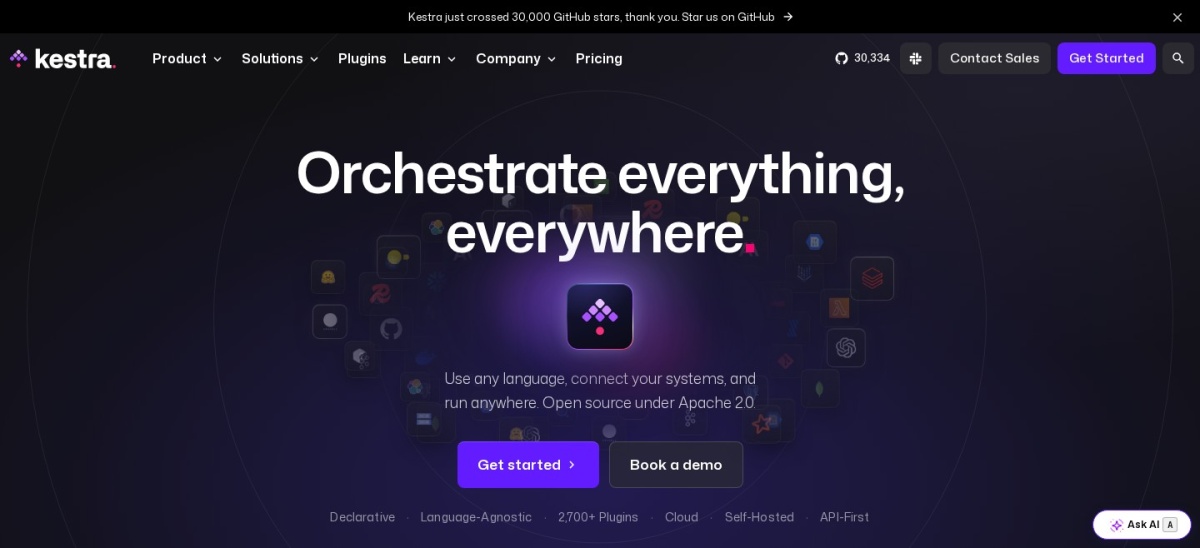
Kestra homepage, captured Nov 2026.
Kestra is an open-source orchestration platform where workflows are declared in YAML and run on a schedule, on events or through an API. The Core edition is free under Apache 2.0 with no limit on flows or executions, and it ships with more than 2,900 plugins and more than 30,000 GitHub stars.
The trade off is maturity and support. Its G2 rating of 4.6 out of 5 rests on only 25 reviews, and self-hosting means running and upgrading the platform yourself. It suits data and engineering teams that want code-first scheduling without a licence fee.
What we like
Free open-source Core with unlimited flows and executions
More than 2,900 plugins for databases, clouds and APIs
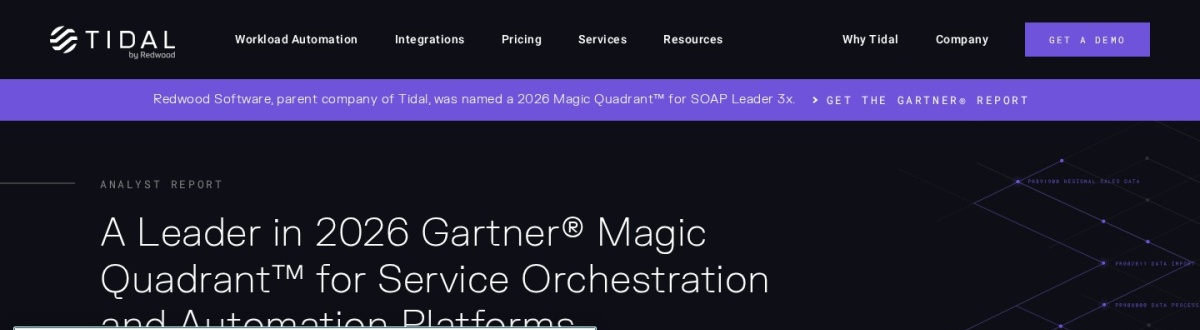
Tidal Automation is a workload automation platform from Redwood that centralises job scheduling across on-premises, cloud and hybrid systems. It offers time and event-based scheduling, custom calendars and more than 40 pre-built integrations, with SLA management built in.
The trade off is price and review depth. Tidal publishes no price, so budgeting needs a quote, and its 4.6 out of 5 G2 rating rests on 73 reviews. It suits teams that need one schedule across many applications with SLA accountability.
What we like
Joint-highest rating among the enterprise picks here
SLA management and 40+ pre-built integrations
Covers on-premises, cloud and hybrid systems
Watch out for
No published price, so budgeting needs a quote
Fewer G2 reviews than RunMyJobs, ActiveBatch or Control-M
OpCon is the workload automation platform from SMA Technologies, built for banks, credit unions and other teams with strict daily schedules. A single-server setup handles from 150 to 150,000 jobs a day, and its Self-Service feature lets business users trigger and monitor their own jobs.
The trade off is evidence and price. Its 4.6 out of 5 G2 rating rests on only 30 reviews, and OpCon publishes no price, so budgeting needs a quote. It suits regulated teams that need tight daily schedules and audited self-service.
What we like
Joint-highest G2 rating in this list, at 4.6 out of 5
Self-service lets business users run their own jobs
ActiveBatch is a workload automation platform from Redwood with a drag-and-drop designer and a library of more than 100 production-ready job steps. It connects to Oracle, SAP, SQL Server, FTP and other systems, and includes a Self-Service Portal so business users can run and monitor their own workflows.
The trade off is pricing. ActiveBatch uses usage-based pricing and asks buyers to request a personalised quote, so the cost depends on agents, environments and add-ins. It suits mid-market teams that want the closest direct swap for JAMS.
Stonebranch is a real-time IT automation platform built around its Universal Automation Center, which orchestrates workflows across on-premises, containerised and SaaS environments. It reacts to events as they happen rather than waiting for the next scheduled slot, and its Integration Hub ships community-built connectors.
The trade off is setup time and price. G2 reports an average implementation of about 5 months, and Stonebranch publishes no price, so budgeting needs a quote. It suits hybrid teams modernising from batch schedules toward event-driven automation.
What we like
Real-time, event-driven automation, not just batch
Prefect is a workflow orchestration platform built for Python teams that want the lightest setup. Add a decorator to existing functions and get scheduling, retries, observability and alerting without restructuring code into DAG files. The Hobby tier is free for 2 users and 5 deployments.
The trade off is the seat-based bill and the acquisition. Starter costs $100 a month for 3 users, Team costs $100 per user a month, and Prefect bought Dagster Labs in July 2026. It suits small Python-first teams that schedule data and API work.
What we like
Lightest setup here for Python teams
Free Hobby tier for 2 users and 5 deployments
Flat Starter price of $100 a month
Watch out for
Team pricing is per user, so costs rise with headcount
Apache Airflow is the open-source standard for orchestrating data pipelines. Pipelines are Python files called DAGs, operators cover every cloud service, and any data engineer the team hires will already know it. It is free to self-host under the Apache licence.
The trade off is the operational load. Self-hosting Airflow means running the scheduler, workers, metadata database and upgrades yourself, and Airflow 3 changed enough that migrations take planning. It suits data teams with the engineers to run it.
Control-M is the long-standing enterprise workload automation platform from BMC, orchestrating batch work from mainframe to multicloud through one unified view. It covers more than 100 integrations, including Snowflake, Databricks, SAP and ServiceNow, with Jobs-as-Code and an AI assistant that explains failed jobs.
The trade off is cost and complexity. The SaaS Starter Pack starts at $29,000 a year for 500 executions a month, and reviewers warn the interface takes time to learn. It suits large enterprises with mainframe estates and the budget to match.
What we like
Strongest mainframe and hybrid coverage here
More than 100 integrations, including SAP and Snowflake
Three tools here publish a price, and the gap is wide. Airflow is free, Prefect Starter is $100 a month, and Control-M starts at $29,000 a year.
The five quote-only tools are all enterprise schedulers. Their vendors size the price to agents, environments and job volume, so two buyers rarely pay the same amount.
Free tools are not free to run. Kestra and Airflow need servers, upgrades and someone on call when a schedule breaks, so compare staffing cost, not just licence cost.
How we chose
We started from the workload automation leaders on G2, then added the two open-source orchestrators buyers most often compare them with, Apache Airflow and Kestra, plus Redwood RunMyJobs, the highest-rated JAMS alternative on G2. Every tool here has a live G2 listing and an established vendor behind it.
Ratings and review counts come from G2, checked on 29 November 2026. Prices come from each vendor's own pricing page where one exists; where a vendor publishes no price, the list shows Custom. The Control-M figure comes from BMC's own pages and its vendor-provided G2 listing.
We left out niche schedulers with no public G2 rating, single-purpose cron tools, and VisualCron, whose Capterra rating rests on only 12 reviews. No vendor paid for a place, and we do not claim to have used these tools ourselves.
How to choose a JAMS Scheduler alternative
Start with your current JAMS estate, then match the replacement to the jobs that matter most.
List your JAMS jobs by platform. Count how many jobs run on Windows, SQL Server and PowerShell, and how many touch SAP, mainframe or cloud systems. The split decides the shortlist.
Decide between SaaS and self-hosted. RunMyJobs and Control-M SaaS remove scheduler servers, while Kestra and Airflow are free to licence but need your team to run them.
Ask for quotes early. Five of the nine tools publish no price. Get quotes before the migration plan, because per-run and per-agent pricing changes the budget.
Pilot the migration on one workflow. Move a single low-risk schedule first, check alerts, dependencies and calendars, then migrate the rest in batches.
FAQ
What is the best JAMS Scheduler alternative in 2026?
RunMyJobs by Redwood is the best JAMS Scheduler alternative for most teams. It is rated 4.8 out of 5 on G2 from 314 reviews, the highest rating in this list, and it runs as fully managed SaaS with the deepest SAP automation.
How much does a JAMS Scheduler alternative cost?
Prices range from free to $29,000 a year and beyond. Airflow is free, Prefect Starter is $100 a month, Control-M starts at $29,000 a year, and RunMyJobs, Tidal, OpCon, ActiveBatch and Stonebranch all publish no price and require a quote.
What is the best free alternative to JAMS Scheduler?
Kestra is the best free alternative. Its Core edition is open source under Apache 2.0 with no limit on flows or executions, and it is rated 4.6 out of 5 on G2. Apache Airflow is the other free pick, best for data pipelines.
Which JAMS alternative is best for small teams?
Prefect is the best pick for small teams. Its Hobby tier is free for 2 users, Starter costs a flat $100 a month for 3 users, and Python teams can start without restructuring their code. Kestra is the free option for teams that self-host.
RunMyJobs vs Tidal: which is better?
RunMyJobs is better for most teams. It is rated 4.8 out of 5 on G2 from 314 reviews against 4.6 from 73 for Tidal, it runs as fully managed SaaS, and it carries the SAP Endorsed App status. Tidal fits teams that want centralised scheduling with SLA management.
Which JAMS alternative is best for SAP?
RunMyJobs is the best JAMS alternative for SAP. It is the only tool here that is an SAP Endorsed App with premium certification, and it is included in the RISE with SAP reference architecture.
Is it hard to migrate from JAMS Scheduler?
Migration takes planning, but the tools here are built for it. Move one low-risk workflow first, map dependencies and calendars, then migrate in batches. Enterprise vendors typically quote implementation time in weeks to months.
SaaS SEO and WordPress specialist with about 8 years of experience. Rakib compares WordPress plugins, themes, hosting and software using public pricing, documentation and user reviews. See how we rank.