Smokeball is the best Filevine alternative for most firms, rated 4.7 out of 5 on G2 from 393 reviews, with automatic time capture and a $49 per user a month entry plan. Clio suits firms that want the largest integration set, while Assembly Neos is the closest fit for personal injury work.
How we make this list: we compare pricing pages, product documentation and public user reviews, then re-check every price before each update. No product paid for a place. Disclosure.
Smokeball has the highest rating here at 4.7 out of 5 on G2, from 393 reviews.
Clio, Smokeball, PracticePanther, Rocket Matter and CosmoLex all start at $49 per user a month.
Assembly Neos is the only tool built specifically for personal injury, at $99 per user a month.
Litify is the most expensive entry point at $150 per user a month, and it needs a Salesforce org.
Two of the nine tools publish no price on their own site, so expect a sales conversation for Litify and TrialWorks.
What should you look for in Filevine alternatives?
Filevine is built for high-volume litigation, so a good alternative must handle the same load. Matters, documents, deadlines, tasks and billing should sit in one record, with workflows that fit how injury cases actually move.
Price transparency is the biggest split in this market. Six tools publish a $49 or $50 per user a month entry price, while Litify and TrialWorks give no price on their own sites and sell through demos and quotes.
Personal injury features decide the shortlist. Medical chronologies, lien tracking, demand drafting and intake built for injury cases matter more than generic matter templates, which is why Neos and TrialWorks rank higher here than their size suggests.
Billing and trust accounting decide the running cost. Clio includes trust accounting on every plan, CosmoLex builds accounting into the entry tier, and MyCase charges $39 per user a month extra for full three-way reconciliation on its higher tiers.
Setup time is the hidden cost. Filevine implementations are reported at $15,000 or more, and Litify averages about 6 months to implement, so ask every vendor what the first 90 days look like before you sign.
Smokeball is a document-heavy practice platform whose standout feature is automatic time capture, recording billable work as lawyers use Word and Outlook without manual timers. The Bill plan costs $49 per user a month, and it is rated 4.7 out of 5 on G2 from 393 reviews, the highest rating in this list.
The trade off is the climb. Boost costs $89 per user a month and the Grow and Prosper+ tiers are quote-only, so a firm that wants the full automation set pays well above the $49 entry price. It suits document-heavy firms that live in Word and Outlook.
Clio is the most widely adopted practice management platform for law firms, covering matters, contacts, documents, calendars, time tracking, billing and trust accounting in one cloud system. Starter costs $49 per user a month on annual billing, and it is rated 4.6 out of 5 on G2 from 997 reviews.
The trade off is the higher tiers, since only Starter lists a $49 price and Core, Signature and Elite are quote-only, so the real cost for a growing firm is higher than the headline. It suits firms of all sizes that want the largest integration set and a clear entry price.
Assembly Neos is case management software for personal injury firms, built on the Needles and Trialworks legacy and now adding AI through NeosAI. It runs cases from intake to settlement, with medical chronologies and demands built for injury work, and it is rated 4.5 out of 5 on G2 from 296 reviews.
The trade off is specialisation and price. Neos is tuned for personal injury, so general practice firms get less from it, and its $99 per user a month starting price rests on a third-party listing rather than the vendor page. It suits personal injury firms that want a proven specialist.
What we like
Built for personal injury from intake to settlement
MyCase is a cloud practice management platform for solos and small firms, combining case management, billing, client texting and e-signature in one subscription. Basic costs $50 per user a month on annual billing, with Pro at $100 and Advanced at $130, and it is rated 4.4 out of 5 on G2 from 390 reviews.
The trade off is accounting depth. Full three-way trust reconciliation needs a $39 per user a month add-on on Pro and Advanced, and advanced automation sits on higher tiers. It suits small firms that want one predictable bill.
TrialWorks is Assembly's trial-focused case management platform, built by trial attorneys around documents, calendaring, case notes and client communication. Capterra lists a $495 one-time starting price per feature, and it is rated 4.4 out of 5 on Capterra from 90 reviews.
The trade off is pricing and age. The full cost comes by quote rather than a published price list, and reviewers note dashboards need paid help unless you know SQL. It suits trial firms that want a one-time licence rather than a monthly bill.
PracticePanther is a cloud practice management platform for solos and small firms, built around tasks, billing and client communication. Solo costs $49 per user a month on annual billing, with native eSignature and workflow automation on every plan, and it is rated 4.3 out of 5 on G2 from 113 reviews.
The trade off is accounting. Full trust and operating accounting only arrives in Business Pro at $114 per user a month, and Solo is capped at one user. It suits small firms that want the lowest transparent entry price.
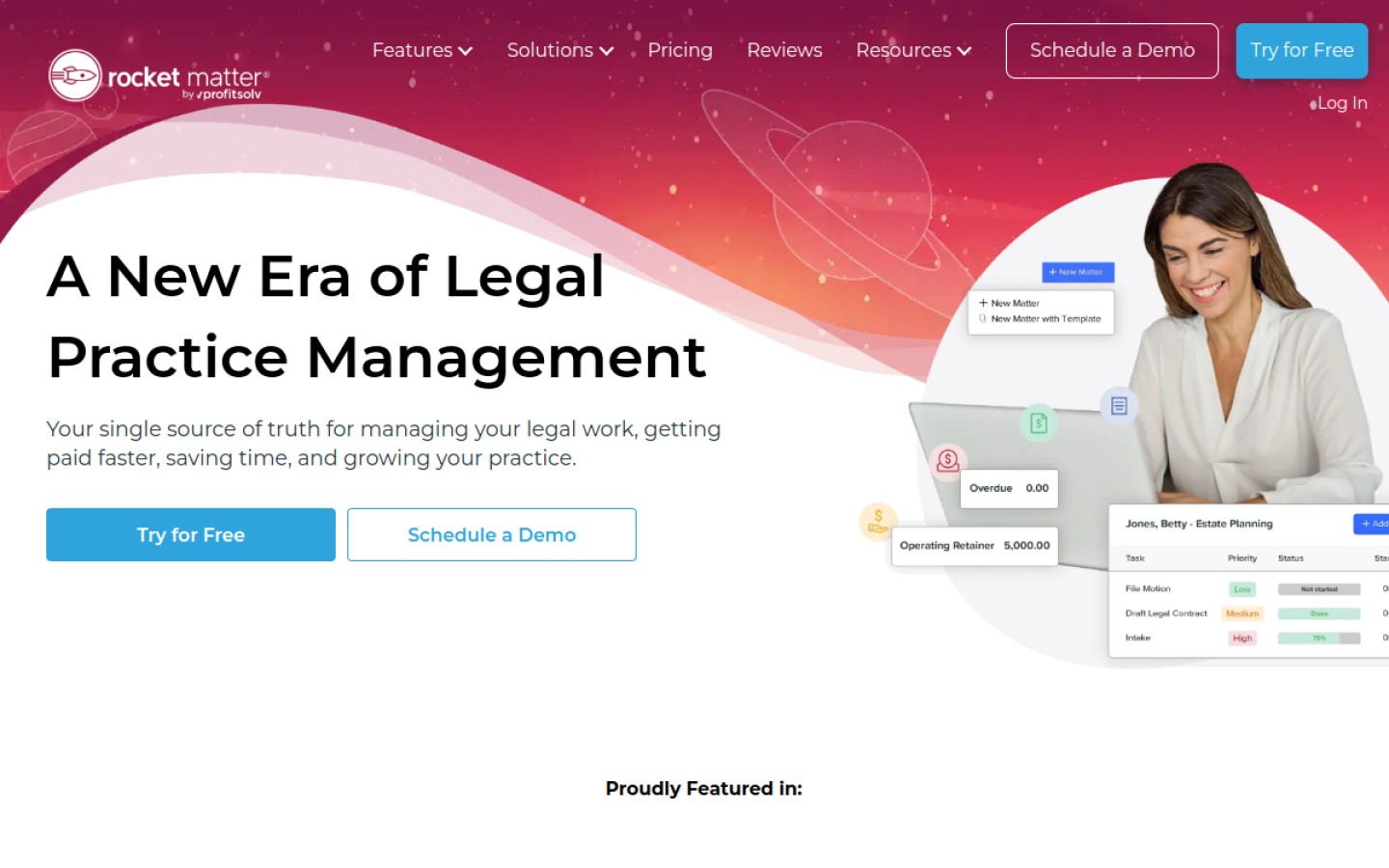
Rocket Matter is a billing-led practice management platform for small firms, built around time, billing and matter management in one cloud system. Essentials costs $49 per user a month, and it is rated 4.3 out of 5 on G2 from 173 reviews, with reviewers rating its billing ease highest.
The trade off is depth beyond billing. Matter automation and integrations are thinner than Clio's, and the entry tier covers the basics, so growing firms should check what the next tier adds before committing. It suits small firms that bill first and manage matters second.
Litify is an enterprise legal operations platform built on Salesforce, covering intake, matters, workflows and document generation for large firms and legal departments. G2 lists both tiers at $150 per user a month, and it is rated 4.2 out of 5 on G2 from 230 reviews.
The trade off is the Salesforce dependency. Litify needs a Salesforce org, so the total cost includes Salesforce licences, and G2 reports implementation averaging 6 months. It suits large firms already standardised on Salesforce.
CosmoLex is a legal practice management platform with built-in accounting, covering matter management, billing, trust ledgers and payments in one subscription. Launch costs $49 per user a month on annual billing, with Core at $99 and Pro at $129, and it is rated 4.2 out of 5 on G2 from 339 reviews.
The trade off is price uncertainty. One comparison lists Launch at $59 per user a month, against $49 on the vendor page check, so confirm the figure before budgeting. It suits firms that want accounting and trust compliance without a separate bookkeeping tool.
Litify and TrialWorks publish no price on their own sites, and Smokeball's higher tiers are quote-only too. A demo quote depends on user count, modules and implementation, so two firms rarely pay the same figure.
Ask for the per-user price, the implementation fee and the annual uplift in one email, before the demo. Filevine buyers report implementation at $15,000 or more, so the setup line can cost more than a year of licences.
Get the trial in writing. Litify offers no free trial, while Clio gives 7 days and MyCase gives 10, so a short trial needs a real matter ready to test on day one.
How we chose
We started from the case management tools that appear most often in current Filevine comparison roundups, then kept the nine with the strongest review record and a published price or a clear quote model.
Prices come from each vendor's pricing page or vendor-supplied G2 pricing data, checked on 29 November 2026. Ratings come from G2 on the same day, except TrialWorks, which comes from Capterra. Where a vendor shows no price, the list says custom quote instead of guessing.
We left out tools built only for intake or billing, and tools with too few reviews to judge. No vendor paid for a place, and we do not claim to have used these tools ourselves.
How to choose a Filevine alternative
Start with the cases you run most, then match the tool to that work.
List your top three case types. A personal injury firm needs medical chronologies and lien tracking, while a general practice firm needs broad matter templates. Neos and TrialWorks fit the first list, Clio fits the second.
Check the entry price against your headcount. Six tools start at $49 or $50 per user a month, so a 10-person firm pays about $490 to $500 a month before add-ons. Litify at $150 a user costs three times that.
Test trust accounting on a real matter. Run one matter from intake to invoice in the trial, including a trust transaction. Clio and CosmoLex include it from the entry tier, while MyCase charges extra for full reconciliation.
Ask for the full first-year cost in writing. Get the licence, implementation fee and any AI or accounting add-ons quoted together, with the renewal price. Quote-only tools can look cheap until the setup line arrives.
FAQ
What is the best Filevine alternative in 2026?
Smokeball is the best Filevine alternative for most firms. It is rated 4.7 out of 5 on G2 from 393 reviews, the highest rating here, with automatic time capture and a $49 per user a month entry plan.
How much do Filevine alternatives cost?
Most Filevine alternatives start at $49 or $50 per user a month, including Clio, Smokeball, PracticePanther, Rocket Matter and CosmoLex. Assembly Neos starts at $99, Litify at $150, and TrialWorks is priced by quote.
Is there a free Filevine alternative?
There is no free plan among these nine tools. All of them except Litify offer a free trial, from 7 days with Clio and PracticePanther to 10 days with MyCase, so you can test a real matter before paying.
Which Filevine alternative is best for small firms?
MyCase is the best fit for small firms that want one predictable bill, with all three tiers published from $50 to $130 per user a month. PracticePanther is the cheapest transparent option at $49, though its Solo plan is capped at one user.
Smokeball vs Clio: which is better as a Filevine alternative?
Smokeball wins on rating at 4.7 out of 5 against Clio at 4.6, and its automatic time capture suits document-heavy firms. Clio wins on breadth, with more than 250 integrations and trust accounting on every plan, so it fits firms that want one platform for everything.
Can I migrate my cases from Filevine to an alternative?
Yes, but migration is a project, not a button. Ask the new vendor for a migration quote, a data checklist and a test import of a few matters before you cancel Filevine, and confirm that documents, notes and deadlines all carry over.
SaaS SEO and WordPress specialist with about 8 years of experience. Rakib compares WordPress plugins, themes, hosting and software using public pricing, documentation and user reviews. See how we rank.