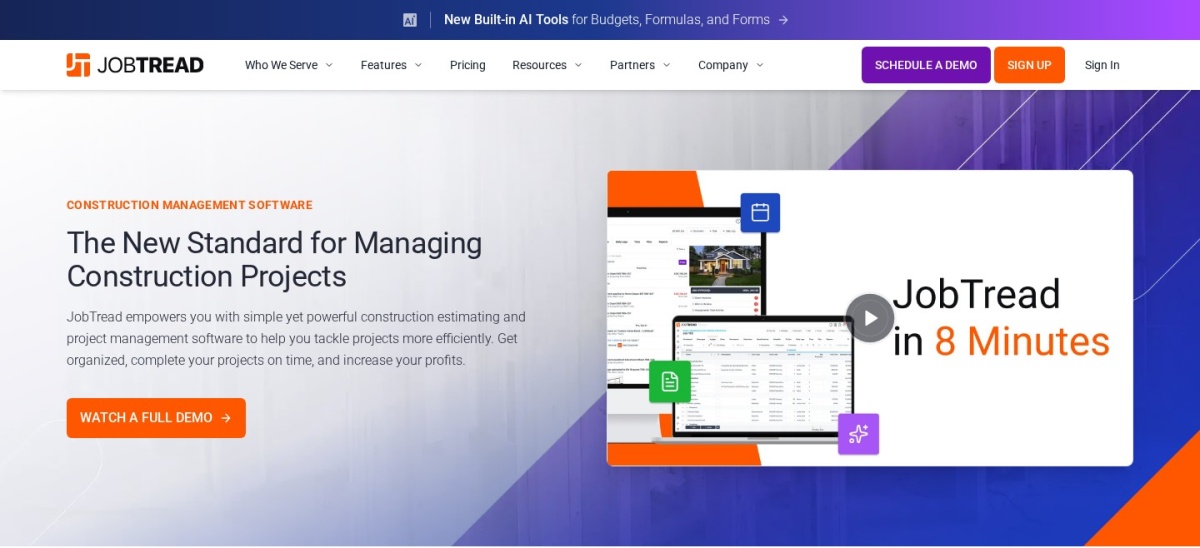
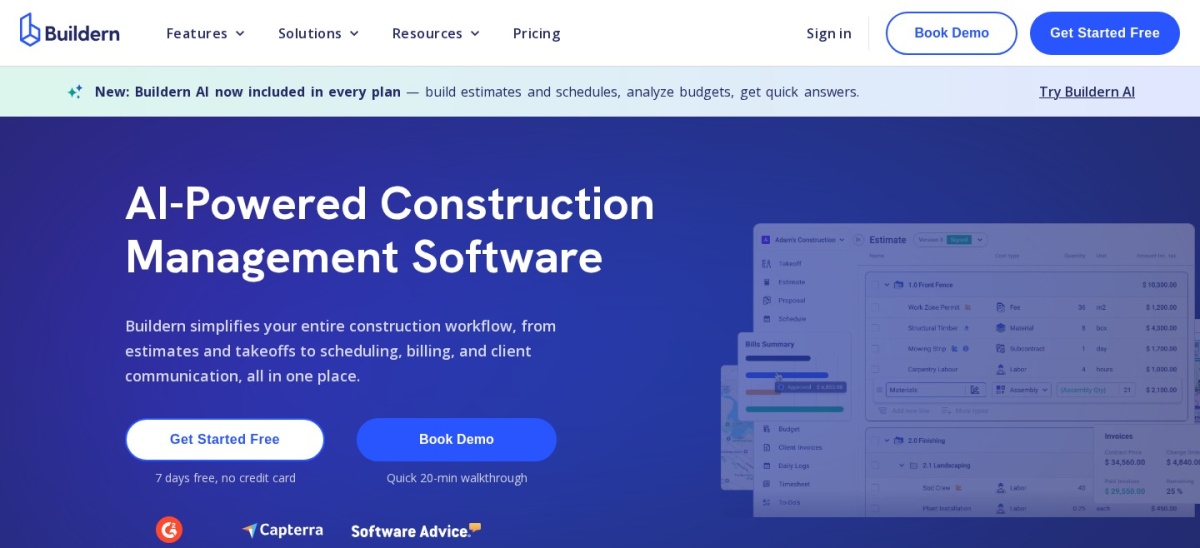
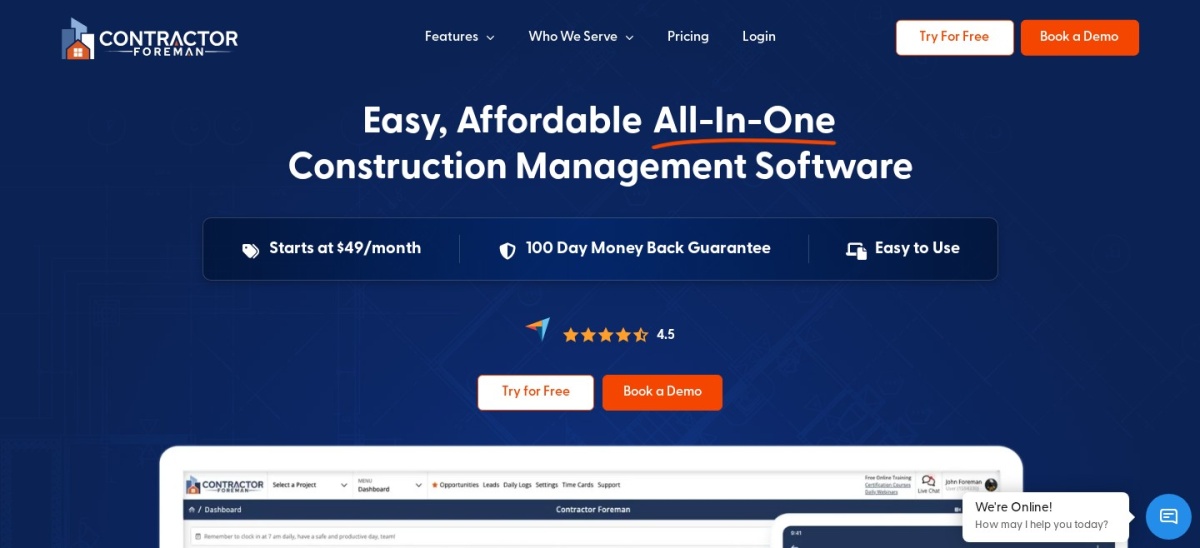
JobTread is the best Buildertrend alternative for most residential builders, with all features in one $199-a-month plan and a 4.9/5 G2 rating. Pick Buildern for a modern all-in-one at $250 a month, Houzz Pro for design-led remodelers, or Contractor Foreman if budget comes first at $49 a month.
How we make this list: we compare pricing pages, product documentation and public user reviews, then re-check every price before each update. No product paid for a place. Disclosure.
JobTread leads at 4.9/5 on G2, with every feature in one $199-a-month plan and free subcontractor and client portals.
Buildern matches JobTread at 4.9/5 on G2 from 23 reviews, starting at $250 a month for two office seats.
Contractor Foreman is the cheapest paid plan here at $49 a month billed annually, for one user.
Procore is the strongest choice for large commercial work, but it is quote-only and priced by annual construction volume.
Houzz Pro, Fieldwire and STACK all offer a free plan, so a small builder can start without paying.
What should you look for in Buildertrend alternatives?
Price structure matters more than the headline number. Buildertrend charges $499 a month for its Essential plan, while most alternatives publish a flat monthly price or a per-user price.
Residential builders need different tools from commercial firms. Scheduling, selections, change orders and a client portal matter most for home building and remodeling.
Per-user pricing can overtake a flat fee fast. A $39-per-user plan costs more than a $199 flat plan once a team passes five paid seats.
Free portals save real money. Tools that let subcontractors, vendors and clients log in free keep the bill tied to office staff only.
Ratings are a check, not a verdict. A 4.9/5 score from 23 reviews is less proven than the same score from hundreds of reviews, so weigh the review count beside the score.
JobTread is a construction management platform for home builders, remodelers and specialty contractors, built around connected budgets. Its single plan covers CRM, estimating, takeoffs, scheduling, budgets, job costing, change orders, invoicing and a client portal, with no feature tiers to climb.
The trade off is the per-user charge. The base price is $199 a month plus $20 a month per internal user, so a larger office team raises the bill, though subcontractor, vendor and client portal users are free. It suits residential builders who want one price for every feature.
Buildern is an all-in-one construction management platform for residential and commercial builders. It covers estimating, scheduling, budgeting, invoicing, timesheets, change orders and client communication, with QuickBooks and Xero integrations for accounting.
The trade off is the small review base. Its 4.9/5 G2 rating comes from 23 reviews, far fewer than JobTread or Procore, so it is less proven at scale. It suits small residential builders who want a modern interface and clear public pricing.
Houzz Pro is business software for remodelers and design-build firms, built around selling the job as well as running it. The Design plan at $99 a month covers 3D floor plans, selections, mood boards, CRM, estimates, proposals, invoices and online payments.
The trade off is the contract. Most Houzz Pro plans run on 12-month contracts, and the Pro plan at $199 a month is needed for takeoffs, change orders, schedules and daily logs. It suits design-led remodelers who also want leads from the Houzz marketplace.
Procore is a construction management platform for commercial general contractors, owners and specialty contractors. It covers project management, financials, RFIs, submittals, drawings, quality and safety in one system, with unlimited users on every plan.
The trade off is price and setup. Procore does not publish a price and quotes by annual construction volume, with reports putting typical costs at $10,000 to $80,000 a year, plus implementation fees. It suits large firms where owners require Procore, not small residential builders.
What we like
Deepest RFI, submittal and financial controls here
Unlimited users, so large crews cost no extra seats
Contractor Foreman is a construction management platform for small general contractors, subcontractors and trade contractors. It covers scheduling, estimating, job costing, change orders, daily logs, AIA billing and a client portal, with QuickBooks integration.
The trade off is the user cap. The $49-a-month Basic plan is billed annually and covers one user, with higher tiers at $105, $166, $221 and $332 a month as the team grows. It suits budget-conscious small builders who want a full toolkit at the lowest published price here.
What we like
Cheapest paid plan in this list at $49 a month
30-day free trial and 100-day money-back guarantee
Knowify is construction software for small builders and specialty contractors, built around job costing. Its Core plan covers estimating, scheduling, time tracking, purchase orders, change orders and AIA billing, with QuickBooks integration for accounting.
The trade off is the seat limit. Core costs $99 a month billed annually for one user, or $149 month to month, with extra users at $29 a month each. It suits small builders who bill on AIA forms and need tight cost tracking per job.
Fieldwire by Hilti is field management software for builders who live on drawings. Its free Basic plan covers 5 users, 3 projects and 100 sheets, while Pro at $39 per user per month billed annually adds unlimited projects, tasks, checklists and plan markups.
The trade off is scope. Fieldwire is strong on plans, tasks and punch lists, but it is not a full estimating and accounting system like JobTread or Buildertrend. It suits builders who need every phone in the field on the same set of drawings.
STACK is takeoff and estimating software for builders and subcontractors. Its Takeoff & Estimate Pro plan at $299 per user per month covers digital takeoffs, estimating and bid workflows, with a free plan limited to one active project a month.
The trade off is that it is not a full project manager. STACK is strongest before the job starts, so most builders pair it with a scheduling and client tool. It suits estimators who want fast, accurate takeoffs more than an all-in-one system.
Autodesk Build is project and field management software in the Autodesk Construction Cloud, for design-build and commercial firms. It connects model coordination and clash detection to schedules, RFIs, quality checks and field execution, with more than 400 integrations.
The trade off is per-user cost. Build starts at $1,400 per user per year, about $117 a month, so a large field team gets expensive fast next to Procore unlimited users. It suits firms already running Revit and Navisworks daily.
What we like
Native Revit and Navisworks coordination
4.4/5 on G2 from 5,270 reviews
30-day free trial of Essentials
More than 400 integrations
Watch out for
Per-user pricing punishes large teams
Too complex and costly for small residential builders
Migration from PlanGrid and BIM 360 is still rough
Flat-price tools let you compare the real monthly cost before a sales call. JobTread at $199, Buildern at $250 and Contractor Foreman at $49 are all published prices.
Quote-only tools hide the cost until you talk to sales. Procore quotes by annual construction volume, so two firms can pay very different amounts for the same product.
Per-user tools sit in between. Fieldwire at $39 a user and Autodesk Build at $1,400 a user a year look cheap for one person and costly for twenty.
How we chose
We started from the established residential and commercial construction platforms most often named as Buildertrend replacements, then kept nine with published prices or a clear quote model and a public rating.
Prices come from each vendor pricing page and review-site pricing listings, checked on 29 November 2026. Ratings and review counts come from G2 and Capterra on the same day. Where a vendor shows a sale or annual discount, the list shows the regular monthly price.
We left out CoConstruct, which was acquired by Buildertrend and is being wound down, and tools with no public rating. No vendor paid for a place, and we do not claim to have used these tools ourselves.
How to choose a Buildertrend alternative
Start with the work you do most, then price it for your real team size.
Count your paid seats first. Flat plans win for larger office teams, while per-user plans win for one or two people. Add extra users before you compare prices.
Match the tool to residential or commercial work. Pick JobTread, Buildern or Houzz Pro for home building and remodeling, and Procore or Autodesk Build for commercial and BIM work.
Check the client portal and change orders. These two features decide whether clients stay informed without extra calls. Make sure subcontractor and client seats are free.
Run a trial on a real job. Use the free plan or trial with one live project, and check estimating, scheduling and invoicing together before you switch.
FAQ
What are the best Buildertrend alternatives in 2026?
JobTread is the best Buildertrend alternative for most residential builders, with all features in one $199-a-month plan and a 4.9/5 G2 rating. Buildern, Houzz Pro and Contractor Foreman are strong picks for modern all-in-one use, design-led remodeling and low budgets.
What is the cheapest Buildertrend alternative?
Contractor Foreman is the cheapest paid alternative here at $49 a month billed annually for one user. Fieldwire, Houzz Pro and STACK also offer free plans, though their paid plans start higher.
Is there a free Buildertrend alternative?
Yes. Houzz Pro, Fieldwire and STACK all offer a free plan. Fieldwire free covers 5 users and 3 projects, Houzz Pro free covers basic estimates and invoicing, and STACK free covers one active project a month.
Which Buildertrend alternative is best for small builders?
JobTread is the best pick for most small builders, because every feature is in one $199-a-month plan. Contractor Foreman suits the smallest budgets at $49 a month, and Buildern suits small builders who want a modern interface at $250 a month.
JobTread vs Buildertrend: which is better?
JobTread is better for builders who want one flat price and the highest rating, at 4.9/5 on G2 and $199 a month with free subcontractor portals. Buildertrend is better for builders who want unlimited users and a larger, longer-established platform at $499 a month.
Is Procore a good Buildertrend alternative?
Procore is a good alternative only for large commercial builders. It offers the deepest RFI, submittal and financial controls and unlimited users, but it is quote-only and typically costs $10,000 to $80,000 a year, far above Buildertrend.
SaaS SEO and WordPress specialist with about 8 years of experience. Rakib compares WordPress plugins, themes, hosting and software using public pricing, documentation and user reviews. See how we rank.