Zoho Inventory is the best WMS software for most small and mid-sized warehouses in 2026, offering a permanent free plan and paid tiers starting at $29/month billed annually with a 4.4/5 G2 rating. For high-volume fulfillment, ShipHero handles unlimited users and SKUs from $15,000/year, while Odoo Inventory offers one free app with unlimited seats.
How we make this list: we compare pricing pages, product documentation and public user reviews, then re-check every price before each update. No product paid for a place. Disclosure.
Entry prices span from $0/month on Zoho Inventory, Odoo Inventory, and Sortly up to $15,000/year on ShipHero.
Flat-rate tiers like Zoho Inventory ($29/month annual) and inFlow Inventory ($99/month annual) prevent per-seat cost spikes.
Manufacturing-heavy systems like Fishbowl ($229/month annual) and Cin7 Core ($349/month) lock advanced MRP or BOMs behind higher tiers.
Promotional intro rates are common: Sortly discounts year one by 50% ($24/month) before renewing at standard annual pricing.
How do you choose the best WMS software?
A warehouse management system (WMS) tracks stock locations, guides picking and packing, and syncs order volumes across sales channels. Unlike basic accounting ledgers, a dedicated WMS manages bin-level accuracy, barcode scanning, and replenishment rules in real time.
Pricing models divide sharply between flat-rate tiers, per-seat licenses, and order-volume contracts. A low monthly sticker price can climb quickly once you add extra users, warehouse locations, or mandatory onboarding packages.
Match your software tier to your operational bottleneck rather than your headcount alone. Ecommerce sellers need fast carrier and marketplace sync, while manufacturers and distributors require lot traceability, multi-level bills of materials, and purchase order automation.
Included capacity500 orders/mo, 3 users, 2 locations
IntegrationsShopify, Amazon, eBay, Zoho Books
zoho.com
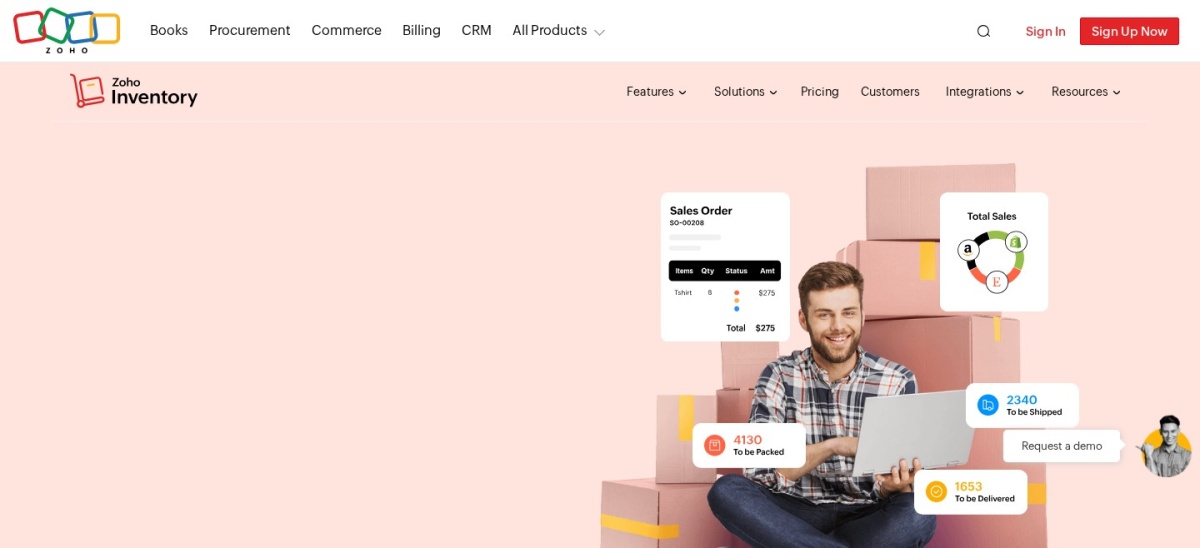
Zoho Inventory homepage, captured Nov 2026.
Zoho Inventory is a cloud warehouse and order management platform built for small to mid-sized sellers. Its permanent free tier covers 50 orders per month, 1 user, and 1 warehouse location, while the Standard plan ($29/month billed annually, or $39/month monthly) raises limits to 500 orders, 3 users, and 2 locations.
The trade off is strict cap gating, as serial and batch tracking require the Premium tier at $79/month billed annually, and Advanced Warehousing costs an extra $124.17/month. It suits cost-conscious retail and ecommerce teams that want flat organization pricing without per-seat surprises.
What we like
Permanent free plan with composite items and dropshipping
Flat per-organization pricing instead of per-user fees
Transparent add-on rates for extra users, orders, and locations
Native sync with Zoho Books, Zoho CRM, and major marketplaces
Watch out for
Serial and batch tracking locked behind the $79/month Premium tier
Advanced Warehousing features require a paid add-on
Strict monthly order caps force tier upgrades during peak seasons
Standard ($29/mo annual) unlocks 500 monthly orders, 3 users, 2 locations, and dropshipments.Visit zoho.com
02
Odoo Inventory
4.4/5on G2 (65 reviews, checked Nov 2026)
Paid from$31.10/mo
Best for integrated ERP and warehouse operations
Free tierOne App Free with unlimited users
Entry paid plan$31.10/user/mo regular ($24.90 yr 1)
Light user rate$8.90/user/mo for barcode operators
DeploymentOdoo Online cloud, Odoo.sh, or on-premise
odoo.com
Odoo Inventory homepage, captured Nov 2026.
Odoo Inventory is a modular warehouse management application that connects double-entry stock moves directly to accounting, purchasing, and manufacturing. Using only the Inventory app is free forever for unlimited users on Odoo Online, while adding apps moves you to the Standard plan at $24.90/user/month in year one ($31.10 regular annual rate).
The trade off is per-seat billing once you connect multiple modules, plus partner implementation costs if your workflows need custom development. It suits growing distributors and manufacturers that want warehouse operations and financial ledgers in a single database.
What we like
One App Free plan covers Inventory for unlimited users
Lower $8.90/month Light User license for floor barcode operators
All-in-one suite includes accounting, purchasing, and MRP on paid plans
Flexible cloud or self-hosted deployment on the Custom tier
Watch out for
Adding a second app requires paid licenses for every active user
First-year introductory discounts step up upon renewal
Complex multi-warehouse setups often require paid partner implementation
Standard ($31.10/user/mo regular annual) unlocks all Odoo apps including Accounting and Manufacturing.Visit odoo.com
03
inFlow Inventory
4.6/5on Capterra (504 reviews, checked Nov 2026)
Starts at$99/mo
Best for B2B wholesale and simple setup
Free tierNo permanent free plan (14-day trial)
Entry paid plan$99/mo annual ($129/mo monthly)
Included capacity2 team members, 1 location, unlimited orders
Add-onsStockroom mobile scanning from $39/mo
inflowinventory.com
inFlow Inventory homepage, captured Nov 2026.
inFlow Inventory is a cloud inventory and order management system tailored to wholesalers, distributors, and small warehouses. Its Lite plan costs $99/month billed annually ($129/month billed monthly) and includes 2 team members, 1 location, and unlimited products, sales orders, and integrations.
The trade off is that sublocations and multi-warehouse transfers require upgrading to the Core plan at $299/month billed annually, and the Stockroom mobile scanning app starts at an extra $39/month. It suits B2B wholesalers that process high order counts and want predictable flat-rate billing.
What we like
Unlimited products, sales orders, and integrations on all plans
Predictable flat-rate tiers without order-volume overage fees
Built-in B2B Showroom portal on Pro plans for wholesale buyers
Optional dedicated smartphone scanners and portable label printers
Watch out for
No permanent free tier after the 14-day trial
Sublocations require the $299/month Core tier
Stockroom mobile barcode app costs an extra $39/month
Lite ($99/mo annual) includes 2 team members, unlimited orders, and a $100 hardware credit.Visit inflowinventory.com
04
Sortly
4.5/5on Capterra (958 reviews, checked Nov 2026)
Paid from$39.20/mo
Best for visual mobile asset and stock tracking
Free tier100 unique items, 1 user license
Entry paid plan$24/mo yr 1 annual ($39.20/mo regular annual)
Monthly rate$49/mo on Advanced (500 unique items)
ScanningBuilt-in mobile barcode and QR label generator
sortly.com
Sortly homepage, captured Nov 2026.
Sortly is a visual inventory tracking system built around mobile QR and barcode scanning, custom folders, and item photos. Its Free plan supports 100 unique items and 1 user, while the Advanced plan includes 500 items and 2 users at $49/month monthly, $24/month in year one on annual billing, and $39.20/month at the regular 20% annual renewal discount.
The trade off is strict item caps and missing fulfillment depth, as purchase orders require the Ultra tier ($149/month monthly) and native Shopify or WooCommerce sync is absent. It suits internal stockrooms, field teams, and small businesses tracking tools or supplies rather than high-volume ecommerce orders.
What we like
Clean mobile interface with photo-based item recognition
Built-in QR code and barcode label generation on all plans
Permanent free tier for micro-inventories up to 100 items
Fast self-serve setup with minimal staff training
Watch out for
First-year 50% annual discount jumps at renewal
Rigid unique-item caps force full tier upgrades
No purchase orders on Free or Advanced plans and no native ecommerce sync
Advanced ($39.20/mo regular annual) increases capacity to 500 unique items, 2 users, and low-stock alerts.Visit sortly.com
05
Fishbowl
4.2/5on Capterra (1,132 reviews, checked Nov 2026)
Included capacity2 users, QuickBooks Online and Xero sync
Advanced tiersWarehouse from $595/mo, Manufacturing $675/mo
fishbowlinventory.com
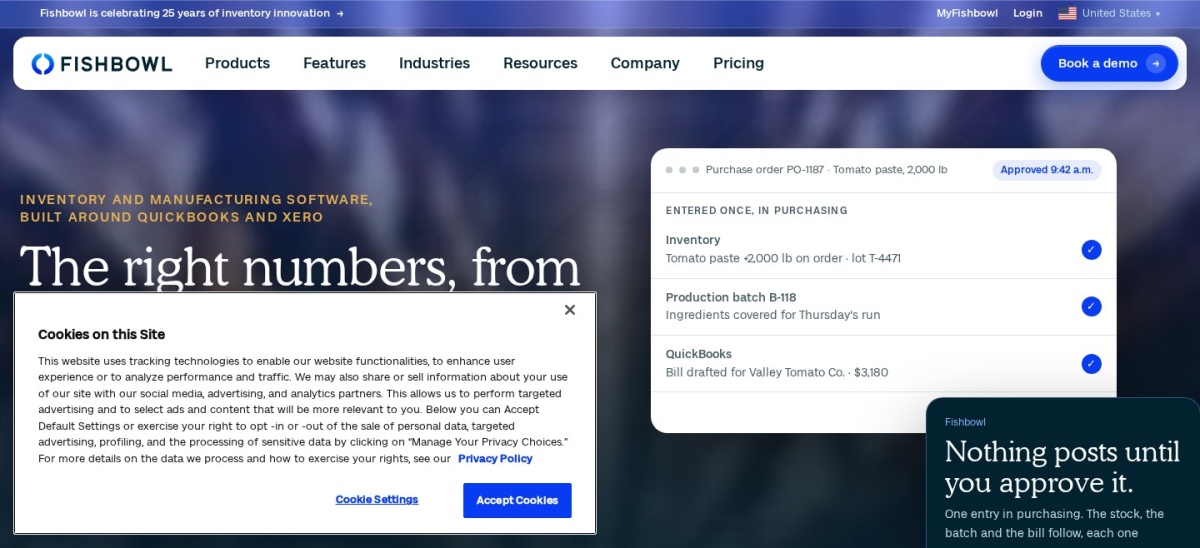
Fishbowl homepage, captured Nov 2026.
Fishbowl is an inventory, warehouse, and manufacturing platform engineered to extend QuickBooks and Xero with barcode-driven floor control. Its cloud Inventory Essentials plan starts at $229/month billed annually for 2 users and includes real-time stock tracking, reorder points, mobile barcode scanning, and accounting sync.
The trade off is mandatory paid implementation and strict feature separation, as multi-level bills of materials, work orders, and MRP require Fishbowl Advanced Manufacturing starting at $675/month. It suits established SMBs and QuickBooks users outgrowing spreadsheets who need structured receiving, picking, and cycle counting.
What we like
Two-way sync with QuickBooks Online, Desktop, Enterprise, and Xero
Dedicated Advanced Warehouse ($595/mo) and Manufacturing ($675/mo) editions
Supports lot, serial, and expiration date tracking on higher tiers
Includes guided onboarding and 6-to-8-week training certification
Base Inventory plans exclude BOMs, work orders, and MRP
Inventory Essentials ($229/mo annual) covers 2 users, barcode scanning, and QuickBooks or Xero sync.Visit fishbowlinventory.com
06
Cin7 Core
4.3/5on Capterra (739 reviews, checked Nov 2026)
Starts at$349/mo
Best for omnichannel wholesale and retail
Free tierNo free plan (14-day free trial)
Entry paid plan$349/mo (Standard plan)
Included capacity5 users, 6,000 sales orders/yr, 2 integrations
Higher tiersPro at $599/mo, Advanced at $1,199/mo
cin7.com
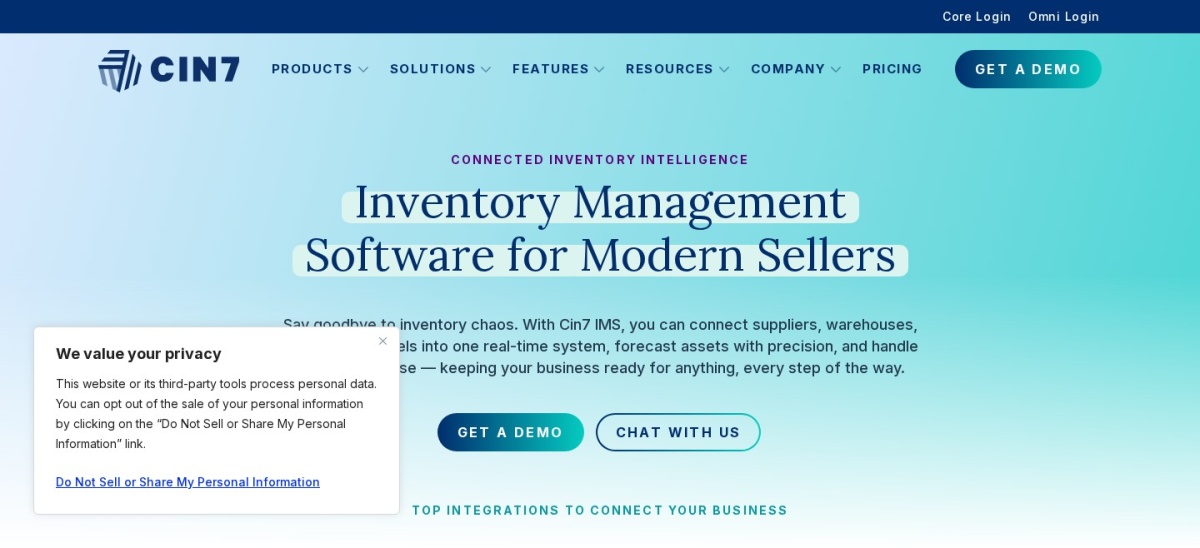
Cin7 Core homepage, captured Nov 2026.
Cin7 Core is a cloud inventory and order management system designed for multichannel retailers, wholesalers, and light manufacturers. Its Standard plan starts at $349/month and includes 5 users, 6,000 annual sales orders, 2 ecommerce or app integrations, unlimited inventory locations, and a warehouse mobile app.
The trade off is add-on and tier gating, as MRP requires the $599/month Pro plan, multi-warehouse advanced picking requires the $1,199/month Advanced plan, and the B2B portal costs extra. It suits multichannel product brands selling across Shopify, Amazon, and wholesale accounts that need centralized stock allocation.
What we like
Includes 5 user seats and unlimited inventory locations on the entry tier
Dedicated warehouse mobile app for barcode picking, packing, and put-away
Supports batch, serial, and expiration tracking with assembly BOMs
Connects directly to Xero, QuickBooks Online, Shopify, and Amazon
Watch out for
$349/month entry price is steep for smaller operations
Standard plan caps sales orders at 6,000/year and includes only 2 integrations
Advanced multi-warehouse WMS and MRP require higher plans or add-ons
Standard ($349/mo) includes 5 users, 6,000 annual sales orders, 2 integrations, and mobile WMS.Visit cin7.com
Included capacity25,000 DTC shipments/yr, 10 store connections
User & SKU limitsUnlimited users, SKUs, warehouses, and 3PL clients
shiphero.com
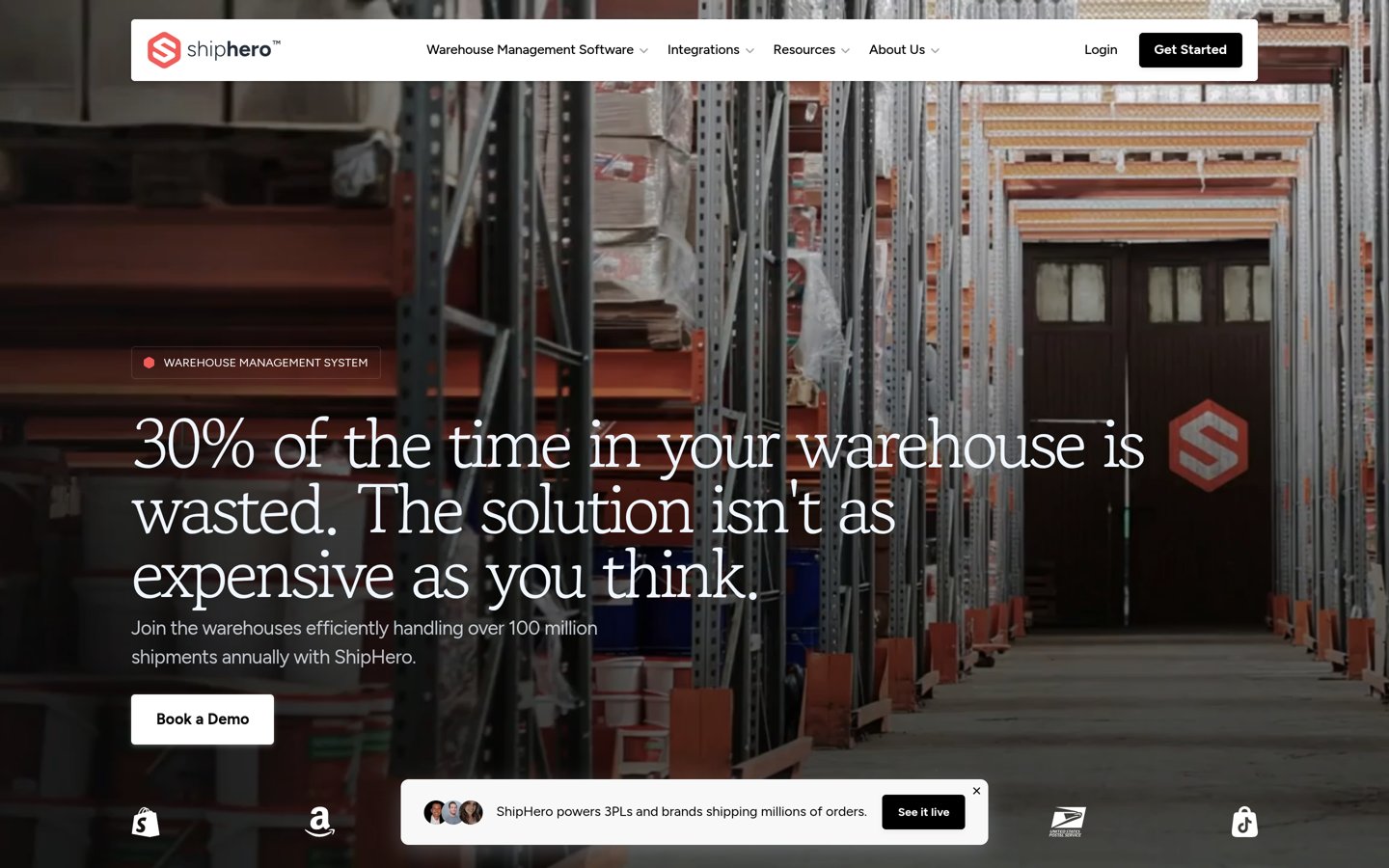
ShipHero homepage, captured Nov 2026.
ShipHero is a cloud warehouse management system built for high-volume direct-to-consumer brands and third-party logistics (3PL) providers. Its Core plan starts at $15,000/year on a 12-month contract and includes 25,000 annual DTC shipments, 10 store connections, and unlimited users, SKUs, warehouses, and 3PL client portals.
The trade off is high upfront commitment, including a typical $5,000 one-time onboarding fee plus $0.24 per extra pay-as-you-go shipment ($0.22 prepaid) and $2.10 per wholesale order. It suits fast-moving fulfillment warehouses shipping thousands of parcels monthly that need barcode-led pick-and-pack accuracy without per-seat fees.
What we like
Unlimited users, SKUs, warehouses, and 3PL clients on every plan
Built-in 3PL client portals and automated client billing workflows
Supports Pick-to-Light, Pack-to-Light, and Tap-to-Pack hardware
Prepaid shipment blocks roll over to the next contract year
Watch out for
$15,000/year starting floor plus ~$5,000 onboarding excludes small shops
No free plan or self-serve trial
Wholesale orders are not included in the base DTC shipment allotment
Core ($15,000/yr) includes 25,000 DTC shipments, 10 store connections, and unlimited user seats.Visit shiphero.com
What extra fees push WMS budgets above the sticker price?
Subscription rates rarely represent your full first-year warehouse software spend. Implementation and data migration packages range from $0 for self-serve tools like Zoho Inventory to $5,000 or more for guided setups on Fishbowl and ShipHero.
Watch for metered usage caps and hardware add-ons before signing an annual contract. Exceeding monthly order allowances on Zoho Inventory or Ordoro, adding mobile scanning licenses on inFlow ($39/month), or buying barcode scanners and label printers can add thousands of dollars in year one.
How we chose
We evaluated warehouse management and inventory control platforms widely used by ecommerce sellers, wholesalers, manufacturers, and 3PL operators, prioritizing vendors that publish transparent starting prices and active review profiles.
Every rating, review count, and entry-level regular price in this guide was verified on 29 Nov 2026 directly from official vendor pricing pages and verified software review directories on G2 and Capterra.
We excluded legacy enterprise suites that hide all pricing behind custom quotes (such as Manhattan Active WM, Blue Yonder, and SAP EWM) as well as discontinued standalone tools that have been merged into parent platforms. No vendor paid for a place, and we do not claim testing for this list.
How to pick the right WMS in 4 steps
Audit your daily order volume, sales channels, and warehouse workflows before comparing vendor quotes.
Count your monthly orders, SKUs, and locations. Map your peak monthly shipment volume and active SKU count so you do not get trapped by entry-tier caps like Sortly's 500-item limit or Zoho Inventory's 500-order ceiling.
Check how user seats are billed. If you have 10 warehouse pickers scanning barcodes, flat-rate systems like Zoho Inventory or unlimited-user platforms like ShipHero will cost far less than per-seat tools like Odoo.
Verify native accounting and channel integrations. Confirm whether two-way sync with QuickBooks, Xero, Shopify, or Amazon is included in the base price or sold as a monthly add-on.
Calculate your full year-one total cost. Add mandatory onboarding fees, mobile app add-ons, and renewal price increases after first-year discounts expire before signing an annual contract.
FAQ
What is the best WMS software in 2026?
Zoho Inventory is the best overall WMS software for small and mid-sized businesses in 2026 because it combines a permanent free tier, flat-rate annual pricing starting at $29/month, and native multichannel integrations. High-volume fulfillment teams and 3PLs with larger budgets should look at ShipHero ($15,000/year).
Is there a good free WMS software?
Yes, Zoho Inventory, Odoo Inventory, and Sortly all offer permanent free plans. Zoho Inventory covers 50 monthly orders and 1 location, Sortly tracks up to 100 unique items, and Odoo Inventory provides its single Inventory app free for unlimited users.
How much does WMS software cost per year?
Entry-level cloud WMS subscriptions range from $348/year for Zoho Inventory Standard and $373/year per user for Odoo Standard to $2,748/year for Fishbowl Essentials and $4,188/year for Cin7 Core. Dedicated high-volume platforms like ShipHero start at $15,000/year plus onboarding.
Which WMS is best for ecommerce fulfillment and 3PLs?
ShipHero is built specifically for high-volume DTC ecommerce fulfillment and 3PLs, offering unlimited users, client portals, and 25,000 included annual shipments starting at $15,000/year. Smaller ecommerce brands shipping under 6,000 orders annually can start with Cin7 Core ($349/month) or Zoho Inventory.
Zoho Inventory vs Fishbowl: which should I choose?
Choose Zoho Inventory ($29/month billed annually) if you are a small retail or ecommerce business wanting self-serve setup and low flat-rate pricing. Choose Fishbowl ($229/month billed annually) if you rely heavily on QuickBooks Desktop or Enterprise and need structured barcode receiving, picking, or manufacturing workflows.
SaaS SEO and WordPress specialist with about 8 years of experience. Rakib compares WordPress plugins, themes, hosting and software using public pricing, documentation and user reviews. See how we rank.