Best Vulnerability Management Tools in 2026: 9 Tools Compared
WLWPLegible EditorsLast verified 24 Nov 2026How we rank12 min read
★ Short answer
Tenable Vulnerability Management is the best pick for most teams, with the deepest detection and VPR prioritization at $3,500 a year for 100 assets. Choose Wiz for cloud attack paths and Snyk for fixing vulnerable code.
How we make this list: we compare pricing pages, product documentation and public user reviews, then re-check every price before each update. No product paid for a place. Disclosure.
Tenable covers the broadest infrastructure at $3,500 a year for 100 assets, with VPR ranking by exploitability.
Wiz is the highest-rated cloud tool here at 4.7 out of 5 from 845 G2 reviews, but Essential starts at $24,000 a year.
Qualys pairs scanning with patch jobs in one console, from $596 a month for 128 hosts.
Snyk is the only tool here with a free plan, and Team starts at $25 per developer a month.
Orca and Sysdig are the priciest entries, with entry packs at $7,000 and $1,440 a month.
What vulnerability management actually covers
Vulnerability management is the loop after the scan: find flaws, rank them by real risk, assign each one to an owner, and confirm the fix held. A scanner alone only makes the list. The tools here carry findings through to closure, or plug into the ticketing system that does.
The CVE count keeps rising. The CVE Program published more than 40,000 vulnerabilities in 2024, and the total passed 48,000 in 2025, so no team patches everything. Ranking by exploitability matters more than ranking by severity, which is why most tools in this list use EPSS, CISA KEV or exploit data.
Coverage decides the shortlist before price does. A host scanner misses cloud workloads, a cloud tool misses network gear, and a code scanner misses both, so start from the asset classes you must cover. Our guide on checking a plugin for vulnerabilities shows the same idea at WordPress scale: know what you run before you scan it.
Prices in this list are hard to compare directly, because vendors charge per asset, per workload, per user or per endpoint. Model the bill at your real counts, and check what counts as an asset before you sign.
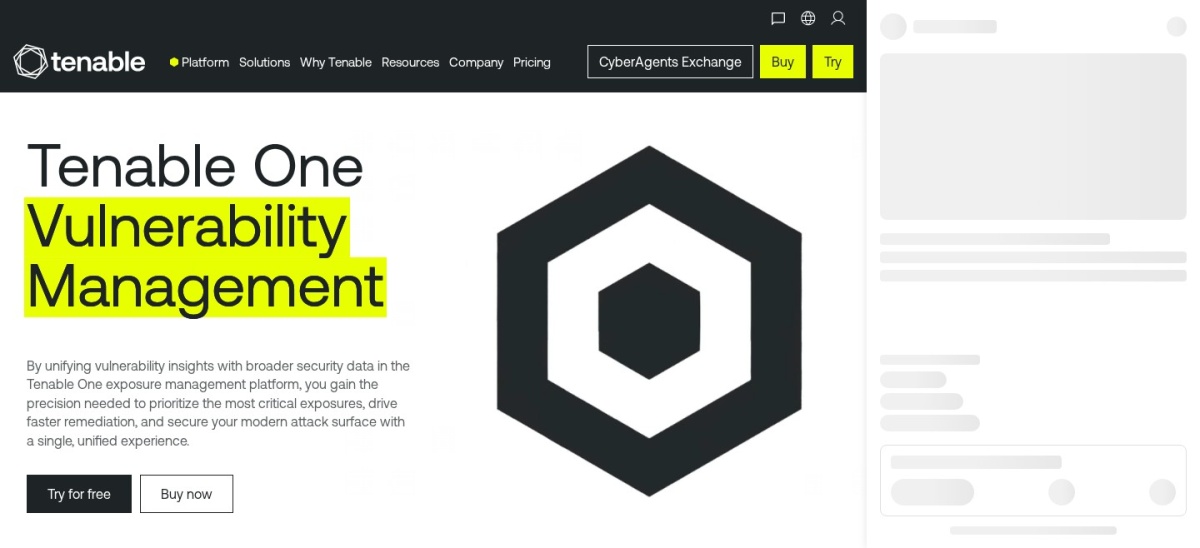
Tenable Vulnerability Management homepage, captured Nov 2026.
Tenable Vulnerability Management is a cloud platform built on the Nessus scanner, with continuous discovery across servers, network devices, cloud workloads and containers. It ranks findings with its VPR score, which weighs exploit availability and active threats beside CVSS, and ships CIS benchmark checks and compliance reports.
The trade off is price and scale. The published entry point is $3,500 a year for 100 assets, so the bill climbs with every asset you add, and patch deployment needs a separate module. It suits enterprise and regulated teams that want the deepest detection and audit-ready reporting in one place.
What we like
Deepest plugin coverage in this list
VPR ranks by exploitability, not CVSS alone
CIS benchmarks and compliance reports included
Watch out for
Per-asset pricing climbs fast at scale
Patching needs an extra module
Paid plans add patch management and exposure management modulesVisit tenable.com
02
Wiz
4.7/5on G2 (845 reviews, checked Nov 2026)
Starts at$24,000/yr
Best for cloud exposure prioritization
CoverageCloud workloads, containers, code
PrioritizationSecurity Graph attack paths
Runtime detectionSensor add-on
Entry price$24,000/yr, 100 workloads
wiz.io
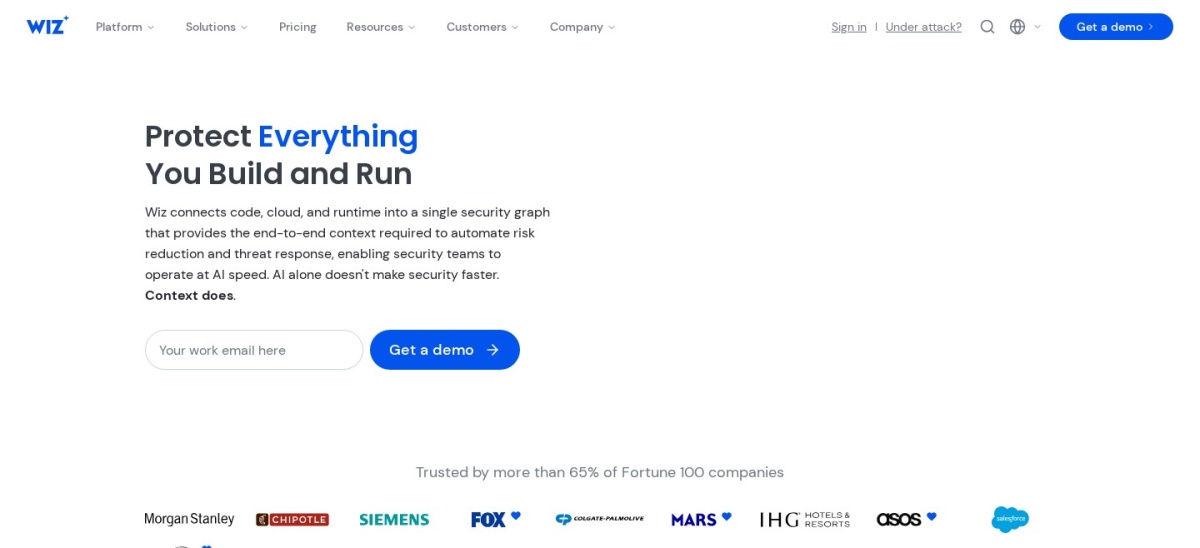
Wiz homepage, captured Nov 2026.
Wiz is an agentless cloud platform that scans workloads, containers and code through cloud APIs, then ties each finding to exposure, identity and data in its Security Graph. Its catalog covers more than 120,000 vulnerabilities across 40-plus operating systems, and it pulls in findings from third-party scanners too.
The trade off is cost and scope. Essential starts at $24,000 a year for 100 workloads, and runtime detection needs the Sensor add-on, so a full setup stacks several priced parts. It suits cloud teams that want attack-path context to decide which flaw to fix first.
What we like
Highest G2 rating here, 4.7 from 845 reviews
Agentless setup covers cloud in minutes
Attack-path context cuts triage noise
Watch out for
Entry price is far above the other tools
Runtime protection costs extra
Advanced and Sensor add runtime detection and code scanningVisit wiz.io
03
Qualys VMDR
4.4/5on G2 (168 reviews, checked Nov 2026)
Starts at$596/mo
Best for hybrid scanning and patching
CoverageHybrid cloud, on-prem, containers
PrioritizationTruRisk score
PatchingPatch jobs included; deploy add-on
Entry price$596/mo, 128 hosts
qualys.com
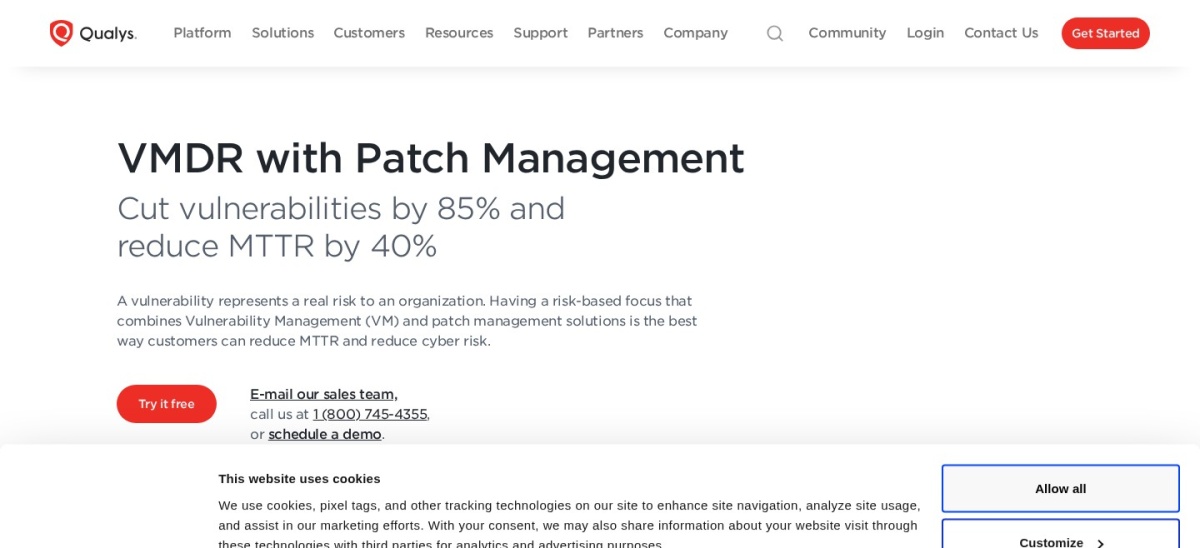
Qualys VMDR homepage, captured Nov 2026.
Qualys VMDR is a cloud platform that discovers assets, scans for vulnerabilities and CIS misconfigurations, and ranks each finding with its TruRisk score, which blends CVSS, EPSS and CISA KEV data. Virtual scanners, Cloud Agents and container sensors are unlimited in the license, so coverage scales by asset count.
The trade off is packaging. Patch deployment, cloud security and container assessment sit in add-ons, and the 128-host entry tier lists at $596 a month, so the real bill depends on which modules you buy. It suits hybrid estates that want scanning and patching from one vendor.
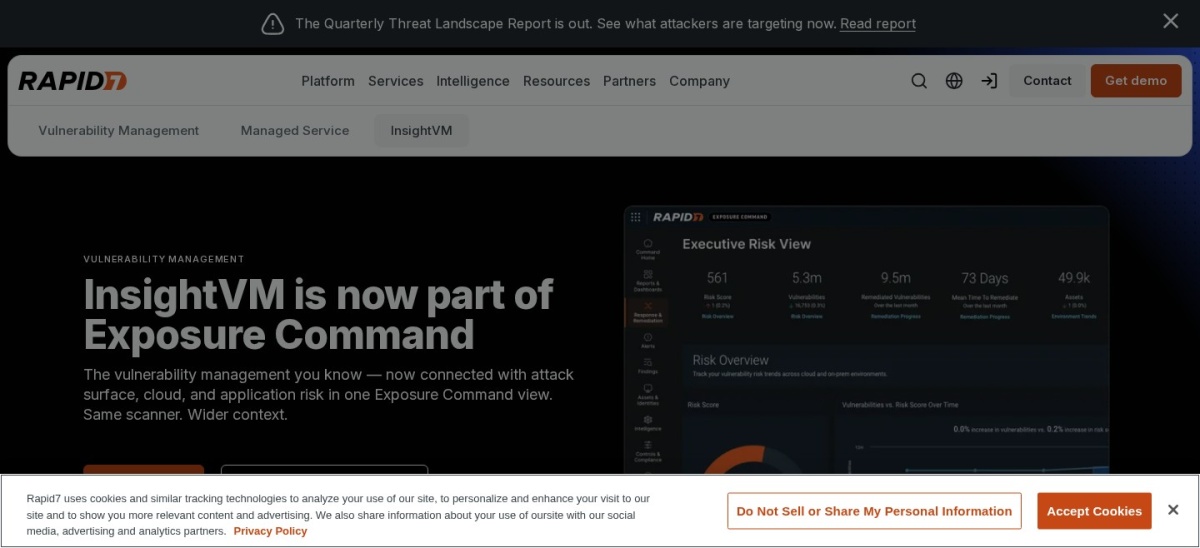
Rapid7 InsightVM is a vulnerability management platform that scans networks and endpoints with scan engines and a lightweight agent, then ranks flaws with its Active Risk score, built from Metasploit exploit data, AttackerKB and CISA KEV. Remediation Projects turn findings into tracked work that syncs with ServiceNow or Jira.
The trade off is packaging and price clarity. InsightVM now sits inside Exposure Command, and the $1.62 per asset per month starting rate applies at 500 assets, with larger volumes quoted. It suits mid-market and enterprise teams that track remediation progress, not just scan coverage.
What we like
Strongest remediation tracking of the enterprise scanners
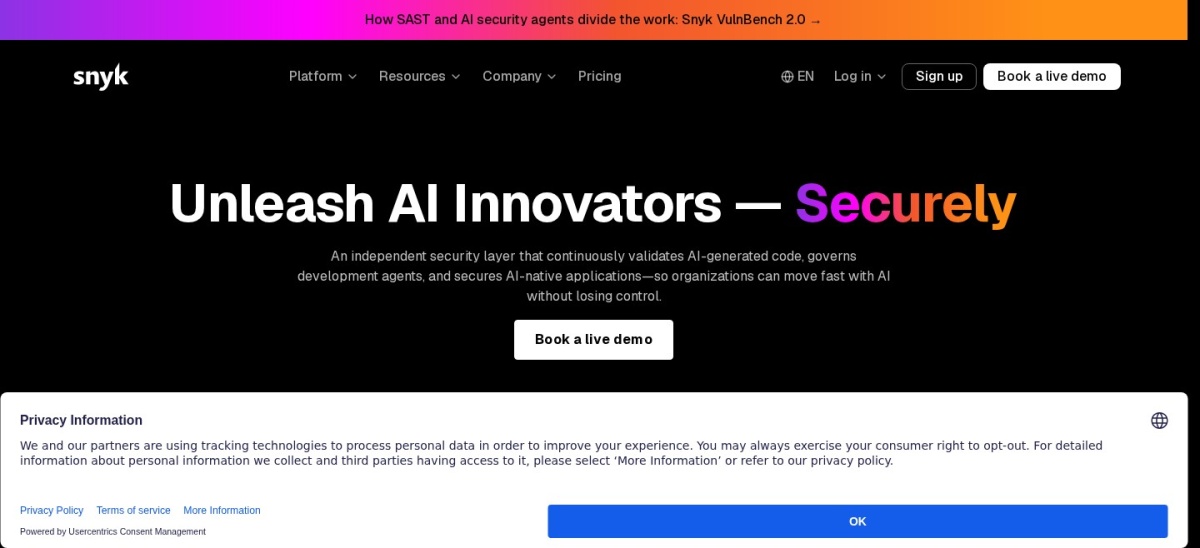
Snyk is a developer platform that scans open-source dependencies, first-party code, container images and infrastructure as code for known vulnerabilities. It maps a flawed dependency to a safe version and opens a fix pull request, so engineers can merge the upgrade where they already work.
The trade off is scope. Snyk secures code and dependencies, not servers or network gear, so most teams run it beside an infrastructure scanner. Team starts at $25 per developer a month, and Enterprise is credit-based. It suits engineering-led teams that fix flaws in the pull request.
Orca Security is an agentless cloud platform that reads cloud storage and configuration out of band with SideScanning, then builds one risk model from vulnerabilities, misconfigurations, secrets and sensitive data. It is strong at finding shadow data, such as production databases copied into forgotten accounts.
The trade off is price. The Small starter pack lists at $7,000 a month, so Orca sits at the enterprise end even at entry scale, and snapshot-based scans run on a schedule rather than continuously. It suits cloud teams that put data security beside vulnerability risk.
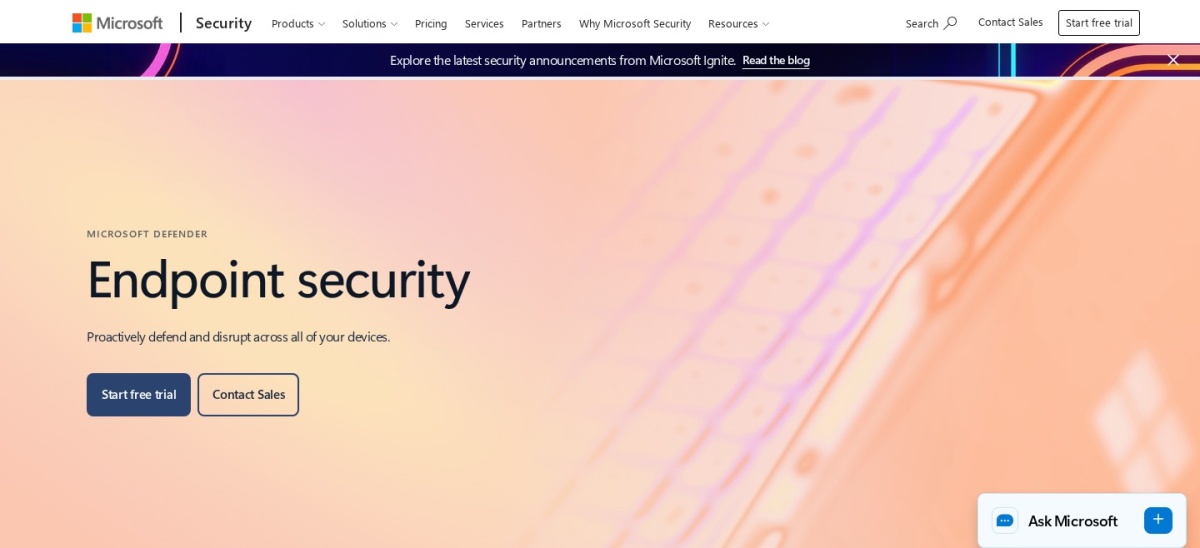
Microsoft Defender Vulnerability Management homepage, captured Nov 2026.
Microsoft Defender Vulnerability Management is the vulnerability layer inside Defender for Endpoint, ranking flaws with an exposure score tied to Secure Score for Devices. Core assessment ships in Defender for Endpoint Plan 2 and Microsoft 365 E5, and remediation requests flow to IT through Intune.
The trade off is depth outside Windows. Linux coverage is weaker, dashboard updates can lag by hours, and premium checks such as baselines and certificate assessment cost about $2 per user a month extra. It suits Microsoft shops that already hold Plan 2 or E5.
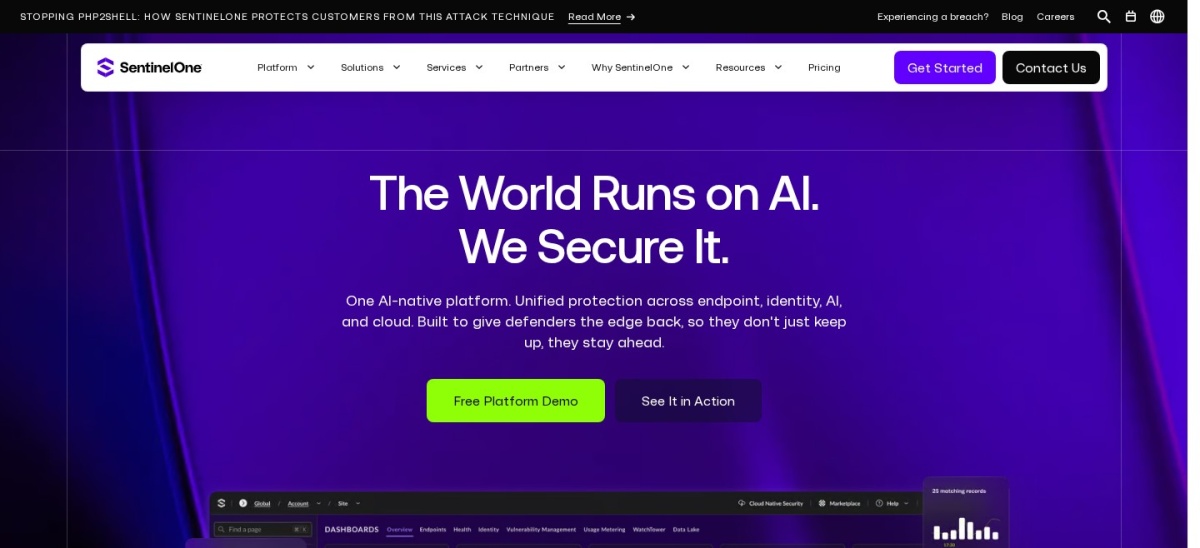
SentinelOne Singularity homepage, captured Nov 2026.
SentinelOne Singularity is a vulnerability management platform that runs on the same agent that handles endpoint protection, scanning Windows, macOS and Linux endpoints for application and OS flaws with no separate scanner to deploy. It ranks findings with a Risk Score built from EPSS and CISA KEV data, and Network Discovery finds unmanaged devices.
The trade off is depth. It gives baseline coverage from the agent rather than a dedicated scanner, and the pricing page does not state which tier includes vulnerability management. Complete lists at $179.99 per endpoint a year. It suits teams that already run SentinelOne for endpoint protection.
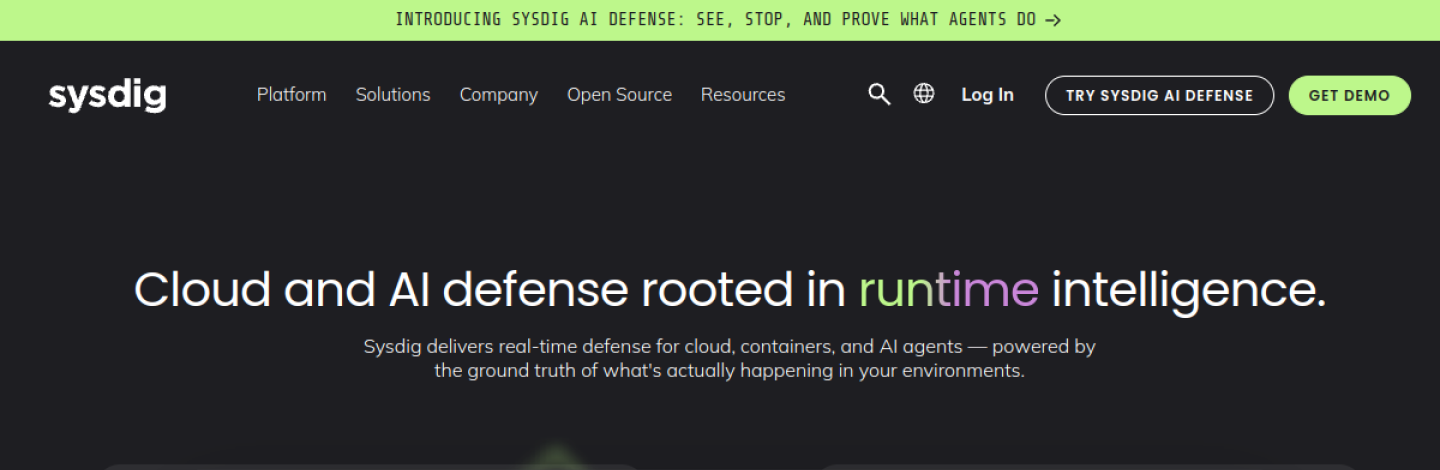
Sysdig is a cloud-native platform that scans container images, registries and running workloads, then uses runtime evidence to mark which vulnerable packages are actually in use. That cuts the queue to flaws that matter, and CVE360 gathers each flaw, its affected resources and its fix in one view.
The trade off is scope and entry cost. In Use tracking covers Java, Go, JavaScript, Python and Ruby, not every language, and the CNAPP entry lists at $72 per unit a month with a 20-unit minimum. It suits Kubernetes teams whose container backlog needs runtime proof before a rebuild.
Only Snyk in this list has a free plan, and it covers code and dependencies, not hosts. Tenable and Rapid7 offer trials, and Defender's core set is already inside Plan 2 or E5, but there is no free host scanner here.
Paid plans mostly add depth and proof. You get agentless cloud context, runtime evidence, patch deployment and verified closure instead of a raw list of CVEs.
If you run a small estate, start with the free Snyk plan for code and a trial of a host scanner, then pay for the one that finds the flaws your team actually fixes. For larger estates, the per-asset bill is the number to model first.
How we chose
We started from the established vulnerability management platforms with public G2 review bases, then kept nine that cover different estates: infrastructure, cloud, code, endpoints and containers.
Prices and ratings were checked on 24 November 2026. Ratings and review counts come from G2 on that date. Prices come from vendor pricing pages and public marketplace listings where vendors do not publish a list price, and the list shows the regular price, not a sale price.
We left out tools with no public G2 review base and pure scanners with no remediation workflow. No vendor paid for a place, and we do not claim hands-on testing for this list.
How to choose a vulnerability management tool
List the asset classes you must cover, then match each one to a tool before you compare prices.
Count what you must scan. List servers, endpoints, cloud workloads, containers and code repos. A tool that misses a whole class leaves a blind spot no dashboard fixes.
Challenge the ranking. Ask how a flaw earns its place at the top. Look for EPSS, CISA KEV or exploit data, not a CVSS sort with a new name.
Follow one finding to closure. Route it to Jira or ServiceNow, patch it, then rescan. If the tool cannot prove the fix held, it is a scanner, not a management platform. See how to check a plugin for vulnerabilities for the same check at smaller scale.
Model the bill at your real counts. Per-asset, per-workload and per-user prices diverge fast. Price the estate you will have in a year, not the trial size.
FAQ
What is the best vulnerability management tool?
Tenable Vulnerability Management is the best pick for most teams, with the deepest detection and VPR prioritization, at $3,500 a year for 100 assets. Wiz leads for cloud estates, and Snyk leads for code.
What is the difference between a vulnerability scanner and vulnerability management?
A scanner finds flaws and stops there. Vulnerability management ranks them by risk, assigns each one to an owner, tracks the fix and verifies it with a rescan. Most tools in this list do the full loop.
How much does vulnerability management software cost?
Entry prices in this list run from about $2 per user a month for the Defender add-on to $24,000 a year for Wiz Essential. Most enterprise platforms are priced per asset or per workload, so the bill depends on estate size.
Is there a free vulnerability management tool?
Snyk has a free plan for code, dependency and container scanning. For hosts and networks there is no free tool in this list, though Tenable, Qualys, Rapid7, Wiz and Orca offer trials.
Do I need a separate tool if I already use an EDR?
Not always. SentinelOne and Defender add vulnerability management to the agent you already run, which covers managed endpoints. You still need a scanner for network gear, unmanaged devices and cloud workloads.
How often should vulnerability scans run?
Continuously where the tool allows it, and at least weekly for the full estate. Agentless cloud tools and EDR agents assess in near real time, while network scans usually run on a schedule.