Best Transaction Monitoring Software in 2026: 9 Tools Compared
WLWPLegible EditorsLast verified 24 Nov 2026How we rank13 min read
★ Short answer
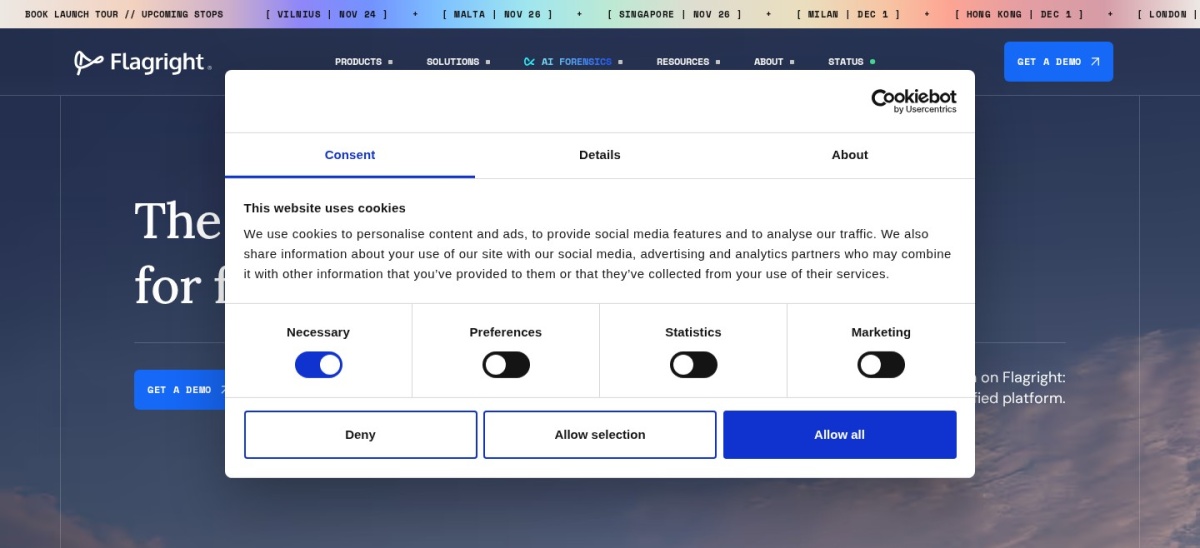
Flagright is the best transaction monitoring software for most teams, rated 5.0/5 on G2 from 48 reviews with 100+ ready scenarios and rule simulation. Pick Sardine for pre-transaction fraud scoring and Unit21 for combined fraud and AML in one platform.
How we make this list: we compare pricing pages, product documentation and public user reviews, then re-check every price before each update. No product paid for a place. Disclosure.
Flagright leads with a 5.0/5 G2 rating from 48 reviews and 100+ ready scenarios with rule simulation before deployment.
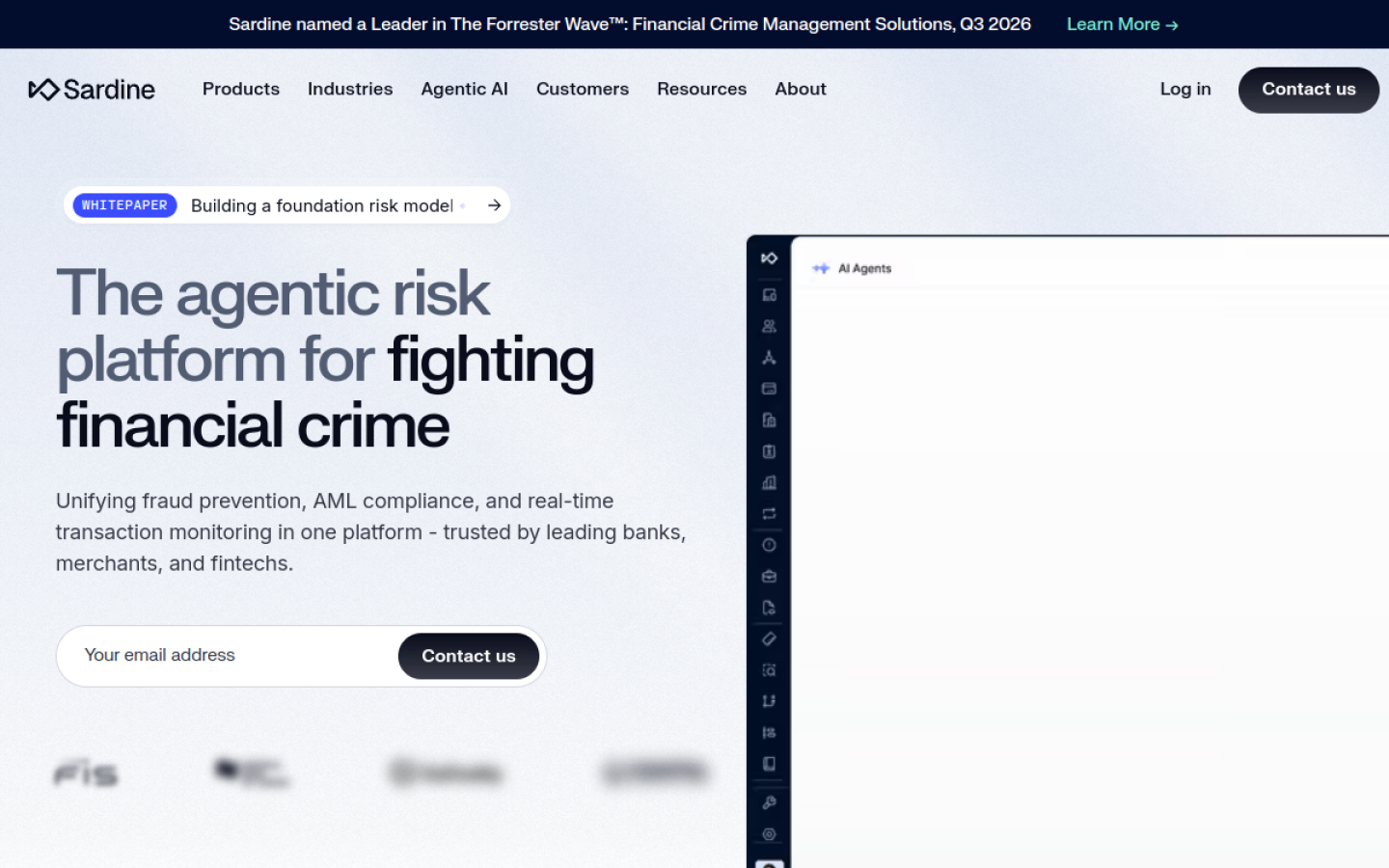
Sardine pairs device and behavior signals with AML monitoring and scores payments before funds move, rated 4.8/5 from 39 G2 reviews.
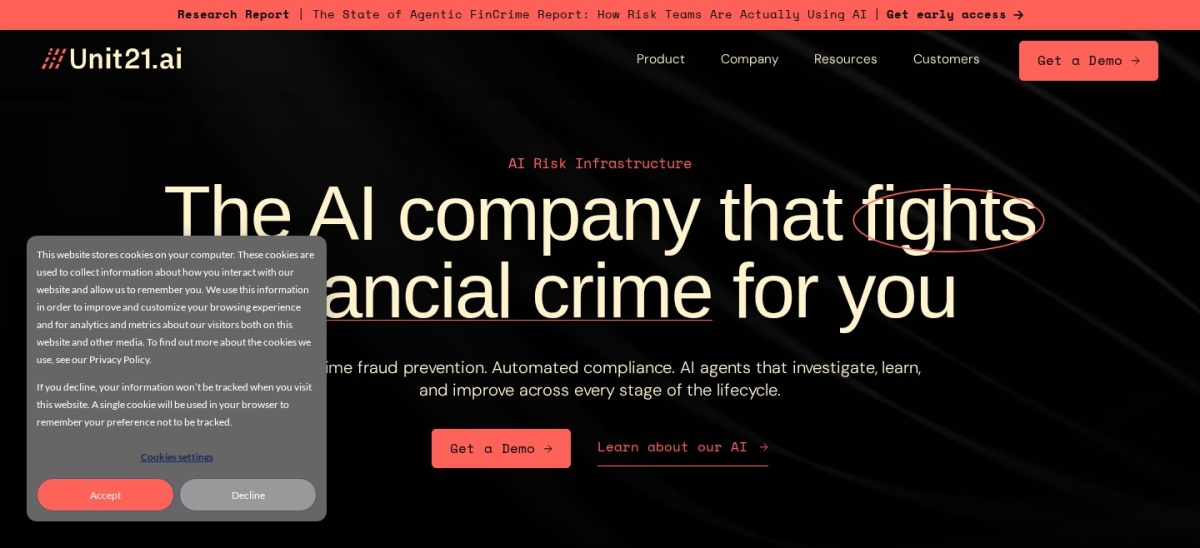
Unit21 covers fraud and AML in one platform with sub-150ms detection and AI agents that pre-populate SAR and CTR filings.
ComplyAdvantage is the only tool here with a published starting price, $99 a month, but transaction monitoring sits on its Enterprise plan only.
Eight of the nine tools publish no price, so expect a sales quote shaped by volume, modules and analyst seats.
What transaction monitoring software should cover
Transaction monitoring watches payments and account activity for patterns that point to money laundering or fraud. It flags the suspicious activity, then routes alerts to analysts who investigate and file reports where needed.
A good tool combines rules with behavior baselines. Rules catch known patterns such as structuring, while baselines flag activity that is unusual for that customer, even when no single rule fires.
Case management matters as much as detection. Alerts need an audit trail, linked transactions and customer history in one place, or analysts waste time gathering evidence across systems.
Most of these tools also screen sanctions lists and watch for fraud on the same transactions. Our guide on stopping card testing attacks shows one fraud pattern that monitoring should catch early.
Pricing is almost always quote-only in this market. Only ComplyAdvantage publishes a starting price, and its transaction monitoring needs the Enterprise plan, so budget for a sales conversation with the rest.
Flagright is a real-time transaction monitoring platform for banks, fintechs and payment firms. It ships 100+ pre-configured scenarios, lets teams build rules in plain English, and processes 1.4 billion transactions a month across 35+ jurisdictions.
The trade off is price. Flagright publishes no price and sells by quote, so small teams cannot budget from the site alone. It suits compliance teams that want to test rules against 90 days of history before they go live.
What we like
Highest G2 rating in this list, 5.0/5 from 48 reviews
Simulate and shadow-test rules before deployment
Real-time risk scoring with 200 ms p99 API latency
Covers monitoring, screening and case management in one workspace
Watch out for
No published price; every deal needs a sales quote
G2 reviewers note simulation runs can be slow on large samples
Reporting and advanced analytics still maturing, per G2 reviews
Sardine is a fraud and AML platform that scores transactions before funds move, using device intelligence, behavior biometrics and network signals. Its rules engine offers 12,000+ machine-learning risk features, and AI agents triage alerts and draft case summaries.
The trade off is price. Sardine publishes no rate card, and G2 puts average implementation at about 2 months. It suits fintechs and banks that want fraud and AML signals in one view instead of two separate tools.
What we like
Rated 4.8/5 on G2 from 39 reviews
Scores payments in real time across ACH, wires, cards and instant rails
AI agents handle first-pass alert triage and evidence gathering
Unit21 is a real-time risk and compliance platform for fintechs and banks, covering fraud detection, AML transaction monitoring, case management and regulatory filing. It evaluates transactions in under 150 milliseconds and serves 180+ financial institutions.
The trade off is price. Unit21 publishes no rate card and quotes per institution, so costs depend on volume and modules. It suits teams that want AI agents to triage alerts and pre-populate SAR, CTR and 314(a) filings.
What we like
Rated 4.6/5 on G2 from 31 reviews
No-code rules teams can change without engineers
AI Detection and Investigation agents automate alert review
Consortium signals from 100+ participating institutions
Watch out for
No published price; every deal needs a sales quote
G2 reviewers say initial rule setup takes time to learn
A few reviewers report inconsistent case exports
Quote only; ask sales for a price based on volumeVisit unit21.ai
04
ComplyAdvantage
4.4/5on G2 (110 reviews, checked Nov 2026)
Starts at$99/mo
Best for published starter pricing
Starter price$99/mo
Starter limitUp to 2,000 entities
Transaction monitoringEnterprise only
PricingPOA for Enterprise
complyadvantage.com
ComplyAdvantage homepage, captured Nov 2026.
ComplyAdvantage is an AML platform covering sanctions, PEP and adverse-media screening, customer screening and transaction monitoring. Its Starter plan starts at $99 a month for up to 2,000 monitored entities, and it is rated 4.4/5 on G2 from 110 reviews.
The trade off is that transaction monitoring is not in the Starter plan. It sits on the Enterprise plan, priced on application, so the $99 figure buys screening only. It suits teams that want a low published entry point for screening first.
What we like
Only tool here with a published starting price
Largest G2 review base in this list, 110 reviews
Free ComplyLaunch programme for qualifying early-stage startups
Setup within 1 business day, per the pricing page
Watch out for
Transaction monitoring needs the Enterprise plan, priced on application
G2 reviewers flag cost as high compared with rivals
SAS Fraud and AML is an enterprise platform that combines fraud detection, anti-money laundering and security intelligence in one system. It uses advanced analytics and machine learning to monitor transactions in real time and prioritise alerts for investigators.
The trade off is implementation time. G2 puts average implementation at 10 months, and reviewers note setup needs strong technical knowledge. It suits large banks that already run SAS analytics and want deep, configurable detection.
What we like
Rated 4.2/5 on G2 from 83 reviews
Real-time monitoring with machine-learning alert prioritisation
Strong audit trails and case management, per G2 reviewers
Handles large transaction volumes in one platform
Watch out for
No published price; custom enterprise contracts only
Long implementation, about 10 months on average per G2
G2 reviewers say setup has a steep learning curve
Quote only; ask sales for a price based on volumeVisit sas.com
06
Nasdaq Verafin
4.2/5on G2 (3 reviews, checked Nov 2026)
PricingCustom/yr
Best for banks and credit unions
Consortium partners2,800+
Transactions analysed1.8B per week
G2 reviews3
PricingQuote only
verafin.com
Nasdaq Verafin homepage, captured Nov 2026.
Nasdaq Verafin is a cloud financial crime platform that combines fraud detection and BSA/AML compliance, with case management and automated regulatory reporting. Its consortium of 2,800+ partners analyses about 1.8 billion transactions a week.
The trade off is evidence depth. Its G2 rating of 4.2/5 rests on only 3 reviews, and pricing is quote-only. It suits banks and credit unions that want cross-institution signals and automated reporting in one cloud platform.
What we like
Consortium data adds signals one bank cannot see alone
Automated regulatory reporting built in
AI agents for alert triage announced in 2026
Cloud delivery with no on-site install
Watch out for
G2 rating rests on only 3 reviews, so treat it as thin evidence
NICE Actimize is an enterprise financial crime platform covering suspicious activity monitoring, sanctions screening, customer due diligence and regulatory reporting. It says more than 1,000 organisations in over 70 countries use it.
The trade off is scale and cost. It is built for large banks, pricing is quote-only, and third-party estimates put mid-market deals in six figures a year. It suits large institutions that want one vendor for AML, fraud and surveillance.
What we like
Rated 4.1/5 on G2 from 25 reviews
Widest module breadth in this list, from SAM to STAR reporting
AML Essentials cloud suite for mid-sized institutions
Mature scenario library for transaction monitoring
Watch out for
No published price; custom enterprise contracts only
Implementation can run 12-24 months, per third-party reviews
G2 reviewers note false positives need tuning effort
4.5/5on Gartner Peer Insights (21 reviews, checked Nov 2026)
PricingCustom/yr
Best for large-scale real-time scoring
Events analysed120B per year
Network intelligence$19T
Out-of-box AML scenarios20+
PricingQuote only
feedzai.com
Feedzai homepage, captured Nov 2026.
Feedzai is an AI-native RiskOps platform that unifies fraud, identity and AML monitoring for banks and payment providers. It analyses 120 billion events a year, and its AML monitoring ships with 20+ out-of-box scenarios.
The trade off is fit. Feedzai targets large institutions, pricing is quote-only, and its G2 presence is thin, so we use its 4.5/5 Gartner Peer Insights rating from 21 ratings. It suits high-volume banks that need real-time scoring across every channel.
What we like
Rated 4.5/5 on Gartner Peer Insights from 21 ratings
Behavioural baselines per customer, not broad segments
White-box explanations for AI risk decisions
Farol AI agent helps analysts manage rules and alerts
Watch out for
No published price; custom quotes only
G2 lists no Feedzai reviews, so public review volume is thin
G2 and Gartner reviewers note rule-building can be hard to learn
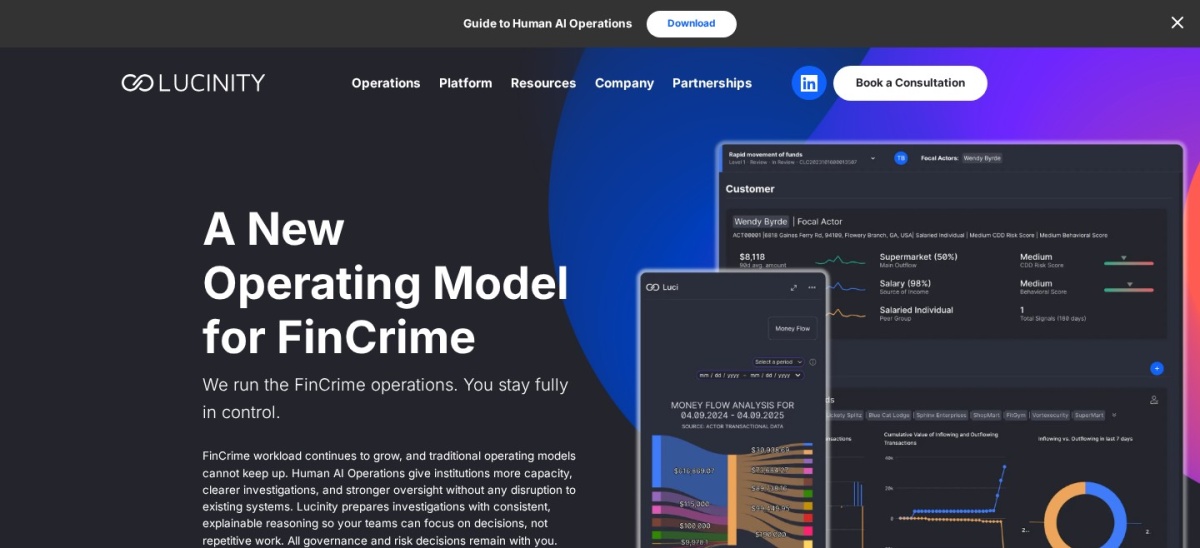
Lucinity is a SaaS AML platform built around four modules: Transaction Monitoring, Case Manager, Actor Intelligence and SAR Manager. Its AI drafts investigation narratives and adds visual context to alerts, so analysts start cases with evidence already gathered.
The trade off is evidence depth. Its G2 rating of 4.5/5 rests on only 3 reviews, and pricing is quote-only. It suits compliance teams that want investigator workflows and AI-written narratives more than a broad fraud suite.
What we like
Rated 4.5/5 on G2 and 5.0/5 on Capterra, both from very few reviews
AI narratives speed up investigation write-ups
Focused AML scope, not a sprawling multi-product suite
Visual context links alerts to actors and transactions
Watch out for
G2 rating rests on only 3 reviews, so treat it as thin evidence
No published price; custom quotes only
Smaller public footprint than the enterprise names in this list
Eight of the nine tools in this list publish no price. That is normal in this market, where cost depends on transaction volume, modules, analyst seats and implementation scope.
Ask each vendor for the same scope in writing: monthly transaction volume, number of analysts, which modules are included, and whether implementation and training are in the quote.
ComplyAdvantage is the exception, with a Starter plan from $99 a month. Remember that its transaction monitoring needs the Enterprise plan, so use the Starter price only as a screening baseline.
How we chose
We started from the established transaction monitoring and AML platforms with public review profiles, then kept nine that cover real-time monitoring, case management and regulatory reporting.
Prices come from each vendor pricing page, checked on 24 November 2026. Ratings and review counts come from G2 on the same day, except Feedzai, which uses Gartner Peer Insights because G2 lists no Feedzai reviews. Where a vendor shows no price, the list shows Custom.
We left out tools whose public review base was too thin to rate at all, including Hawk AI. No vendor paid for a place, and we do not claim hands-on testing for this list.
How to choose transaction monitoring software
Start with your transaction volume and regulatory scope, then shortlist tools built for teams your size.
Map your volume and rails first. Count monthly transactions and list the rails you run, such as ACH, wires, cards or instant payments. A tool that cannot score your fastest rail in real time will leave gaps.
Check the rule and alert workflow. Ask for a demo with your own typologies. You need to build, simulate and tune rules without waiting on the vendor, and see how alerts reach analysts.
Ask what the quote actually includes. Most prices are custom, so get implementation, training, analyst seats and support in writing. Compare the same scope across vendors, not headline figures.
Plan the filing step before you buy. Confirm how alerts turn into SAR, CTR or STR filings, and whether the tool pre-populates them. Get the filing workflow in the demo, not just in the sales deck.
FAQ
What is the best transaction monitoring software?
Flagright is the best pick for most teams. It is rated 5.0/5 on G2 from 48 reviews, ships 100+ ready scenarios, and lets teams simulate rules before deployment. Sardine and Unit21 are strong alternatives for fintechs.
How much does transaction monitoring software cost?
Most tools in this list publish no price and sell by quote, with cost shaped by volume, modules and analyst seats. ComplyAdvantage is the exception, with a Starter plan from $99 a month, though transaction monitoring needs its Enterprise plan.
What is the difference between transaction monitoring and fraud detection?
Transaction monitoring watches for money laundering patterns over time and feeds compliance reporting, while fraud detection blocks bad payments in the moment. Many tools in this list do both, but their compliance and filing features are what set monitoring apart.
Do I need transaction monitoring if I already screen sanctions lists?
Yes. Screening checks names against lists at onboarding and payment time, while monitoring watches behaviour over weeks and months. A clean screening result does not catch structuring, mule activity or unusual velocity.
Can small fintechs use these tools?
Yes, though most are built for mid-market and enterprise teams. Flagright, Sardine and Unit21 all serve fintechs, and ComplyAdvantage offers a published Starter plan and a free programme for qualifying early-stage startups.
How long does it take to implement transaction monitoring software?
It varies by vendor and data readiness. G2 reports about 2 months for Flagright and Sardine, and about 10 months for SAS. Ask each vendor for a timeline tied to your own data sources before signing.