Best Tools for SEO Topical Maps in 2026: 9 Tools Compared
WLWPLegible EditorsLast verified 24 Nov 2026How we rank8 min read
★ Short answer
MarketMuse is the best tool for SEO topical maps for large content teams. It audits whole-site topic coverage and turns gaps into a prioritised plan, from $149 a month. Pick Surfer for clusters plus live optimisation and Frase for fast briefs at $15 a month.
How we make this list: we compare pricing pages, product documentation and public user reviews, then re-check every price before each update. No product paid for a place. Disclosure.
MarketMuse models authority across the whole site, but its paid tiers are now quote-led and start from about $149 a month.
Surfer pairs a Topical Map with a live Content Editor, from $79 a month billed annually.
Clearscope has the highest G2 rating here at 4.9 out of 5, but Essentials covers only 15 reports a month.
Frase and AlsoAsked are the budget entries, from $15 and $12 a month, and both have free or trial options.
Keyword Insights clusters by SERP similarity and scores 4.9 on G2, but that rating rests on only 11 reviews.
What a topical map tool should do
A topical map is a plan of the topics your site should cover to be seen as an authority, and the pages that cover each one. Without it, content grows at random and pages compete with each other.
A good tool starts from the search results, not from keyword similarity alone. It groups keywords by what Google actually shows, finds the gaps in your coverage and turns each cluster into a brief.
Price varies widely because the job varies. A question tool like AlsoAsked costs $12 a month, while a site-wide authority platform like MarketMuse starts near $149. Match the tool to the size of the site.
MarketMuse is a content intelligence platform that audits your whole site's topic coverage, grades every page against ranking content and turns gaps, weak pages and cannibalisation into a prioritised content map.
The trade off is it is the priciest tool here, and its paid tiers are now sold through sales, so the $149 entry figure is a guide rather than a checkout price. It suits large content teams planning authority across dozens of topics..
Surfer is an on-page optimisation platform whose Topical Map proposes content clusters from your domain and competitors, then scores each draft live in its Content Editor against the top-ranking pages.
The trade off is the Essential plan covers 15 articles a month, so a team publishing daily needs Scale at $175 a month, and AI writing costs extra. It suits content teams that plan clusters and optimise drafts in one workflow..
Clearscope is a content optimisation platform that turns a keyword into a clear graded brief covering the terms, headings and questions a ranking article needs, with letter grades writers understand at a glance.
The trade off is Essentials covers only 15 reports a month and one seat style, so agencies pay $399 a month for Business, and there is no free trial, only a demo. It suits editorial teams that want clean, writer-friendly briefs..
Frase is an AI content workflow tool that scrapes the top search results, extracts competitor headings, spots content gaps and turns them into a structured brief, outline and first draft in minutes.
The trade off is Solo covers only 4 articles a month, so regular publishers need Basic at $45 a month, and the AI writer is a $35 add-on. It suits solo writers and small teams that want briefs without Surfer prices..
Keyword Insights is a keyword research tool that clusters keywords by SERP similarity, labels search intent and turns each cluster into a content brief and AI draft, which is the closest thing to an automatic topical map.
The trade off is it runs on credits, so a big keyword list burns through the 10,000-credit Basic allowance fast, and its G2 rating rests on only 11 reviews. It suits strategists planning large sites from keyword lists..
SE Ranking is a full SEO suite with keyword clustering, rank tracking, site audits and backlink monitoring, so a topical map built here sits beside the tracking that proves it worked.
The trade off is its clustering is simpler than Keyword Insights, and the Essential plan covers 5 projects and 500 keywords, so big sites need Pro at $95 a month. It suits freelancers and small agencies that want one suite, not five tools..
Semrush is the broadest SEO suite, whose Topic Research tool maps subtopics, headlines and questions around a seed keyword, backed by one of the largest keyword databases and daily rank tracking.
The trade off is Pro costs $139.95 a month and still caps projects at 5 and keywords at 500, so the topical map work sits inside a much bigger bill. It suits teams already paying for Semrush that want maps without another subscription..
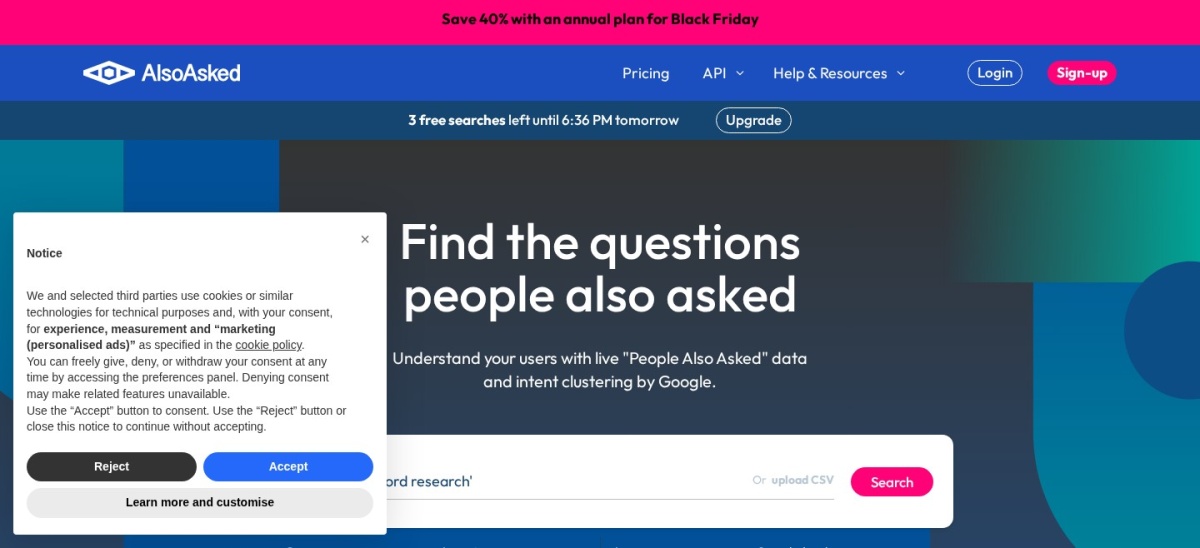
AlsoAsked is a question research tool that pulls live Google People Also Ask questions for a keyword and maps them into intent trees by country, city and language, which is the raw material for a question-led topical map.
The trade off is it only covers questions, so you still need a clustering or brief tool to turn the tree into a content plan, and its review base is thin. It suits bloggers and small teams building maps from real questions..
LowFruits is a SERP analysis tool that scans the top results for each keyword, flags the weak pages you can outrank and groups keywords into clusters, so a topical map starts from winnable topics, not just popular ones.
The trade off is it is a focused tool, so briefs, tracking and audits need other subscriptions, and its review base is thin. It suits small sites that want to rank for topics they can actually win..
A keyword list is a pile of terms. A topical map groups them into clusters, names the pillar page for each cluster and shows which pages are missing.
The tools in this list do that grouping for you. Keyword Insights and Surfer cluster by SERP overlap, while AlsoAsked groups by the questions people actually ask.
Start with one cluster, not the whole site. Map the topic that already brings traffic, fill its gaps, then move to the next.
How we chose
We started from the tools that appear most often in topical authority roundups and G2's SEO category, then kept the nine with a real clustering or topic-mapping feature and a public rating.
Prices come from each vendor's pricing page, checked on 24 November 2026. MarketMuse plans start from about $149 a month, Surfer Essential costs $79 a month billed annually and Clearscope Essentials $129 a month. Ratings and review counts come from G2 on the same day, except AlsoAsked and LowFruits, which have no verified G2 rating.
We left out tools with no public rating or no published price. No vendor paid for a place, and we do not claim hands-on testing for this list.
How to choose a topical map tool
Start with the size of your site, then pick the tool that maps at that scale.
Count your pages first. A site with 50 pages needs a different tool than one with 5,000. Small sites do fine with Frase or AlsoAsked; large ones need MarketMuse or Surfer.
Check the clustering method. SERP-based clustering beats keyword similarity, because it groups terms Google already treats as one topic. Ask how the tool groups before you pay.
Trial one cluster end to end. Map one topic, write the missing pages and watch rankings for a month. If the tool cannot take you from map to brief, it is only half a tool.
Watch credit and report caps. Cheap plans cap articles, reports or credits. Count how many clusters you will build each month and pick a plan that covers them.
FAQ
What is a topical map in SEO?
A topical map is a plan of the topics a site covers, grouped into clusters with a pillar page for each. It shows which topics are covered, which are thin and which are missing entirely.
Which tool is best for topical maps?
MarketMuse is the strongest for large sites, because it audits whole-site coverage. Surfer is the best all-rounder, and Frase is the best budget pick for fast briefs.
Can I build a topical map for free?
Partly. AlsoAsked has a free plan with 3 searches a day and MarketMuse offers 10 free queries a month. A full map still needs a paid plan for clustering and briefs.
How is a topical map different from keyword research?
Keyword research finds terms to target. A topical map groups those terms into clusters, assigns pillar pages and shows the gaps. Research finds the words; a map plans the site.
Do I need a topical map for a small blog?
Not at first. A small blog can plan clusters in a spreadsheet. A map tool pays off once the site passes about 50 pages and clusters start overlapping.
Why do some tools charge per credit?
Credit pricing fits tools that analyse SERPs on demand. Each keyword cluster costs credits, so heavy users pay more. Check your monthly volume before choosing a credit plan.