Best Tools to Find Long-Tail Keywords in 2026: 7 Tools Compared
WLWPLegible EditorsLast verified 22 Nov 2026How we rank12 min read
★ Short answer
AnswerThePublic is our top tool for discovering long-tail questions, with 3 free searches daily and a Starter plan at $6.66 per month billed annually. SpyFu is better for finding phrases competitors already rank for, while Ahrefs suits SEO professionals who need keyword difficulty, traffic estimates and deeper SERP research.
How we make this list: we compare pricing pages, product documentation and public user reviews, then re-check every price before each update. No product paid for a place. Disclosure.
AnswerThePublic offers 3 free searches daily, while Starter provides 100 monthly searches at $6.66/month billed annually.
SpyFu Basic costs $59/month and allows up to 10,000 keyword search results, making it useful for competitor-driven research.
Ahrefs Starter costs $29/month, while Lite costs $129/month and includes 750 tracked keywords.
Serpstat Individual lists $50/month with annual billing, 100 daily searches and 50,000 monthly export rows.
SE Ranking Core costs $103.20/month billed annually and includes daily tracking for 2,000 keywords.
Semrush SEO starts at $117.33/month billed annually and includes monitoring for 5 websites and 500 tracked keywords.
What makes a good long-tail keyword research tool?
Long-tail keywords are specific search queries that often reveal a clear question, problem or buying intention. They are not defined strictly by word count, although many contain several words.
The right tool should generate relevant keyword variations from a seed topic and help you decide which phrases deserve dedicated content. Useful metrics include search volume, keyword difficulty, search intent and the strength of competing pages.
Keyword discovery tools approach this differently. AnswerThePublic organizes questions and related searches, SpyFu reveals competitor keywords, and Ahrefs provides extensive keyword metrics and SERP analysis.
Search volume should not be your only filter. A highly specific query with modest estimated demand may convert better than a broad keyword because its search intent closely matches your product or service.
Consider monthly research limits and data exports before subscribing. Some platforms are built for occasional content planning, while larger SEO suites include rank tracking, site audits, backlink research and competitor monitoring.
Best for discovering long-tail questions and content ideas
Free searches3 per day
Starter searches100 per month
AI prompt suggestions1,000 per month on Starter
Paid planStarter, $6.66/mo billed annually
answerthepublic.com
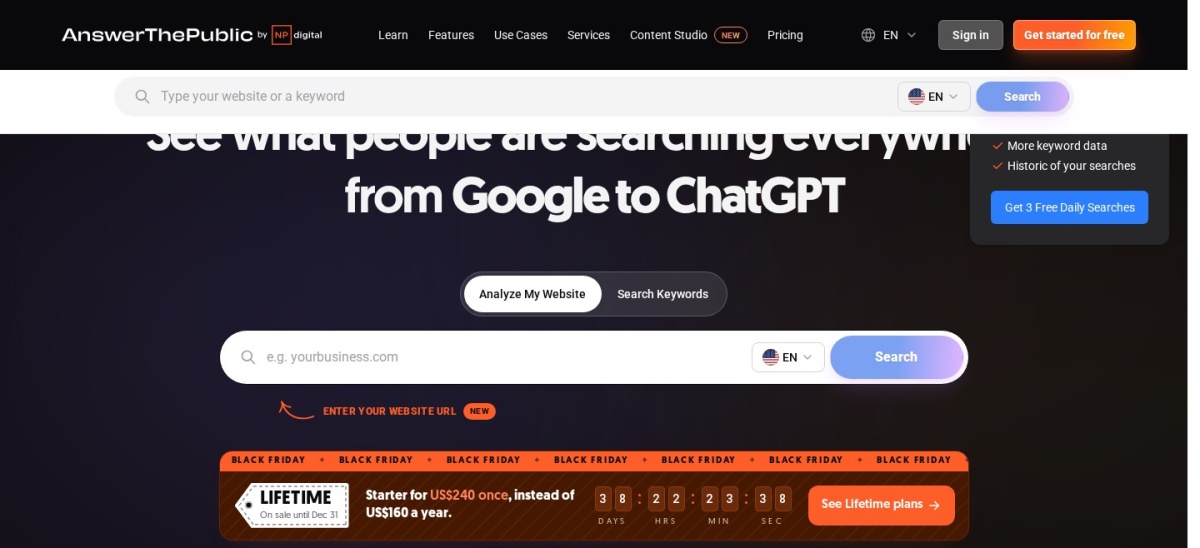
AnswerThePublic homepage, captured Nov 2026.
AnswerThePublic is a search-listening and keyword discovery platform that turns seed topics into questions, comparisons and related search ideas. Its free plan allows 3 searches daily across supported search platforms. Starter includes 100 searches monthly, search volume and CPC data, keyword lists and 1,000 monthly AI prompt suggestions.
The trade off is that AnswerThePublic focuses on discovering audience questions rather than providing a complete technical SEO or backlink research suite. Starter costs $6.66 per month billed annually, totaling $159.96 per year. It suits bloggers, content marketers and small businesses building articles around specific search questions.
What we like
Free daily searches for keyword discovery
Organizes search questions and related phrases
Useful for FAQ and article outline research
Starter includes search volume and CPC data
Supports research across several search platforms
Watch out for
Free searches are limited
Not a complete SEO auditing platform
Search volume estimates need additional validation
Starter adds 100 monthly searches, volume data, keyword lists and AI prompt suggestions.Visit answerthepublic.com
02
SpyFu
4.6/5on G2 (518 reviews, checked Nov 2026)
Paid from$59/mo
Best for finding long-tail keywords from competitors
Keyword results10,000 on Basic
Domain results10,000 on Basic
Data exports10,000 results on Basic
Paid planBasic, $59/mo
spyfu.com
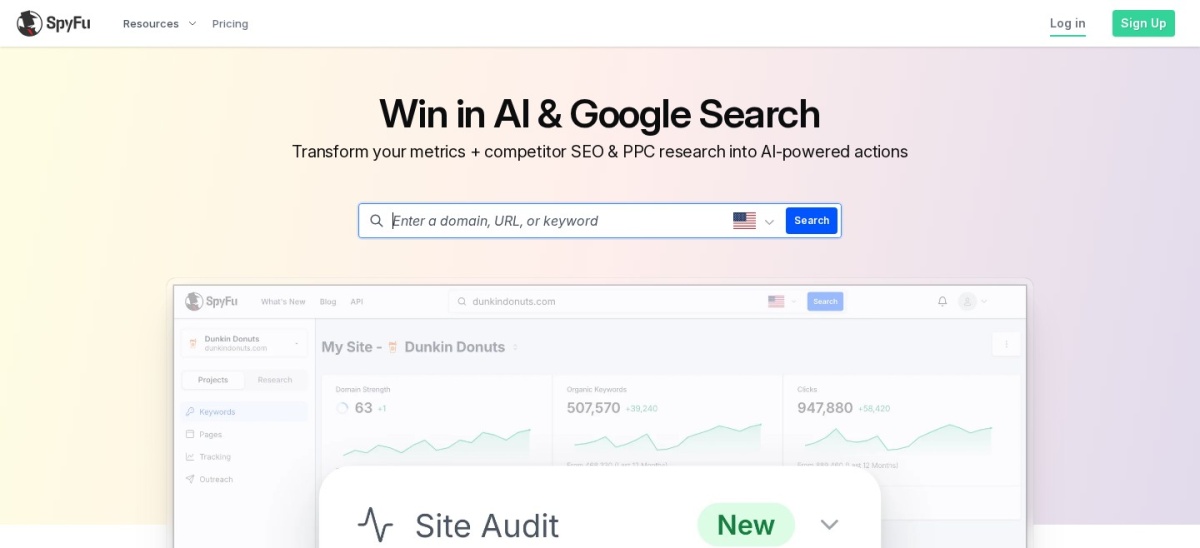
SpyFu homepage, captured Nov 2026.
SpyFu is an SEO and paid search competitive intelligence platform that identifies keywords competing websites rank for. Its public search interface provides limited research access, while Basic includes up to 10,000 keyword search results, competitor analysis, keyword grouping and data exports. Users can compare domains to uncover missed keyword opportunities.
The trade off is that Basic excludes some historical ranking features and advanced automation available in Pro + AI. Basic costs $59 monthly, with a separate discounted annual subscription option. It suits SEO consultants and businesses looking for specific search phrases already driving traffic to competing websites.
What we like
Strong competitor keyword discovery
Organic and paid keyword research
Domain comparison for finding content gaps
Keyword grouping and export capabilities
Historical competitive insights on higher plans
Watch out for
Some historical features require Pro + AI
Not every niche keyword has detailed data
Full SEO research requires a paid subscription
Basic expands keyword research limits, data exports and competitor analysis.Visit spyfu.com
03
Ahrefs
4.5/5on G2 (725 reviews, checked Nov 2026)
Paid from$29/mo
Best for detailed keyword difficulty and SERP research
Entry planStarter
Starter price$29/mo
Lite tracked keywords750
Lite price$129/mo
ahrefs.com
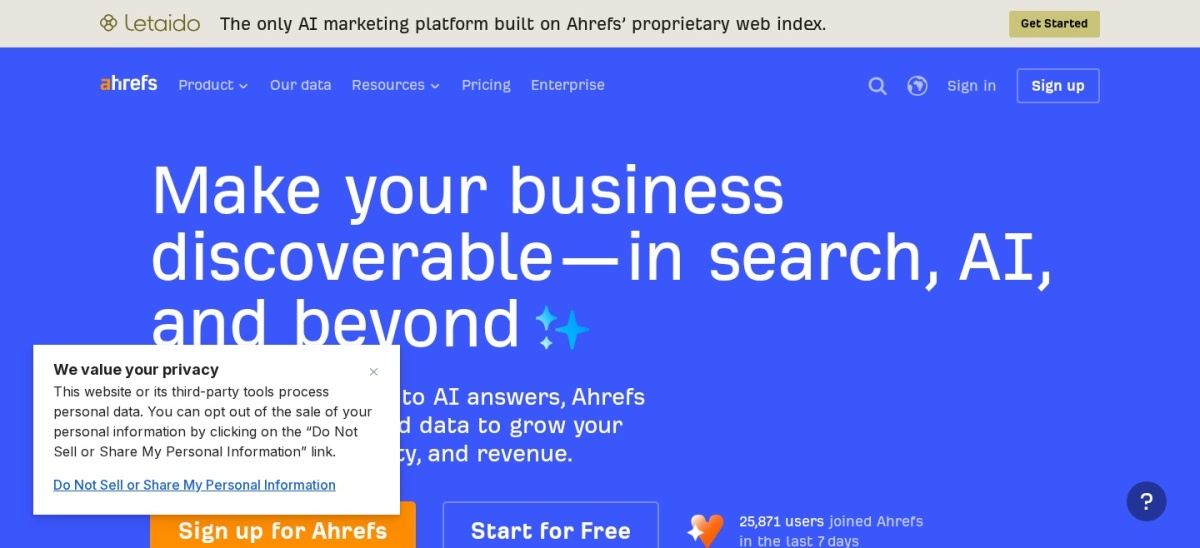
Ahrefs homepage, captured Nov 2026.
Ahrefs is an SEO research platform that helps discover keyword variations, evaluate ranking difficulty and inspect competing search results. Starter costs $29 monthly and provides limited entry-level keyword and competitor research. Lite expands access to Keywords Explorer, Site Explorer, rank tracking and site audits, with 750 tracked keywords and 5 non-verified projects.
The trade off is that Starter has restricted functionality, while Lite costs $129 monthly and uses a credit-based model. Advanced keyword clustering and deeper search intent features require Standard. It suits SEO professionals who need to evaluate long-tail opportunities against competing pages before creating content.
What we like
Detailed keyword and competitor research
Keyword difficulty and SERP analysis
Site Explorer helps uncover competitor terms
Entry-level Starter subscription available
Free webmaster tools for verified websites
Watch out for
Starter has limited research functionality
Lite uses research credits
Advanced clustering requires Standard
Lite adds broader Keywords Explorer access, 750 tracked keywords and site audits.Visit ahrefs.com
04
Ubersuggest
4.2/5on G2 (160 reviews, checked Nov 2026)
Paid from$290 one-time
Best for beginner-friendly keyword research
Entry purchaseIndividual lifetime
Included projects1
Tracked keywords125
Entry purchase price$290 one-time
ubersuggest.com
Ubersuggest homepage, captured Nov 2026.
Ubersuggest is an SEO and content research platform that generates keyword ideas, related searches and content opportunities. Its free access offers limited research, while the Individual lifetime package covers 1 project, 125 tracked keywords and competitor analysis. Keyword suggestions can be filtered using search volume, competition and other SEO metrics.
The trade off is that the entry package limits projects, tracking capacity and research credits. The published Individual lifetime purchase costs $290 as a one-time payment; monthly subscriptions are also available. It suits beginners and solo website owners who want keyword ideas and basic SEO research without paying for a larger professional suite.
What we like
Accessible keyword research interface
Related keyword and content suggestions
Competitor keyword analysis
Free limited research access
Published lifetime purchase option
Watch out for
Research and tracking limits apply
Less extensive advanced SEO functionality
Some reviewers question volume estimates
Individual lifetime access expands research credits, projects and keyword tracking beyond free access.Visit ubersuggest.com
05
Serpstat
4.6/5on G2 (466 reviews, checked Nov 2026)
Starts at$50/mo
Best for keyword clustering and competitive SEO research
Daily searches100 on Individual
Projects5
Monthly exports50,000 rows
Paid planIndividual, $50/mo billed annually
serpstat.com
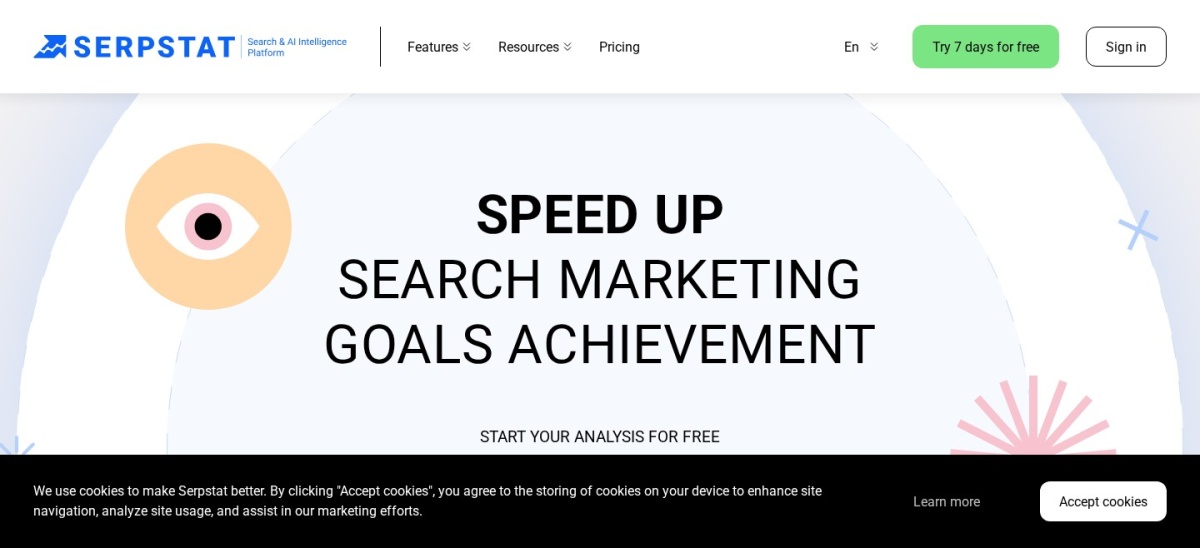
Serpstat homepage, captured Nov 2026.
Serpstat is an SEO intelligence platform combining keyword research, competitor analysis, rank tracking and technical auditing. Individual includes 5 projects, 100 daily searches, 10,000 keyword position checks and 50,000 export rows. Its keyword research tools help identify related phrases, competing domains and content opportunities.
The trade off is that Individual has daily search limits and lacks some team-oriented tools, including broader API and collaboration access. The displayed annual-billing price is $50 monthly, totaling $600 yearly, with temporary promotional offers shown separately. It suits freelancers and SEO teams that want keyword research alongside broader website analysis.
What we like
Keyword research and competitor analysis together
Daily research allowance on Individual
Keyword position tracking included
Exportable keyword data
Site audits and backlink analysis available
Watch out for
Individual has daily search limits
Advanced collaboration needs Team
API and expanded analysis require higher plans
Team adds expanded research limits, collaboration, API access and scheduled reporting.Visit serpstat.com
06
SE Ranking
4.8/5on G2 (1,495 reviews, checked Nov 2026)
Starts at$129/mo
Best for agencies combining keyword research and rank tracking
Core projects10
Tracked keywords2,000 daily
Monthly audit pages250,000
Paid planCore, $129/mo regular monthly
seranking.com
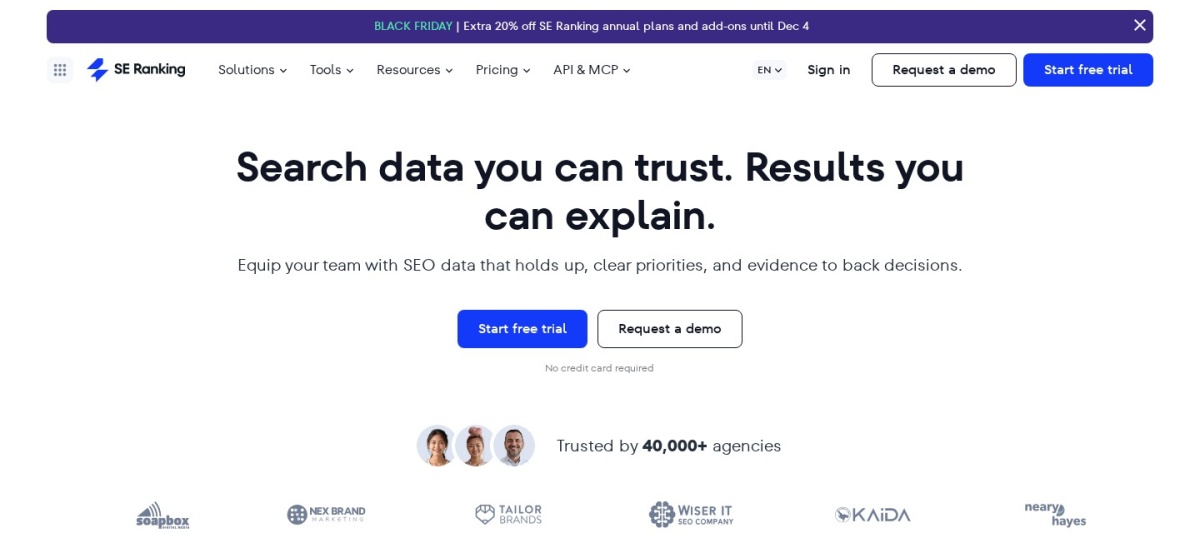
SE Ranking homepage, captured Nov 2026.
SE Ranking is an SEO platform combining keyword discovery, competitor research, rank tracking and website audits. Core supports 10 projects, daily monitoring of 2,000 keywords, 250,000 monthly audit pages and 25,000 API credits. Its keyword research tools help identify related queries and analyze the search results competing for them.
The trade off is that Core costs $129 monthly, although annual billing reduces the effective price to $103.20 monthly. Its broader features may exceed the needs of someone researching occasional blog topics. It suits agencies and in-house SEO teams that need keyword discovery connected to ongoing performance monitoring.
What we like
Keyword research with competitive insights
Daily keyword position monitoring
Site auditing included
Multiple projects supported
API and reporting options available
Watch out for
Higher cost than dedicated keyword tools
Advanced features increase complexity
Some capacity upgrades cost extra
Growth expands project limits, historical data and collaboration capacity.Visit seranking.com
07
Semrush
4.4/5on G2 (4,303 reviews, checked Nov 2026)
Paid from$139/mo
Best for comprehensive keyword and content strategies
Entry planSEO
Monitored websites5
Tracked keywords500 daily
Paid plan$139/mo regular monthly
semrush.com
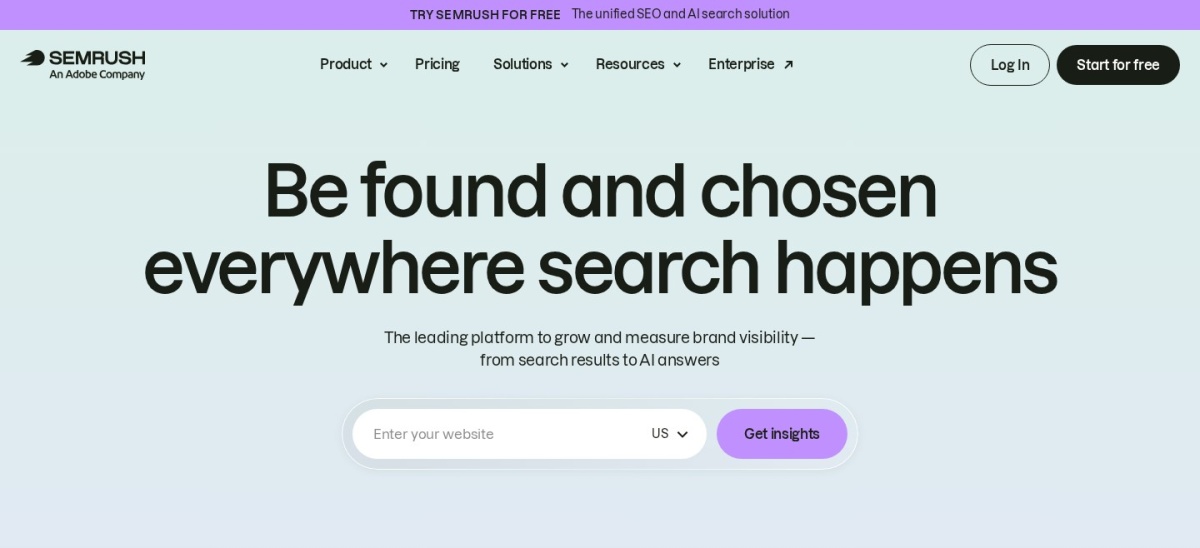
Semrush homepage, captured Nov 2026.
Semrush is an SEO and search visibility platform offering keyword research, competitor analysis, site auditing and position tracking. Its entry SEO plan includes monitoring for 5 websites, daily tracking for 500 keywords and basic keyword research. The platform also provides tools for exploring keyword variations, search intent and competitor visibility.
The trade off is that the entry SEO plan has fewer advanced keyword optimization features than higher subscriptions. Its regular monthly price is $139, or $117.33 monthly with annual billing. It suits established content teams that need long-tail keyword research integrated with competitive analysis and ongoing SEO reporting.
What we like
Extensive keyword research tools
Search intent and competitor insights
Keyword tracking and site audits
Limited free research tools available
Supports broader SEO workflows
Watch out for
Higher regular monthly subscription cost
Advanced optimization tools require higher tiers
More features than occasional keyword research needs
Starter expands keyword optimization, competitor insights and AI search monitoring.Visit semrush.com
How to find long-tail keywords worth targeting
Begin with a broad topic related to your product, service or audience. Enter the topic into a keyword discovery tool and explore questions, comparisons, alternatives and specific problems.
Use keyword modifiers such as for beginners, near me, vs, how to or best for when they naturally match search intent. These modifiers can reveal more specific audience needs.
Next, filter candidate keywords by relevance, search volume and estimated difficulty. Do not automatically reject low-volume queries because search tools can underestimate demand for highly specific phrases.
Inspect the ranking pages before creating content. Look for weak matches to the query, outdated information, missing details and opportunities to provide a clearer answer.
Finally, group similar phrases by search intent. Closely related keywords usually belong together on one helpful page rather than being split into many nearly identical articles.
Mistakes to avoid with long-tail keyword research
One mistake is treating every longer phrase as an easy keyword. Long-tail queries can still be competitive when established websites dominate the search results.
Another is relying entirely on estimated search volume. Keyword tools use different databases and models, so their estimates may disagree, especially for uncommon searches.
Avoid publishing separate articles for every slight wording variation. If multiple phrases have the same intent and similar search results, a comprehensive page is usually more useful.
Do not ignore commercial relevance. A keyword with fewer searches may be more valuable when it closely matches what prospective customers want to buy or accomplish.
How we chose
We evaluated established keyword research and SEO platforms with publicly documented capabilities for keyword suggestions, question discovery, competitor research and search performance analysis. Products were compared on relevance to long-tail discovery, workflow fit, research limits and public user feedback.
Vendor pricing pages and G2 review listings were opened on 24 Nov 2026, with 22 Nov 2026 used as the requested publication date. We distinguished regular monthly prices, annual-billing discounts and one-time purchases, and checked the stated plan limits where accessible.
We excluded tools whose regular pricing could not be confirmed from accessible official information, along with products that lacked sufficient public reviews. We did not treat estimated search volume or difficulty scores as independently verified measurements. No vendor paid for a place, and we do not claim testing for this list.
How to choose the best long-tail keyword research tool
Identify the kind of keyword opportunities you need and match them to the research features you will actually use.
Start with your primary keyword research goal. Choose AnswerThePublic when you need question-based topics and content ideas. Consider SpyFu for competitor keyword gaps or Ahrefs when evaluating difficulty, competing pages and organic search opportunities.
Check the quality of the keyword metrics. Look for search volume estimates, ranking difficulty, search intent and competitor information. Compare keyword suggestions against actual search results because software metrics cannot fully describe whether your content can satisfy a query.
Calculate the required research capacity. Review daily searches, monthly reports, tracked keywords, exports and project limits. A smaller subscription may work for occasional content planning, while an agency can quickly exhaust entry-level allowances.
Choose between specialized discovery and a full SEO suite. Dedicated keyword discovery software is appropriate when you primarily need content ideas. A broader platform such as Serpstat, SE Ranking or Semrush becomes more useful when you also require audits, rank tracking and competitive reporting.
FAQ
What is the best tool to find long-tail keywords?
AnswerThePublic is our top choice for discovering question-based long-tail keywords and related search ideas. It provides 3 free searches daily and a paid Starter subscription. For competitor research, SpyFu is a better fit, while Ahrefs offers deeper keyword difficulty and SERP analysis.
What are long-tail keywords in SEO?
Long-tail keywords are specific search queries that usually represent a narrower topic or intention than broad head terms. They often contain several words, but specificity and search demand matter more than length alone. They can be useful for attracting visitors with clearly defined needs.
Can I find long-tail keywords for free?
Yes. AnswerThePublic offers 3 free searches daily, while Ahrefs and Semrush provide limited free research tools. You can also use search engine autocomplete suggestions and related searches to develop initial ideas. Paid platforms become more useful when you need detailed metrics and exports.
Is Ahrefs or Semrush better for long-tail keyword research?
Both provide keyword research and competitor analysis. Ahrefs is useful for exploring related keywords, SERP competition and traffic potential. Semrush combines keyword discovery with intent analysis and broader SEO workflows. Compare the features included at your subscription level before choosing.
How do I find low-competition long-tail keywords?
Generate specific keyword ideas, filter them by difficulty and relevance, then inspect the actual ranking pages. Look for results that do not adequately answer the query or lack useful detail. A low difficulty score is a starting point, not a guarantee of easy rankings.
Are long-tail keywords easier to rank for?
Some are easier because fewer websites target the exact search intent. However, that is not always true. Competitive commercial queries can remain difficult even when they are highly specific. Evaluate the authority, relevance and quality of existing ranking pages before deciding.
Which tool is best for finding long-tail questions?
AnswerThePublic is particularly useful because it organizes topic suggestions around questions and related searches. Its free plan allows initial exploration, while Starter adds search volume information and higher research capacity. This makes it suitable for planning FAQs, tutorials and informational articles.
Can competitor analysis reveal long-tail keywords?
Yes. Platforms such as SpyFu, Ahrefs, Serpstat and Semrush show keywords associated with competing websites. Reviewing those terms can reveal specific searches your content does not yet address. Prioritize phrases that fit your audience rather than copying a competitor's entire keyword list.
Should I create a separate article for every long-tail keyword?
Usually not. Closely related phrases with the same search intent can often be addressed within one well-organized article. Create separate pages when the queries represent meaningfully different needs. Comparing the search results for each phrase helps determine whether separate content is justified.