Best Software for Distributors in 2026: 7 Tools Compared
WLWPLegible EditorsLast verified 22 Nov 2026How we rank11 min read
★ Short answer
Odoo Inventory is the top software for distributors in 2026, earning a 4.4 out of 5 G2 rating with modular warehouse routing and a free single-app plan. Zoho Inventory fits budget-conscious teams from $348 a year, while SimplyDepo serves field-sales wholesale reps from $828 a year.
How we make this list: we compare pricing pages, product documentation and public user reviews, then re-check every price before each update. No product paid for a place. Disclosure.
Odoo Inventory offers a free single-app plan with unlimited users and scales to all apps at $31.10 per user a month on annual billing.
Zoho Inventory includes a free plan for 50 monthly orders and starts paid tiers at $29 a month billed annually ($348 a year).
SimplyDepo scores 4.7 out of 5 on G2 and prices wholesale field-sales routes from $69 per user a month billed annually ($828 a year).
inFlow Inventory covers multi-location stock and B2B showrooms starting at $99 a month billed annually ($1,188 a year).
Fishbowl Inventory connects directly to QuickBooks and Xero from $229 a month billed annually ($2,748 a year) for two users.
Cin7 Core includes unlimited inventory locations on every tier, starting at $349 a month ($4,188 a year) for five users.
What to look for in distribution software
Wholesale and commercial distributors run on thin margins where stock accuracy, order speed, and purchasing discipline decide profit. Spreadsheets break down once you track multiple warehouses, case-versus-unit conversions, customer-specific price lists, or backorders across phone, email, and B2B portals.
The right system depends on whether your bottleneck sits in the warehouse, on the road with sales reps, or in accounting sync. Lightweight inventory platforms connect cleanly to QuickBooks or Xero at lower monthly rates, while modular ERP suites unify purchasing, multi-location replenishment, and invoicing under one database.
Pay close attention to how each vendor meters growth. Some tools cap monthly sales orders or active SKUs, while others charge per user seat, restrict warehouse locations on lower tiers, or require paid onboarding packages before go-live.
Odoo Inventory is a modular warehouse and supply chain application within the Odoo ERP suite, rated 4.4 out of 5 across 65 G2 reviews. Its One App Free plan costs $0 with unlimited users on Odoo Online when you only run Inventory, covering barcode scanning, multi-warehouse transfers, drop-shipping, and automated replenishment rules.
The trade off is that connecting Inventory with Sales, Purchasing, or Accounting moves every user onto a paid plan. The Standard plan regularly costs $31.10 per user a month billed annually ($373.20 a year), with an advertised $24.90 introductory rate for the first 12 months. It suits distributors that want an adaptable system that can expand into full ERP.
What we like
Free single-app tier supports unlimited users on Odoo Online
Supports double-entry inventory, multi-warehouse routes, and barcode scanners
Scales into full accounting, purchasing, and B2B ecommerce without migrating data
Custom plan allows self-hosting or Odoo.sh deployment
Watch out for
Adding a second app requires paid seats for every backend user
First-year discount expires after 12 months at regular renewal rates
Complex multi-warehouse setups often require paid Success Packs or partner help
Standard ($31.10/user/mo annual) unlocks all Odoo apps including Sales, Purchase, and Accounting.Visit odoo.com
02
Zoho Inventory
4.4/5on G2 (93 reviews, checked Nov 2026)
Paid from$29/mo
Best value for small wholesale distributors
Entry price$29/mo billed annually
Free plan50 orders/mo, 2 locations
Standard cap500 orders/mo, 3 users
AccountingNative Zoho Books sync
zoho.com
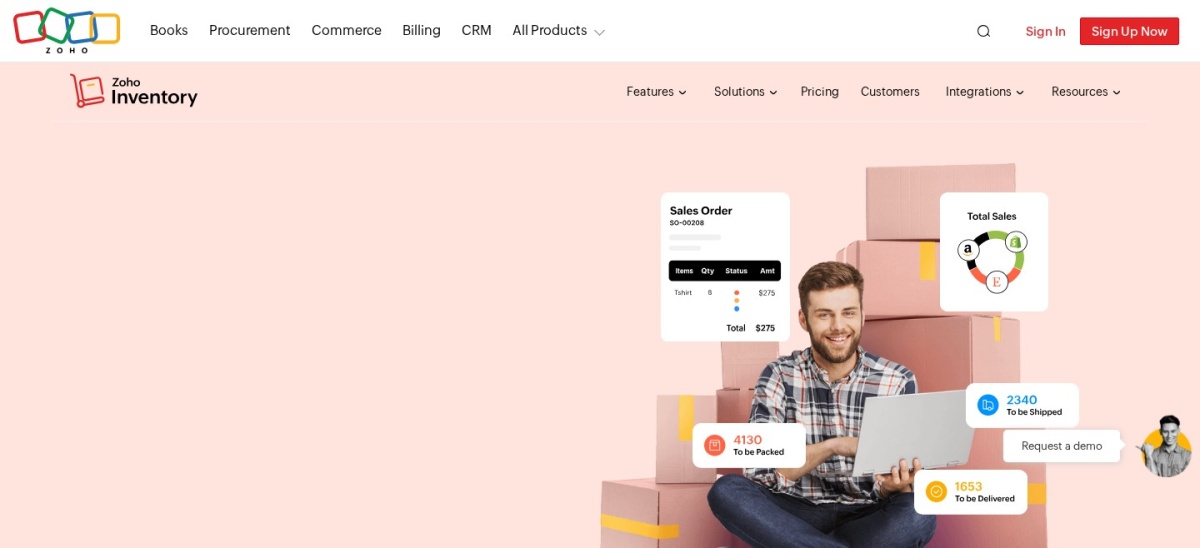
Zoho Inventory homepage, captured Nov 2026.
Zoho Inventory is a cloud order and stock management platform rated 4.4 out of 5 across 93 G2 reviews. Its free plan covers up to 50 orders a month, one user, and two warehouse locations, while the Standard plan starts at $29 per organization a month billed annually ($348 a year) for 500 monthly orders and three users.
The trade off is strict tier caps on orders, users, and warehouse locations. Adding extra users costs $7.50 a month each and extra locations cost $10 a month on top of your tier, while serial and batch tracking sit on higher plans. It suits small distributors looking for predictable flat-rate pricing.
What we like
Usable free tier for low-volume distribution with two locations
Flat organization pricing rather than per-seat licensing on base tiers
Direct integration with Zoho Books, Zoho CRM, and major shipping carriers
Supports composite items, kitting, and drop-shipments
Watch out for
Monthly order and shipment caps force upgrades as volume rises
Additional users and warehouses incur monthly add-on fees
Batch and serial tracking require higher-tier subscriptions
Standard ($29/mo annual) raises limits to 500 monthly orders, 3 users, and multi-channel integrations.Visit zoho.com
03
SimplyDepo
4.7/5on G2 (58 reviews, checked Nov 2026)
Starts at$69/mo
Best for CPG and field-sales distributors
Entry price$69/user/mo billed annually
Free planNo (free trial available)
Team tiersStarter (1–5), Growth (6–15)
Core focusRoute planning & retail execution
simplydepo.com
SimplyDepo homepage, captured Nov 2026.
SimplyDepo is a wholesale distribution and field-sales platform built for food, beverage, and consumer goods teams, holding a 4.7 out of 5 rating across 58 G2 reviews. Its Starter plan costs $69 per user a month billed annually ($828 a year), or $89 a month billed monthly, with no minimum user requirement or setup fee.
The trade off is per-rep pricing and lighter warehouse automation than a full ERP. Larger teams save per seat on Growth ($79 monthly) and Scale ($69 monthly), but complex warehouse picking or manufacturing workflows still require a paired accounting or ERP system. It suits distributors managing outside sales reps and delivery routes.
What we like
Highest G2 rating on this list at 4.7 out of 5
Combines mobile order capture, route optimization, and shelf audits in one app
No minimum seat count or mandatory onboarding fee
Per-seat rate drops as sales team size scales
Watch out for
No permanent free tier
Per-rep billing adds up for large field teams
Not built for complex multi-warehouse pick-and-pack automation
Starter ($69/user/mo annual) gives 1–5 reps mobile ordering, route planning, and live inventory visibility.Visit simplydepo.com
04
inFlow Inventory
4.4/5on G2 (58 reviews, checked Nov 2026)
Starts at$99/mo
Best for sublocation tracking and B2B showrooms
Entry price$99/mo billed annually
Free planNo (14-day free trial)
Lite limits2 users, 1 location
B2B portalShowroom add-on ($39/mo)
inflowinventory.com
inFlow Inventory homepage, captured Nov 2026.
inFlow Inventory is a cloud inventory and order management system for product wholesalers and light manufacturers, rated 4.4 out of 5 across 58 G2 reviews. Its Inventory Lite plan starts at $99 a month billed annually ($1,188 a year), or $129 billed monthly, covering two users, one location, barcoding, and purchase and sales orders.
The trade off is a steep jump to multi-location tiers and extra add-on fees. Moving to Inventory Core for up to five locations costs $299 a month billed annually plus a required $499 onboarding package, while the Showroom B2B ordering portal and lot tracking cost $39 a month each. It suits small distributors outgrowing spreadsheets.
What we like
Clean interface with fast staff onboarding and mobile barcode scanning
Supports aisle, shelf, and bin sublocations plus per-location reorder points
Optional B2B Showroom portal lets wholesale buyers place self-serve orders
Integrates with QuickBooks, Xero, Shopify, and shipping tools
Watch out for
Lite plan restricts you to a single inventory location
Jumping from Lite ($99/mo) to Core ($299/mo) triples the monthly software cost
Core and higher tiers require a $499 one-time onboarding package
Lite ($99/mo annual) includes 2 users, barcoding, and full purchase-to-sales order workflows.Visit inflowinventory.com
05
Fishbowl Inventory
4/5on G2 (274 reviews, checked Nov 2026)
Starts at$229/mo
Best for QuickBooks-based wholesale warehouses
Entry price$229/mo billed annually
Free planNo (14-day free trial)
Essentials seats2 users included
AccountingQuickBooks & Xero sync
fishbowlinventory.com
Fishbowl Inventory homepage, captured Nov 2026.
Fishbowl Inventory is a warehouse and inventory management platform built around QuickBooks and Xero accounting, holding a 4.0 out of 5 rating across 274 G2 reviews. Its Essentials plan starts at $229 a month billed annually ($2,748 a year) for two users, providing barcode-driven stock control, order management, and accounting sync.
The trade off is tier gating and mandatory implementation services. Unlimited warehouses arrive on Growth at $429 a month, while lot tracking, 3PL workflows, and EDI require Scale ($729 a month) or Advanced Warehouse (from $595 a month), plus a required implementation package. It suits distributors committed to QuickBooks.
What we like
Mature two-way sync with QuickBooks Online, QuickBooks Desktop, and Xero
No published cap on annual sales orders across plans
Scales into Advanced Warehouse and Advanced Manufacturing editions
Strong barcode picking, receiving, and cycle-counting workflows
Watch out for
Requires a paid implementation package with multi-week training
Lot tracking and EDI are locked behind higher tiers
Ecommerce integrations beyond included slots cost $50 a month each
Essentials ($229/mo annual) connects 2 users to QuickBooks Online or Xero with barcode stock control.Visit fishbowlinventory.com
06
Cin7 Core
4.3/5on G2 (353 reviews, checked Nov 2026)
Starts at$349/mo
Best for multichannel wholesale and ecommerce
Entry price$349/mo (Standard)
Free planNo (14-day free trial)
Standard caps5 users, 6,000 orders/yr
LocationsUnlimited on all plans
cin7.com
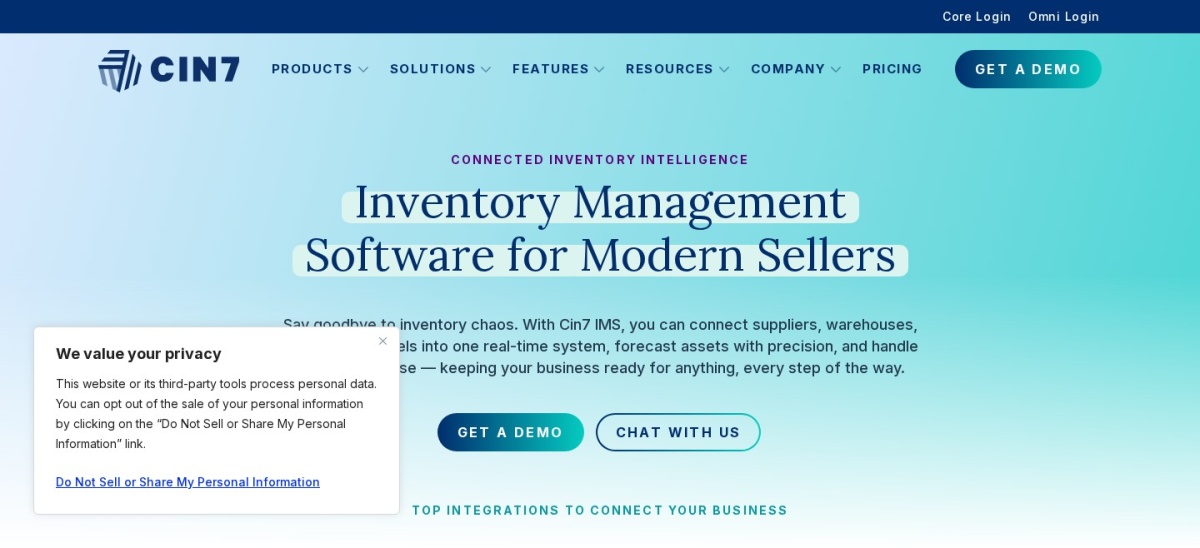
Cin7 Core homepage, captured Nov 2026.
Cin7 Core (formerly DEAR Systems) is an inventory and order management platform for wholesale and multichannel product brands, rated 4.3 out of 5 across 353 G2 reviews. Its Standard plan starts at $349 a month ($4,188 a year on monthly billing, or $3,839 paid yearly) for five users, unlimited inventory locations, and 6,000 sales orders a year.
The trade off is strict annual order ceilings and integration slot caps. Standard includes only two ecommerce or app integrations and caps volume at 6,000 orders a year, while multi-warehouse mobile picking, B2B portals, and ForesightAI forecasting require higher tiers or paid add-ons. It suits mid-sized distributors selling across B2B and marketplaces.
What we like
Unlimited inventory locations included even on the Standard plan
Includes assembly bill of materials and purchasing workflows out of the box
Connects to QuickBooks Online, Xero, Shopify, Amazon, and 3PL partners
Optional native B2B portal and POS add-ons
Watch out for
Annual sales order caps (6,000 on Standard) trigger overages or upgrades
Limited to 2 ecommerce/app integration slots on Standard
Advanced multi-warehouse WMS features require the $1,199/mo Advanced tier
Standard ($349/mo) covers 5 users, unlimited stock locations, and up to 6,000 annual sales orders.Visit cin7.com
07
Descartes Finale Inventory
4.8/5on G2 (41 reviews, checked Nov 2026)
Starts at$499/mo
Best for high-SKU multichannel warehouse operations
Entry price$499/mo (Essentials)
Free planNo (14-day free trial)
Essentials fit1–2 warehouses
Max scaleUp to 1.5M SKUs & orders/mo
finaleinventory.com
Descartes Finale Inventory homepage, captured Nov 2026.
Descartes Finale Inventory is a cloud inventory and warehouse management system built for high-volume multichannel wholesalers and distributors, holding a 4.8 out of 5 rating across 41 G2 reviews. Its Essentials plan starts at $499 a month ($5,988 a year) for operations running one to two warehouses with mobile barcode scanning and automated purchasing.
The trade off is a higher entry price than entry-level inventory apps. Growth moves to $799 a month for larger multi-warehouse and multichannel operations, though the architecture scales up to 300 users, 1.5 million products, and 1.5 million orders a month. It suits fast-moving distributors with large SKU catalogs.
What we like
Highest G2 score in the comparison at 4.8 out of 5
Handles up to 1.5 million SKUs and 1.5 million monthly orders at scale
Built-in custom barcode label printing and mobile wave picking
Automated landed-cost and weighted-average COGS syncing to QuickBooks Online
Watch out for
Entry Essentials plan starts at $499 a month with no free tier
Utilitarian interface prioritizes speed over modern visual polish
Live phone and Zoom support are reserved for higher tiers
Essentials ($499/mo) equips 1–2 warehouses with mobile barcode scanning, kitting, and PO automation.Visit finaleinventory.com
Watch out for hidden distribution software costs
Headline monthly rates rarely reflect your total first-year bill. Systems like Fishbowl and inFlow Core require paid onboarding or implementation packages ranging from $499 to several thousand dollars, while Odoo charges extra for implementation Success Packs if you do not configure the database yourself.
Metered limits also push total spend higher as order volume grows. Zoho Inventory and Cin7 Core enforce monthly or annual sales order ceilings, and several vendors charge separately for extra warehouse locations, B2B ordering portals, lot traceability, or additional ecommerce connectors.
How we chose
We built this list by evaluating established inventory, wholesale, and ERP platforms actively used by commercial and B2B distributors. Each candidate needed a public pricing page with verifiable rates and an active review profile on G2.
All prices, plan limits, G2 ratings, and review counts were checked on 22 Nov 2026 against official vendor pricing pages and G2 product listings. Where a vendor advertises a temporary first-year promotion, we list the regular renewal price in the comparison table and price ladder.
We excluded enterprise distribution ERPs that hide all pricing behind custom quotes, such as NetSuite, Acumatica, Epicor Prophet 21, and Cin7 Omni, as well as tools lacking sufficient public review volume. No vendor paid for a place, and we do not claim testing for this list.
How to choose software for your distribution business
Map your order volume, warehouse count, and accounting setup before comparing monthly subscription rates.
Audit your warehouse and lot-tracking rules first. Confirm whether you need bin-level sublocations, barcode picking, or lot and serial traceability for expiration dates, as many platforms lock those tools behind mid-tier plans.
Check how each vendor meters growth. Compare per-user pricing against order-volume caps so a seasonal spike in wholesale orders or extra warehouse scanners does not trigger unexpected tier upgrades.
Verify two-way accounting and B2B ordering needs. Decide whether you want an all-in-one ERP ledger like Odoo or tight synchronization with QuickBooks or Xero alongside a self-serve B2B customer portal.
Factor implementation fees into year-one budgets. Ask vendors in writing whether data migration, barcode hardware setup, and staff training are included or billed as a mandatory onboarding package.
FAQ
What is the best software for small distributors?
Odoo Inventory and Zoho Inventory are the strongest starting options for small distributors. Odoo offers a free single-app plan with unlimited users and scales to full ERP at $31.10 per user a month annually, while Zoho Inventory includes a free tier for 50 monthly orders and starts paid plans at $29 a month billed annually.
How much does distribution software cost per year?
Entry-level distribution platforms range from $348 a year for Zoho Inventory Standard and $373 a year per user for Odoo Standard up to $4,188 a year for Cin7 Core and $5,988 a year for Descartes Finale Essentials. Expect additional costs for extra users, B2B portals, and paid onboarding packages.
What is the difference between inventory software and distribution ERP?
Inventory software focuses on stock counts, purchase orders, warehouse picking, and syncing numbers to external accounting tools like QuickBooks or Xero. A distribution ERP like Odoo combines warehouse operations, customer-specific pricing, purchasing, and full double-entry accounting inside one unified database.
Which distribution software works best with QuickBooks?
Fishbowl Inventory is purpose-built around QuickBooks Online and QuickBooks Desktop sync, starting at $229 a month billed annually. inFlow Inventory, Cin7 Core, and Descartes Finale Inventory also provide direct accounting integrations with QuickBooks Online and Xero.
Is there free software for wholesale distributors?
Yes. Odoo Inventory offers a permanent free plan with unlimited users when you only use the Inventory module on Odoo Online, and Zoho Inventory provides a free tier supporting up to 50 orders a month, one user, and two warehouse locations.