Adobe Photoshop is the best software for astrophotography processing for most people, rated 4.6/5 from 13,460 G2 reviews, with deep layer and masking tools for stacked images. Pick DxO PhotoLab for the strongest noise reduction and GIMP if you want a free editor.
How we make this list: we compare pricing pages, product documentation and public user reviews, then re-check every price before each update. No product paid for a place. Disclosure.
Photoshop is the top pick at 4.6/5 from 13,460 G2 reviews, and it works as a host for astro plugins.
DxO PhotoLab has the strongest noise reduction in this list, with DeepPRIME XD, at $249.99 as a one-time license.
Capture One Pro is the best-rated RAW editor for color work at 4.5/5, but its $30 a month plan is the priciest subscription here.
GIMP is the only free tool here, rated 4.3/5 from 1,484 reviews, and it handles layers, masks and RAW files.
Luminar Neo, ON1 Photo RAW and DxO PhotoLab are one-time purchases, shown as yearly amounts in the ladder below.
What astrophotography processing actually involves
Astrophotography processing has two jobs. First, many exposures are stacked into one cleaner image. Then that image is stretched, cleaned and finished, and that second job is what this list covers.
The tools here are the finishing editors astrophotographers actually use. Photoshop leads because stacked files open there for layers, masks and plugins, while DxO PhotoLab, Capture One and Luminar Neo handle RAW files and noise first.
Noise is the main problem in night-sky images. Long exposures and high ISO settings add grain, so a strong denoise tool matters more here than in daytime photography, and it should come before any creative edit.
Dedicated stacking tools such as PixInsight, Astro Pixel Processor, Siril and DeepSkyStacker are not ranked here. They have no public rating on G2 or Capterra, so they could not meet the rating rule for this list, even though many astrophotographers stack with them first.
The 7 best software for astrophotography processing
01
Adobe Photoshop
4.6/5on G2 (13,460 reviews, checked Nov 2026)
Starts at$22.99/mo
Best astrophotography processing software overall
RAW editingCamera Raw built in
LayersYes, with masks
Noise reductionAI Denoise
Cheapest plan$22.99/mo
adobe.com
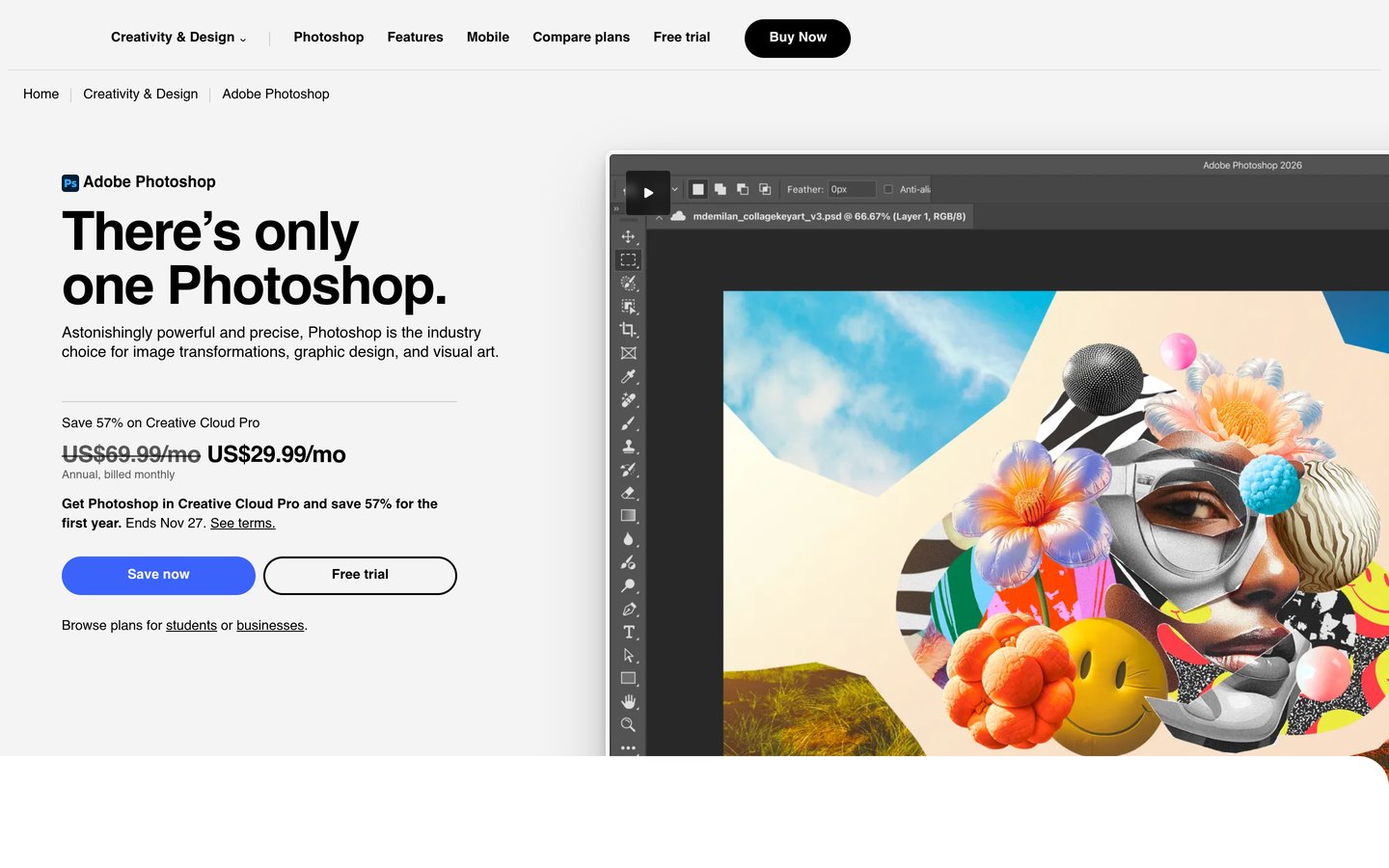
Adobe Photoshop homepage, captured Nov 2026.
Adobe Photoshop is the standard finishing editor for astrophotography, rated 4.6/5 from 13,460 G2 reviews. Stacked images open as layered files, so you can stretch faint detail, mask the sky from the stars and run astro plugins for noise reduction and star removal. It includes Camera Raw for RAW files and AI Denoise for high-ISO frames.
The trade off is the subscription. Photoshop costs $22.99 a month for individuals, with no one-time license, and the full toolset takes time to learn. It suits photographers who already stack elsewhere and want the deepest control over the final image.
What we like
Deepest layer and masking control for stacked images
Camera Raw and AI Denoise built in
Largest review base in this list, 13,460 G2 reviews
DxO PhotoLab is a RAW editor built around noise reduction, rated 4.4/5 from 14 Capterra reviews. Its DeepPRIME XD engine cleans high-ISO frames at the demosaicing stage, which is where faint nebula detail is usually lost to grain. It also corrects lens distortion and chromatic aberration from lab-measured camera profiles.
The trade off is price and scope. PhotoLab 10 Elite costs $249.99 as a one-time license, currently $199.99 in a Black Friday sale, and it has no layers like Photoshop. It suits photographers who want the cleanest RAW file before finishing elsewhere.
What we like
DeepPRIME XD is the strongest denoise here
Lab-measured lens corrections
Perpetual license, no subscription
Watch out for
No layers for compositing
Highest one-time price in this list at $249.99
Only 14 Capterra reviews
Paid license adds the full RAW editor with DeepPRIME XDVisit dxo.com
03
Capture One Pro
4.5/5on G2 (79 reviews, checked Nov 2026)
Starts at$30/mo
Best for color control in astro images
RAW processingCustom camera profiles
Tethering550+ cameras supported
Activations3 devices
Cheapest plan$30/mo
captureone.com
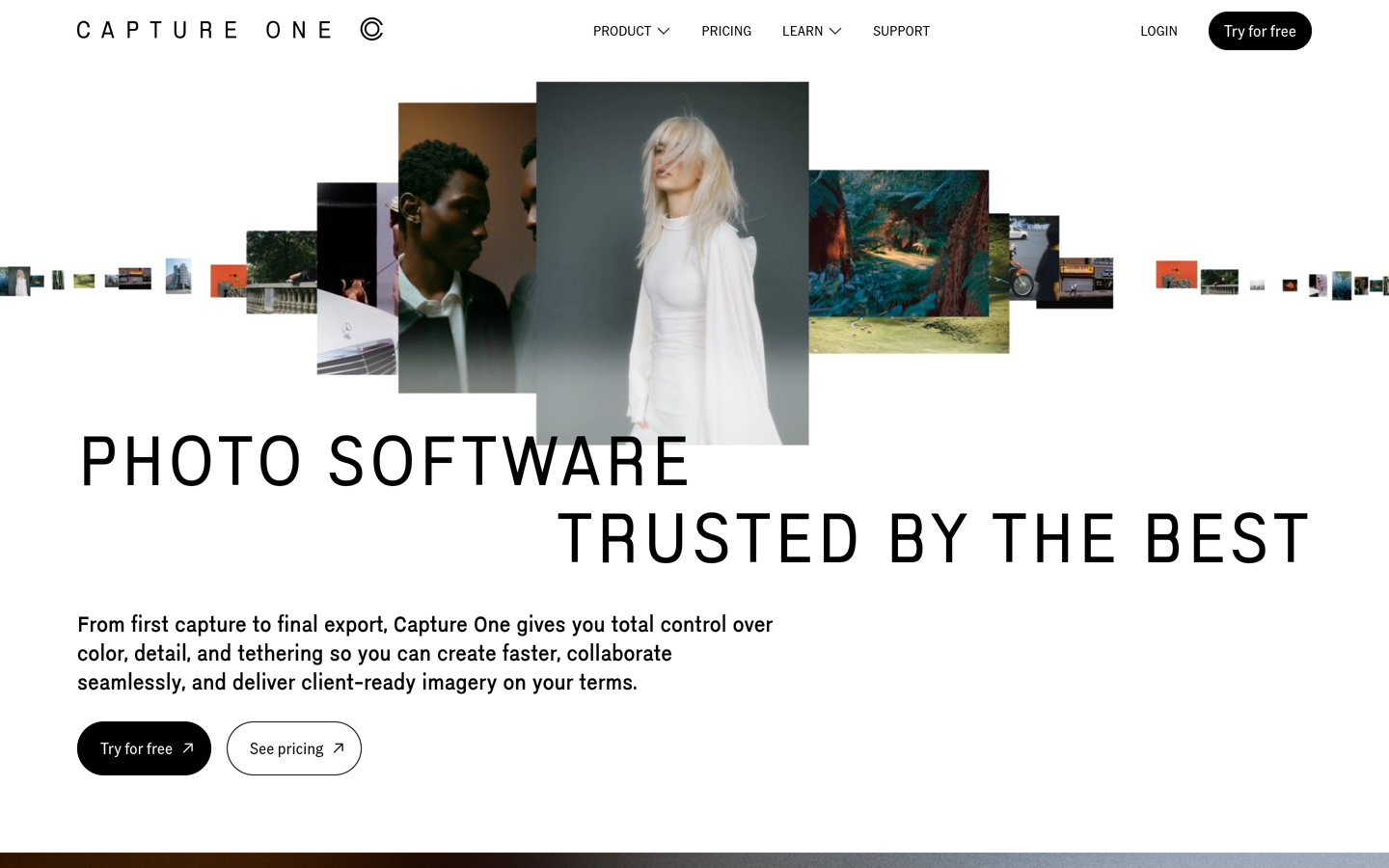
Capture One Pro homepage, captured Nov 2026.
Capture One Pro is a RAW editor known for color accuracy, rated 4.5/5 from 79 G2 reviews. It gives precise control over highlights, shadows and color grading, with tethered shooting for 550+ cameras and sessions for organizing large shoots. Its Enhanced Denoise handles high-ISO frames without a waxy finish.
The trade off is cost. The Pro plan lists from $30 a month, the highest subscription in this list, and there is no free plan, only a trial. It suits photographers who shoot tethered or want the most exact color in their night-sky edits.
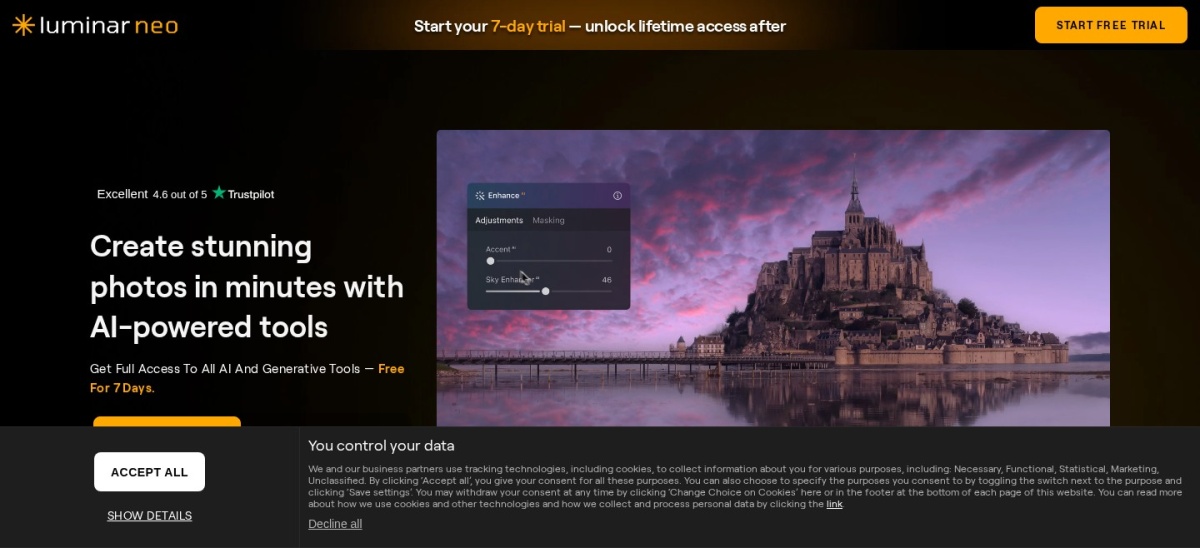
Luminar Neo is an AI-led photo editor, rated 4.4/5 from 113 G2 reviews. It supports over 1,000 cameras and RAW files, and its Noiseless AI, Supersharp AI and Sky AI tools clean and enhance night-sky images in a few clicks. It also works as a plugin inside Photoshop and Lightroom.
The trade off is the one-time price. The Desktop Only license lists at $417, currently $99 in a Black Friday sale, and AI tools renew after 365 days through Luminar Prime. It suits photographers who want quick AI edits without a subscription.
What we like
Quick AI tools for sky, noise and sharpness
Supports over 1,000 cameras
Works as a Photoshop and Lightroom plugin
One-time license
Watch out for
AI tools renew after 365 days
Regular price of $417 is high
Smaller review base than the Adobe tools
Paid license adds the full editor plus 1 year of AI toolsVisit skylum.com
05
GIMP
4.3/5on G2 (1,484 reviews, checked Nov 2026)
PriceFree
Best free software for astrophotography processing
PriceFree, open source
RAW supportDNG, NEF, CR2 and more
LayersYes, with masks
PlatformsWindows, macOS, Linux
gimp.org
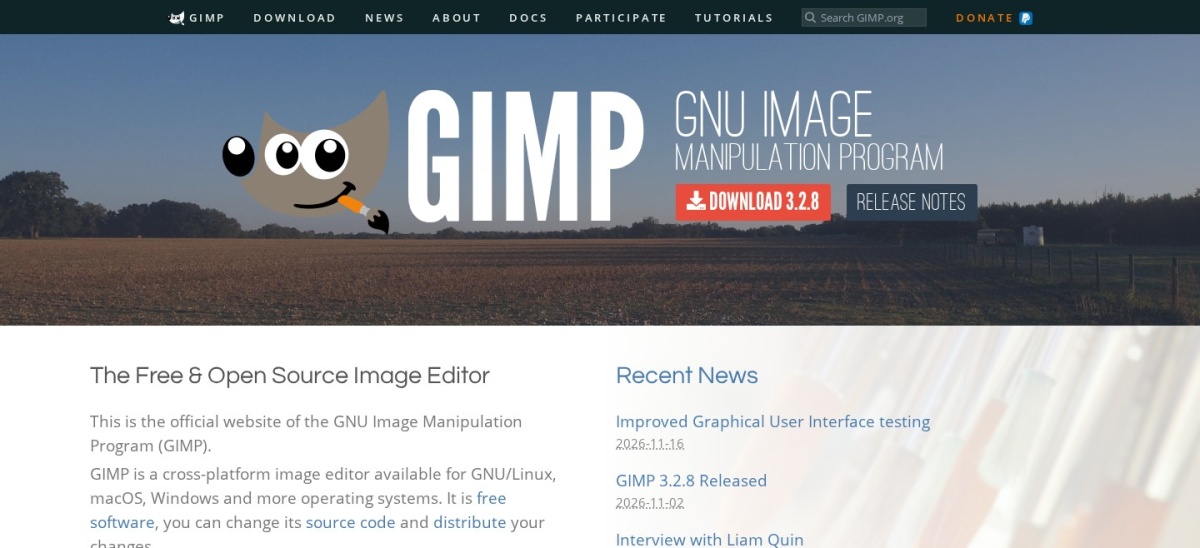
GIMP homepage, captured Nov 2026.
GIMP is the free and open-source image editor in this list, rated 4.3/5 from 1,484 G2 reviews. It runs on Windows, macOS and Linux, opens RAW files such as DNG, NEF and CR2, and offers layers, masks and a large library of community plugins. There is no paid plan at all.
The trade off is polish. The interface feels dated next to paid editors, some workflows take more steps, and there is no built-in AI denoise. It suits photographers on a zero budget who are happy to add plugins for astro-specific work.
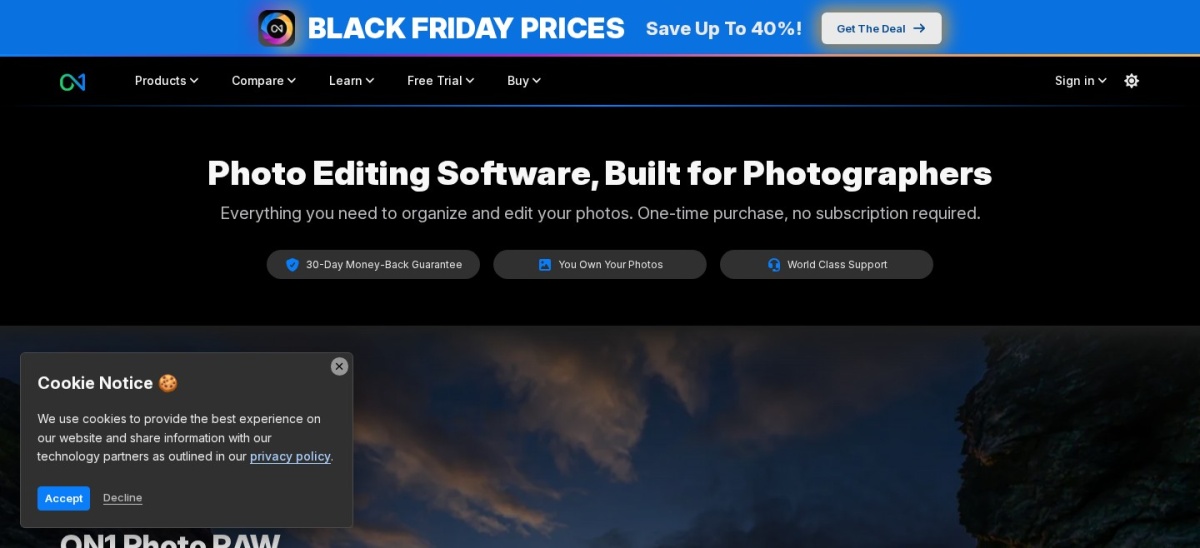
ON1 Photo RAW is an all-in-one RAW editor, rated 5.0/5 from 2 G2 reviews. It combines browsing, RAW editing, layers, effects and masking in one app, with NoNoise AI for high-ISO shots and Resize AI for enlarging small targets. You own version 2027 outright, with installs on 2 computers.
The trade off is the thin rating base. Only 2 G2 reviews sit behind the 5.0 score, so treat it as a weak signal, and the MAX features cost extra. It suits photographers who want one app for the whole workflow without a subscription.
What we like
All-in-one RAW editor with layers
NoNoise AI for high-ISO shots
One-time license, no subscription
Watch out for
Only 2 G2 reviews behind the 5.0 score
MAX features cost extra
Smaller community than Photoshop or GIMP
Paid license adds the full editor; MAX adds Restore AI and pluginsVisit on1.com
07
Topaz Photo AI
4.3/5on G2 (2 reviews, checked Nov 2026)
Starts at$199/yr
Best AI cleanup for already-stacked images
DenoiseRAW Denoise
SharpenSuper Focus
RenderingLocal and cloud
Cheapest plan$199/yr
topazlabs.com
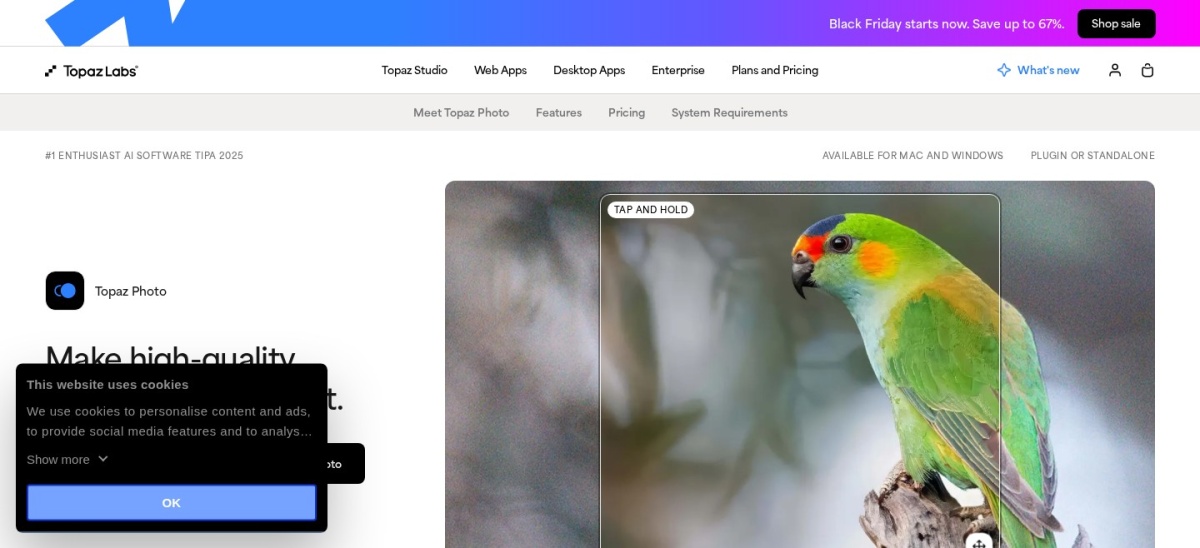
Topaz Photo AI homepage, captured Nov 2026.
Topaz Photo AI is an AI enhancement app for denoise, sharpening and upscaling, rated 4.3/5 from 2 G2 reviews. Its RAW Denoise, Sharpen and Super Focus models rescue soft or noisy frames, and it works standalone or as a plugin for Photoshop, Lightroom Classic and Affinity. Rendering runs locally or in the cloud.
The trade off is the thin rating base and the subscription. Only 2 G2 reviews sit behind the 4.3 score, and Topaz Photo now costs $199 a year, with $169 for the first year. It suits photographers who need AI cleanup on already-stacked images.
What we like
Strong AI denoise and sharpening
Works as a plugin for Photoshop and Lightroom Classic
Stacking combines many short exposures into one image with less noise. Free tools such as Siril and DeepSkyStacker do this job, and PixInsight and Astro Pixel Processor are the paid specialists.
The seven tools in this list do the second job: finishing. They stretch faint detail, reduce noise, correct color and prepare the final image for sharing or print.
Skylum now sells Luminar Neo as Luminar for Desktop, and Topaz renamed Photo AI to Topaz Photo. The ratings in this list use the older product names from G2, since that is where the reviews sit.
Three tools in this list sell as one-time licenses. The price ladder shows them as yearly amounts because the ladder compares yearly cost, so check the per-plan note on each card before comparing.
How we chose
We started from the tools astrophotographers name most often for processing, then kept only those with a public numeric rating on G2 or Capterra.
Prices come from each vendor's pricing page, checked on 26 November 2026, with sale prices noted in the text and regular prices shown in the ladder. Ratings and review counts come from G2 and Capterra on the same day. Capture One's $30 a month is the lowest price its own product page lists; its full price table loads by script and could not be read as text.
We left out PixInsight, Astro Pixel Processor, Siril and DeepSkyStacker because none of them has a public rating on G2 or Capterra. No vendor paid for a place, and we do not claim to have used these tools ourselves.
How to choose astrophotography processing software
Start with the job your images need most, then pick the tool that does it best.
Decide whether you need stacking or finishing. If you shoot many short exposures, pick a stacker such as Siril first, then finish the stacked file in one of the tools above.
Start with noise reduction. Night-sky images are noisy by nature, so a strong denoise tool such as DxO PhotoLab or Topaz Photo pays off before any creative edit.
Match the license to how often you shoot. A one-time license suits occasional shooters, while a subscription suits people who edit every week and want new features as they arrive.
Try the free options before paying. GIMP costs nothing and covers layers, masks and RAW files, so use it to learn the workflow before buying a paid editor.
FAQ
What is the best software for astrophotography processing?
Adobe Photoshop is the best pick for most people. It is rated 4.6/5 from 13,460 G2 reviews and gives the deepest control over layers, masks and plugins for stacked images, though it needs a $22.99 a month subscription.
Do I need PixInsight to process astrophotography?
No. PixInsight is the best-known stacking and processing specialist, but it has no public rating on G2 or Capterra, so it is not ranked here. You can stack free with Siril or DeepSkyStacker and finish in Photoshop, DxO PhotoLab or GIMP.
What is the best free software for astrophotography processing?
GIMP is the best free option. It costs nothing, runs on Windows, macOS and Linux, and covers layers, masks and RAW files. It is rated 4.3/5 from 1,484 G2 reviews, though it has no built-in AI denoise.
Which tool is best for noise reduction in astro photos?
DxO PhotoLab is the strongest here, with DeepPRIME XD cleaning high-ISO frames during demosaicing. Topaz Photo is the best add-on choice, with AI denoise and sharpening that works as a plugin inside Photoshop and Lightroom Classic.
Are one-time purchase tools better than subscriptions for astro work?
It depends on how often you shoot. A one-time license suits occasional shooters, while a subscription suits weekly editors. Note the ladder shows one-time prices as yearly amounts, so read the per-plan note on each card.
Can Photoshop process astrophotography images on its own?
Photoshop can finish stacked images, but it does not stack exposures itself. Stack first with Siril, DeepSkyStacker or PixInsight, then open the stacked file in Photoshop for stretching, masking and final edits.
SaaS SEO and WordPress specialist with about 8 years of experience. Rakib compares WordPress plugins, themes, hosting and software using public pricing, documentation and user reviews. See how we rank.