Best Software Development Analytics Tools in 2026: 9 Tools Compared
WLWPLegible EditorsLast verified 24 Nov 2026How we rank13 min read
★ Short answer
LinearB is the best software development analytics tool for most engineering teams. It pairs DORA metrics with pull request automation and AI impact measurement at $29 per user a month, rated 4.6 out of 5 on G2. Pick GitClear for code-level AI attribution and Swarmia for a free plan up to 9 developers.
How we make this list: we compare pricing pages, product documentation and public user reviews, then re-check every price before each update. No product paid for a place. Disclosure.
LinearB leads on workflow automation: DORA metrics, PR automation and AI impact in one platform at $29 per user a month.
GitClear is the cheapest paid option at $14.95 per contributor a month, and the only tool here that attributes each line of code to the AI model that wrote it.
Swarmia and Typo both offer free plans for small teams, while Haystack and Typo share the lowest paid entry point at $20 a month.
Waydev and Code Climate no longer publish dollar prices on their own pricing pages, so their figures below come from the last published prices and are flagged.
SonarQube is the only tool here priced by lines of code instead of per developer, so small codebases stay cheap whatever the team size.
What software development analytics should measure
Software development analytics turns Git, ticket and CI data into answers about delivery: how long work takes, where reviews stall and whether AI tools help or add rework.
The four DORA metrics are the common core: deployment frequency, lead time for changes, change failure rate and time to restore service. Most tools here report all four.
Code quality is the second half. A tool that only counts commits can reward churn, so look for review time, rework and defect signals beside raw output.
Pricing is mostly per developer per month, billed annually, but the seat definition matters. Some tools charge only for people who commit code, while others charge for every member. Our analytics comparison guide shows the same care with definitions on the web analytics side.
AI impact measurementYes, 1,000 AI credits/user/mo
Paid planEssentials, $29/user/mo
linearb.io
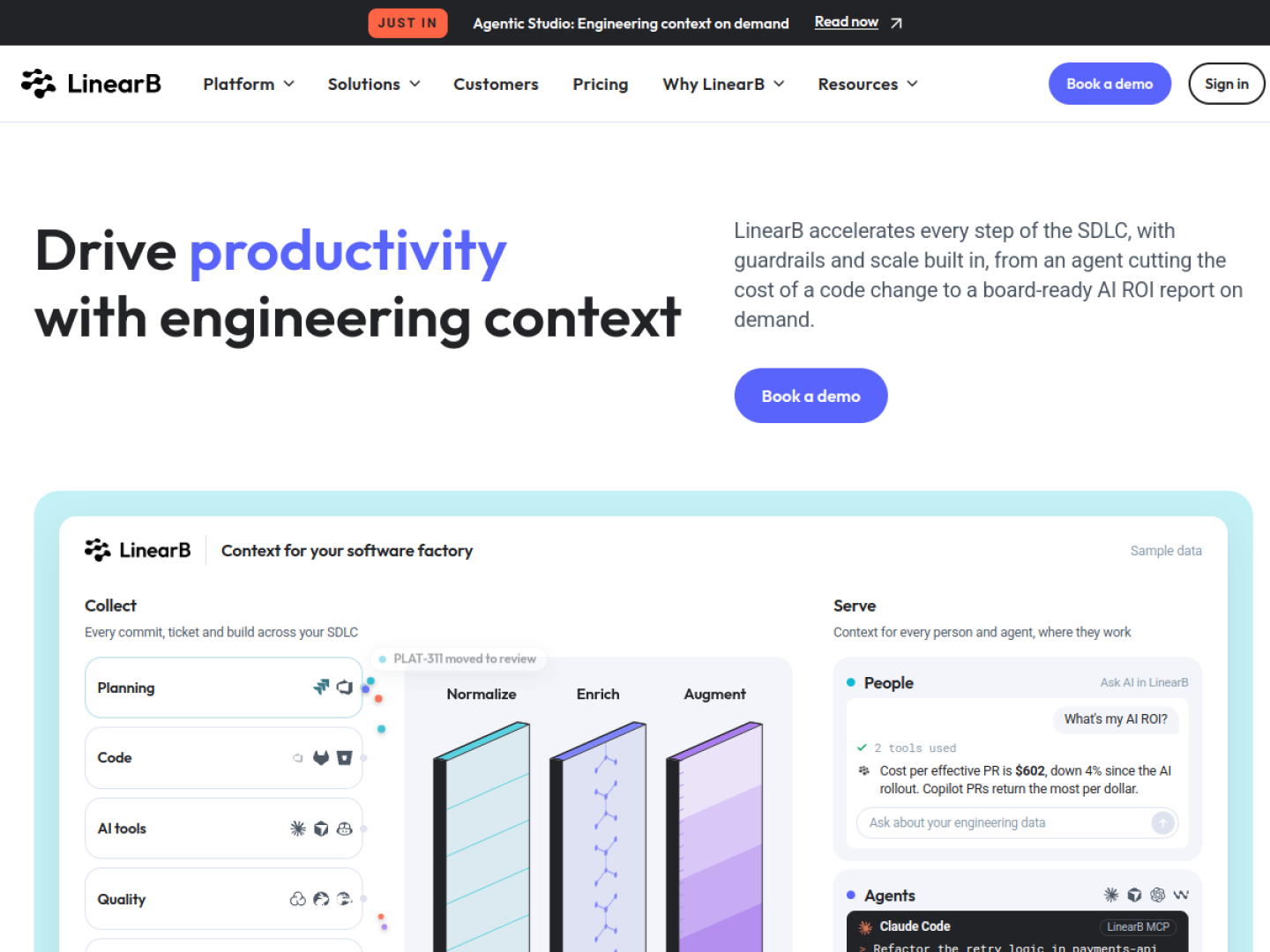
LinearB homepage, captured Nov 2026.
LinearB is an engineering productivity platform that reads Git, Jira and CI data and turns it into delivery metrics, forecasts and pull request automation. Essentials costs $29 per user a month billed annually, includes DORA metrics, benchmarks, developer surveys and 1,000 monthly AI credits per user.
The trade off is scale. Essentials is built for teams of 50 or more developers and supports GitHub Cloud only, so smaller teams and other Git hosts need the $59 Enterprise plan. It suits engineering leaders who want metrics plus automation that acts on them, not just dashboards.
What we like
DORA metrics plus PR automation in one place
AI impact measurement with monthly credits included
Rated 4.6 out of 5 from 80 G2 reviews
Watch out for
Essentials needs at least 50 users
Essentials supports GitHub Cloud only
No free plan, only a trial
Enterprise adds forecasting, allocation and R&D capitalizationVisit linearb.io
02
GitClear
4/5on SpotSaaS (2 reviews, checked Nov 2026)
Paid from$14.95/mo
Best for code-level AI attribution
Free planStarter, up to 3 repos
AI attributionClaude, Cursor, Copilot, Codex and more
DORA metricsLead time and defect tracking
Paid planPro, $14.95/contributor/mo
gitclear.com
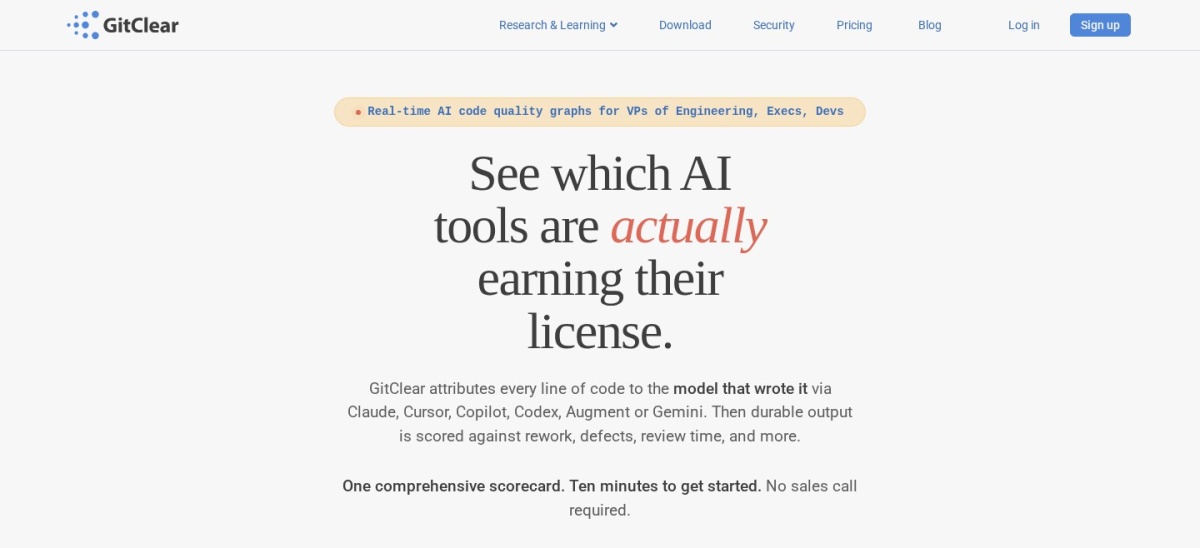
GitClear homepage, captured Nov 2026.
GitClear is a code analytics tool that attributes every line of code to the AI model that wrote it, across Claude, Cursor, Copilot, Codex, Augment and Gemini. The free Starter plan covers up to 3 repositories and 6 months of data, and Pro costs $14.95 per contributor a month billed annually with 25 repositories and a 3-year window.
The trade off is breadth. GitClear is lighter on Jira and delivery outcome views than LinearB or Swarmia, and it charges only for contributors, never for viewers. It suits teams that want to know whether AI-written code survives review and lasts in production.
What we like
Lowest paid price in this list
Line-level AI attribution no rival matches
Free Starter plan with no credit card
Watch out for
Thin public review base, 4.0 from 2 SpotSaaS reviews
Lighter on Jira and delivery planning views
Elite adds 250 repos and a 15-year window at $24.95 a monthVisit gitclear.com
03
Swarmia
4.4/5on G2 (319 reviews, checked Nov 2026)
Paid from$45/mo
Best for team-level flow with a free plan
Free planYes, up to 9 developers
DORA metricsYes, team-level flow
Working agreementsYes, team practices
Paid planStandard, $45/developer/mo
swarmia.com
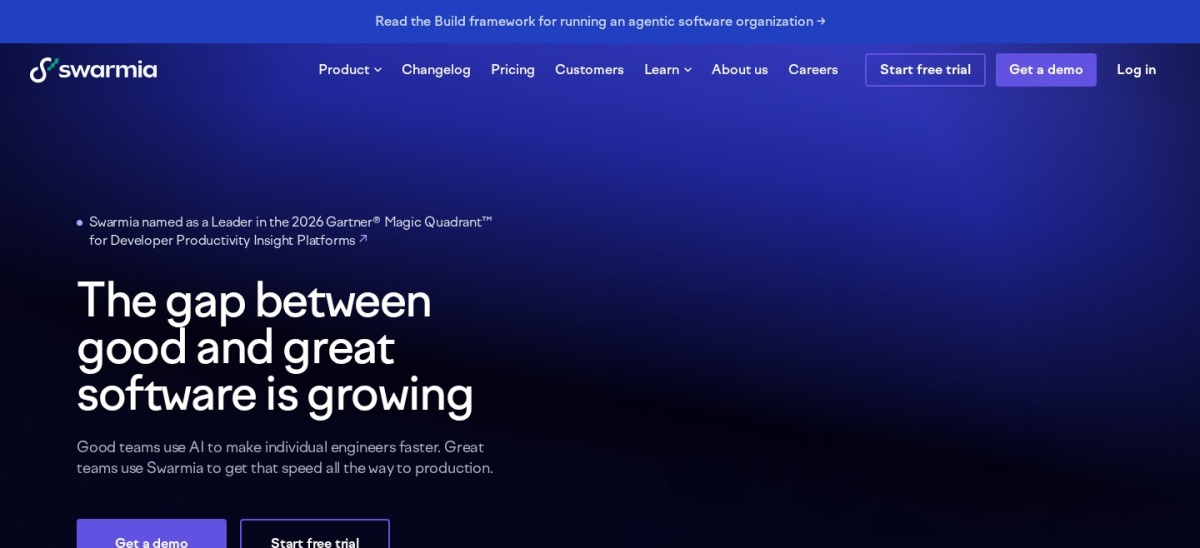
Swarmia homepage, captured Nov 2026.
Swarmia is an engineering intelligence tool built around team flow, working agreements and delivery metrics. Standard costs $45 per developer a month billed annually, and the free plan covers companies with up to 9 developers, which makes it the easiest paid tool here to try with a real team.
The trade off is add-ons. AI adoption and cost, developer surveys and software capitalization are separate add-ons from $5 to $23 per developer a month, so the full set costs well above $45. It suits teams that want a quick rollout with published prices and no seat minimum.
What we like
Free for teams up to 9 developers
Clear published pricing with no seat minimum
Largest review base here, 4.4 from 319 G2 reviews
Watch out for
AI and capitalization features cost extra as add-ons
Higher headline price than LinearB or GitClear
Enterprise adds SSO and on-premise integrations at $55 a monthVisit swarmia.com
04
Waydev
4.7/5on G2 (62 reviews, checked Nov 2026)
Paid from$29/mo
Best for Git analytics with an AI agent
Free planStart Up, 10 repos
DORA metricsYes, plus SPACE and DX
AI agentWaydev Agent, Premium
Paid planPro, $29/contributor/mo
waydev.co
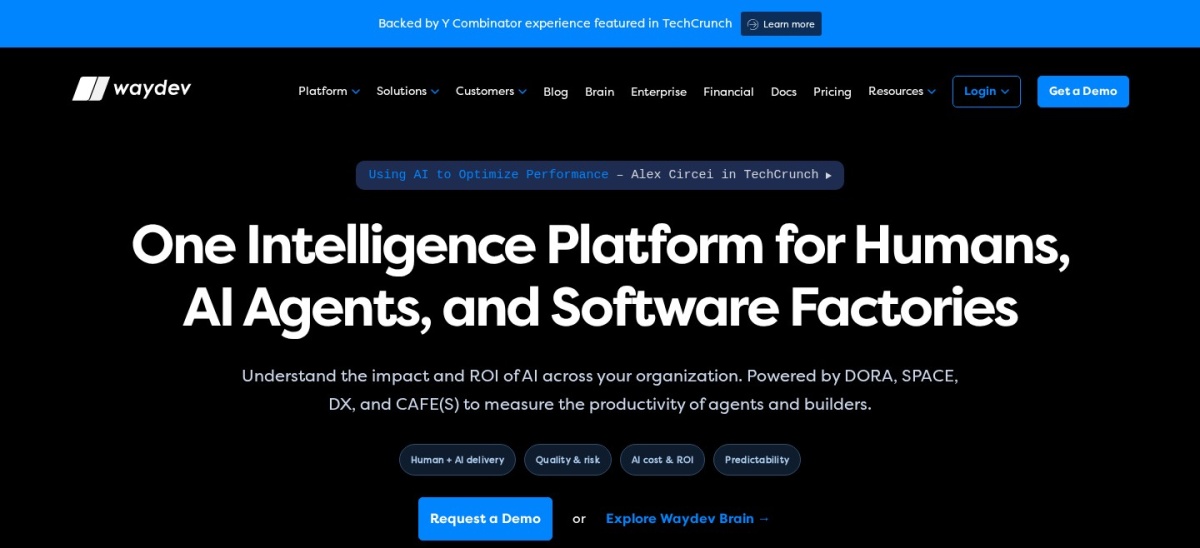
Waydev homepage, captured Nov 2026.
Waydev is an engineering intelligence platform that covers DORA, SPACE and developer experience metrics from Git, with AI adoption tracking and the Waydev Agent for asking questions of the data. Pro was last published at $29 per active contributor a month billed annually, with 100 repositories and 6 months of data.
The trade off is price transparency. Waydev's own pricing page now shows custom quotes with no dollar figures, so the $29 figure is the last published price from September 2026. It suits teams that want broad coverage, including AI ROI and resource planning, and can get a quote.
What we like
Broadest metric coverage: DORA, SPACE, DX and AI ROI
AI agent answers questions from live data
Rated 4.7 out of 5 on G2
Watch out for
No dollar prices on the pricing page now
Full AI suite needs Premium at $49 a month
Premium adds AI impact, AI ROI and planning at $49 a monthVisit waydev.co
05
Code Climate Velocity
4.3/5on G2 (92 reviews, checked Nov 2026)
Paid from$449/yr
Best for pairing delivery flow with code quality
Free planTeam, up to 20 people
DORA metricsYes, PR and delivery based
Code qualityYes, with Quality product
Paid planStartup, $449/seat/yr
codeclimate.com
Code Climate Velocity homepage, captured Nov 2026.
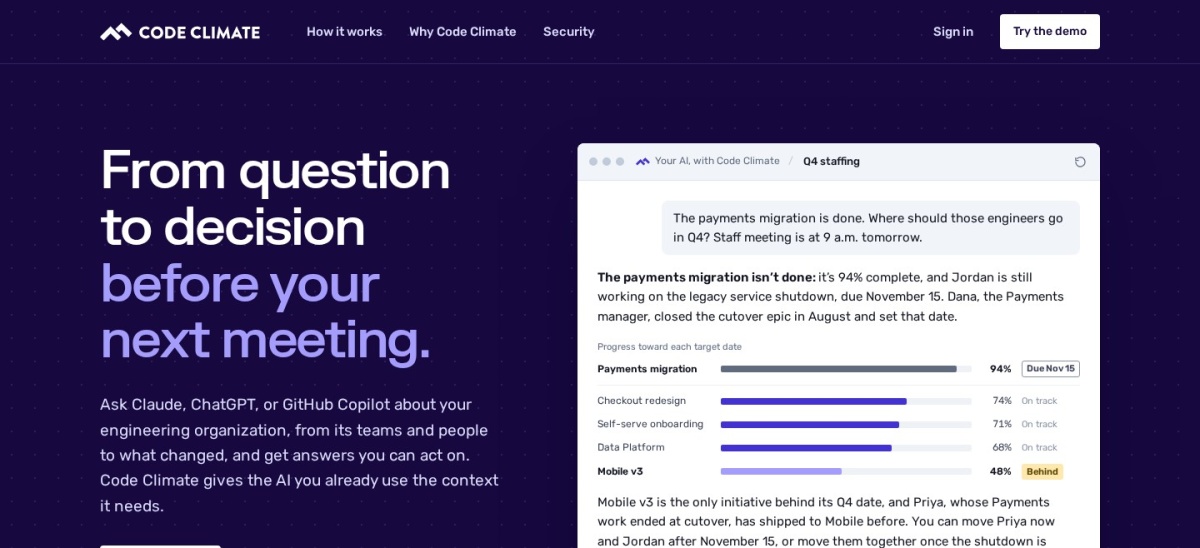
Code Climate Velocity is an engineering analytics platform that connects pull request flow and delivery metrics with code quality signals from its Quality product. The free Team tier covers up to 20 people and 50 repositories with 3 months of history, and the Startup plan was last published at $449 per seat a year.
The trade off is pricing clarity. Code Climate stopped publishing prices on its own site, and secondary sources disagree, with figures from $20 a month to $70 a month per committer. It suits teams that already use Code Climate Quality and want delivery metrics on the same data.
What we like
Joins delivery metrics to code quality in one view
Free Team tier for up to 20 people
Long track record, launched in 2018
Watch out for
No published prices on its own pricing page
Secondary price sources disagree widely
Company plan adds unlimited repos and 36 months of history at $649 a yearVisit codeclimate.com
06
Typo
4.6/5on G2 (152 reviews, checked Nov 2026)
Paid from$20/mo
Best low-cost pick for small GitHub teams
Free planYes, up to 10 developers
DORA metricsYes, real-time
AI code reviewsYes, Pro plan
Paid planStarter, $20/contributor/mo
typoapp.io
Typo homepage, captured Nov 2026.
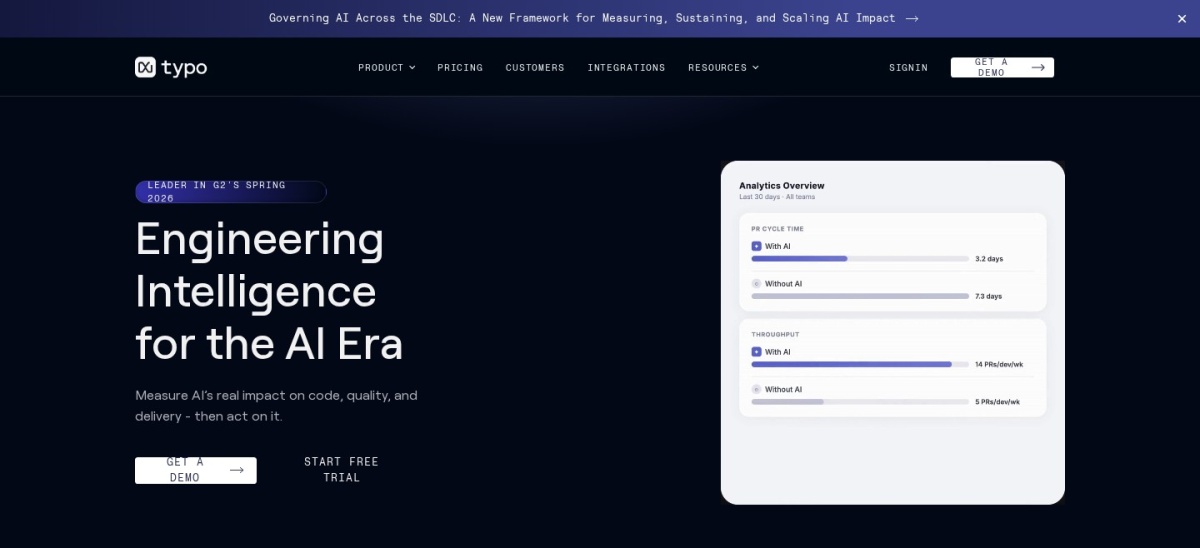
Typo is an engineering intelligence tool for small and mid-size teams that tracks DORA metrics, pull request cycle time and AI impact on delivery speed and code quality. The free plan covers up to 10 developers and 5 repositories, and Starter costs $20 per Git contributor a month with sprint insights and 6 months of history.
The trade off is depth at the top end. Typo is built for GitHub-first teams and its AI code reviews and unlimited history need the $28 Pro plan. It suits small teams that want a low entry price and a free tier that already shows real delivery data.
What we like
Low $20 entry price with a useful free plan
Rated 4.6 out of 5 from 152 G2 reviews
AI impact on PR cycle time and throughput
Watch out for
Aimed at GitHub teams, less for other hosts
AI code reviews need the Pro plan
Pro adds AI code reviews and unlimited history at $28 a monthVisit typoapp.io
07
Haystack
4.8/5on G2 (11 reviews, checked Nov 2026)
Starts at$20/mo
Best for lightweight delivery risk alerts
Free planNo, 14-day trial
DORA metricsYes, team delivery focus
Risk alertsYes, Slack and email
Paid planGrowth, $20/member/mo
usehaystack.io
Haystack homepage, captured Nov 2026.
Haystack is a delivery analytics tool that sits on Git and Jira, flags at-risk epics and sprints, and sends status updates to Slack so managers stop chasing standups. Growth costs $20 per member a month with an annual commitment, includes unlimited alerts and 12 months of history, and is aimed at teams under 100 engineers.
The trade off is depth. Haystack is lighter on finance reporting and AI cost tracking than Jellyfish or Swarmia, and its G2 rating rests on only 11 reviews. It suits delivery managers who want sprint risk answers fast, not a finance platform.
What we like
Low $20 price with no seat minimum
Automatic risk alerts and Slack status updates
Highest G2 rating here at 4.8 out of 5
Watch out for
Only 11 G2 reviews, a thin base
No free plan, only a 14-day trial
Enterprise adds on-premise integrations for teams of 100 or moreVisit usehaystack.io
08
Allstacks
4.5/5on G2 (57 reviews, checked Nov 2026)
Paid from$400/yr
Best for predictive delivery forecasting
Free planProduct Studio Starter
ForecastingYes, predictive delivery
R&D capitalizationYes, standalone or bundled
Paid planGrowth, $400/contributor/yr
allstacks.com
Allstacks homepage, captured Nov 2026.
Allstacks is an engineering intelligence platform that uses machine learning to forecast delivery risk and outcomes across projects, with portfolio views for leaders. Growth costs $400 per contributor a year, and the platform adds AI agents that surface problems, explain root causes and suggest fixes.
The trade off is that the cheapest useful tier is a yearly per-contributor charge, and Enterprise at $600 needs at least 100 contributors. It suits product and engineering leaders who manage many teams and need forecasts and capitalization reporting in one place.
What we like
Predictive forecasting no other tool here offers
R&D capitalization reporting built in
Rated 4.5 out of 5 from 57 G2 reviews
Watch out for
Annual-only per-contributor billing
Enterprise needs a 100-contributor minimum
Enterprise adds single-tenant hosting and a dedicated manager at $600 a yearVisit allstacks.com
09
SonarQube
4.4/5on G2 (154 reviews, checked Nov 2026)
Paid from$34/mo
Best for code quality gates on pull requests
Free planCloud free, up to 50k lines
Languages40+ on Cloud Team
Quality gatesYes, block failing merges
Paid planCloud Team, from $34/mo
sonarsource.com
SonarQube homepage, captured Nov 2026.
SonarQube is a code quality and security platform that scans code for bugs, vulnerabilities and maintainability problems, then enforces quality gates on pull requests. SonarQube Cloud is free for private projects up to 50,000 lines of code, and the Team plan starts at $34 a month for up to 100,000 lines.
The trade off is the pricing model. Team is priced by lines of code, not by people, so managers and reviewers cost nothing but a growing codebase raises the bill. It suits teams that want one gate for bugs and security across many languages, priced by code size.
What we like
Quality gates block merges that fail the bar
Free tier for small private projects
Rated 4.4 out of 5 from 154 G2 reviews
Watch out for
Priced by code size, so costs grow with the codebase
Free plans in this list cover the basics well: DORA metrics, a few repositories and a few months of history. They are enough to learn whether the metrics match how your team actually works.
Paid plans mostly add history, breadth and AI. You get longer data windows, more repositories, AI impact measurement and features such as forecasting or capitalization reporting.
The expensive step is usually the add-on, not the base plan. Swarmia charges extra for AI and surveys, and LinearB reserves forecasting and allocation for Enterprise.
How we chose
We started from the established engineering analytics tools with published prices or a free plan, then kept the nine that cover DORA metrics, code quality or AI impact for software teams.
Prices come from each vendor's pricing page or the last published price where the vendor now shows a quote, checked on 24 November 2026. Ratings come from G2 on the same day, except GitClear, whose rating comes from SpotSaaS and is noted in the text.
We left out quote-only enterprise platforms such as Jellyfish, which publishes no per-seat price, and Pluralsight Flow, which its owner says will be retired on 31 December 2027. No vendor paid for a place, and we do not claim to have used these tools ourselves.
How to choose a software development analytics tool
Start with the question you need answered, then match the tool to it.
Name the one metric that matters first. If reviews are the bottleneck, pick a PR-focused tool such as LinearB or GitClear. If delivery dates slip, pick a forecasting or risk tool such as Allstacks or Haystack.
Check the seat definition before the price. Per-contributor billing charges only people who commit code, while per-member billing charges every member. A $20 member price can cost more than a $29 contributor price on a large team.
Use the free plan with real data. Connect one repository and one tracker, then check whether the cycle time and review numbers match what your team sees. A tool that needs weeks of setup is a warning sign.
Price the tier you will actually need. AI impact, forecasting and capitalization often sit a tier up or in add-ons. Add those to the quote before you compare headline prices.
FAQ
What is the best software development analytics tool?
LinearB is the best pick for most teams. It combines DORA metrics, pull request automation and AI impact measurement at $29 per user a month, and it holds a 4.6 out of 5 rating from 80 G2 reviews.
What are DORA metrics?
DORA metrics are four delivery measures: deployment frequency, lead time for changes, change failure rate and time to restore service. Most tools in this list report all four from Git and CI data.
Which software development analytics tool is cheapest?
GitClear is the cheapest paid option at $14.95 per contributor a month billed annually. Haystack and Typo share the next lowest entry point at $20 a month, and several tools offer free plans for small teams.
Is there a free software development analytics tool?
Yes. GitClear, Swarmia, Waydev, Code Climate Velocity, Typo, Allstacks and SonarQube all offer free plans or free tiers, usually limited by repositories, team size or months of history.
Do these tools measure AI coding tools?
Most now do. LinearB, GitClear, Waydev, Typo and Swarmia track AI adoption, cost or impact on delivery, though some put the deeper AI views on higher tiers or paid add-ons.
How is SonarQube different from the others?
SonarQube measures code quality, not delivery flow. It scans code for bugs, vulnerabilities and maintainability problems and blocks merges that fail quality gates, while the other tools measure how fast work moves.