Torq is the best SOAR platform for most teams, rated 4.8/5 on G2 from 169 reviews for easy, no-code automation. Pick Tines for a free starting point with 429 G2 reviews, or Cortex XSOAR if you need the largest integration marketplace with more than 1,000 integrations.
How we make this list: we compare pricing pages, product documentation and public user reviews, then re-check every price before each update. No product paid for a place. Disclosure.
Torq leads on G2 at 4.8 out of 5 from 169 reviews, with the fastest typical setup in this list at about 1 month.
Tines is the only pick with a usable free edition: 3 live workflows and a one-time $50 AI allowance.
Microsoft Sentinel is the only tool here with published usage pricing: $4.30 per GB pay-as-you-go in East US.
Seven of the nine platforms publish no prices at all, so expect a sales quote and a procurement cycle.
Cortex XSOAR has the largest integration marketplace in this list, with more than 1,000 integrations.
What a SOAR platform should cover
SOAR stands for security orchestration, automation and response. A SOAR platform connects the tools in a security stack, then runs playbooks that triage alerts, enrich incidents with threat data and carry out response steps without an analyst clicking through each one.
The core test is how much routine work the playbooks remove. Look for a visual playbook builder, a wide integration library and case management that keeps the whole incident in one place, so the team can see what ran, what changed and when it closed.
Pricing is the hardest part of this market. Most vendors publish no prices, so the real cost only appears in a quote, and the bill often depends on analysts, data volume or the number of connected tools.
Before you buy, map the response process you already follow. Our guide on how to run a WordPress security audit shows the same discipline at a smaller scale: list what you check, in what order, and who acts on each finding.
Torq is an AI SOC platform that automates alert triage, investigation and response with no-code workflows. Reviewers on G2 rate it 4.8 out of 5 from 169 reviews, the highest score in this list, and praise its ease of use in more than 60 mentions. G2 lists a typical setup time of about 1 month.
The trade off is pricing. Torq publishes no prices, so every deal is a sales quote, and reviewers mention budget pressure and hard-to-forecast costs. It suits mid-market SOC teams that want fast, no-code automation without a long build phase.
What we like
Highest G2 rating in this list at 4.8 out of 5
Ease of use praised in 60+ reviewer mentions
Fastest typical setup here at about 1 month
Watch out for
No published pricing, so costs are hard to forecast
Reviewers note a learning curve for advanced features
Paid plans are quote-only; ask for a priced proposalVisit torq.io
02
Tines
4.7/5on G2 (429 reviews, checked Nov 2026)
PricingCustom/yr
Best free starting point
Free edition3 live workflows
Paid plansQuote only
G2 rating4.7/5, 429 reviews
Integrations400+ apps
tines.com
Tines homepage, captured Nov 2026.
Tines is a no-code automation platform for security workflows, built around a drag-and-drop canvas for stories that connect tools through APIs. Its free edition covers unlimited users, spaces and connectors with 3 live workflows and a one-time $50 AI allowance. It connects to more than 400 apps and tools, and G2 reviewers rate it 4.7 out of 5 from 429 reviews.
The trade off is debugging. Reviewers say complex workflows can be hard to trace when something breaks, and paid editions are quote-only with no published prices. It suits teams that want a free starting point and a visual builder their analysts can use without code.
What we like
Only free edition in this list
Largest review count here at 429 G2 reviews
No-code builder usable by non-developers
Watch out for
Free edition allows only 3 live workflows
Debugging complex workflows can be hard
Paid editions have no published prices
Paid editions add unlimited workflows and flexible hostingVisit tines.com
03
Cortex XSOAR
4.6/5on G2 (29 reviews, checked Nov 2026)
PricingCustom/yr
Best for large SOCs
Free planNo
PricingQuote only
G2 rating4.6/5, 29 reviews
Integrations1,000+
paloaltonetworks.com
Cortex XSOAR homepage, captured Nov 2026.
Cortex XSOAR is Palo Alto Networks' enterprise SOAR platform, built around playbooks, case management and a marketplace of more than 1,000 integrations. It runs on-premises or in the cloud, and G2 reviewers rate it 4.6 out of 5 from 29 reviews. G2 lists a typical implementation time of about 2 months.
The trade off is complexity and cost. Reviewers describe a steep learning curve and costly licensing, and Palo Alto publishes no prices. It suits large SOCs that already use Palo Alto products and need deep, custom automation at scale.
Swimlane is a SOAR platform built on its Turbine automation engine, with case management, dashboards and reporting for SOC teams. Reviewers on G2 rate it 4.5 out of 5 from 45 reviews and praise its ease of use and integrations. It focuses on customizable automation that fits how a team already works.
The trade off is time and price. G2 lists a typical implementation of about 5 months, the longest in this list, and Swimlane publishes no prices. It suits mid-market teams that want strong reporting and case tracking and can invest in a longer rollout.
What we like
Strong reporting, dashboards and case management
Ease of use and integrations praised by reviewers
Flexible playbooks that adapt to existing workflows
Microsoft Sentinel is a cloud-native SIEM with built-in SOAR, including automation rules and playbooks for triage and response. It connects to more than 500 sources and is rated 4.4 out of 5 on G2 from 298 reviews, the largest review count in this list. Pay-as-you-go analytics ingestion costs $4.30 per GB in East US, with commitment tiers from 100 GB a day.
The trade off is that the bill follows data volume. Reviewers say costs can climb fast as log ingestion grows, and the platform is a SIEM first, so pure SOAR buyers pay for detection too. It suits teams already standardized on Microsoft Defender and Azure.
ServiceNow Security Operations homepage, captured Nov 2026.
ServiceNow Security Operations brings SOAR into the ServiceNow platform, tying incident response to the same tickets, assets and workflows IT already uses. G2 reviewers rate it 4.4 out of 5 from 89 reviews and list 85 integrations. It covers security incident response, vulnerability response and threat intelligence in one system.
The trade off is setup effort. Reviewers note a steep learning curve for initial setup and customization, G2 lists about 3 months to implement, and ServiceNow publishes no prices. It suits large organizations already running ServiceNow for IT service management.
What we like
Shares tickets and workflows with IT teams
Covers incident, vulnerability and threat response
Splunk SOAR is now a native capability inside Splunk Enterprise Security, automating triage, investigation and response with its Visual Playbook Editor. It integrates with more than 300 third-party tools and supports over 2,800 automated actions, and runs in the cloud, on-premises or hybrid. G2 reviewers rate it 4.4 out of 5 from 40 reviews.
The trade off is cost and complexity. Reviewers call it expensive, especially for smaller teams, and say the documentation can fall short for complex workflows. It suits Splunk Enterprise Security customers who want SOAR inside the SIEM they already run.
What we like
Visual Playbook Editor for building workflows
2,800+ automated actions across 300+ tools
Cloud, on-premises or hybrid deployment
Watch out for
Expensive, especially for smaller teams
Documentation can fall short on complex workflows
No published pricing
Sold as part of Splunk Enterprise Security; pricing is quote-onlyVisit splunk.com
08
D3 Security
4.2/5on G2 (69 reviews, checked Nov 2026)
PricingCustom/yr
Best for flexible custom integrations
Free planNo
PricingQuote only
G2 rating4.2/5, 69 reviews
Largest segmentEnterprise
d3security.com
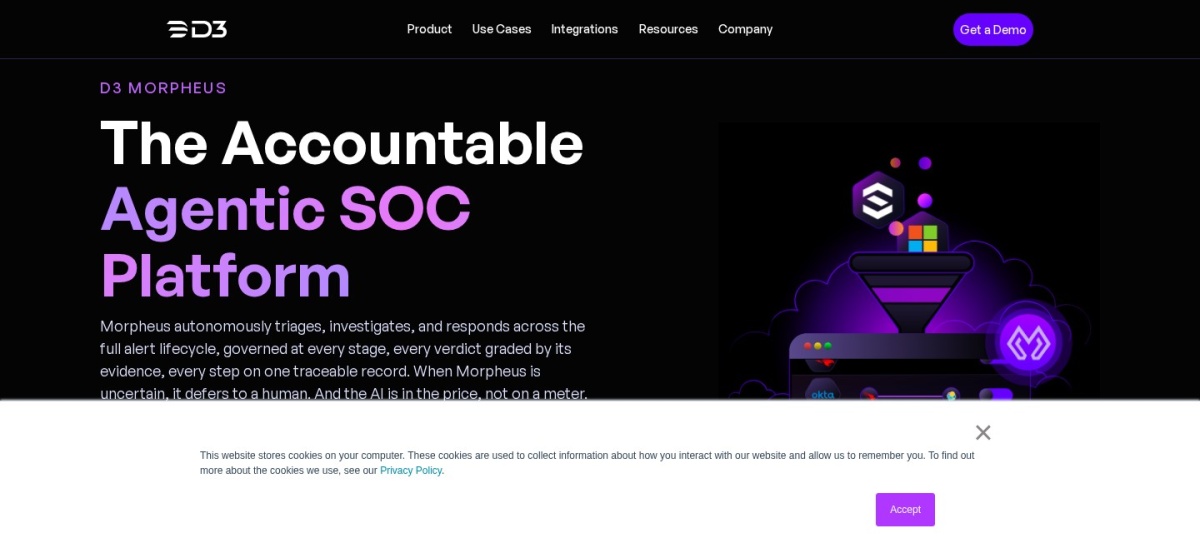
D3 Security homepage, captured Nov 2026.
D3 Security is a SOAR platform focused on flexible integrations and workflow management, with playbooks for threat detection and response. It is rated 4.2 out of 5 on G2 from 69 reviews, mostly from enterprise reviewers. D3 emphasizes custom API development, so teams can connect tools that lack a ready-made integration.
The trade off is maintenance cost. Recent reviewers describe D3 as expensive to maintain, with higher charges than other SOAR options, and D3 publishes no prices. It suits enterprise teams that need flexible, custom integrations more than a fixed playbook library.
What we like
Flexible integrations with custom API development
Strong workflow and incident management
Scales from small teams to large enterprises
Watch out for
Expensive to maintain, per recent reviewers
No published pricing
Support sits in a different time zone for some buyers
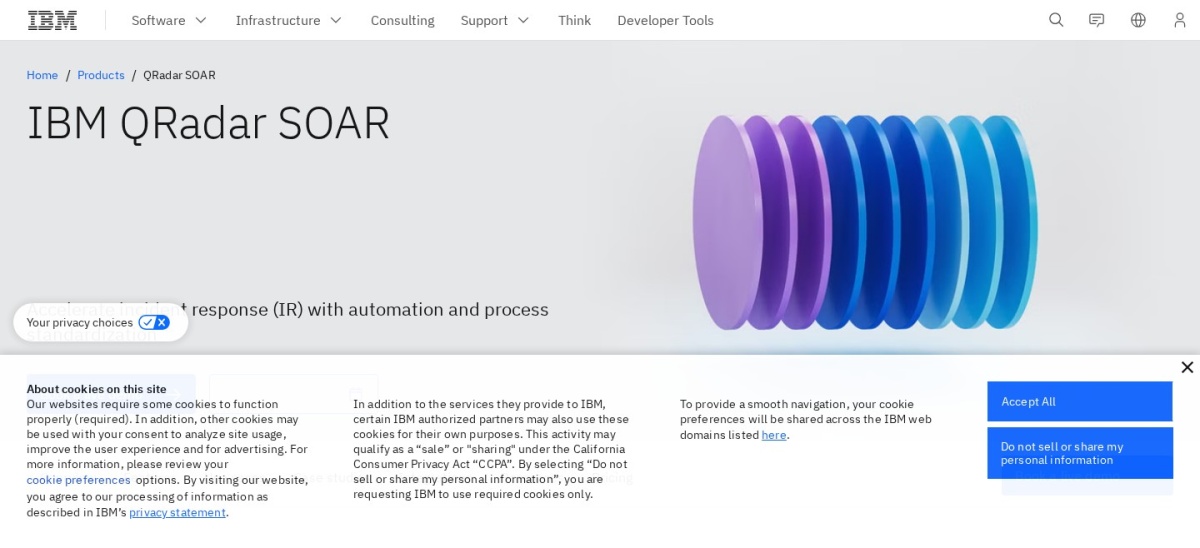
IBM QRadar SOAR is an incident response platform built around its Playbook Designer, a graphical canvas that won a Red Dot design award. It offers more than 300 integrations and a Breach Response add-on covering over 180 privacy regulations. G2 reviewers rate it 4.0 out of 5 from 29 reviews, mostly from enterprise teams.
The trade off is that it is the lowest-rated tool in this list, and reviewers flag ease of administration as a weak point. IBM publishes no prices, so every deal is a quote. It suits IBM QRadar SIEM customers and teams that need structured breach notification workflows.
What we like
Breach Response covers 180+ privacy regulations
Award-winning Playbook Designer canvas
More than 300 integrations
Watch out for
Lowest G2 rating in this list at 4.0 out of 5
Ease of administration scores low with reviewers
No published pricing
Pricing is quote-only; Breach Response is an add-onVisit ibm.com
Why most SOAR prices are hidden
Seven of the nine platforms in this list publish no prices. SOAR deals are usually sized by analysts, data volume, connected tools and deployment, so vendors quote each buyer rather than list a flat rate.
That makes shortlisting on price alone impossible. Ask every vendor for the same scope: the same number of analysts, the same daily alert volume and the same integrations, or the quotes will not compare.
Microsoft Sentinel is the exception, with a published pay-as-you-go rate of $4.30 per GB in East US. Tines is the other exception in the other direction: its free edition lets a small team start without a quote at all.
How we chose
We started from the products in G2's Security Orchestration, Automation, and Response (SOAR) category with published ratings, then kept the nine with the strongest review counts and the clearest SOAR focus.
Prices come from each vendor's pricing page, checked on 25 November 2026. Ratings and review counts come from G2 on the same day. Where a vendor publishes no price, the list shows Custom and says so in the text.
We left out Rapid7 InsightConnect, which has only 5 G2 reviews and is now sold as a capability of the Rapid7 Command Platform rather than a standalone product. No vendor paid for a place, and we do not claim to have used these tools ourselves.
How to choose a SOAR platform
Start with the stack you already run, then match the SOAR platform to it.
Check what your SIEM already automates. Many SIEMs now include playbooks and automation rules. If yours covers the routine triage, you may need a lighter SOAR or none at all.
Count the tools you need to connect. List every endpoint, identity, ticket and threat feed the playbooks must touch, then check each one against the vendor integration list.
Ask for a priced quote before you shortlist. Give every vendor the same scope: analysts, daily alert volume and integrations. Without matching scopes, quote-only prices cannot be compared.
Run a trial on one real workflow. Pick a single repeatable job, such as phishing triage, and build it end to end. If the team cannot build it in the trial, the platform will not get easier later.
FAQ
What is the best SOAR platform?
Torq is the best SOAR platform for most teams in this list. It is rated 4.8 out of 5 on G2 from 169 reviews, with ease of use praised in more than 60 mentions and a typical setup time of about 1 month.
How much does a SOAR platform cost?
Seven of the nine platforms here publish no prices, so expect a sales quote sized to your team and data volume. The exception is Microsoft Sentinel at $4.30 per GB pay-as-you-go in East US, and Tines offers a free edition with 3 live workflows.
Is there a free SOAR platform?
Tines is the only tool in this list with a free edition, covering unlimited users with 3 live workflows and a one-time $50 AI allowance. No enterprise SOAR platform here is free outright, so a free plan is a starting point, not a full deployment.
What is the difference between SOAR and SIEM?
A SIEM collects logs and detects threats, while a SOAR platform automates the response to what the SIEM finds. Microsoft Sentinel combines both, while Torq, Tines and Cortex XSOAR focus on the automation side and connect to a SIEM you already run.
Do small teams need a SOAR platform?
Most small teams do not. Start with the automation your SIEM or ticketing tool already offers, and only add a SOAR platform when manual triage takes real analyst hours each week. Tines free edition or Sentinel pay-as-you-go are the lowest-cost ways to start.
Which SOAR platform is easiest to set up?
Torq has the fastest typical setup in this list at about 1 month, according to G2. Tines is the easiest to start without a purchase, since its free edition needs no quote and its builder is designed for analysts rather than developers.
SaaS SEO and WordPress specialist with about 8 years of experience. Rakib compares WordPress plugins, themes, hosting and software using public pricing, documentation and user reviews. See how we rank.