Surfer is the best semantic SEO automation for most teams, with a Content Editor that scores drafts 0-100 against the top-ranking pages and tracks AI visibility from $49 a month, rated 4.8/5 on G2 from 548 reviews. Pick Clearscope for writer-friendly grading and Rank Math for WordPress schema automation on a budget.
How we make this list: we compare pricing pages, product documentation and public user reviews, then re-check every price before each update. No product paid for a place. Disclosure.
Surfer leads with the largest review base here: 4.8/5 on G2 from 548 reviews, and its editor scores drafts 0-100 against the pages already ranking.
Clearscope holds the highest rating at 4.9/5, but Essentials costs $129 a month and caps drafts at 20 a month.
InLinks is the only tool built purely around entities, with a free plan, but its G2 rating rests on just 5 reviews.
Rank Math is the cheapest route in: a free plugin with schema and AI linking, and PRO at $8.99 a month billed yearly.
Paid plans start at $97 a year for Link Whisper and climb to $1,548 a year for Clearscope Essentials.
What semantic SEO automation actually does
Semantic SEO is about meaning, not exact keywords. Search engines read entities, topics and relationships, so a page that covers a topic in full usually outranks one that repeats a phrase.
These tools automate the repetitive parts: scoring a draft against the pages already ranking, suggesting related terms and questions, building schema markup and placing internal links.
Schema is the most mechanical win. Our guide on adding schema markup to WordPress shows how structured data tells search engines what a page is about.
Automation still needs a human check. A suggested term or link can be off-topic, and a tool that injects links with JavaScript leaves nothing in the raw HTML for crawlers that do not run scripts.
Surfer is a content optimisation platform built around a live Content Score. It grades a draft from 0 to 100 against the pages already ranking for a keyword, suggesting terms, headings and length, and its AI Search Analytics tracks brand mentions across ChatGPT, Gemini, Perplexity, AI Overviews and AI Mode.
The trade off is the credit system. Discovery at $49 a month billed yearly covers 120 documents a year and one seat, and AI visibility tracking only starts on Standard at $99 a month. It suits small teams that publish often and want one tool for both Google rankings and AI citations.
What we like
Highest review volume here: 4.8/5 from 548 G2 reviews
Content Score gives writers a clear target
Tracks mentions in AI answers as well as Google
WordPress, Google Docs and Zapier integrations
Watch out for
Document limits bite on the cheapest plan
AI visibility tracking needs the $99 Standard plan
Internal linking automation starts on Pro at $182 a month
Clearscope is a content optimisation platform that grades a draft from F to A++ against the pages already ranking. It hands writers the terms, questions and search intent to cover, tracks queries across ChatGPT and Gemini, and every plan includes unlimited users and projects.
The trade off is price. Essentials costs $129 a month and caps drafts at 20 a month, so a team publishing more pays $399 for Business, which keeps the same 20-draft limit. It suits agencies and content teams that want the cleanest grading workflow and can absorb the cost.
Frase is an SEO and GEO content platform that researches what ranks, drafts the article and scores it for Google and AI answers. Starter at $39 a month billed yearly covers one seat, one site and 10 articles a month, and Content Guard rewrites pages that start slipping in the rankings.
The trade off is volume. The 10-article monthly cap on Starter is tight for busy publishers, and internal linking and the content calendar only arrive on Professional at $103 a month billed yearly. It suits freelancers and small teams that want briefs, drafting and publishing in one place.
What we like
Strongest brief workflow in this list
GEO score and AI Visibility across four AI engines
Publishes straight to WordPress, Webflow, Sanity or Wix
Starter stops at its limits instead of charging overages
Watch out for
Only 10 articles a month on Starter
Internal linking needs the Professional plan
Trustpilot sits at 3.7/5 from 63 reviews
Professional adds internal linking and 3 seatsVisit frase.io
04
SE Ranking
4.7/5on G2 (1,567 reviews, checked Nov 2026)
Starts at$52/mo
Best budget all-in-one SEO suite
Content Editor score0-100 vs top 10 pages
Rank trackingDaily, desktop and mobile
Site audit170+ checks
Entry planEssential, $52/mo
seranking.com
SE Ranking homepage, captured Nov 2026.
SE Ranking is an all-in-one SEO suite with a content editor that scores drafts 0-100 against the top 10 pages for a keyword. It suggests semantic terms, word count, headings and questions, and the same subscription covers rank tracking, site audits and backlink analysis.
The trade off is depth. Its content editor is simpler than Surfer or Clearscope, and the Essential plan covers only 3 projects, so agencies outgrow it fast. It suits small teams that want rank tracking and content scoring in one cheaper subscription.
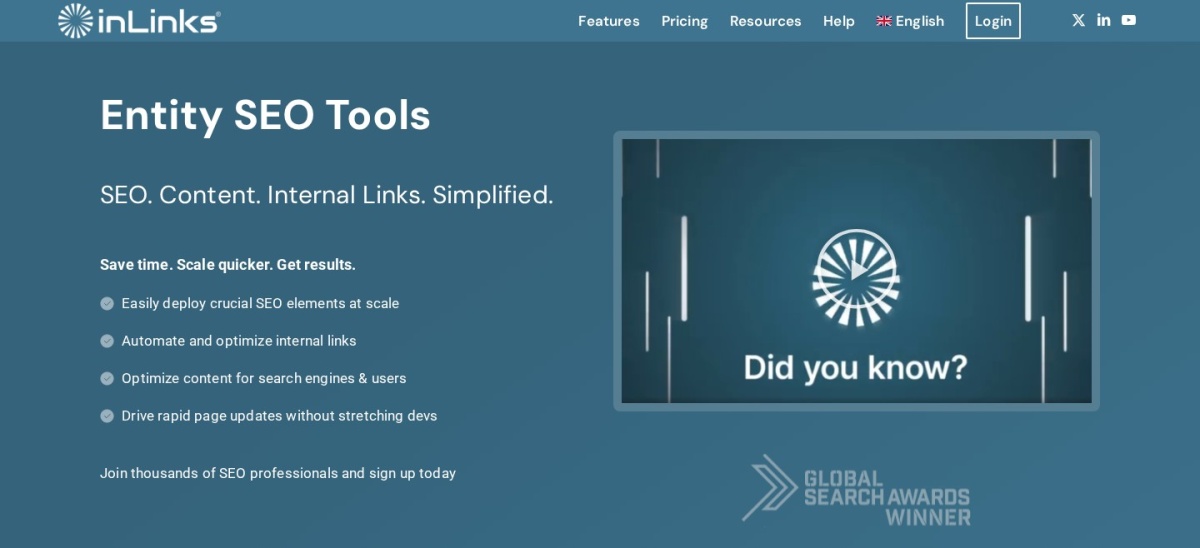
InLinks is an entity SEO platform that builds a knowledge graph of a site, then automates internal linking and schema markup from it. It maps entities and topics across pages, finds link opportunities at paragraph level and deploys approved links and schema through a small JavaScript snippet.
The trade off is delivery. Links and schema injected by JavaScript are seen by Google, which renders scripts, but not by AI crawlers that fetch raw HTML, and everything vanishes if you cancel. It suits Google-focused teams that want entity schema and internal links without developer work.
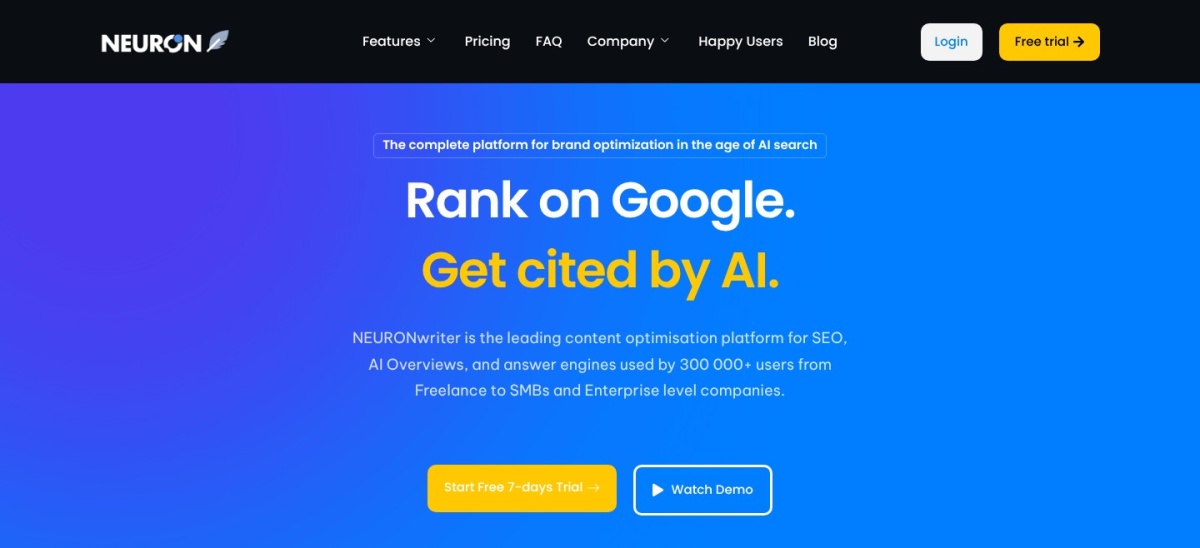
NeuronWriter is a content optimisation editor that scores drafts against the top-ranking pages using NLP term recommendations. Bronze at $23 a month covers 2 projects, 25 documents a month and 15,000 AI credits, and it adds AI drafting, a plagiarism checker and internal link suggestions.
The trade off is polish. Reviewers flag a dated interface that slows down on longer documents, and WordPress and Search Console integrations only unlock on Gold at $69 a month. It suits solo bloggers and freelancers who want Surfer-style scoring at a third of the price.
4.8/5on WordPress.org (7,523 reviews, checked Nov 2026)
Paid from$8.99/mo
Best WordPress schema automation
Schema types16 or more, free
Focus keywords5 per post, free
Rank tracking1,000 keywords on PRO
Entry planPRO, $8.99/mo billed yearly
rankmath.com
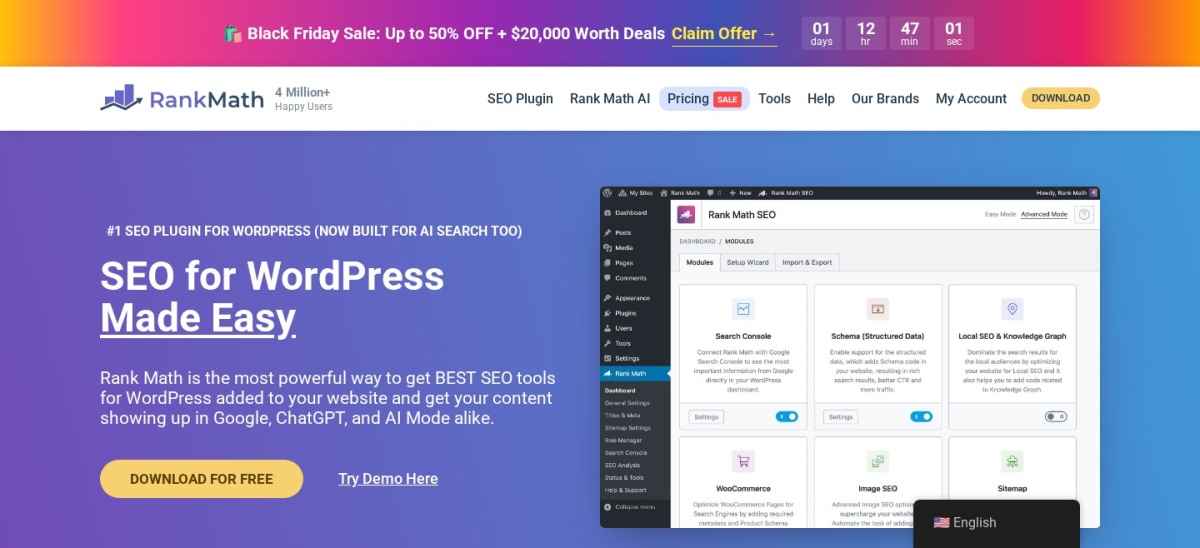
Rank Math homepage, captured Nov 2026.
Rank Math is a WordPress SEO plugin that automates schema markup, redirects and internal linking inside the editor. The free version covers 16 or more schema types, a 404 monitor and Search Console data, and PRO adds AI Link Genius, which builds keyword-to-URL maps and links them automatically.
The trade off is renewal pricing. PRO is on sale at $4.99 a month for Black Friday but renews at $8.99 a month billed yearly, and its Content AI runs on credits rather than a flat allowance. It suits WordPress sites that want schema and linking automation without a second subscription.
4.1/5on WordPress.org (152 reviews, checked Nov 2026)
Paid from$97/yr
Best for in-editor internal linking
AI credits on Starter2,000 a month
Orphan page finderYes, free version
Sites on Starter1
Entry planStarter, $97/yr
linkwhisper.com
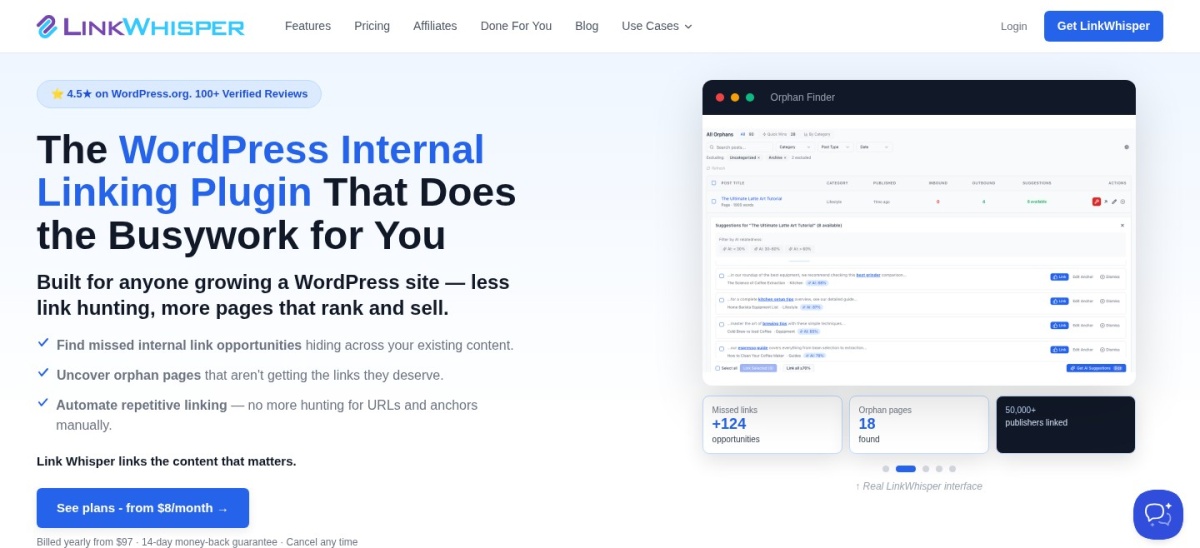
Link Whisper homepage, captured Nov 2026.
Link Whisper is a WordPress plugin that suggests internal links inside the post editor as you write. Its AI reads content for topic and semantic relevance rather than exact keywords, and the free version adds orphan page reports and a link health dashboard.
The trade off is the rating. It holds 4.1/5 from 152 WordPress.org reviews, the lowest here, and bulk linking and auto-linking need Premium, with Starter at $97 a year on sale at $57 for Black Friday. It suits WordPress publishers who want link suggestions at the point of writing.
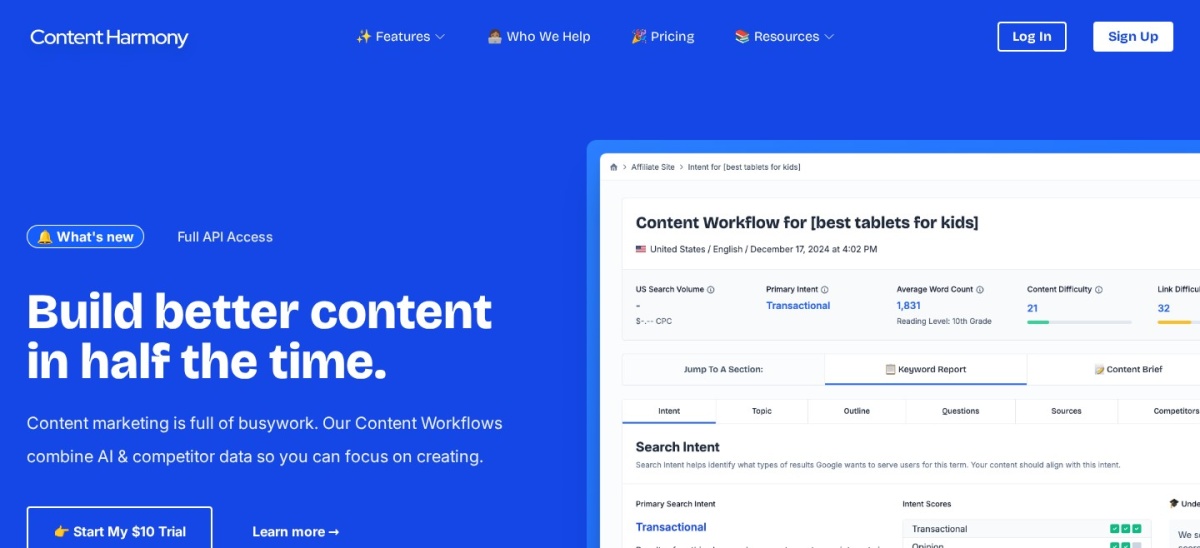
Content Harmony is a content briefing platform that turns a keyword into a production-ready brief. Each workflow combines a keyword report, a structured brief and a content grader, with search intent classification and competitor data behind every recommendation.
The trade off is scope. There is no writing editor, so drafts still need Google Docs or WordPress, and Standard covers only 5 workflows a month. It suits agencies and content teams where the brief is the deliverable and writers need clear instructions.
Automate the scoring and the first draft of a brief. A content score and a list of missing terms are cheap to generate and easy to verify.
Check every internal link before it goes live. Our guide on adding internal links in WordPress explains why a link only helps when the destination genuinely answers the reader.
Keep schema generation automatic but review the output. Wrong schema types can mislead search engines more than no schema at all.
How we chose
We started from the tools that specialise in semantic SEO: content optimisers that score drafts against ranking pages, entity platforms that build knowledge graphs and schema, and internal linking tools that map topics.
Prices come from each vendor's pricing page, checked on 25 November 2026. Ratings and review counts come from G2 and WordPress.org on the same day. Where a vendor shows a sale, the list shows the regular price.
We left out tools with no published rating and tools whose pricing is hidden behind a sales call. No vendor paid for a place, and we do not claim to have used these tools ourselves.
How to choose a semantic SEO automation
Start with the job you repeat most, then match the tool to that job.
Name the repetitive job. If you optimise drafts every week, a content editor like Surfer or Clearscope pays first. If internal links eat your time, start with Link Whisper or InLinks.
Check what your site already runs. WordPress sites get schema, redirects and AI linking from Rank Math before paying for a separate platform. See how to optimise WordPress for AI search before adding another subscription.
Weigh the review base, not just the score. A 4.9 from 5 reviews is thinner evidence than a 4.7 from 1,500. InLinks and Content Harmony score high on small samples.
Trial the editor on a real draft. Most of these tools offer a free trial or free plan. Score one existing page and judge the suggestions before committing to a monthly plan.
FAQ
What is semantic SEO automation?
Semantic SEO automation uses software to handle the meaning layer of search: finding related entities and terms, scoring drafts against ranking pages, generating schema markup and placing internal links. It replaces manual checklists, not editorial judgement, and every suggestion still needs a human review before publishing.
Which semantic SEO tool is best overall?
Surfer is the best overall pick. Its Content Editor scores drafts 0-100 against the pages already ranking, it tracks brand mentions inside ChatGPT, Gemini and Perplexity, and it holds a 4.8/5 G2 rating from 548 reviews. Discovery starts at $49 a month billed yearly.
Can these tools replace an SEO specialist?
No. They automate scoring, briefs, schema and link suggestions, but they cannot set strategy, judge whether a topic fits your audience, or fix thin content. Treat them as a faster checklist and keep a person deciding what to publish.
Do automated internal links always help?
Not always. A link only helps when the destination genuinely answers the reader, so review every suggestion before it goes live. Links injected with JavaScript are seen by Google, which renders scripts, but not by AI crawlers that fetch raw HTML.
What is the cheapest semantic SEO tool?
Rank Math is cheapest: the free plugin covers schema, redirects and basic AI features, and PRO costs $8.99 a month billed yearly. Link Whisper is next at $97 a year for one site. Both run inside WordPress, so there is no separate platform to learn.
Do I need a separate schema tool if I use Rank Math?
Usually not. Rank Math generates schema for 16 or more types in the free plugin and adds templates in PRO. A dedicated tool like InLinks only makes sense if you also want entity mapping and automated internal linking across a large site.
SaaS SEO and WordPress specialist with about 8 years of experience. Rakib compares WordPress plugins, themes, hosting and software using public pricing, documentation and user reviews. See how we rank.