Doppler is the best secrets management tool for most DevOps teams, rated 4.8 out of 5 on G2, with a free plan and a $21 per user monthly Team plan. Pick Infisical for an open-source start, or AWS Secrets Manager if your workloads already run on AWS.
How we make this list: we compare pricing pages, product documentation and public user reviews, then re-check every price before each update. No product paid for a place. Disclosure.
Doppler leads on ratings at 4.8 out of 5 from 96 G2 reviews, ahead of Akeyless at 4.6 out of 5 from 93.
Infisical's free plan covers 5 identities, and Pro costs $20 per identity a month billed yearly.
AWS Secrets Manager costs $0.40 per secret a month, the cheapest metered option in this list.
HashiCorp Vault's managed Development cluster starts at about $450 a month, so self-hosting is the cheap route.
Akeyless and CyberArk Conjur do not publish paid prices; both are quote only, with free tiers.
What DevOps teams should look for in a secrets manager
Secrets sprawl is the problem these tools solve. API keys, database passwords and tokens end up in code, config files and chat, where they leak, go stale and cannot be revoked in one place.
Rotation matters more than storage. A vault that only stores static secrets still leaves long-lived credentials lying around, so look for automatic rotation or short-lived dynamic secrets for databases and cloud accounts.
Pricing models are not comparable at a glance. Some tools charge per user, some per identity including machines, and cloud stores charge per secret, so model your own counts before comparing headline prices. Teams that automate deploys should also check how secrets reach pipelines, as in our guide to deploying with GitHub Actions.
Free tiers are genuinely useful here. Six of the nine tools in this list have a free plan or a free edition, so a small team can move secrets out of code before spending anything.
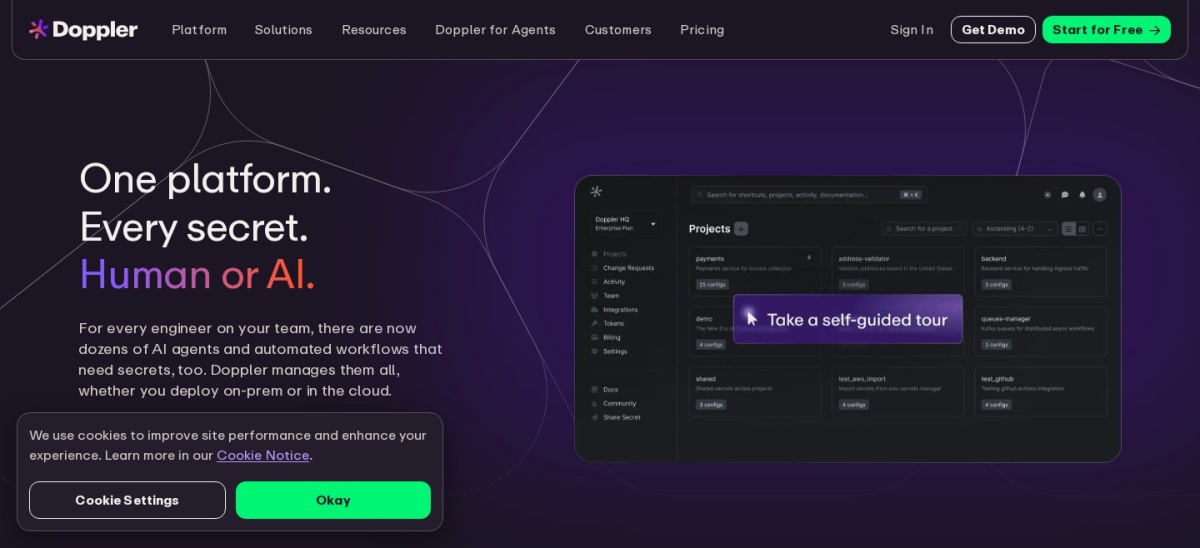
Doppler is a DevOps-first secrets manager built around projects, configs and environments, with a free plan for small teams. It syncs secrets to cloud providers and CI tools, covers GitHub, Kubernetes and Docker integrations, and gives every human and AI agent its own scoped access.
The trade off is per-user pricing. Team costs $21 per user a month, so a large team with many service accounts pays for seats that other tools bill per secret. It suits DevOps teams that want one central place for secrets across projects and environments.
What we like
Highest G2 rating in this list at 4.8 out of 5
Free plan for getting started
Syncs secrets to cloud providers and CI tools
Scoped access for humans and AI agents
Watch out for
Per-user pricing grows with team size
Dynamic secrets need a higher plan
Team adds unlimited projects and advanced access controlsVisit doppler.com
02
Infisical
4.8/5on G2 (9 reviews, checked Nov 2026)
Paid from$20/mo
Best open-source start for small teams
Free plan5 identities, unlimited projects
Paid planPro, $20/identity/mo
Dynamic secretsAdvanced, $40/identity/mo
GitHub stars30,000+
infisical.com
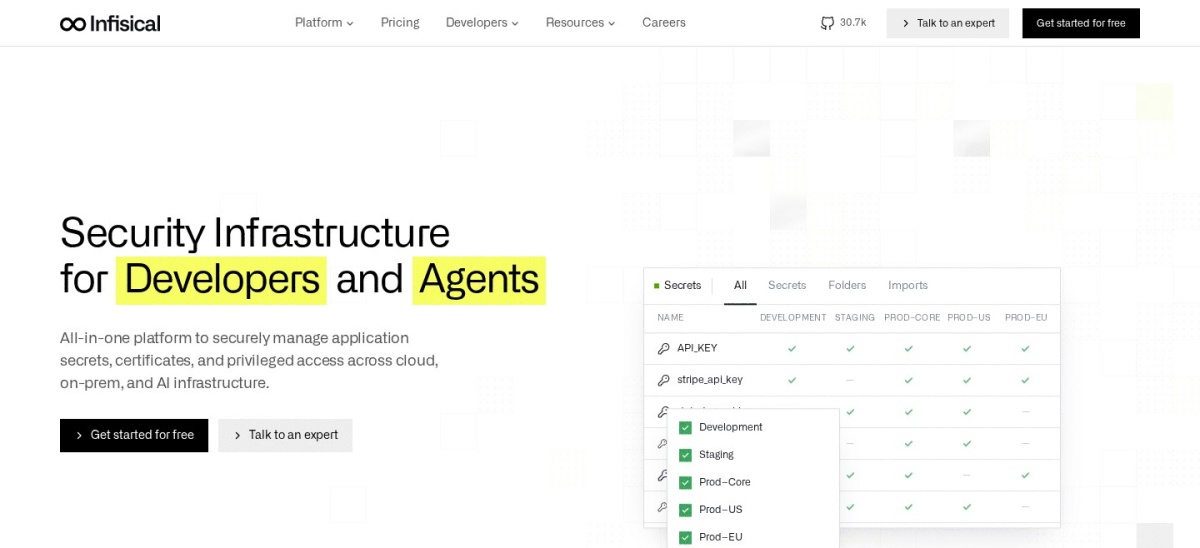
Infisical homepage, captured Nov 2026.
Infisical is an open-core secrets platform that covers secrets, certificates and privileged access in one product. The free plan covers 5 identities with unlimited projects, and Pro at $20 per identity a month billed yearly adds secret rotation, SAML single sign-on and 30-day audit logs.
The trade off is the billing unit. An identity is any person or machine that signs in, so costs grow with services and pipelines as well as people, and dynamic secrets need Advanced at $40. It suits startups and mid-size teams that want a managed vault fast.
HashiCorp Vault is the reference vault for multi-cloud teams. It stores static secrets, mints short-lived dynamic credentials for databases and cloud accounts, handles encryption as a service, and logs every access. The self-hosted Community edition is free under a source-available licence.
The trade off is operational weight. The managed HCP Vault Dedicated Development tier starts at about $450 a month, is capped at 25 clients and has no audit logging, while Enterprise is quote only. It suits platform teams that need dynamic secrets across clouds.
AWS Secrets Manager is the native secret store for workloads on AWS. It costs $0.40 per secret a month plus $0.05 per 10,000 API calls, rotates database credentials automatically, and lets applications read secrets through IAM roles with no stored key at all.
The trade off is lock-in. It is built for AWS, so multi-cloud teams need another vault beside it, and heavy API reads add up because every call is billed. It suits teams whose services, databases and pipelines already live on AWS.
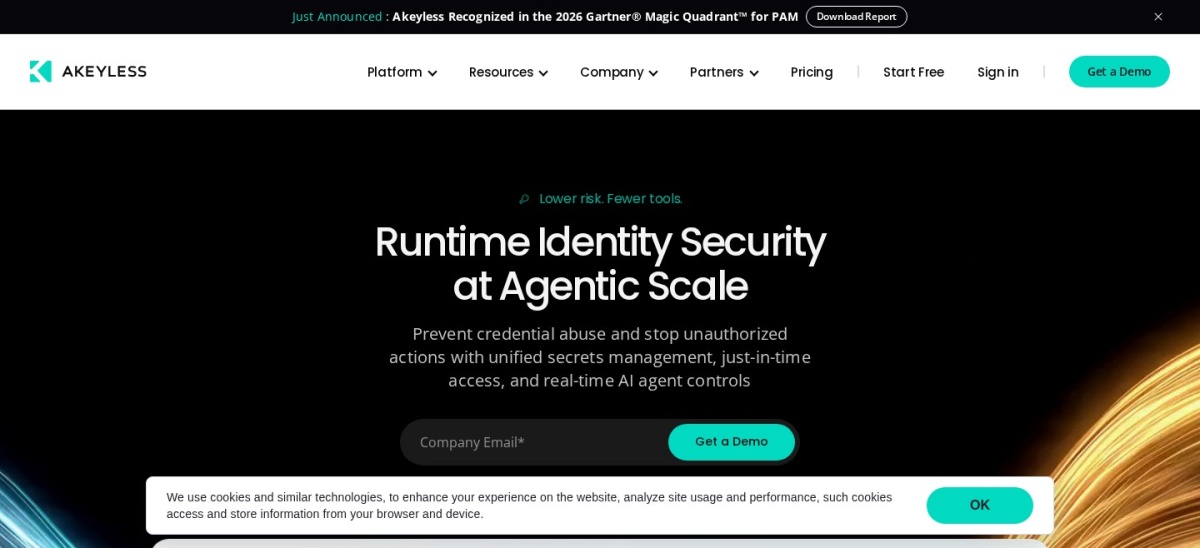
Akeyless is a cloud vault for secrets, keys and privileged access across multi-cloud and hybrid estates. It offers dynamic secrets with rotation, fine-grained access controls and a connector that syncs secrets into the stores teams already use, such as AWS Secrets Manager and Azure Key Vault.
The trade off is pricing. The Basic tier is free, but paid plans are quote only and metered by clients and transactions, so budgeting needs a sales conversation. It suits security teams managing service accounts across several clouds.
What we like
Rated 4.6 out of 5 from 93 G2 reviews
Dynamic secrets and rotation included
Syncs into AWS and Azure secret stores
Free Basic tier to validate fit
Watch out for
Paid pricing is quote only
Initial setup can be complex
Metered billing is hard to forecast
Paid plans add full secrets, PAM and certificate featuresVisit akeyless.io
06
1Password
4.6/5on G2 (1,810 reviews, checked Nov 2026)
Starts at$24.95/mo
Best for teams already using 1Password
Cheapest paidTeams, $24.95/mo for 10 users
Business$8.99 per user a month
Free trial14 days
Dynamic secretsNo
1password.com
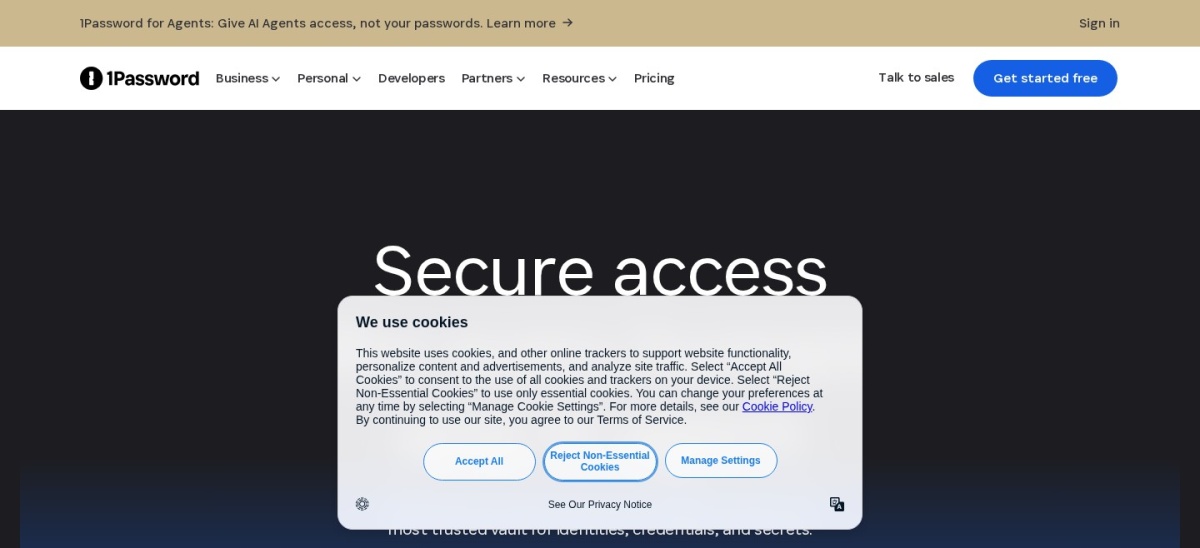
1Password homepage, captured Nov 2026.
1Password is a password manager whose Secrets Automation feature lets developers read secrets from the same vaults the company already uses for staff passwords. Service accounts, the CLI and SDKs feed secrets into pipelines and code, and Business adds SSH key signing, Git commit signing and CI integrations.
The trade off is scope. There are no dynamic secrets or rotation, and rate limits bite: each service account token allows 1,000 reads and 100 writes an hour on Teams. It suits companies already standardised on 1Password.
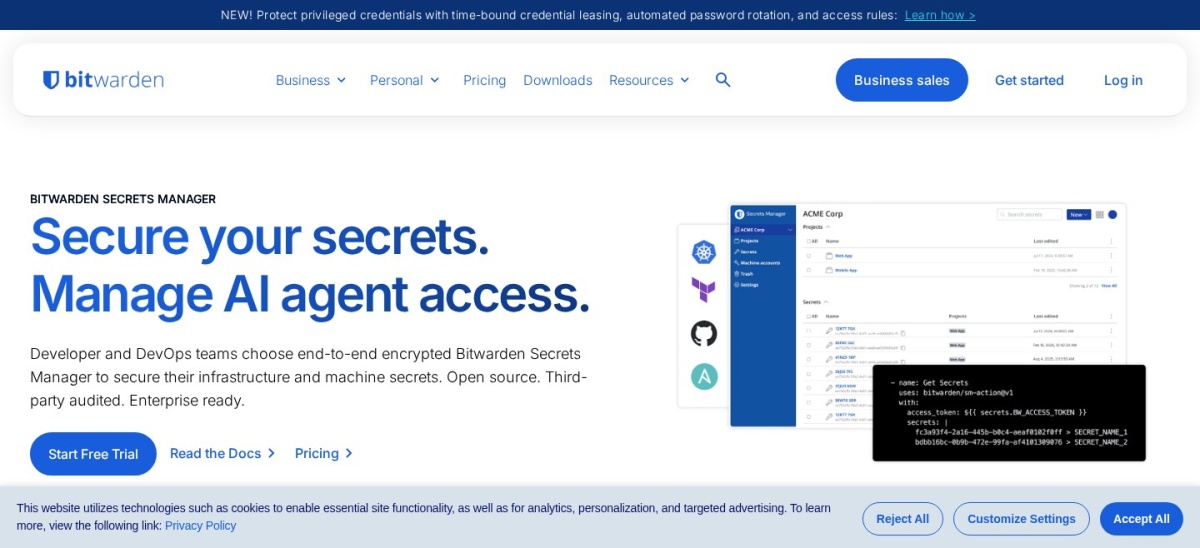
Bitwarden Secrets Manager homepage, captured Nov 2026.
Bitwarden Secrets Manager is the developer secrets product beside the Bitwarden password manager. Secrets are end-to-end encrypted with a zero-knowledge design, the code is open source and third-party audited, and Teams costs $6 per user a month with unlimited projects and 20 machine accounts.
The trade off is scope. It centres on storing and injecting static secrets, with no dynamic database credentials and no broad sync to cloud secret stores, and self-hosting needs Enterprise at $12. It suits small teams that want cheap, encrypted secrets.
CyberArk Conjur is an open-source secrets engine for applications, containers and CI/CD pipelines. Secrets, roles and access rules are defined as declarative, version-controlled policy, with granular authorisation and detailed audit logs that suit demanding compliance regimes.
The trade off is weight. The policy-as-code approach has a learning curve, standing up the enterprise edition takes real platform investment, and it is now sold as Idira Secrets Manager with quote-only pricing. It suits large teams already invested in the CyberArk platform.
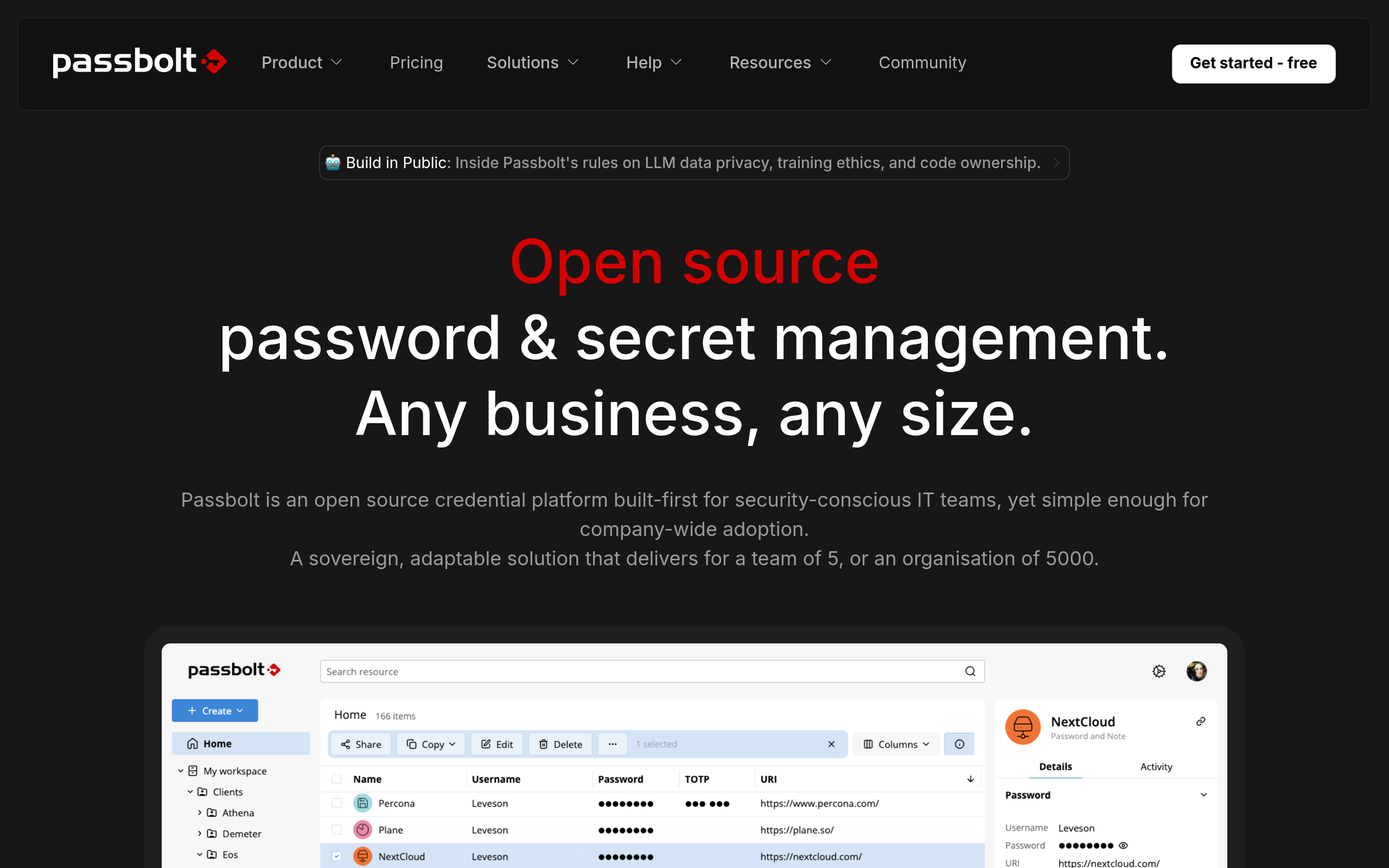
Passbolt is an open-source credential platform for teams that share secrets with granular, role-based access. The Community edition is free to self-host, and Pro costs $4.90 per user a month billed yearly, with a cloud option for teams that do not want to run servers.
The trade off is focus. Passbolt is built for team credential sharing rather than machine-heavy DevOps flows, so it has fewer CI and cloud-native integrations than Doppler or Vault. It suits small teams that want a cheap, self-hosted secrets store.
Per-user, per-identity or per-secret: how the billing works
Per-user billing is the simplest to forecast. Doppler charges $21 per user a month, Passbolt $4.90 and Bitwarden Secrets Manager $6, so the bill tracks headcount.
Per-identity billing counts machines too. Infisical charges $20 per identity a month on Pro, and an identity is any person or machine that signs in, so a team with many services pays for those as well.
Per-secret billing suits small secret counts. AWS Secrets Manager charges $0.40 per secret a month, which stays cheap until the secret count or the API calls grow.
Quote-only tools hide the bill entirely. Akeyless and CyberArk Conjur both need a sales conversation, and HashiCorp Vault Enterprise is the same, so budget for time as well as money.
How we chose
We started from the secrets tools DevOps teams actually deploy, then kept the nine with a public user rating and a published price or a free tier.
Prices come from each vendor's pricing page as quoted on 26 November 2026, and ratings come from G2 or Capterra on the same day. Where a vendor shows a sale, the list shows the regular price.
We left out cloud secret stores with no public user rating and tools whose secrets product has no reviews of its own. No vendor paid for a place, and we do not claim to have used these tools ourselves.
How to choose a secrets management tool for DevOps
Start with where your workloads run, then match the billing model to your secret count.
Check where your workloads run. AWS teams get the most from AWS Secrets Manager, Azure and Google Cloud teams from their own stores, and multi-cloud teams from Doppler, Vault or Akeyless.
Count secrets, users and machines. Per-user plans suit small teams, per-secret plans suit few secrets, and per-identity plans need a count of services and pipelines too.
Decide whether you need rotation. If long-lived keys are the risk, shortlist tools with automatic rotation or dynamic secrets, such as Vault, Akeyless or Infisical Pro.
Try the free tier first. Six tools here have a free plan or edition, so move a small set of secrets over and check the CLI and CI integration before paying.
FAQ
What is the best secrets management tool for DevOps?
Doppler is the best pick for most DevOps teams. It is rated 4.8 out of 5 on G2 from 96 reviews, has a free plan, and its Team plan costs $21 per user a month with sync to cloud providers and CI tools.
Is HashiCorp Vault still free?
Yes, the self-hosted Community edition is free under a source-available licence. The managed HCP Vault Dedicated service starts at about $450 a month for a Development cluster, and Enterprise pricing is quote only.
How much does AWS Secrets Manager cost?
AWS Secrets Manager costs $0.40 per secret a month plus $0.05 per 10,000 API calls. There is no monthly plan, so the bill depends on how many secrets you store and how often applications read them.
Do these tools rotate secrets automatically?
Some do. AWS Secrets Manager rotates database credentials automatically, Infisical Pro adds rotation, and Vault and Akeyless issue short-lived dynamic secrets. 1Password and Bitwarden Secrets Manager do not offer rotation.
What is the cheapest secrets manager for a small team?
Passbolt Pro at $4.90 per user a month is the cheapest per-user paid plan here, and its Community edition is free. Bitwarden Secrets Manager is next at $6 per user a month, with a free plan for 2 users.
Can I self-host a secrets manager?
Yes. HashiCorp Vault, Infisical, Bitwarden Secrets Manager on Enterprise, CyberArk Conjur and Passbolt all offer self-hosting. Doppler, AWS Secrets Manager and Akeyless are cloud services with no self-hosted option in this list.
SaaS SEO and WordPress specialist with about 8 years of experience. Rakib compares WordPress plugins, themes, hosting and software using public pricing, documentation and user reviews. See how we rank.