SDS Manager is the best SDS management software for most teams, with a free plan to 200 SDSs, paid plans from $228 a year and a 4.9/5 G2 rating from 25 reviews. Pick SafetyCulture for frontline access across inspections and training, or VelocityEHS when SDS must sit inside a full enterprise EHS platform.
How we make this list: we compare pricing pages, product documentation and public user reviews, then re-check every price before each update. No product paid for a place. Disclosure.
SDS Manager is the only tool here with a free plan to 200 SDSs and a published paid price of $228 a year, and it holds the highest G2 rating at 4.9/5.
SafetyCulture, now Mitti, is free for up to 10 users, with Premium at $24 per seat a month, and the largest review base at 241 G2 reviews.
Five of the nine tools publish no prices at all: VelocityEHS, HSI, EcoOnline, Cority and SciSure are all quote-based.
CloudSDS offers a free account and a flat $2,500-a-year Basic tier, but only 9 G2 reviews back it so far.
EHS Insight is the only suite with a published entry price, $5,000 a year for small and mid-size businesses.
What SDS management software has to do
Every employer using hazardous chemicals must keep safety data sheets accessible to workers. In the US, OSHA's Hazard Communication Standard makes that a legal duty, not a nice extra.
A good tool keeps one current library matched to the chemicals actually on site, flags supplier updates, and gives every exposed worker access during a shift, often on a phone.
Access matters more than dashboards. Our guide on running a WordPress security audit makes the same point for websites: a record you cannot reach when it counts is not a control.
The split that matters most is storage versus authoring. End users, warehouses and labs need a library; manufacturers that create chemicals need software that writes compliant sheets, which is a separate product class.
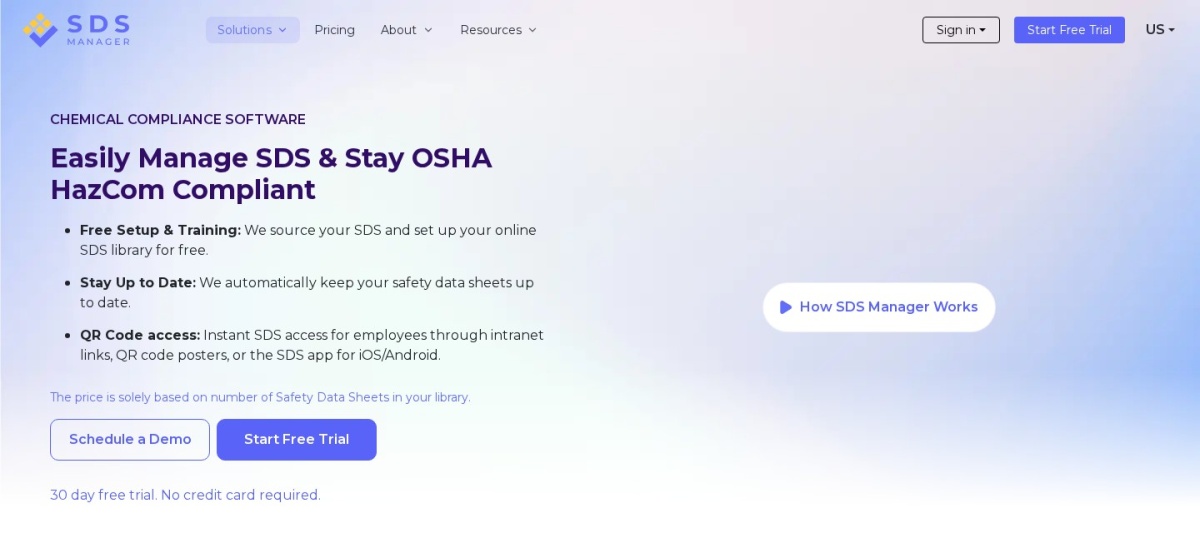
SDS Manager is a cloud library built only for safety data sheets. The free plan covers up to 200 SDSs with one admin user and a shared PDF binder link, and paid plans add automatic SDS updates, QR code posters, barcode scanning and an offline mobile app.
The trade off is that the cheapest paid plan is login-only. QR posters and automatic updates start with Premium at $39 a month, or $468 a year for 100 SDSs, and SDS authoring is a separate ExactSDS product. It suits small and mid-size sites that want a dedicated library without an enterprise platform.
What we like
Free plan covers up to 200 SDSs
Highest G2 rating in this list, 4.9/5
QR posters give workers access with no login
Automatic update monitoring on paid plans
Watch out for
Basic plan needs an employee login, with no QR access
SDS authoring is a separate product
Setting up location hierarchies takes care at first
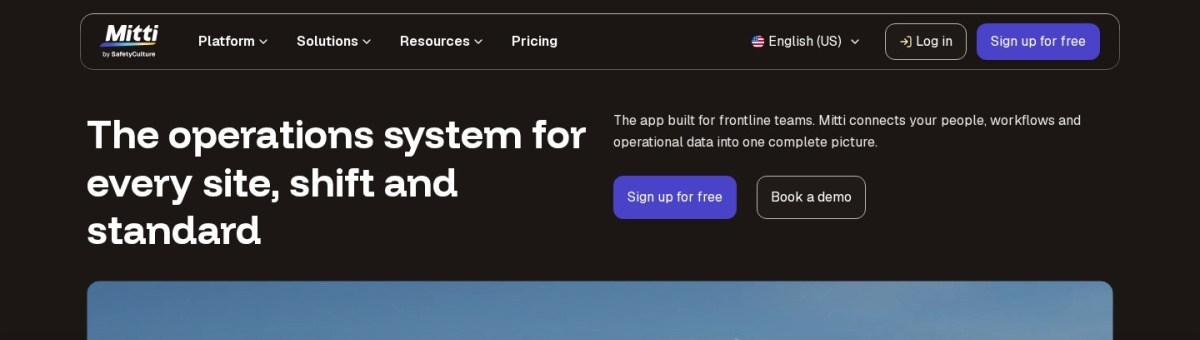
SafetyCulture (Mitti) homepage, captured Nov 2026.
SafetyCulture (Mitti) is a frontline operations platform where SDS documents sit beside inspections, actions and training in one mobile app. The free plan covers up to 10 users with 5 active templates, and Premium costs $24 per seat a month on annual billing.
The trade off is per-seat pricing. Costs climb with every inspector added, and SDS handling is lighter than in a dedicated library. It suits teams that already run inspections on the platform and want safety documents in the same place workers already open.
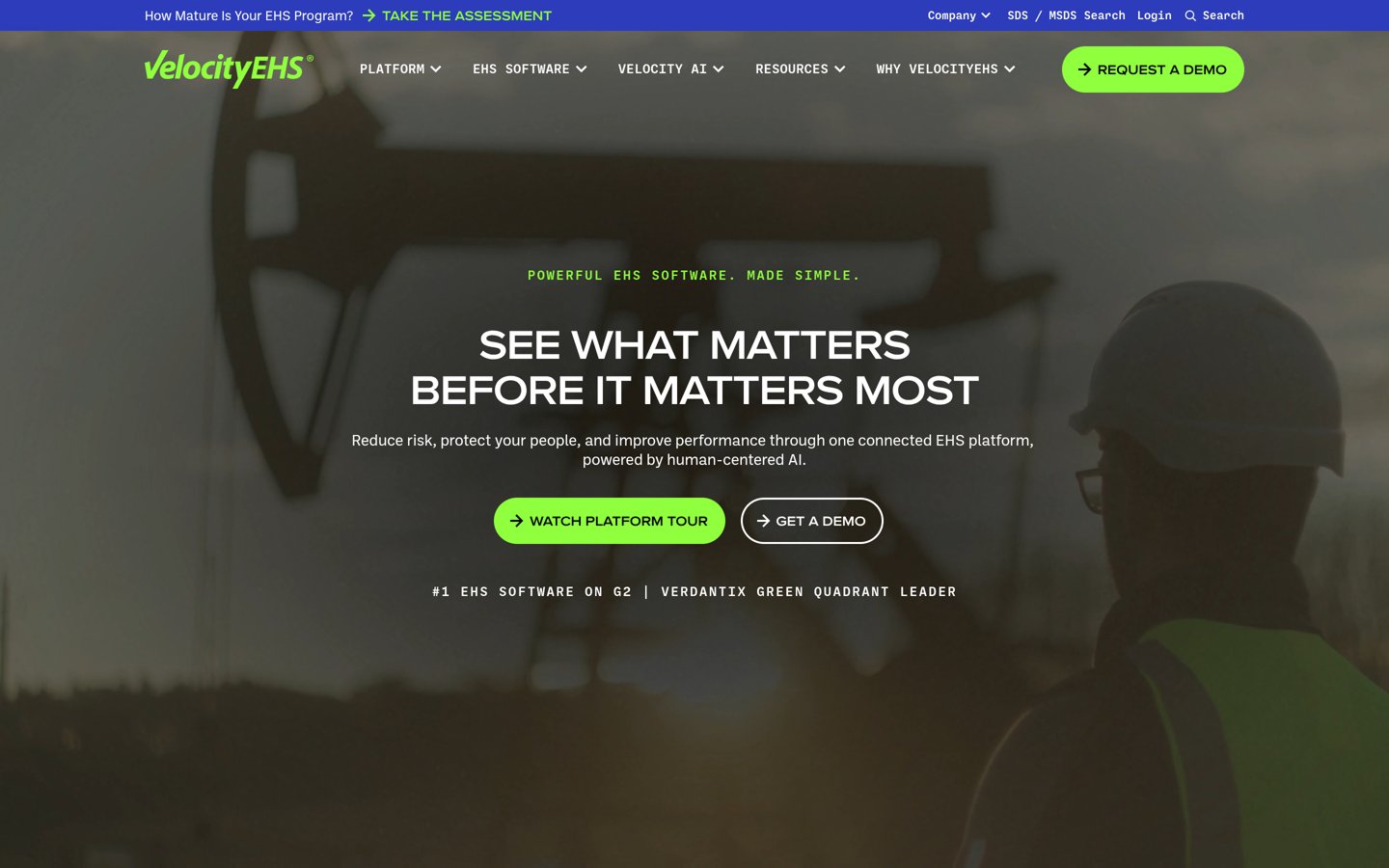
VelocityEHS is the platform play: chemical and SDS management as one module of the Accelerate EHS suite, beside safety, industrial ergonomics, operational risk, contractor safety and environmental compliance. Chemical inventory feeds risk assessments, training assignments and regulatory reports without re-entry.
The trade off is scope and price. VelocityEHS publishes no prices and sells by quote, and rollout is a platform project rather than a quick setup. It suits enterprises standardizing EHS on one vendor rather than teams that only need a current SDS binder.
What we like
Chemical data feeds risk, training and reports
Early alignment with OSHA's 2024 HazCom rule
Strong review base, 186 G2 reviews
Watch out for
No published prices; quote only
Platform rollout, not a quick setup
Some reviewers find navigation confusing
Pricing is quoted per module and site countVisit ehs.com
04
HSI
4.7/5on G2 (53 reviews, checked Nov 2026)
PricingCustom/yr
Best for SDS tied to training
Free planDemo only
Paid planQuote-based
Training libraryLarge course library
QR code accessYes, on containers
hsi.com
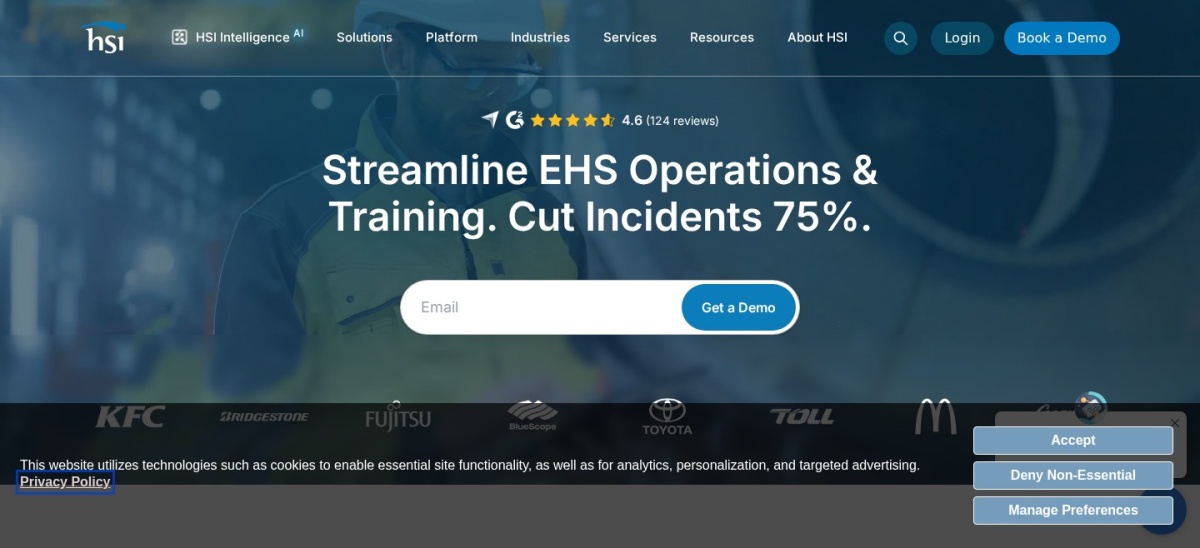
HSI homepage, captured Nov 2026.
HSI is an EHS platform that connects chemical management to incident management, inspections, corrective actions and a large safety training course library. QR codes on containers let workers pull the right sheet on a phone in seconds, and an AI layer flags gaps and recommends training.
The trade off is that pricing is custom, calculated on workforce size and the modules selected, so a scoping conversation comes first. It suits the safety manager building a connected program rather than a buyer who only needs document storage.
What we like
SDS beside training, incidents and inspections
AI flags gaps and recommends training
Mobile QR access to sheets
Watch out for
Quote only; no published prices
More platform than a library-only buyer needs
Training value depends on using the library
Price is quoted by workforce size and modulesVisit hsi.com
05
EcoOnline
4.3/5on G2 (47 reviews, checked Nov 2026)
PricingCustom/yr
Best for global chemical safety
Free planDemo only
Paid planQuote-based
Coverage80+ countries
SDS sourcingManaged, from makers
ecoonline.com
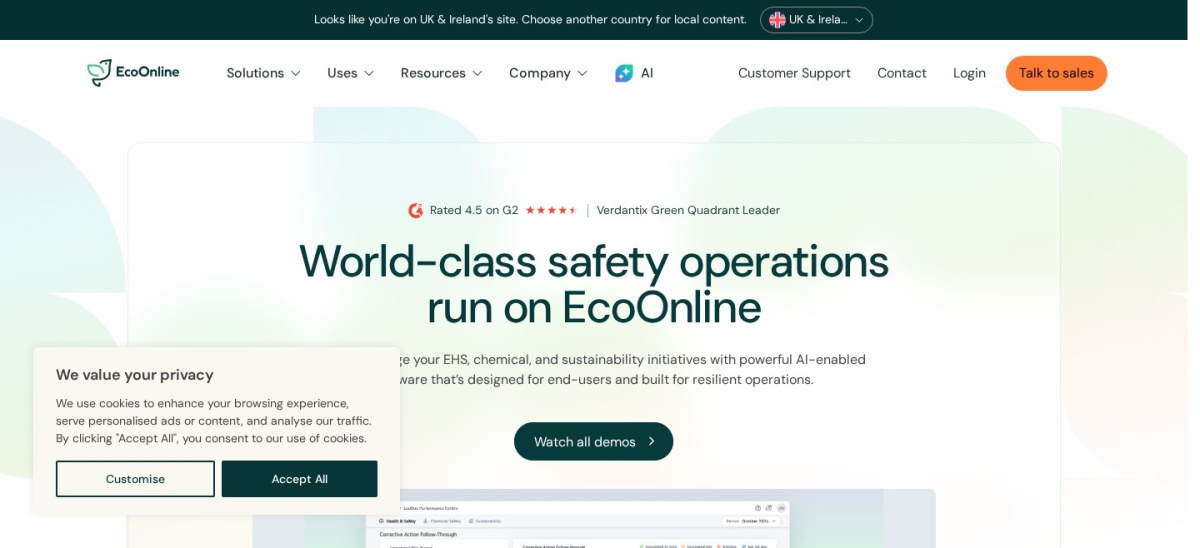
EcoOnline homepage, captured Nov 2026.
EcoOnline is a chemical safety platform built around Chemical Manager, which the vendor says gives 11,000+ global safety teams one live record of every SDS, risk assessment and compliance report. SDS sourcing is managed direct from manufacturers, with AI extraction and coverage across 80+ countries.
The trade off is that EcoOnline publishes no prices and its workflow-driven distribution adds admin overhead. It suits multi-site, multi-country programs that need controlled SDS revisions and signed acknowledgments, not a single site with a small binder.
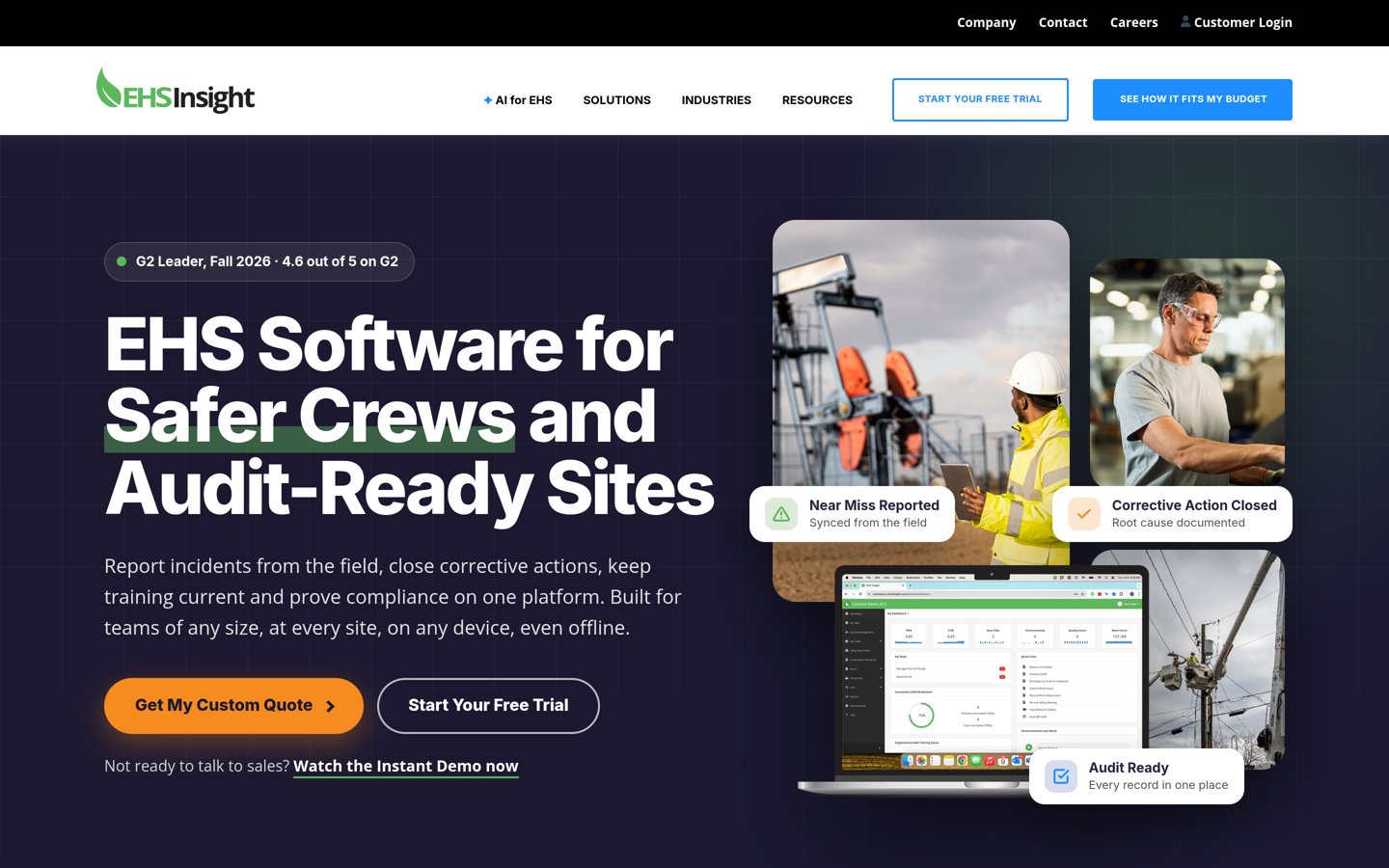
EHS Insight is a dedicated EHS suite with 32 modules covering incident management, CAPA, audits, inspections, training and OSHA recordkeeping, with SDS and chemical inventory inside the same system. Its Small and Medium Business pricing starts at $5,000 a year, a rare published entry price in this market.
The trade off is that $5,000 is a floor, not a full quote. Price scales with the number of contacts covered and the modules selected, and there is no free plan. It suits mid-market teams that want a modular start with a known entry price.
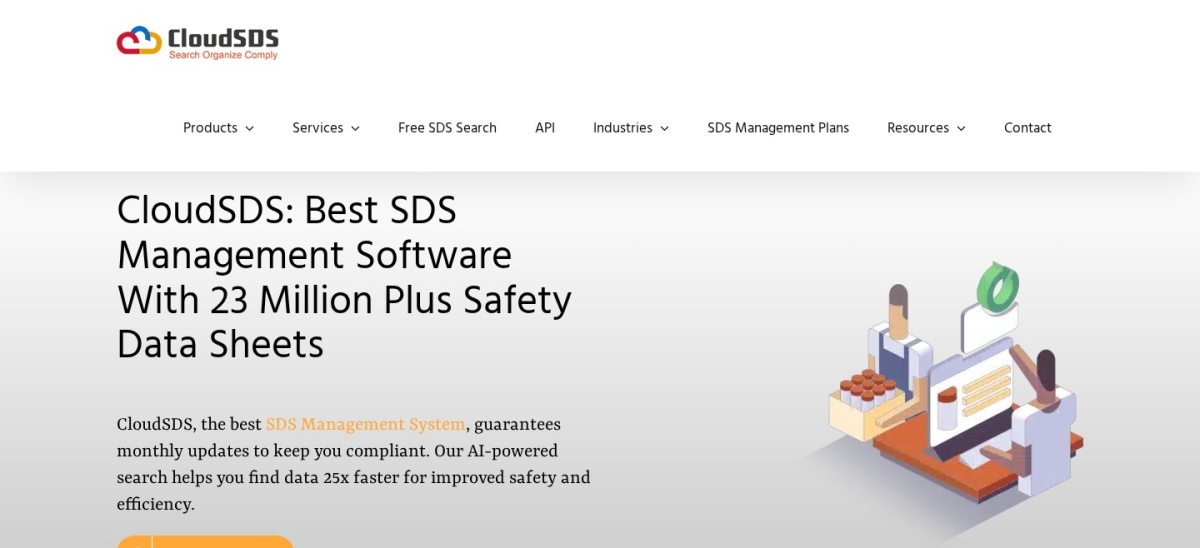
CloudSDS is a cloud SDS library that leads with search. Its AI-assisted lookup covers a 23-million-plus SDS database by product name, CAS number or manufacturer, and a conversational Copilot answers hazard questions. A free account lowers the trial barrier, and Basic is a $2,500 flat yearly rate.
The trade off is the thin review record. Only 9 G2 reviews back it so far, and the vendor is younger than the established names in this list. It suits teams that value search speed and a modern interface and are willing to check support responsiveness during evaluation.
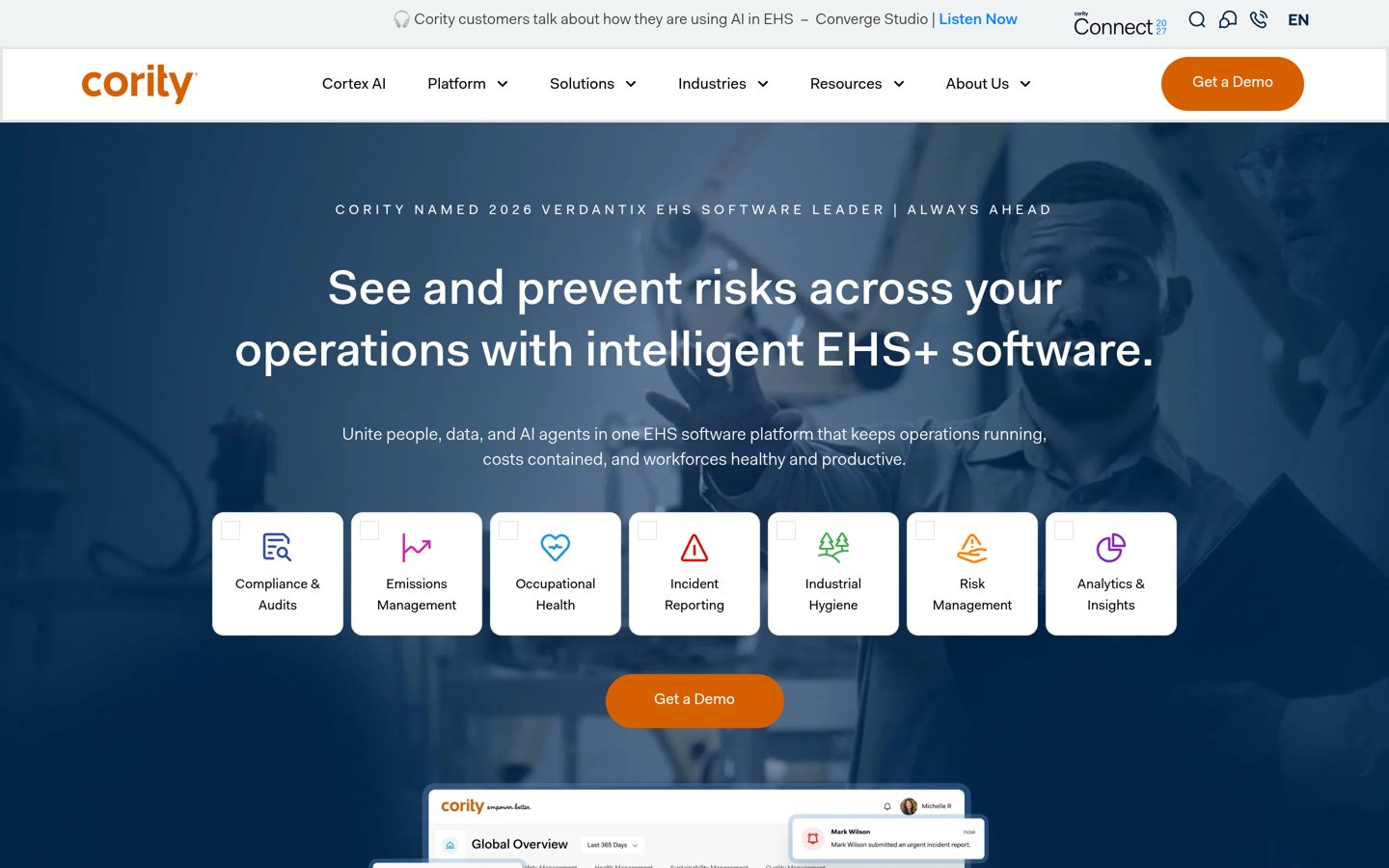
Cority is an enterprise EHS platform, now sold as CorityOne, whose chemical management ties SDS updates to workflow-controlled intake approvals and the same chemical records used for inventory reconciliation. Its SDS library reaches 14 million sheets through a 3E partnership.
The trade off is weight. Cority publishes no prices, implementation is a long project, and good governance depends on clean chemical master data. It suits large regulated enterprises that need SDS revisions to feed inspections, audits and corrective actions across sites.
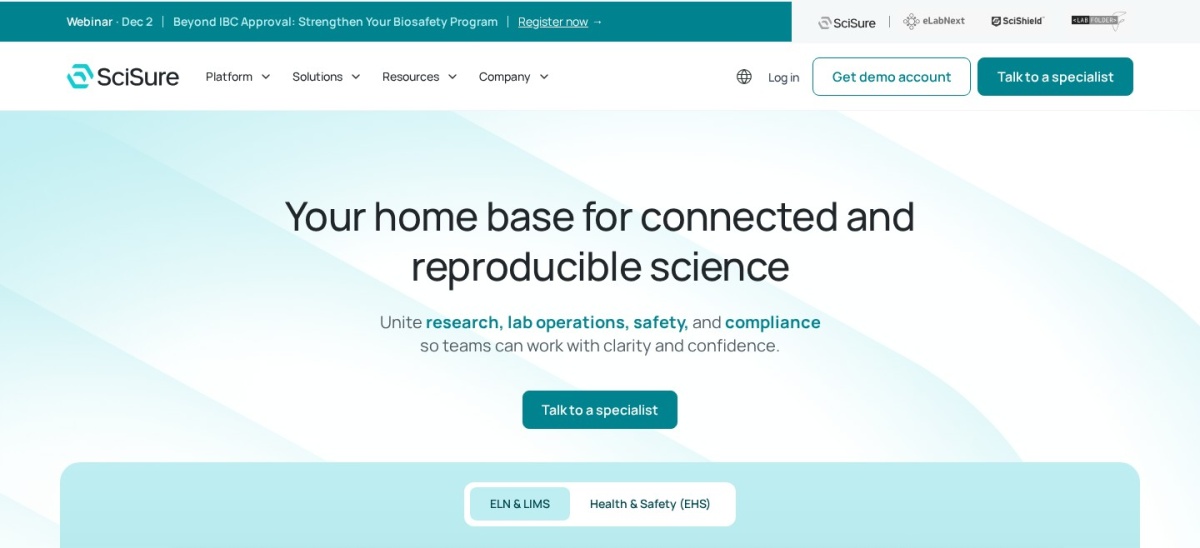
SciSure is a lab platform, formerly SciShield and eLabNext, that unifies experiment records, sample tracking and safety oversight. Container-level chemical inventory with GHS hazard classes and fire-code reporting ties each container to its SDS, which is what lab safety teams audit.
The trade off is fit. SciSure is built for labs, not general industry, and the vendor publishes no prices, so cost only comes from a quote. It suits research and lab teams that need inventory, SDS and compliance reporting in one governed system.
Most buyers only need storage: a current library matched to inventory, with access for every worker. SDS Manager, CloudSDS and SafetyCulture cover that job.
Manufacturers and distributors that create chemicals need authoring: hazard classification, multilingual sheets and distribution to customers. That is a separate product class, and two tools that touch it, ERA and SiteHawk, carry no public G2 or Capterra rating, so they are not ranked here.
Buying authoring software when you only store sheets wastes money. Storing sheets in spreadsheets when you manufacture products risks non-compliance.
How we chose
We started from every established SDS and chemical management product with a public G2 or Capterra rating, then kept nine that cover dedicated libraries, lab tools and full EHS suites.
Prices come from each vendor's pricing page or, where the vendor publishes no price, the list shows Custom. Ratings and review counts come from G2, checked on 26 November 2026. Where a vendor shows a sale, the list shows the regular price.
We left out products with no public rating on G2, Capterra or Trustpilot, including Chemwatch, KHA Online-SDS, ERA and SiteHawk, rather than guess a score. No vendor paid for a place, and we do not claim to have used these tools ourselves.
How to choose SDS management software
Start with your role in the chemical lifecycle, then check access the way workers will use it.
Decide whether you store sheets or create them. End users, warehouses and labs need a library matched to inventory. Manufacturers need authoring, which is a separate product class.
Check mobile and offline access first. Workers need the sheet during a shift, often with poor signal. QR codes and offline binders matter more than dashboards.
Audit the library against your real inventory. A library that does not match the chemicals on site fails an inspection, however good the software looks.
Get the quote in writing before you commit. Five tools here are quote-only, so ask for per-module pricing, renewal terms and what counts as a billable contact or seat.
FAQ
What is the best SDS management software?
SDS Manager is the best pick for most teams. Its free plan covers up to 200 SDSs, paid plans start at $228 a year, and it holds a 4.9 out of 5 G2 rating from 25 reviews.
Is there free SDS management software?
Yes. SDS Manager is free for up to 200 SDSs, SafetyCulture is free for up to 10 users, and CloudSDS offers a free account. Chemwatch also offers a free Backpack tier for under 50 SDSs.
How much does SDS management software cost?
Published prices in this list run from $228 a year for SDS Manager Basic to $5,000 a year for EHS Insight. Most enterprise tools, including VelocityEHS, HSI and Cority, are quote-only, so the real cost depends on sites, users and modules.
What is the difference between SDS management and SDS authoring?
Management stores and tracks safety data sheets that suppliers provide, keeping them current and accessible. Authoring creates new compliant sheets for chemicals a company makes, with hazard classification and multilingual output.
Do workers need SDS access offline?
Yes, in practice. Workers need the sheet during their shift, and warehouses and field sites often have poor signal. Offline mobile apps, QR posters and downloaded binders keep access working when the network does not.
Can SDS software replace paper binders?
Yes, if access is reliable. A digital library with QR codes or an offline app gives faster access than a binder, but only when every exposed worker can reach it without a login delay.
SaaS SEO and WordPress specialist with about 8 years of experience. Rakib compares WordPress plugins, themes, hosting and software using public pricing, documentation and user reviews. See how we rank.