MongoDB Atlas is the best scalable database for most teams, with a free M0 tier, Flex from about $8 a month and a 4.5 out of 5 rating from 904 G2 reviews. Pick Supabase for managed Postgres apps, or PostgreSQL if you want a free open-source foundation.
How we make this list: we compare pricing pages, product documentation and public user reviews, then re-check every price before each update. No product paid for a place. Disclosure.
MongoDB Atlas leads on breadth: a free M0 tier, Flex from $8 a month, and a 4.5 out of 5 rating from 904 G2 reviews.
Supabase is the cheapest managed Postgres start: Pro at $25 a month, rated 4.6 out of 5 from 241 G2 reviews.
PostgreSQL itself is free, rated 4.4 out of 5 from 682 G2 reviews, and powers several tools on this list.
Four tools bill by usage, not by seat: Snowflake, TiDB, CockroachDB and Spanner have no flat monthly plan.
PlanetScale has the thinnest evidence here, with only 4 G2 reviews behind its 4.3 rating.
What makes a database scalable
Scalable database software earns its name when growth does not force a rebuild. The tools on this list add nodes, storage or compute without downtime, instead of asking you to move to a bigger single server.
Start with the data model. Document stores such as MongoDB Atlas fit flexible, nested data, while SQL options such as PostgreSQL, TiDB and CockroachDB fit relational data and strict transactions. Our guide on what MySQL is explains the relational model these SQL tools share.
Then check the billing unit. Flat plans such as Supabase Pro at $25 a month are easy to budget, while usage plans such as Snowflake credits or TiDB Request Units depend on how much your app actually reads and writes.
Free tiers help, but read their limits. Atlas M0 gives 512 MB, Supabase free projects pause after 7 days idle, and PlanetScale has no free tier at all.
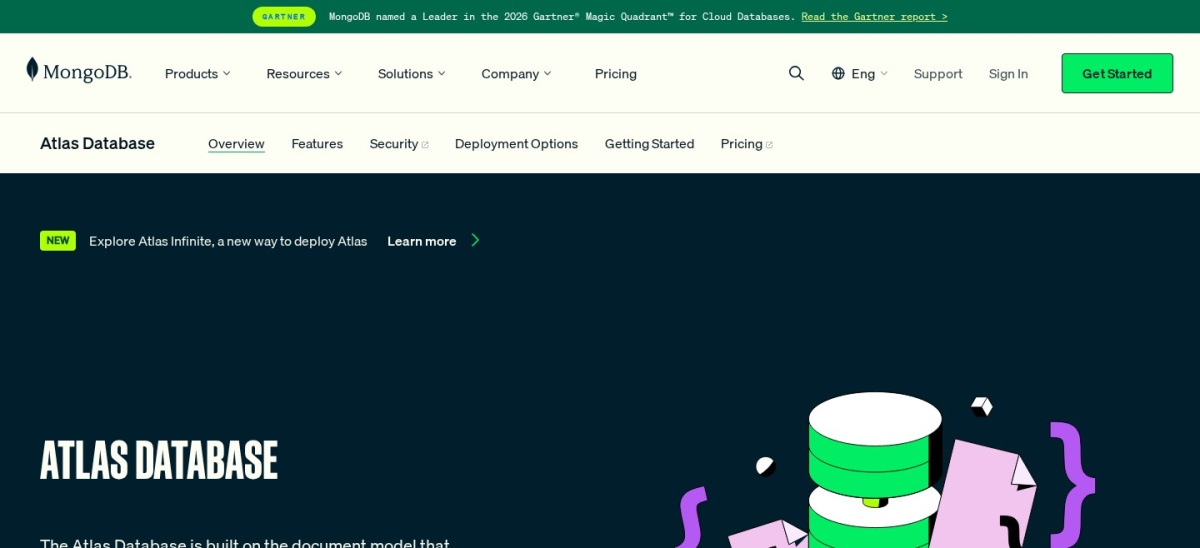
MongoDB Atlas is the managed cloud version of MongoDB, a document database that stores data as flexible JSON-like documents instead of fixed tables. The free M0 tier gives 512 MB of storage, and Flex starts at about $8 a month for small workloads, with dedicated M10 clusters from $56.94 a month.
The trade off is that dedicated pricing climbs fast as cluster tiers rise, and storage and I/O on dedicated tiers cost extra. It suits teams building document-shaped data that must grow from a prototype to production without re-platforming.
What we like
Flexible document model with no fixed schema
No server management, with backups built in
Atlas Search and Vector Search included
Runs on AWS, Azure and Google Cloud
Watch out for
Dedicated clusters get expensive quickly
Pricing is hard to predict at scale
Dedicated plans add backups, higher limits and compliance controlsVisit mongodb.com
02
Supabase
4.6/5on G2 (241 reviews, checked Nov 2026)
Paid from$25/mo
Best managed Postgres for apps
Free tierFree, 2 projects
Cheapest paidPro, $25/mo
DatabasePostgreSQL
ExtrasAuth, storage, realtime
supabase.com
Supabase homepage, captured Nov 2026.
Supabase is an open-source platform built on PostgreSQL, adding authentication, file storage, edge functions and realtime subscriptions beside the database. The free plan covers two projects with a 500 MB database, and Pro starts at $25 a month with an 8 GB database and 100,000 monthly active users.
The trade off is that each project needs its own compute, and Pro includes only $10 of compute credits, so extra projects and larger sizes add to the bill. It suits app teams that want real SQL with a managed backend in one place.
PostgreSQL is a free, open-source relational database with more than 40 years of development behind it, and it is the engine under Supabase and many managed services. It handles complex queries, JSON data and full-text search in one system, and it runs on your own servers or any cloud.
The trade off is that scaling is your job: sharding, replication and failover need design work or a managed service on top. It suits teams that want a proven SQL foundation and are happy to operate it, or to pair it with a managed host.
Snowflake is a managed cloud data platform that separates storage from compute, so warehouses scale up and down independently of the data they hold. Storage costs $23 per TB a month and Standard compute starts at $2.00 per credit, with a small warehouse burning about 2 credits an hour.
The trade off is the bill: warehouses charge a 60-second minimum on start, and costs rise with every query if auto-suspend is not set. It suits analytics teams that need elastic SQL compute and data sharing across clouds.
TiDB is a distributed SQL database from PingCAP that speaks the MySQL protocol, so MySQL apps can move to it with little change. TiDB Cloud Starter is free up to 25 GiB of row storage and 250 million Request Units a month, and overages cost about $0.10 per million RUs.
The trade off is production size: a real cluster needs at least two TiDB nodes plus three TiKV nodes, and Dedicated starts from about $1,376 a month. It suits MySQL teams that need horizontal scale plus built-in analytics in one system.
What we like
MySQL compatible with little migration work
Built-in analytics through TiFlash
Horizontal scaling without sharding code
Watch out for
Minimum production footprint is large
Dedicated pricing is steep
Essential from about $400 a month adds provisioned capacityVisit pingcap.com
06
YugabyteDB
4.5/5on G2 (65 reviews, checked Nov 2026)
Paid from$125/vCPU/mo
Best Postgres-compatible distributed SQL
Free tierOpen source, $0 licence
Cheapest paidAeon Standard, $125/vCPU/mo
CompatibilityPostgreSQL wire
DeploymentMulti-region, BYOC
yugabyte.com
YugabyteDB homepage, captured Nov 2026.
YugabyteDB is an open-source distributed SQL database that speaks the PostgreSQL wire protocol, so Postgres apps can scale across regions without rewriting queries. The database itself is free to download and run, and the managed Aeon service starts at $125 per vCPU a month on Standard.
The trade off is price at the managed tier: $125 per vCPU a month adds up fast on multi-node clusters, and Enterprise is quote-only. It suits teams that need Postgres compatibility with strong consistency across regions.
What we like
Postgres compatible across regions
Strong consistency with automatic failover
Open source with a free self-hosted path
Watch out for
Managed pricing is high per vCPU
Self-hosting needs operations skill
Aeon Professional at $167 per vCPU a month adds more featuresVisit yugabyte.com
07
CockroachDB
4.3/5on G2 (29 reviews, checked Nov 2026)
Paid from$131/mo
Best for multi-region transactions
Free tierBasic, 50M RUs a month
Cheapest paidStandard, from $131/mo
CompatibilityPostgreSQL wire
DeploymentAWS, Azure, Google Cloud
cockroachlabs.com
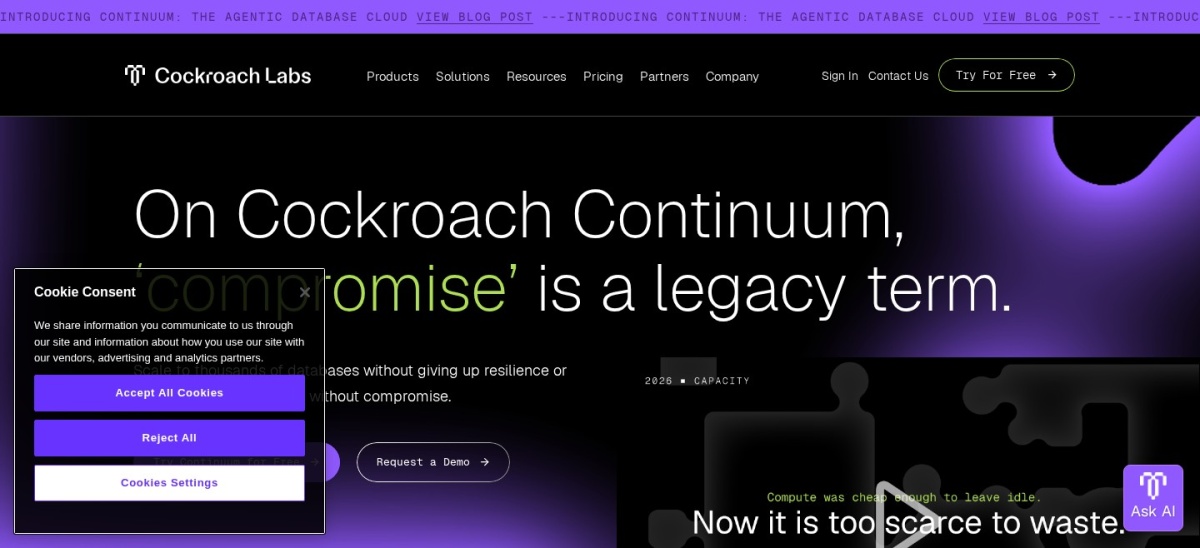
CockroachDB homepage, captured Nov 2026.
CockroachDB is a distributed SQL database built for multi-region transactional workloads with strong consistency and automatic failover. CockroachDB Cloud Basic is free up to 50 million Request Units and 10 GiB of storage a month, and extra usage costs about $0.20 per million RUs.
The trade off is that production dedicated clusters start from about $0.18 per vCPU-hour, roughly $131 a month for one vCPU, and the review base is small at 29 G2 reviews. It suits global apps that must stay up when a whole region fails.
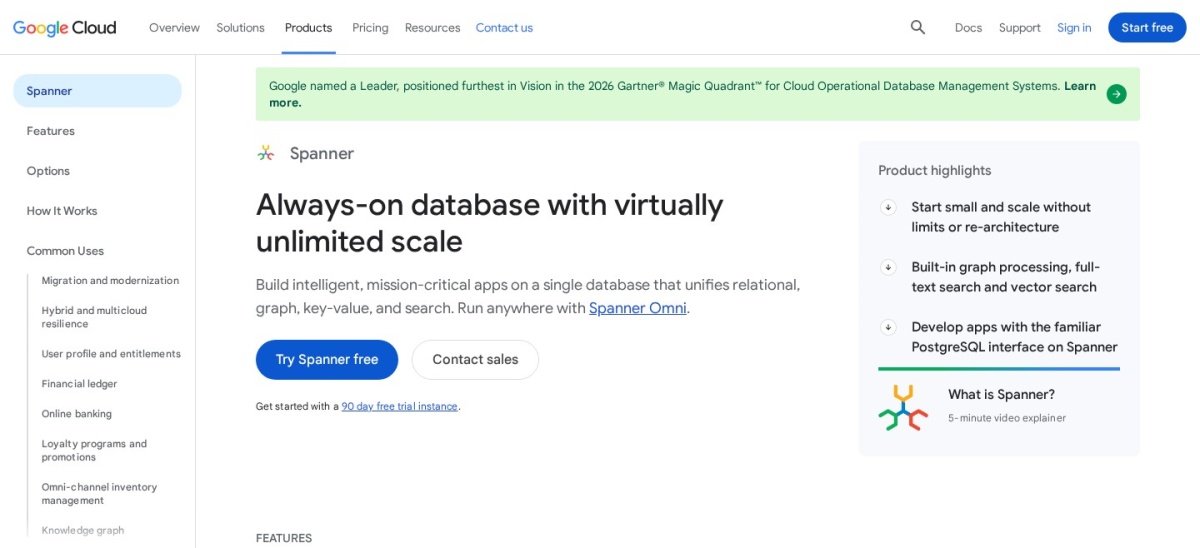
Google Cloud Spanner is a globally distributed relational database that keeps data consistent across regions using Google TrueTime synchronisation. Standard edition costs $0.72 per node-hour in us-central1, and a 90-day free trial instance lets teams try it before paying.
The trade off is cost and lock-in: multi-region designs that reach 99.999% availability carry a high baseline spend, and it only runs on Google Cloud. It suits global apps where a transaction must be consistent everywhere at once.
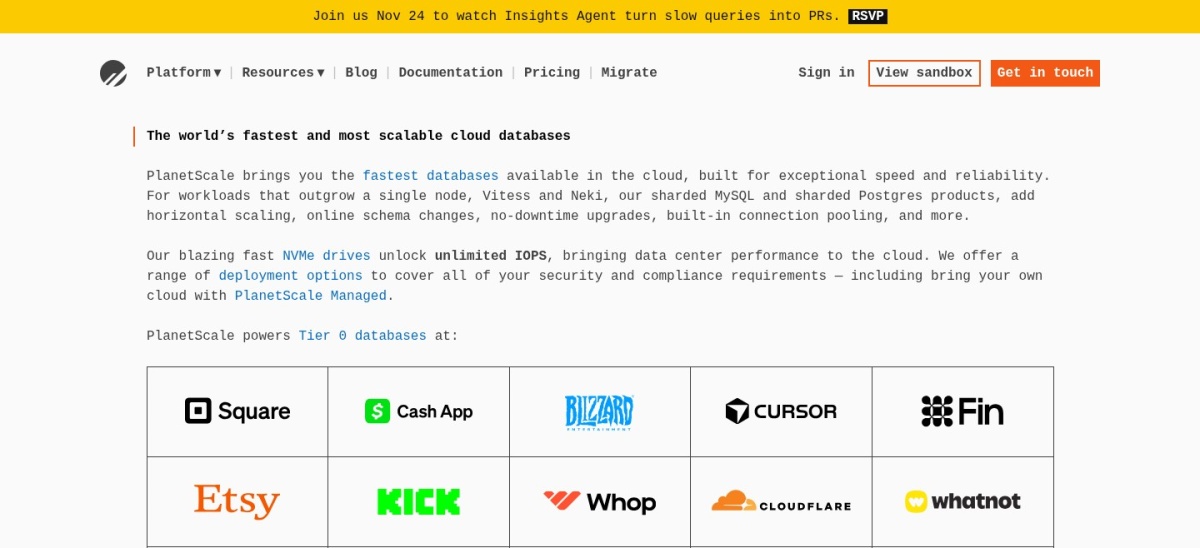
PlanetScale is a serverless MySQL platform built on Vitess, the sharding technology behind YouTube, with Git-style database branching and deploy requests for schema changes. The cheapest plan is Scaler at $39 a month per database, with 10 GB of storage and 1 billion row reads a month.
The trade off is the thin public record: only 4 G2 reviews back its 4.3 rating, and there is no free tier since the Hobby plan ended in April 2024. It suits MySQL teams that ship schema changes often and want them reviewed like code.
Four tools on this list have no flat monthly plan, so the ladder uses a flat equivalent: Snowflake storage at $23 a month for 1 TB, TiDB Essential from about $400 a month, CockroachDB Standard from about $131 a month for one vCPU, and Spanner at $526 a month for one node run continuously. Unit rates are $2.00 per credit, $0.10 per million Request Units, $0.20 per million RUs and $0.72 per node-hour.
That does not mean they are free. A small Snowflake warehouse burns about 2 credits an hour, so ten hours of queries a month costs about $40 before storage, and a busy app can pass the cost of a flat plan quickly.
Budget these tools from a usage estimate, not from the headline rate. Run a realistic workload on the free tier or trial first, then size the plan from what it actually burned.
How we chose
We started from the databases named most often for horizontal scale: managed document, relational and distributed SQL services, plus the open-source engines they are built on.
Prices come from each vendor's pricing page, checked on 26 November 2026. Ratings and review counts come from G2 on the same day. Where a vendor shows a sale, the list shows the regular price. Usage-priced tools show a flat monthly equivalent in the ladder, and the body gives the published unit rate.
We left out tools with no public rating and tools that only sell by quote. No vendor paid for a place, and we do not claim to have used these tools ourselves.
How to choose a scalable database
Match the database to your data model first, then to your budget.
Name your data model. Document data fits MongoDB Atlas; relational data with strict transactions fits PostgreSQL, TiDB, CockroachDB or Spanner.
Estimate real usage, not just users. Usage-priced tools bill reads, writes and compute, so a small app can cost little and a busy one can cost far more than a flat plan.
Test the free tier with real queries. Load a realistic dataset and run your slowest queries before you commit, since free tiers hide limits such as paused projects or capped operations.
Check the exit path. Open-source engines such as PostgreSQL, TiDB and YugabyteDB let you self-host, while managed-only services tie you to one cloud.
FAQ
What is the best scalable database software?
MongoDB Atlas is the best pick for most teams. It pairs a free M0 tier with Flex from about $8 a month, runs on AWS, Azure and Google Cloud, and holds a 4.5 out of 5 rating from 904 G2 reviews.
Which scalable database is cheapest to start?
PostgreSQL is free to download and run, with no licence cost at all. Among managed services, MongoDB Atlas Flex starts at about $8 a month, while Supabase Pro starts at $25 a month.
What is the difference between TiDB, CockroachDB and YugabyteDB?
All three are distributed SQL databases, but TiDB speaks MySQL while CockroachDB and YugabyteDB speak PostgreSQL. TiDB adds built-in analytics through TiFlash, while CockroachDB and YugabyteDB lead on multi-region transactions.
Is Snowflake a good scalable database?
Snowflake scales analytics well, with storage and compute billed separately at $23 per TB a month and $2.00 per credit on Standard. It is built for SQL analytics and sharing, not for transactional apps that need row-level writes.
Do I need a managed database, or can I self-host?
Self-hosting PostgreSQL, TiDB or YugabyteDB costs no licence fee but needs your time for backups, patching and failover. Managed services charge for that work, so they suit teams without a database specialist.
Why does PlanetScale have so few reviews?
PlanetScale holds a 4.3 out of 5 G2 rating from only 4 reviews, the smallest base on this list. Its Vitess sharding and branching are well regarded, but treat the rating as weak evidence until more reviews appear.
SaaS SEO and WordPress specialist with about 8 years of experience. Rakib compares WordPress plugins, themes, hosting and software using public pricing, documentation and user reviews. See how we rank.