Loopio is the best RFP response software for most teams, with the easiest content library and SME workflows to adopt and 813 G2 reviews behind it. Pick Responsive for high-volume enterprise operations from $10,000 a year, or Qwilr from $35 per user per month when the proposal itself must impress.
How we make this list: we compare pricing pages, product documentation and public user reviews, then re-check every price before each update. No product paid for a place. Disclosure.
Loopio leads for most teams at 4.6/5 from 813 G2 reviews, with the easiest content library and SME workflows to adopt.
Responsive is the enterprise pick, from $10,000 a year for the Emerging Edition, with 23-language support and 25-plus Fortune 100 customers.
Six of the nine tools are quote-only, including Loopio, QorusDocs, Qvidian and Ombud, so budget a sales call before you shortlist.
RocketDocs is the only dedicated RFP platform with a published entry price: plans start at $18,500 a year.
PandaDoc, Proposify and Qwilr publish prices from $19 to $39 per user per month, but they are proposal tools, not dedicated RFP platforms.
What RFP response software should do
An RFP response is a team task with a deadline. A 200-question document arrives, it must be split into assignable questions, answered from approved content, reviewed by subject matter experts and submitted on time.
The software earns its price by routing questions, reusing approved answers and keeping experts on schedule. A content library nobody maintains is the most common failure, so library upkeep matters more than any AI feature.
Dedicated RFP platforms and proposal tools solve different problems. Platforms shred inbound questionnaires; proposal tools build outbound documents that look good and track engagement.
Most dedicated platforms are quote-only. Only Responsive and RocketDocs publish an entry price here, so expect a sales conversation and a multi-week implementation for the enterprise tools.
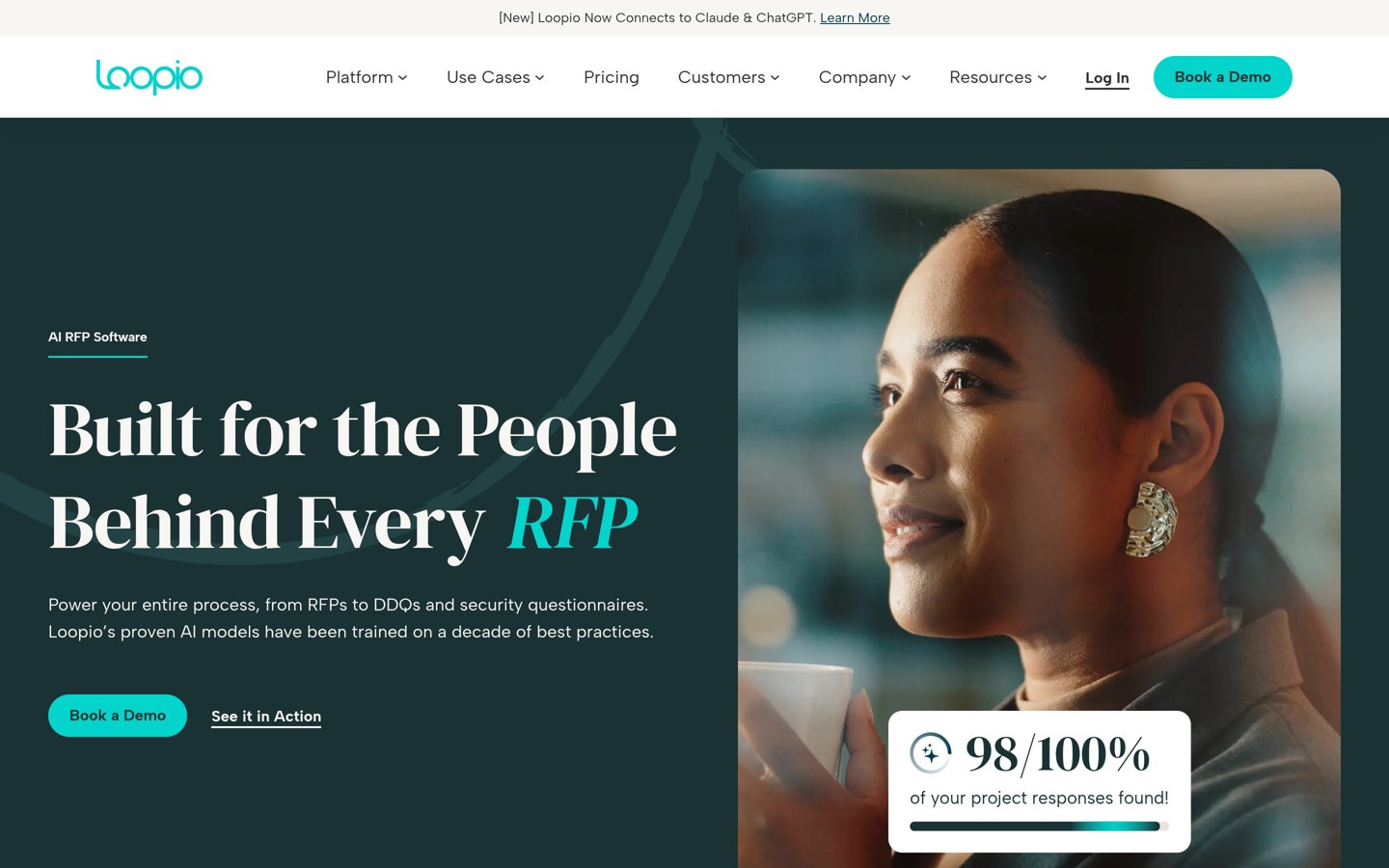
Loopio is a cloud RFP response platform that helps teams answer RFPs, RFIs, DDQs and security questionnaires from one shared content library. Its core loop is intake with automatic question detection, a searchable library of approved answers, AI-assisted drafting, SME assignments with deadlines, and analytics on content performance.
The trade off is price. Loopio publishes no prices, and third-party procurement data puts entry contracts at about $20,000 a year for the Foundations plan with 10 seats. It suits mid-market teams formalizing RFP responses for the first time that want the easiest dedicated platform to adopt.
What we like
Easiest dedicated RFP platform to adopt
Strong content library and collaboration workflows
Excellent customer support reputation
Rated 4.6 out of 5 from 813 G2 reviews
Watch out for
Quote-based pricing, reported from about $20,000 a year
AI drafts still need heavy review on complex questions
Library upkeep grows heavier as answers pile up
Foundations adds the core library and automation for 10 seatsVisit loopio.com
02
Responsive
4.5/5on G2 (1,311 reviews, checked Nov 2026)
Starts at$10,000/yr
Best for high-volume enterprise RFPs
Starting price$10,000/yr, Emerging
Content libraryYes, unlimited storage
Languages23
Free planNo
responsive.io
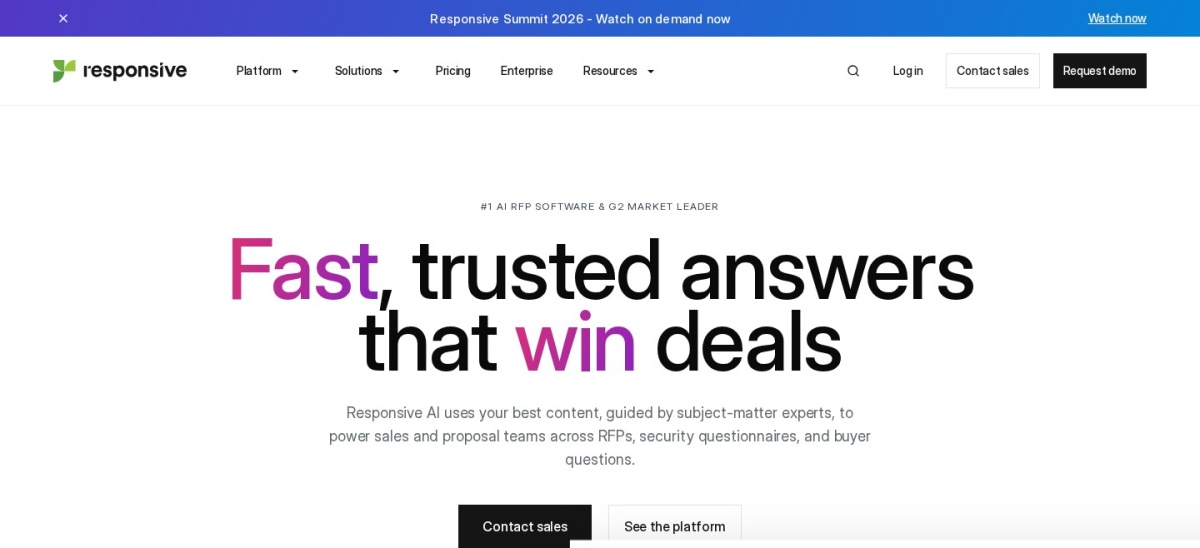
Responsive homepage, captured Nov 2026.
Responsive, formerly RFPIO, is an enterprise response management platform for RFPs, RFIs, DDQs and security questionnaires. It combines a central content library with AI that drafts first answers, extracts requirements and flags content gaps, plus approval workflows, real-time commenting and integrations with Salesforce, Slack and SharePoint.
The trade off is price and setup. The Emerging Edition starts from $10,000 a year, Growth and Enterprise are custom-quoted, and user licences are sold as add-ons, so the bill grows with the team. It suits large teams running hundreds of RFPs across regions, with 23-language support for global operations.
What we like
Enterprise leader, used by 25-plus Fortune 100 companies
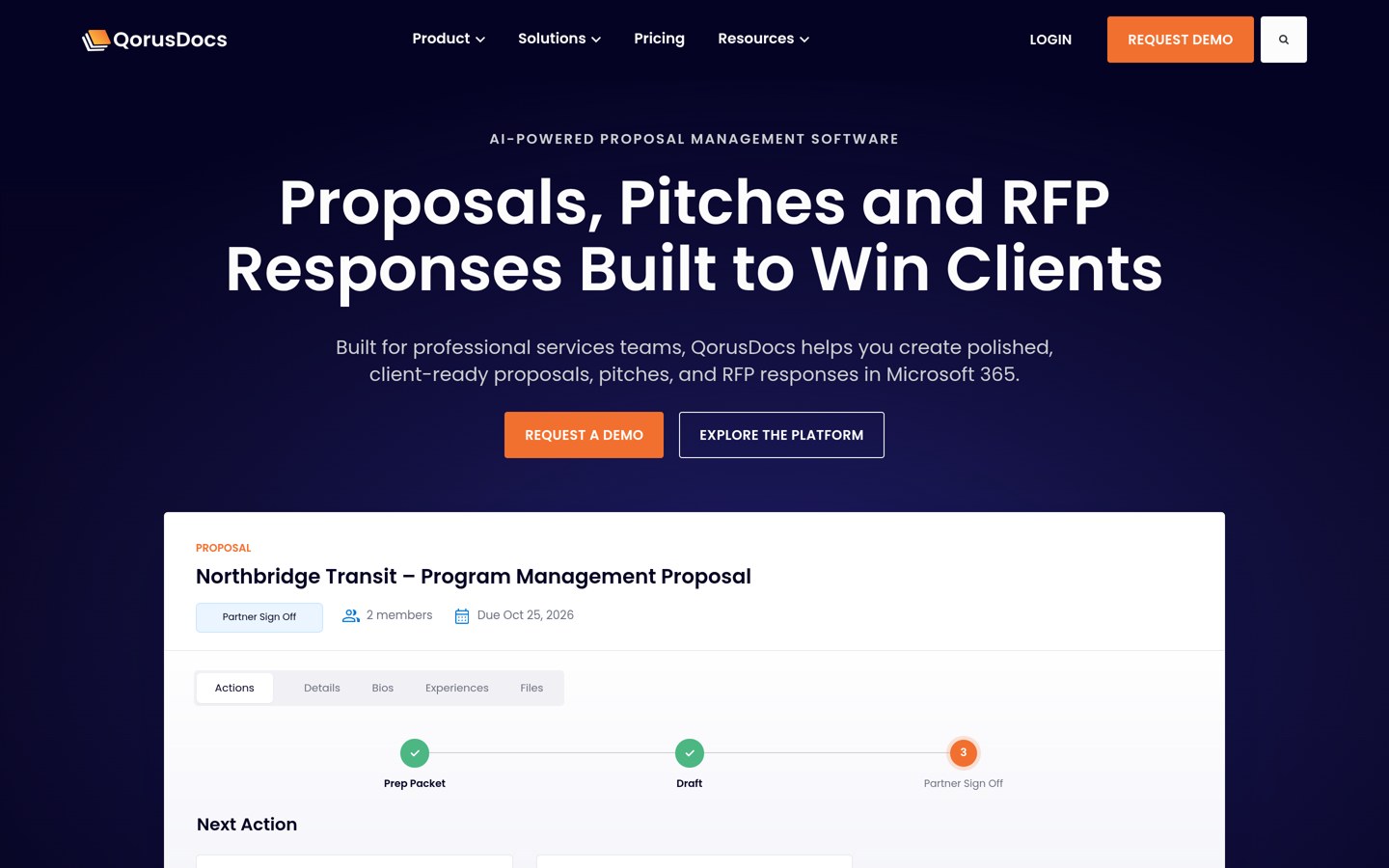
QorusDocs is an AI-powered proposal platform built for organizations that live in Microsoft 365. It brings AI-assisted drafting, content library access and template management into Word, PowerPoint and SharePoint, so proposal teams work inside the documents they already use.
The trade off is price and focus. QorusDocs publishes no prices, so every deal is a custom quote, and Google Workspace organizations get less value from its Microsoft-first design. It suits Microsoft-centric enterprises, especially in regulated industries, that want automation without changing how teams work.
What we like
Works inside Word, PowerPoint and SharePoint
AI-powered proposal automation
Strong template management
High customer support scores on G2
Watch out for
Quote-based pricing
Microsoft focus limits Google Workspace teams
Reviewers note high per-user pricing in some markets
Qvidian, part of Upland Software, is a cloud RFP and proposal automation platform built around a single managed content library. It covers RFPs, RFIs, DDQs and security questionnaires with template management, version control, permissions and real-time collaboration.
The trade off is price and age. Qvidian publishes no prices, and reviewers note the interface feels dated next to Loopio or newer AI tools. It suits large enterprises in regulated industries that need proven, governed proposal automation and already buy from Upland.
Ombud is a response management platform that pairs a content library with an AI companion, Ombuddy, to help revenue teams create, review and submit RFP responses and security questionnaires. It positions RFP response as part of the revenue workflow, with CRM updates and analytics that connect proposal activity to pipeline.
The trade off is scale and price. Ombud publishes no prices, and with only 26 G2 reviews it has far fewer public references than Loopio or Responsive. It suits large, sales-led revenue teams that want AI help across proposals, SOWs and questionnaires.
What we like
AI companion for drafting and reviewing
Built for sales-led response workflows
Highest G2 rating in this list at 4.7
Strong RevOps positioning
Watch out for
Quote-based pricing
Only 26 G2 reviews, so thin public evidence
Narrower brand recognition than Loopio or Responsive
A quote covers the revenue-team modules you chooseVisit ombud.com
06
RocketDocs
4.2/5on G2 (104 reviews, checked Nov 2026)
Starts at$18,500/yr
Best for regulated industries
Starting price$18,500/yr
CertificationsSOC 2, ISO 27001
SME usersUnlimited
Starter seats5 to 10 core users
rocketdocs.com
RocketDocs homepage, captured Nov 2026.
RocketDocs is a compliance-first proposal management platform for RFPs, RFIs, DDQs and security questionnaires. Its pricing page lists SOC 2 Type II and ISO 27001 certification, and the Starter plan covers 5 to 10 core users with unlimited subject matter experts.
The trade off is price. Plans start at $18,500 a year, and the platform chases AI features less aggressively than newer entrants. It suits mid-size and enterprise teams in regulated industries such as financial services, insurance and healthcare that need audit trails and version control.
PandaDoc is a document automation platform that covers proposals, quotes, contracts and e-signatures in one workflow. It offers more than 1,000 templates, a free eSign plan, approval workflows, CRM integrations and payment collection inside documents.
The trade off is category. PandaDoc is a proposal tool, not a dedicated RFP platform, so it lacks question shredding, SME routing and content-library governance. It suits sales teams that want polished, trackable proposals plus signatures, with Starter from $19 per user per month billed annually.
What we like
All-in-one proposals, contracts and e-signature
Huge template library with 1,000+ templates
Strong CRM integrations
Largest review base here, 3,495 G2 reviews
Watch out for
More proposal tool than RFP platform
Content library needs the $49 Business plan
Pricing not published on the site itself
Business at $49 adds the content library and CRM integrationsVisit pandadoc.com
08
Proposify
4.6/5on G2 (1,135 reviews, checked Nov 2026)
Starts at$39/user/mo
Best for design-led proposals
Starting price$39/user/mo
Free trial14 days
Interactive quotingYes
Engagement analyticsYes
proposify.com
Proposify homepage, captured Nov 2026.
Proposify is a design-led proposal platform for sales teams that care how proposals look. Its drag-and-drop editor, branded templates, interactive quoting with upsells, content library and engagement analytics show which sections buyers read and for how long.
The trade off is price and scope. Build costs $468 per user per year, or $39 per user per month billed annually, and Proposify does not shred RFPs into assignable questions. It suits agencies and consultancies whose proposals compete on brand quality and design.
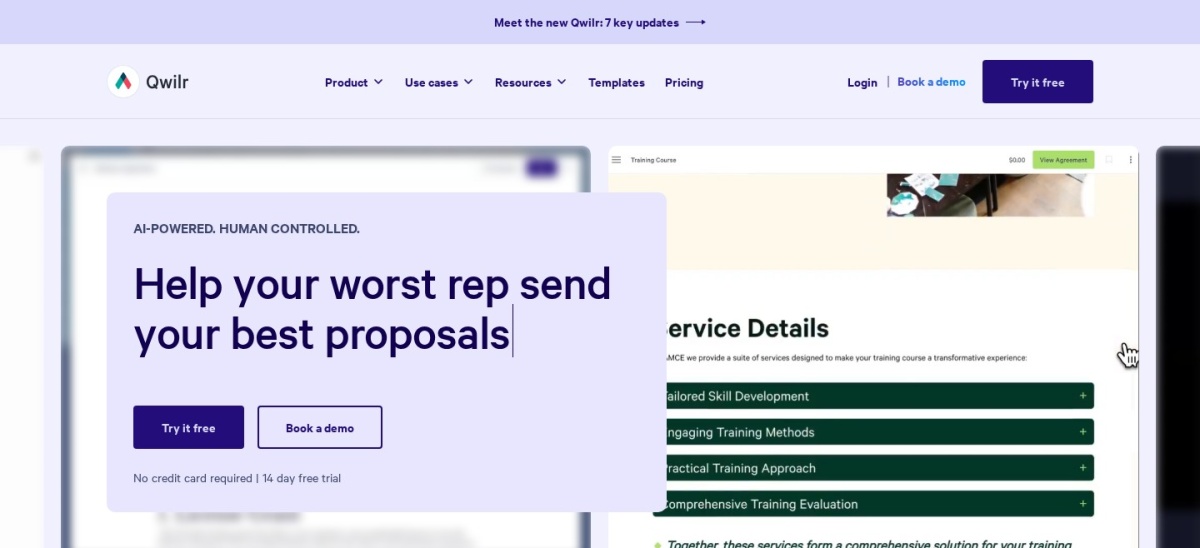
Qwilr replaces the PDF proposal with an interactive web page. Buyers get a responsive page with embedded video, interactive quotes, ROI calculators, one-click acceptance and payments, plus analytics showing who viewed what and for how long.
The trade off is fit. Starter costs $35 per user per month billed annually, and the web-page format does not suit formal RFP submissions that require specific document formats. It suits SaaS and agency sales teams whose proposals compete on experience.
What we like
Published pricing from $35 per user per month
Interactive pages instead of PDFs
Strong analytics and buyer engagement data
Buyers can accept and pay inside the proposal
Watch out for
Web-page format is not right for formal RFP submissions
Growth and Scale are annual-only
Weaker for formal RFP responses than Loopio or Responsive
RFP platforms vs proposal tools: know which problem you have
RFP platforms are built for the inbound problem: a questionnaire arrives and must be answered from approved content under a deadline.
Proposal tools are built for the outbound problem: a rep needs a beautiful, trackable proposal to send a prospect.
Stretching one category into the other is the most common disappointment in this market. PandaDoc and Qwilr handle assembly and sending well but do not manage SME workflows.
If you have both problems, you may need both tools. Start with the pain that costs more: missed RFP deadlines, or proposals that look amateur.
How we chose
We started from the dedicated RFP platforms and proposal tools most often shortlisted in G2 comparisons, then kept nine with a public G2 rating and a live product site.
Prices come from each vendor's pricing page, checked on 25 November 2026. Ratings and review counts come from G2 on the same day. Where a vendor shows no price, the list says quote-only and gives the published entry price where one exists.
We left out AI-native newcomers with too few public reviews to verify. No vendor paid for a place, and we do not claim to have used these tools ourselves.
How to choose RFP response software
Start with the volume and shape of the questionnaires you actually answer, then match the tool to that work.
Count your questionnaires and questions. If you answer a handful of RFPs a year, a proposal tool with published pricing may be enough. Dozens a year with deadlines and SMEs means a dedicated platform.
Audit your approved answers before you buy. A content library is only as good as its answers. Count how many approved answers you have and who will maintain them.
Check the SME workflow, not just the AI. AI drafts from your library, so ask how questions are assigned, chased and approved. Slow experts, not slow drafting, kill most timelines.
Get the real price in writing. Six tools here are quote-only, so ask for the full annual contract, seat types and renewal terms before you compare totals.
FAQ
What is the best RFP response software?
Loopio is the best pick for most teams. It is rated 4.6 out of 5 from 813 G2 reviews, with the easiest content library and SME workflows to adopt, plus AI-assisted drafting for repetitive questions.
How much does RFP response software cost?
Dedicated platforms are mostly quote-only, with third-party reports from about $10,000 to $150,000 a year. Responsive starts from $10,000 a year and RocketDocs from $18,500 a year, while proposal tools publish prices from $19 to $39 per user per month.
What is the difference between Loopio and Responsive?
Loopio is the usability leader for mid-market teams formalizing RFP responses, with the strongest support reputation. Responsive is the enterprise leader, used by more than 25 Fortune 100 companies, with deeper automation and 23-language support for global teams.
Do I need RFP software or proposal software?
Buy an RFP platform if questionnaires arrive inbound and must be answered from approved content under a deadline. Buy a proposal tool if the problem is sending beautiful, trackable proposals to prospects. Teams with both problems may need both.
Can AI write my RFP responses?
AI can draft first answers from your content library, and it works well for repetitive questions. It still needs human review, especially for technical or compliance-sensitive answers, because output quality depends entirely on the library behind it.
How long does RFP software take to implement?
Proposal tools can be live in days to weeks. Dedicated RFP platforms take longer: Loopio typically takes about two months, while Responsive and Qvidian can take two to four months including content library migration and workflow design.
SaaS SEO and WordPress specialist with about 8 years of experience. Rakib compares WordPress plugins, themes, hosting and software using public pricing, documentation and user reviews. See how we rank.