Salesforce Revenue Cloud is the best revenue lifecycle management software for teams already on Salesforce, covering CPQ, billing and revenue recognition from $200 per user per month. Pick Chargebee from $99 a month for a cheaper SaaS start, or DealHub, rated 4.7 out of 5, for a sales-led quote-to-revenue flow.
How we make this list: we compare pricing pages, product documentation and public user reviews, then re-check every price before each update. No product paid for a place. Disclosure.
Salesforce Revenue Cloud covers CPQ, contracts, billing and revenue recognition in one system, from $200 per user per month.
DealHub has the highest G2 rating here at 4.7 out of 5 from 865 reviews, but it publishes no price.
Chargebee is the cheapest way in, with a $0 plan plus 0.80% of volume or $99 a month plus 0.65%.
Maxio pairs billing with revenue recognition and SaaS metrics at $599 a month for up to $100,000 in monthly billings.
Zuora, Conga and BillingPlatform are quote-only enterprise tools; expect a sales process and a longer rollout.
What revenue lifecycle management covers
Revenue lifecycle management covers the whole path from quote to cash: pricing, quoting, contracts, orders, billing, collections and revenue recognition. When those steps live in separate tools, finance has to reconcile them by hand.
The tools in this list differ mainly in how much of that path they cover. Salesforce Revenue Cloud, DealHub, Conga and BillingPlatform aim to cover it all, while Stripe Billing and Recurly focus on billing and need other tools for quoting and contracts.
Price is the hardest part to compare. Four of the nine tools publish no price at all, and the ones that do charge in different units: per user, per month, or as a share of billing volume. Our guide on how to quote in WordPress covers the quoting step for smaller sellers.
Start from your billing model, not the feature list. Simple subscriptions need far less than usage-based pricing with multi-entity billing, and the enterprise tools in this list are overkill for a small subscription book.
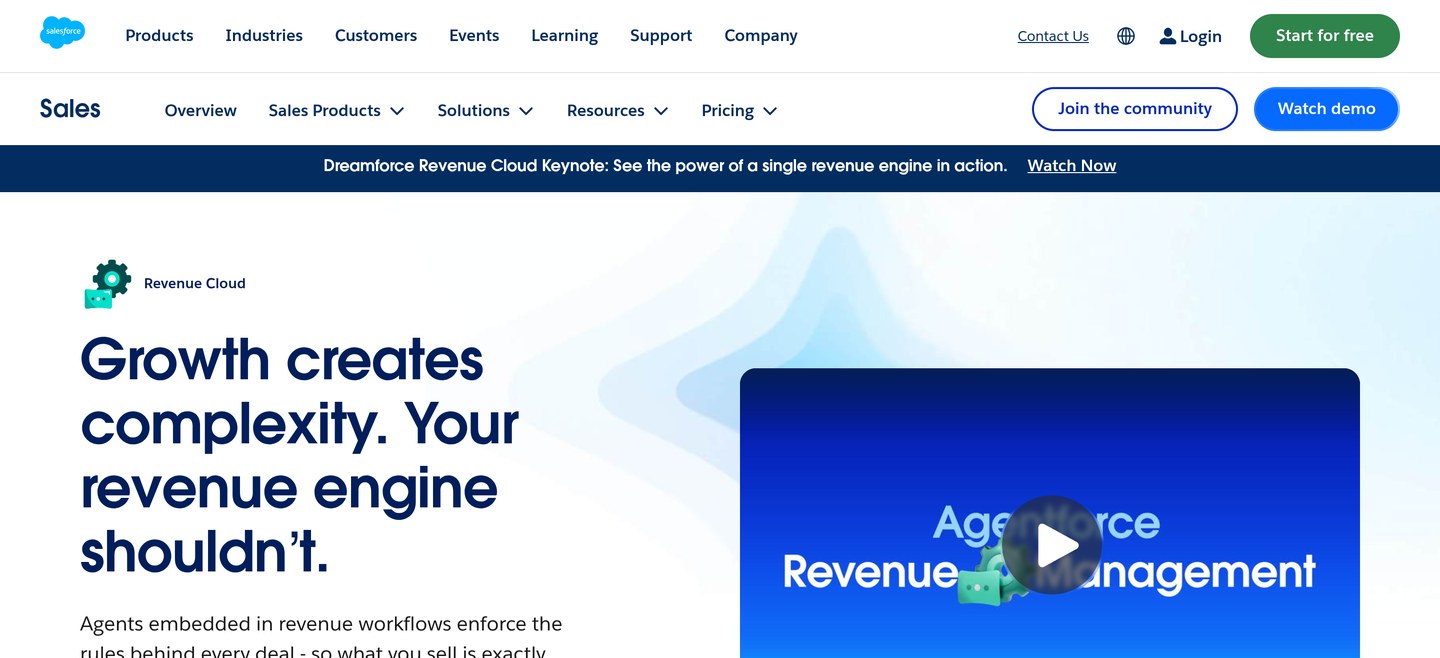
Salesforce Revenue Cloud homepage, captured Nov 2026.
Salesforce Revenue Cloud is the quote-to-cash suite for teams that already run Salesforce, covering CPQ, contracts, orders, billing and revenue recognition in one system. The Revenue Lifecycle Management edition costs $200 per user per month and adds contracts, orders, consumption billing and AI quoting on top of the $75 CPQ edition.
The trade off is cost and setup. You need a Sales Cloud licence underneath, and G2 reviewers report a median implementation of about 5 months, so small teams will find it heavy. It suits mid-market and enterprise Salesforce shops that want one revenue system instead of several point tools.
What we like
Covers CPQ, billing and revenue recognition in one system
Native to Salesforce, so CRM data stays in one place
AI quoting and consumption billing in the top edition
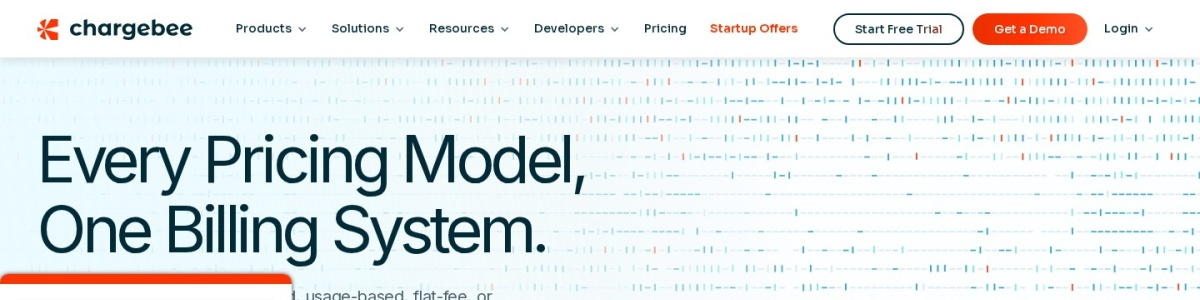
Chargebee is a subscription billing platform for SaaS and AI companies, with pricing, invoicing, dunning and a customer portal. Its Flow plan starts at $0 a month plus 0.80% of invoicing volume, or $99 a month plus 0.65%, and CPQ and revenue recognition are sold as add-ons.
The trade off is that the full lifecycle costs extra. CPQ and revenue recognition are separate paid add-ons, so the headline Flow price is not the whole bill for a team that needs both. It suits growing SaaS teams that want to start cheap and add modules as billing gets more complex.
What we like
Cheapest entry in this list, with a $0 option
40+ payment gateways
CPQ and RevRec available as add-ons
Watch out for
Full lifecycle needs paid add-ons
Percentage fees grow with volume
Support tiers vary by plan
Performance plans add advanced invoicing and chargeback toolsVisit chargebee.com
03
DealHub
4.7/5on G2 (865 reviews, checked Nov 2026)
PricingCustom/yr
Best quote-to-revenue flow for sales teams
CPQYes
Contracts (CLM)Yes
BillingYes
Published priceNo, quote only
dealhub.io
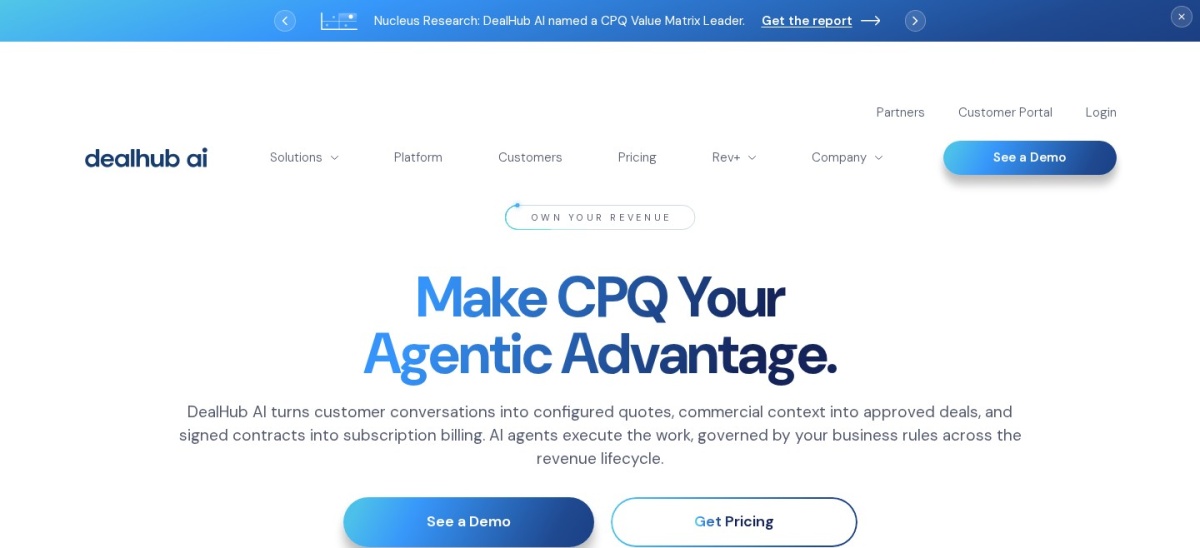
DealHub homepage, captured Nov 2026.
DealHub is a quote-to-revenue platform that joins CPQ, contract management, digital deal rooms, subscription management and billing in one flow. It holds the highest G2 rating in this list at 4.7 out of 5 from 865 reviews, with support singled out by reviewers.
The trade off is price. DealHub publishes no list price and sells by quote, with contract data from Vendr showing a median deal of about $54,500 a year, so budgeting needs a sales conversation. It suits mid-market sales-led teams that want quotes, contracts and billing to stay connected.
What we like
Highest G2 rating in this list at 4.7 out of 5
CPQ, contracts, deal rooms and billing in one flow
Best billing plus revenue recognition for SaaS finance
BillingSubscription + usage
Revenue recognitionYes, ASC 606
SaaS metricsMRR, ARR, churn
Free trial30 days
maxio.com
Maxio homepage, captured Nov 2026.
Maxio is a B2B SaaS billing and revenue platform built from the Chargify and SaaSOptics merger, pairing subscription billing with revenue recognition and SaaS metrics. The Grow plan costs $599 a month for up to $100,000 in monthly billings, and agreements are paid annually by default.
The trade off is the entry price. At $599 a month it prices out early-stage teams, and advanced revenue management and multi-entity support are add-on modules. It suits B2B SaaS finance teams that want billing, recognition and MRR reporting in one place.
What we like
Billing plus ASC 606 revenue recognition in one place
SaaS metrics like MRR and ARR built in
No per-seat charge, unlimited users
Watch out for
$599 a month prices out small teams
Advanced modules cost extra
Reviewers report a steep learning curve
Scale is quoted for billings above $100,000 a monthVisit maxio.com
05
Zuora
3.9/5on G2 (311 reviews, checked Nov 2026)
PricingCustom/yr
Best for complex enterprise subscriptions
BillingSubscription + usage
Revenue recognitionYes, ASC 606
CPQYes, Zuora CPQ
Published priceNo, quote only
zuora.com
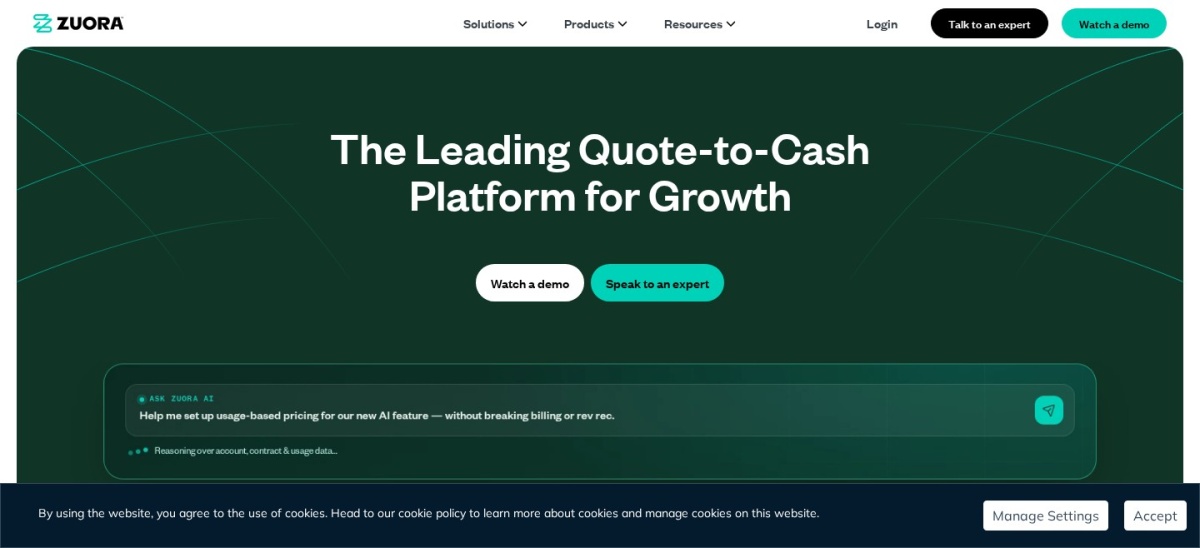
Zuora homepage, captured Nov 2026.
Zuora is the long-standing enterprise platform for subscription billing, revenue recognition and subscription analytics, in use since 2007. It handles complex multi-entity models, usage billing and contract changes that simpler tools cannot, and it is rated 3.9 out of 5 from 311 G2 reviews.
The trade off is complexity and cost. Zuora publishes no prices, reviewers describe a difficult learning curve, and rollout usually needs services help. It suits large companies whose subscription models are already complex.
What we like
Deepest handling of complex subscription models
Native revenue recognition and analytics
Long record with large enterprises
Watch out for
Lowest G2 rating in this list at 3.9 out of 5
No published price
Reviewers describe a difficult learning curve
Zuora CPQ and Zuora Revenue are separate productsVisit zuora.com
06
Conga
4.2/5on G2 (237 reviews, checked Nov 2026)
PricingCustom/yr
Best enterprise suite for pricing and contracts
CPQYes
Contracts (CLM)Yes
BillingYes
Published priceNo, quote only
conga.com
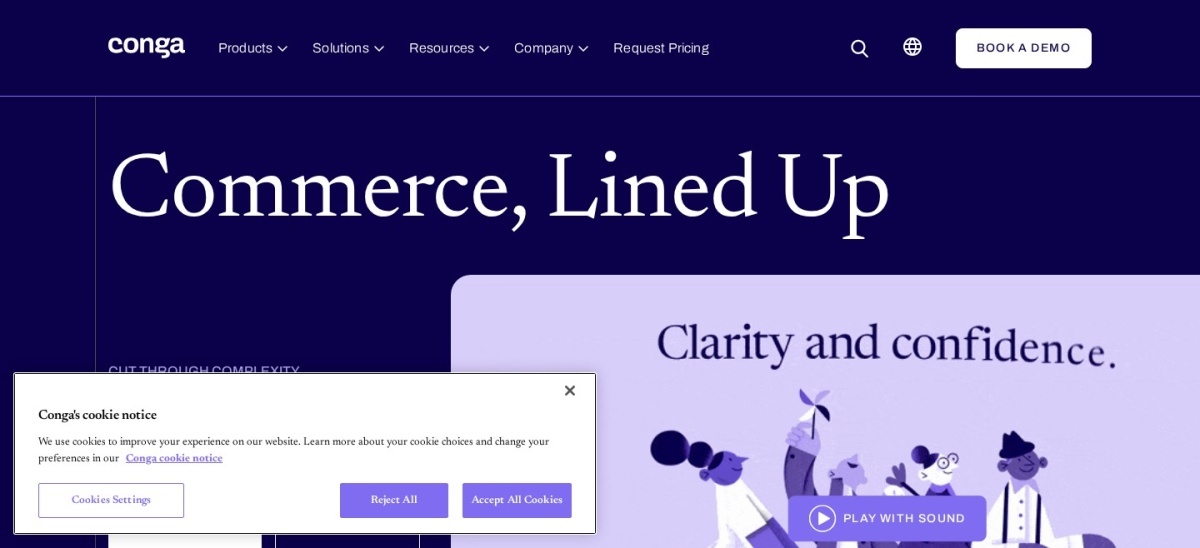
Conga homepage, captured Nov 2026.
Conga is an enterprise revenue lifecycle suite covering CPQ, contract lifecycle management, document generation and billing on the Conga Advantage platform. It is rated 4.2 out of 5 from 237 G2 reviews for its CPQ product, and ISG ranked Conga first overall in its 2026 revenue lifecycle guide.
The trade off is that pricing is entirely quote-based and the suite is modular, so the final bill depends on which products and users you add. It suits enterprises, often on Salesforce, that want pricing, contracts and billing governed in one system.
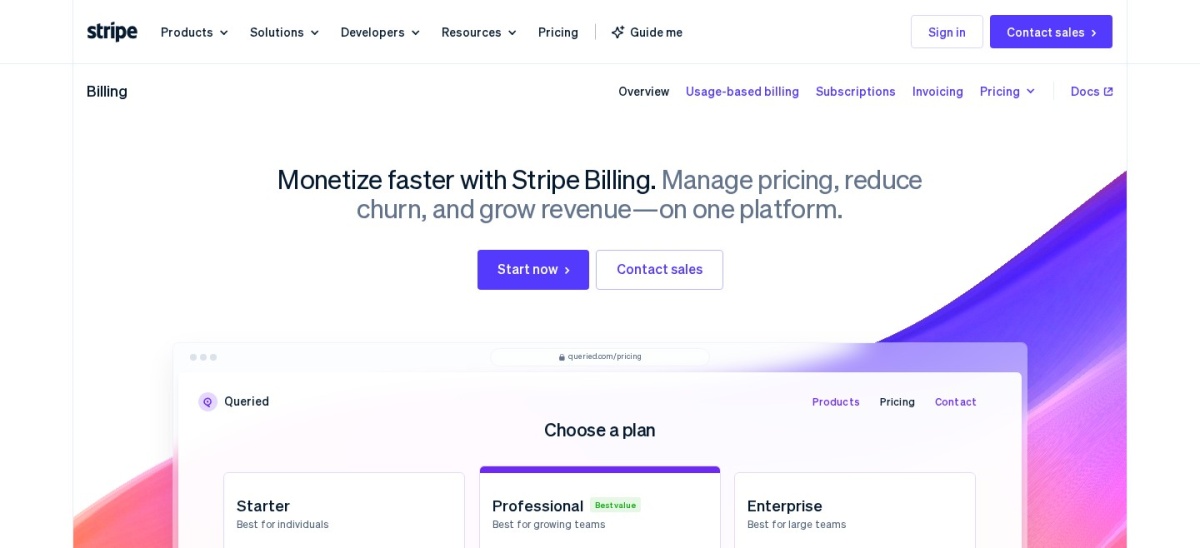
Stripe Billing is the subscription layer on top of Stripe Payments, handling recurring billing, trials, discounts, proration, invoices and a hosted customer portal. It charges 0.7% of billing volume with no monthly fee, and annual plans start at $620 a month for higher volumes.
The trade off is scope. Revenue recognition is a paid add-on, and there is no built-in CPQ or contract management, so quote-to-cash needs other tools. It suits engineering-led teams already on Stripe that want billing live fast with no platform fee.
What we like
No monthly fee on pay-as-you-go pricing
Developer-friendly API and docs
Smart Retries recover failed payments
Watch out for
Revenue recognition is a paid add-on
No built-in CPQ or contracts
Payment processing fees sit on top of the billing fee
Annual plans start at $620 a month for higher volumesVisit stripe.com
08
Recurly
4.1/5on G2 (225 reviews, checked Nov 2026)
Starts at$249/mo
Best for recovering failed payments
Starter plan$249/mo + 0.9%
Volume includedFirst $40K/mo
Free trial90 days
Revenue recognition$850/mo add-on
recurly.com
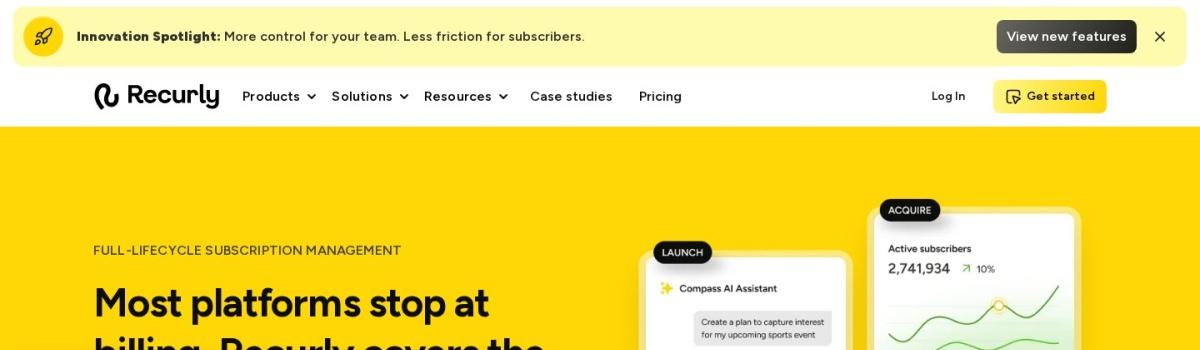
Recurly homepage, captured Nov 2026.
Recurly is a subscription billing platform focused on keeping subscribers paying, with dunning, retries, coupons and a customer portal. The Starter plan costs $249 a month plus 0.9% of billing volume above $40,000 a month, and it includes a 90-day free trial.
The trade off is the floor price and the add-ons. Revenue recognition costs $850 a month on the annual plan, and higher tiers are quoted rather than published. It suits consumer subscription businesses where failed-payment recovery matters as much as invoicing.
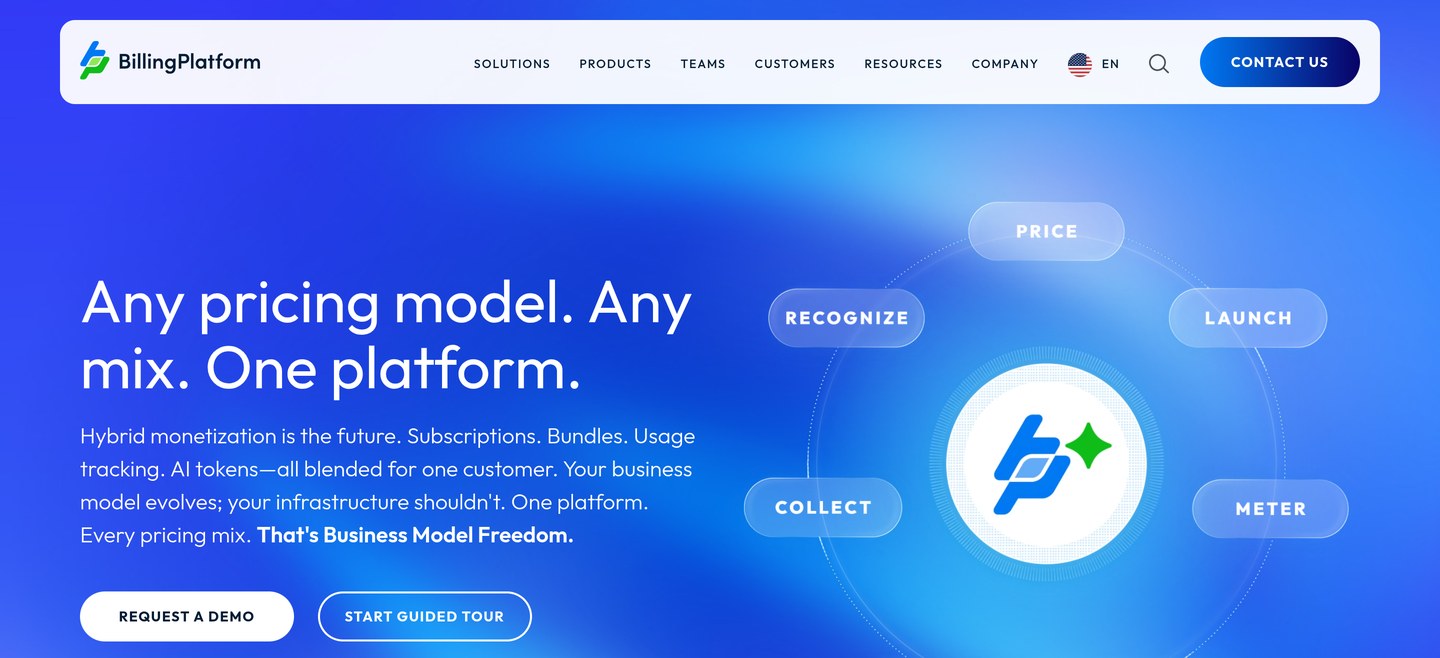
BillingPlatform is an enterprise revenue lifecycle platform for high-volume, complex billing across subscription, usage and hybrid models. It covers product catalog, order management, mediation, invoicing, revenue recognition and collections, and G2 rates it 4.3 out of 5 from 25 reviews.
The trade off is scale and setup. Pricing is quote-only, the review base is small at 25 reviews, and reviewers say setup needs technical skill and outside help. It suits large enterprises with heavy transaction volumes and formula-based pricing that off-the-shelf billing cannot handle.
What we like
Handles subscription, usage and hybrid models together
Native ASC 606 and IFRS 15 recognition
Leader in the 2026 Gartner Magic Quadrant for recurring billing
Four tools in this list publish no price: DealHub, Zuora, Conga and BillingPlatform. You will need a scoping call and a written quote before you can budget.
Ask for the quote to split out licence, implementation, integrations and support. Enterprise rollouts often cost as much in services as in the first year of licence fees.
If you need a number this week, start with the five tools that publish one. Chargebee, Stripe Billing and Recurly all list entry prices, and Maxio and Salesforce publish theirs too.
How we chose
We started from the vendors named most often in G2's revenue lifecycle and subscription billing categories and in ISG's 2026 revenue lifecycle guide, then kept the nine with a public G2 rating and a product that covers billing plus at least one more lifecycle step.
Prices come from each vendor's pricing page or from G2's vendor-supplied pricing data, checked on 25 November 2026. Ratings and review counts come from G2 on the same day. Where a vendor shows a sale, the list shows the regular price.
We left out pure contract tools with no billing, and tools with no public rating. No vendor paid for a place, and we do not claim to have used these tools ourselves.
How to choose revenue lifecycle management software
Map your quote-to-cash path first, then match the tool to the steps you actually run.
List the steps you run today. Write down how a deal moves from quote to contract to invoice to recognised revenue, and mark the steps done by hand or in spreadsheets. Those are the gaps the tool must close.
Check what your CRM already covers. Salesforce shops get the most from Salesforce Revenue Cloud, while HubSpot and other CRM teams should check each tool's native connector before shortlisting it.
Price it on your volume, not the headline. A $99 plan plus a share of volume can cost more than a $599 flat fee once billings grow. See how to sell subscriptions with WooCommerce for a small-scale billing example.
Ask for a written quote and a rollout plan. For quote-only tools, get licence, implementation and support split out in writing, and ask how long rollout takes for a company your size.
FAQ
What is revenue lifecycle management software?
It is software that manages the path from quote to cash: pricing, quoting, contracts, orders, billing, collections and revenue recognition. Instead of separate tools for each step, one platform carries the deal through, so finance does not reconcile the steps by hand.
What is the best revenue lifecycle management software?
Salesforce Revenue Cloud is the best pick for teams already on Salesforce, covering CPQ, billing and revenue recognition from $200 per user per month. Chargebee is the best cheaper start for SaaS teams, and DealHub leads on G2 rating at 4.7 out of 5.
How much does revenue lifecycle management software cost?
Entry prices in this list run from $0 plus a share of billing volume at Stripe Billing and Chargebee to $599 a month at Maxio. Four of the nine tools publish no price, and enterprise deals are quoted, so expect five-figure annual contracts for the full platforms.
Do I need CPQ as part of revenue lifecycle management?
You need it if your sales team builds custom quotes with discounts, bundles or ramped pricing. If you sell fixed-price plans from a pricing page, billing plus revenue recognition is enough, and Stripe Billing or Recurly will cover it.
What is the difference between billing software and revenue lifecycle management?
Billing software handles invoices, payments and dunning. Revenue lifecycle management adds the steps around billing: pricing, quoting, contracts, orders and revenue recognition, so the whole path from quote to cash runs in one system.
Which tool is best for a small SaaS team?
Chargebee is the best fit, with a $0 plan plus 0.80% of invoicing volume and a $99 plan for growing teams. Stripe Billing is the other cheap start at 0.7% of volume with no monthly fee, though it has no CPQ or revenue recognition built in.
SaaS SEO and WordPress specialist with about 8 years of experience. Rakib compares WordPress plugins, themes, hosting and software using public pricing, documentation and user reviews. See how we rank.