Jama Connect is the best requirements management tool for most regulated product teams, rated 4.3 out of 5 from 222 G2 reviews with the category's highest satisfaction score. Pick Modern Requirements4DevOps if you live in Azure DevOps, and ReqView if you want the cheapest dedicated tool at €440 per user a year.
How we make this list: we compare pricing pages, product documentation and public user reviews, then re-check every price before each update. No product paid for a place. Disclosure.
Jama Connect leads the dedicated tools at 4.3 out of 5 from 222 G2 reviews, with the highest satisfaction score in the category.
Modern Requirements4DevOps is the highest rated tool here at 4.7 out of 5 from 81 reviews, but it only works inside Azure DevOps.
Four of the nine tools publish no price: Jama Connect, Modern Requirements4DevOps, codebeamer and Perforce ALM all sell by quote.
The cheapest published entry is Azure DevOps at $6 per user a month after the first five users free; ReqView is the cheapest dedicated tool at €440 per user a year.
Jira Standard costs $8.48 per user a month on Atlassian's own pricing page, while G2 still lists the older $7.91 figure.
ReqView is the only dedicated tool with a free plan, limited to one document and 150 objects.
What requirements management software should cover
Every product starts as a list of things it must do. Requirements management is the discipline of writing those things down, linking them to the work that builds them, and proving nothing was missed.
Traceability is the core test. A good tool links each requirement to design items, code, tests and risks, and flags the links when a requirement changes, so a late edit does not silently break a test.
Reviews are the second test. Regulated teams approve requirements in writing, with e-signatures and baselines that freeze a version for audit. That review habit looks a lot like collaborating on a document in WordPress: one shared record beats five emailed copies.
Price is the third test. Four tools in this list publish no price at all, and the published ones range from $6 to $164 per user a month, so the shortlist should start with the standard you must meet, not the sticker price.
List prices in each vendor's currency, checked Nov 2026
JamaCustom
Modern ReqCustom
codebeamerCustom
PerforceCustom
Azure DevOpsFREE$72
JiraFREE$102
ClickUpFREE$144
ReqViewFREE€440
DOORS Next$1,968
The 9 best requirements management tools
01
Jama Connect
4.3/5on G2 (222 reviews, checked Nov 2026)
PricingCustom/quote
Best requirements management platform overall
Live TraceabilityYes, end-to-end
Review workflowsYes, with approvals
Free trialYes
Paid planQuote only
jamasoftware.com
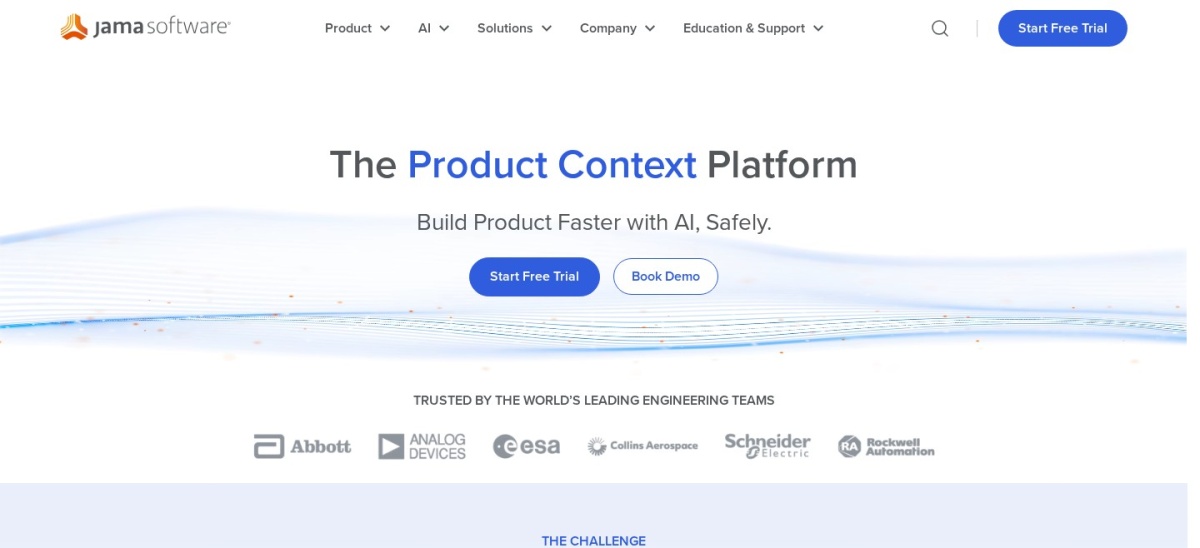
Jama Connect homepage, captured Nov 2026.
Jama Connect is a cloud requirements platform for regulated product teams in aerospace, automotive and medical devices. It keeps requirements, tests, risks and reviews in one place, with Live Traceability linking every requirement to the design, test and risk items that prove it, plus structured review and approval workflows.
The trade off is price and setup. Jama publishes no price list and sells by quote, and G2 reviewers report implementation takes about four months. It suits mid-size and enterprise teams whose audits demand full traceability, not small teams that need a quick start.
What we like
Highest satisfaction score in G2's requirements category
Live Traceability across requirements, tests and risks
Structured reviews with approval workflows
ReqIF import and export, plus Jira integration
Watch out for
No published price; every deal is a quote
Implementation takes about four months, per G2 reviewers
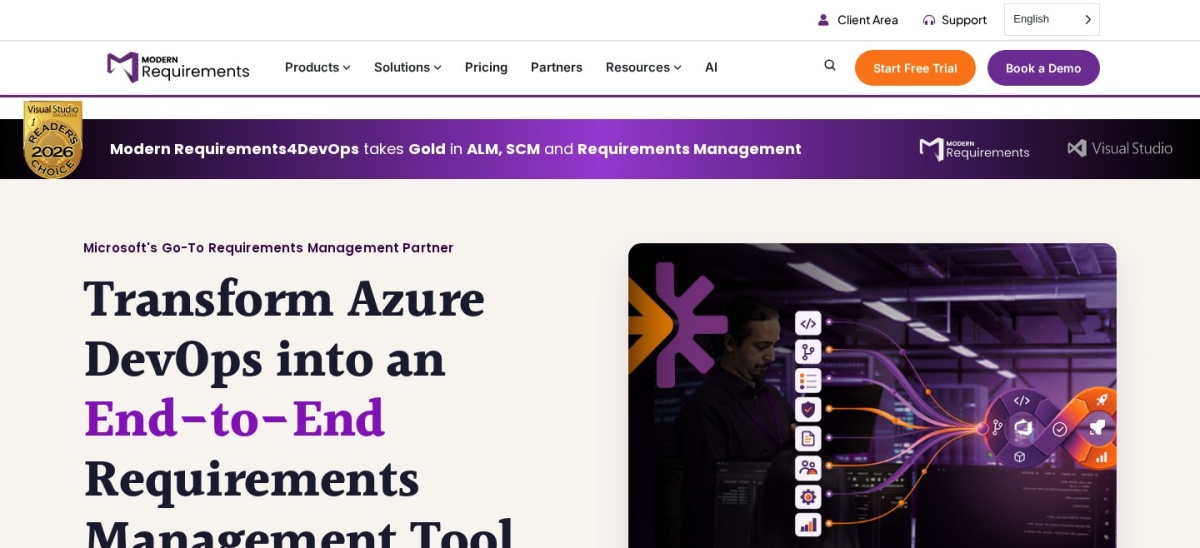
Modern Requirements4DevOps homepage, captured Nov 2026.
Modern Requirements4DevOps is an extension that turns Azure DevOps into a requirements platform. Smart Docs builds numbered specification documents from work items, and it adds traceability matrices, baselines, version control and e-signature reviews without moving data out of Azure DevOps.
The trade off is lock-in. It only works inside Azure DevOps, so Jira or GitLab teams cannot use it, and pricing is quote-only across four editions. It suits Microsoft shops that want document-based requirements without buying a second system.
What we like
Highest G2 rating in this list at 4.7 out of 5
Documents, baselines and traceability stay in Azure DevOps
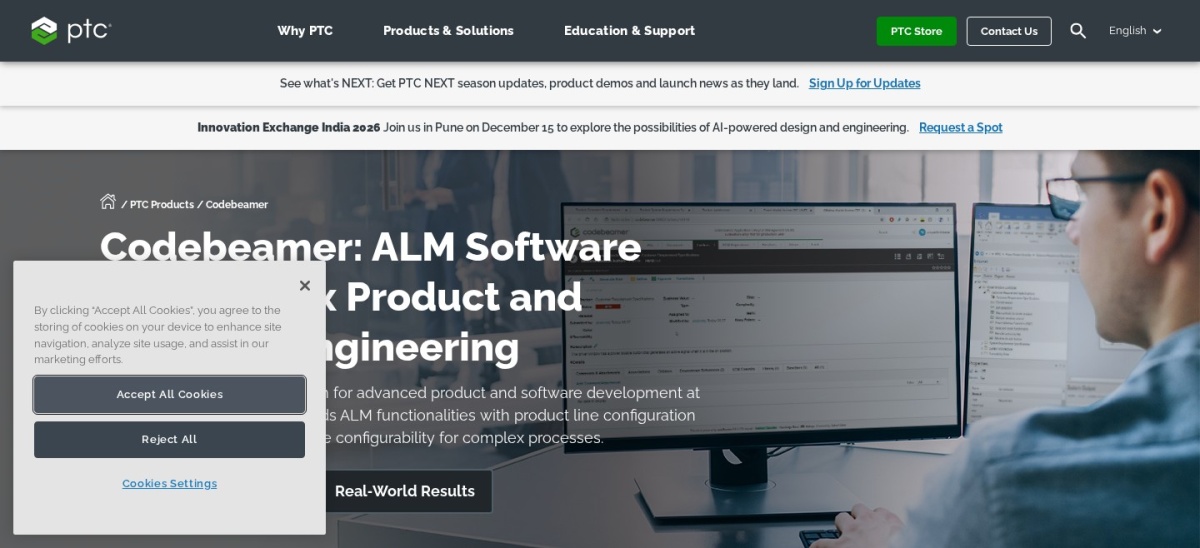
codebeamer is PTC's application lifecycle platform for complex product and software development. It covers requirements, test management, risk and release work in one system, with end-to-end traceability and templates for automotive and medical device standards.
The trade off is price opacity. PTC publishes no price list, and third-party listings disagree, citing about $1,500 per user a year in one place and $102 per user a month in another. It suits large engineering teams that need one ALM system, not buyers who want a price upfront.
What we like
Full ALM coverage, not just requirements
Strong fit for automotive and medical devices
Flexible configuration for complex processes
Rated 4.3 out of 5 from 141 G2 reviews
Watch out for
No published price; third-party figures conflict
Implementation typically takes 1 to 3 months
Support quality is mixed in G2 reviews
Higher tiers add more users, roles and integrationsVisit ptc.com
04
Perforce ALM
4.1/5on G2 (102 reviews, checked Nov 2026)
PricingCustom/quote
Best for branching and variant requirements
Requirements + test + issuesYes, one suite
Branching and variantsYes, in Helix RM
Free trial30 days
Paid planQuote only
perforce.com
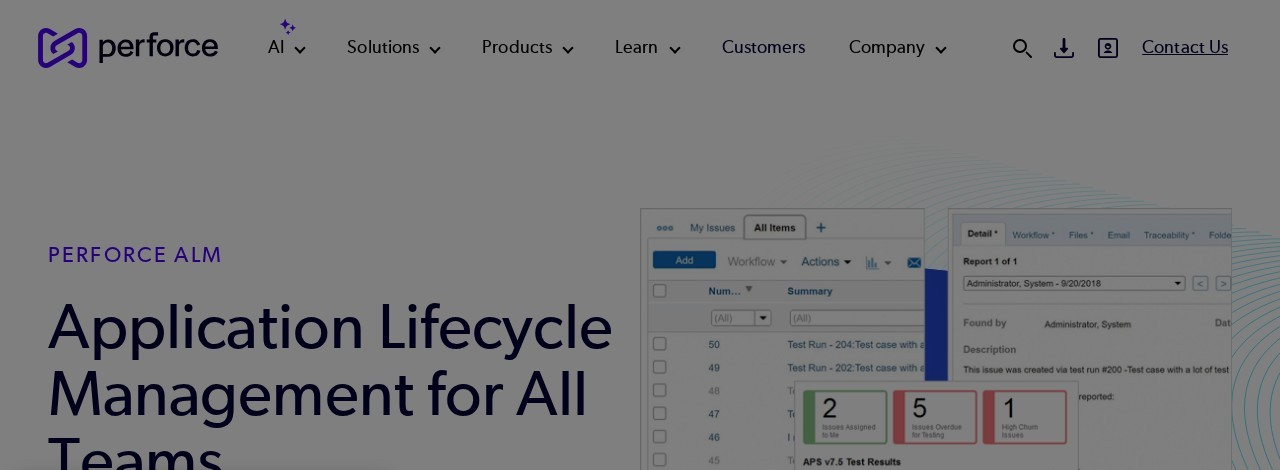
Perforce ALM homepage, captured Nov 2026.
Perforce ALM is the new name for Helix ALM, combining requirements, test case and issue management in one platform. Its Helix RM module handles branching and variant management, so one requirement can serve several product variants, and it builds traceability matrices automatically.
The trade off is price and age. Perforce sells by quote, and marketplace listings cite about $89 per user a month, while the interface still shows its desktop roots. It suits systems engineering teams that branch requirements like code and need audit-ready evidence.
What we like
Branching and merging for requirements variants
Automatic traceability matrices
ISO 26262 certified for functional safety
Jira and Jenkins integrations included
Watch out for
No published price; quote only
Interface feels dated next to cloud rivals
Only 102 G2 reviews, a thinner base than the leaders
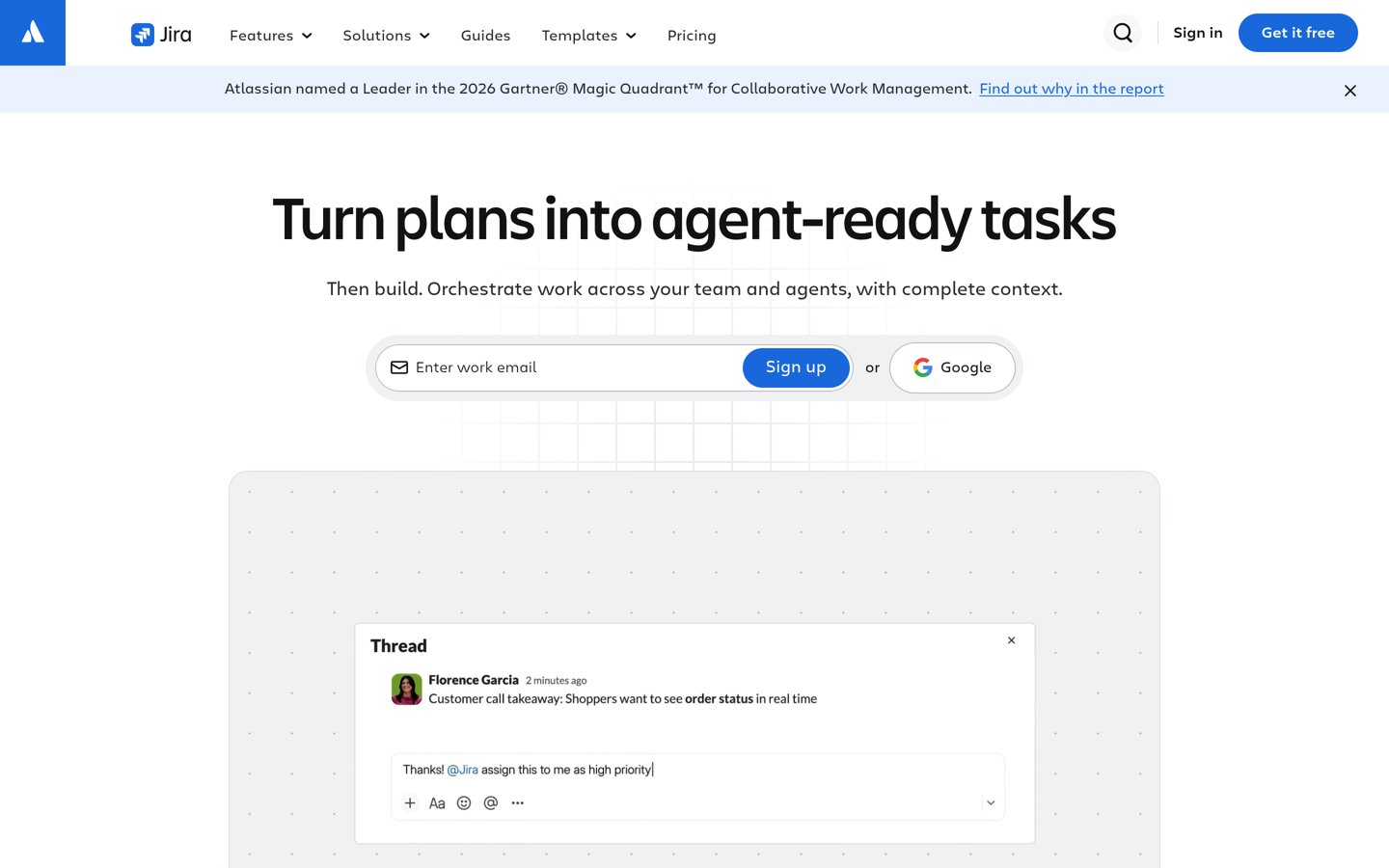
Jira is Atlassian's issue tracker that most software teams already use to run sprints. Requirements live as epics and stories with custom fields, workflows and roadmaps, and the free plan covers up to 10 users, so a small team can start without paying.
The trade off is governance. Jira has no baselines, e-signatures or traceability matrices of its own, so regulated teams add Marketplace apps such as R4J. Standard costs $8.48 per user a month on Atlassian's own pricing page. It suits agile software teams that do not need formal compliance evidence.
What we like
Rated 4.3 out of 5 from 7,938 G2 reviews
Free plan for up to 10 users
Huge Marketplace for requirements add-ons
Roadmaps, sprints and automation built in
Watch out for
No baselines or e-signatures without paid add-ons
Per-user pricing climbs fast as teams grow
Setup and admin take real effort
Premium adds AI features and cross-team planning at $15.56 per user a monthVisit atlassian.com
06
ClickUp
4.6/5on G2 (15,600 reviews, checked Nov 2026)
Paid from$12/user/mo
Best all-rounder for small teams
Free planYes, personal use
Docs with requirementsYes
Traceability matrixNo
Paid planCore, $12/user/mo
clickup.com
ClickUp homepage, captured Nov 2026.
ClickUp is a general work platform that small teams use to track requirements as docs, tasks and goals in one place. Docs hold the specification, tasks carry acceptance criteria, and dashboards show what is done, with a free plan for personal use.
The trade off is depth. ClickUp has no baselines, traceability matrices or compliance templates, so it cannot prove coverage for an audit. Core costs $12 per user a month billed yearly, the regular price after a $9 sale price. It suits small teams that want one cheap tool for everything.
What we like
Rated 4.6 out of 5 from 15,600 G2 reviews
Docs, tasks, goals and chat in one place
Free plan to start on
Low entry price for a full work platform
Watch out for
No baselines or traceability matrices
Not built for regulated compliance
Feature sprawl can overwhelm new users
Higher plans add goals, advanced automation and more storageVisit clickup.com
07
Azure DevOps
4.3/5on G2 (585 reviews, checked Nov 2026)
Paid from$6/user/mo
Best for Microsoft-based teams
Free planYes, first 5 users
Boards and work itemsYes
Test Plans$52/user/mo extra
Paid planBasic, $6/user/mo
azure.microsoft.com
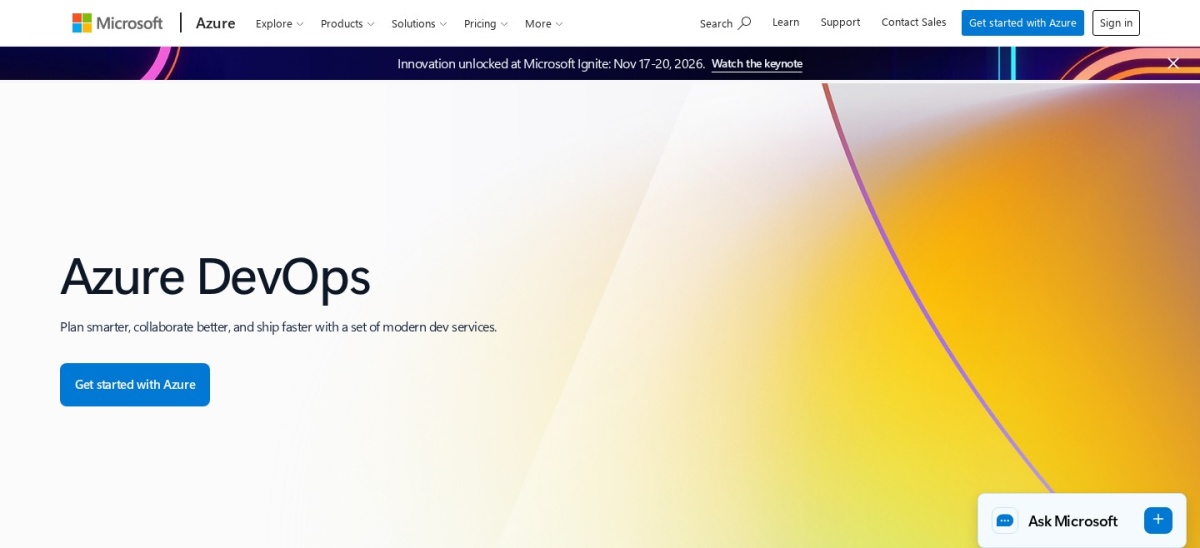
Azure DevOps homepage, captured Nov 2026.
Azure DevOps is Microsoft's suite for planning, building and shipping software, with Azure Boards at its core. Requirements become work items with states, links and queries, and the first five Basic users are free, with each extra user at $6 a month.
The trade off is formality. Boards track requirements but offer no baselines, e-signatures or compliance templates, and manual test case management needs Basic + Test Plans at $52 per user a month. It suits Microsoft shops that already live in Azure and Visual Studio.
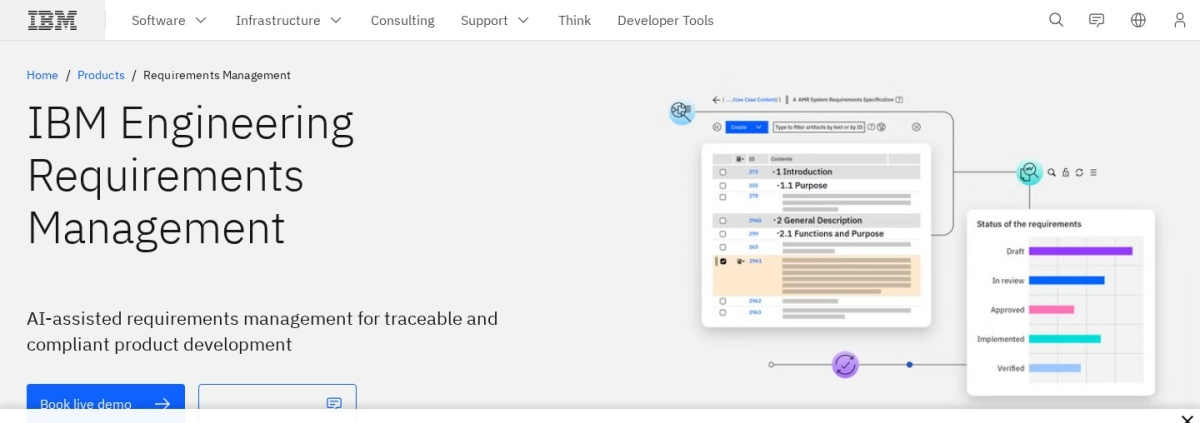
IBM DOORS Next is the long-standing enterprise tool for complex systems. It manages requirements with modules, links, baselines and suspect-link flags, and it is the default choice in aerospace, automotive and defence programmes.
The trade off is cost and weight. Professional SaaS starts at $164 per user a month, and G2 reviewers report implementation takes three to six months. It suits large enterprises with deep compliance needs and the budget to match.
What we like
Deepest track record in regulated engineering
Strong traceability and document publishing
Baselines and suspect-link flags built in
Web-based, with IBM support behind it
Watch out for
Most expensive published price in this list
Implementation takes three to six months
Lowest G2 rating in this list at 4.0 out of 5
Enterprise SaaS adds a private cloud and VPN tunnelVisit ibm.com
09
ReqView
4.6/5on GetApp (49 reviews, checked Nov 2026)
Paid from€440/user/yr
Best budget pick for small teams
Free planYes, 1 document
Stores requirements inGit or Subversion
Traceability matrixYes
Paid planPRO, €440/user/yr
reqview.com
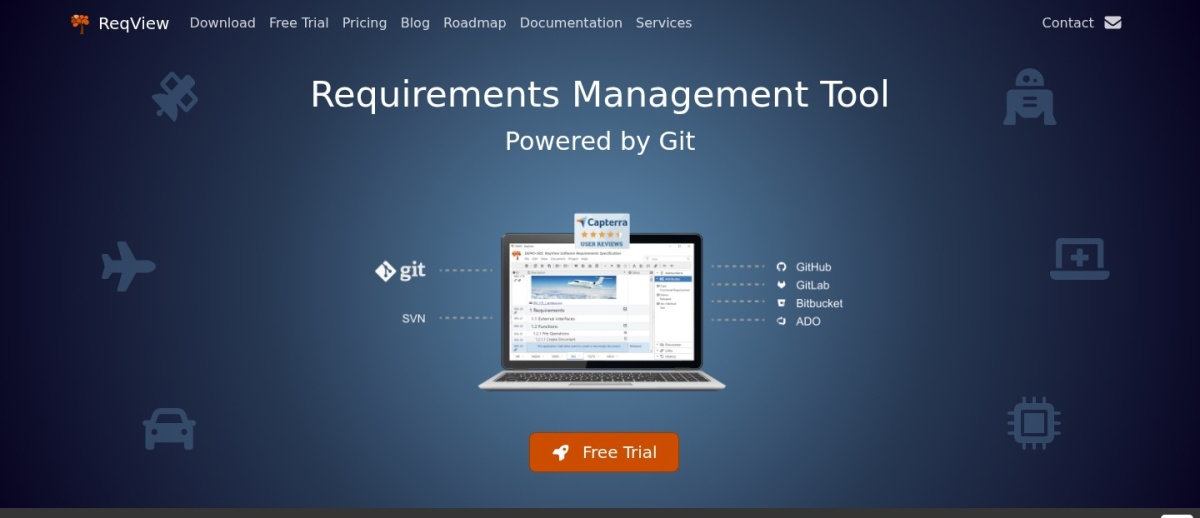
ReqView homepage, captured Nov 2026.
ReqView is a desktop requirements tool that stores requirements as readable JSON files in Git or Subversion. It covers structured documents, end-to-end traceability and Word, Excel and PDF export, with a free plan limited to one document and 150 objects.
The trade off is scale. It is a desktop app, not a cloud platform, so collaboration runs through Git rather than live editing, and the TEAM plan needed for integrations costs €600 per user a year. It suits small engineering teams that want versioned requirements without a server.
What we like
Cheapest dedicated tool in this list
Requirements live in Git beside the code
Rated 4.6 out of 5 on GetApp
Best value for money score in this list at 4.8 out of 5
Watch out for
Desktop app, not a live cloud platform
Free plan caps at 150 objects
Only 49 GetApp reviews, a thin base
TEAM adds dashboards and Jira integration at €600 per user a yearVisit reqview.com
Dedicated tools vs general trackers
Dedicated tools exist because an audit asks different questions from a sprint review. Baselines, suspect links and e-signatures prove what changed, when, and who approved it.
General trackers are cheaper and faster to adopt. Jira, ClickUp and Azure DevOps cover most software teams, and their free plans mean a team of five can start for nothing.
The line is the standard you must meet. If your product answers to ISO 26262, IEC 62304 or DO-178C, budget for a dedicated tool. If it does not, a general tracker plus a document habit is usually enough.
How we chose
We started from the products in G2's Requirements Management category with at least 10 reviews, then kept those with a published price or a clear quote-only model, plus the generalist tools teams actually use for requirements.
Prices come from each vendor's pricing page or its G2 pricing listing, checked on 26 November 2026. Ratings and review counts come from G2, except ReqView, which uses GetApp. Where a vendor shows a sale, the list shows the regular price.
We left out tools with no public rating and no published price. No vendor paid for a place, and we do not claim to have used these tools ourselves.
How to choose a requirements management tool
Start with the standard you must satisfy, then match the tool to it.
Check which standard governs your product. ISO 26262, IEC 62304, DO-178C or FDA rules decide the traceability and audit evidence you need. A general tracker will not produce it.
Count the real cost per seat. Quote-only tools hide the price, and per-user pricing climbs fast. Price the seats you will actually buy, not the cheapest line on the page.
Test the review workflow, not the demo. Approvals, e-signatures and baselines are where regulated teams live. Run one real requirement through review on the free trial before you commit.
Check the exit route. Requirements live for years. Confirm you can export to ReqIF, Word or Excel before you sign, so a later move does not strand your history.
FAQ
What is the best requirements management tool?
Jama Connect is the best pick for most regulated product teams. It leads G2's requirements category with a 4.3 out of 5 rating from 222 reviews and the highest satisfaction score, and its Live Traceability links every requirement to tests and risks. Azure DevOps teams should look at Modern Requirements4DevOps instead.
How much does requirements management software cost?
Published prices run from $6 per user a month for Azure DevOps to $164 for IBM DOORS Next, while ReqView charges €440 per user a year. Jama Connect, Modern Requirements4DevOps, codebeamer and Perforce ALM publish no prices and sell by quote, so budget for a sales call before you compare totals.
Do I need a dedicated tool, or is Jira enough?
Jira is enough when requirements are stories with acceptance criteria and no audit trail is needed. Regulated teams need baselines, e-signatures and traceability matrices, which Jira lacks without paid Marketplace apps. If an assessor will read your evidence, buy a dedicated tool.
What is requirements traceability?
Traceability is the link from each requirement to the design, code, tests and risks that satisfy it. A traceability matrix shows which requirements have test coverage and which do not, and flags suspect links when a requirement changes. Auditors in automotive, aerospace and medical devices ask for it by name.
Which requirements tool is best for a small team?
ReqView is the best fit for small engineering teams, with a free plan for one document and a PRO plan at €440 per user a year. ClickUp is the cheapest general option at $12 per user a month, but it has no traceability matrix. Azure DevOps is free for the first five users.
What is ReqIF?
ReqIF is the standard file format for exchanging requirements between tools. Teams use it to move requirements from DOORS to Jama Connect or Polarion, or to hand a specification to a supplier using a different system. Most dedicated tools in this list import and export ReqIF.
Can I try these tools before buying?
Yes. Jira, ClickUp, Azure DevOps and ReqView all have free plans, and the other five offer free trials. Run one real requirement through review on the trial before you commit, and check that export works before you sign.
SaaS SEO and WordPress specialist with about 8 years of experience. Rakib compares WordPress plugins, themes, hosting and software using public pricing, documentation and user reviews. See how we rank.