Square is the best POS and inventory management software for most small retailers: its free plan covers checkout and stock, and Plus adds purchase orders and low-stock alerts for $49 a month. Pick Lightspeed for deeper multi-location inventory and Shopify POS if you already sell online.
How we make this list: we compare pricing pages, product documentation and public user reviews, then re-check every price before each update. No product paid for a place. Disclosure.
Square starts free and its $49 Plus plan adds purchase orders, stock intake and cost-of-goods reporting.
Lightspeed Retail has the deepest stock control here, with variants and multi-location tracking from $89 a month.
Shopify POS Pro costs $89 a month per location on top of a Shopify plan, so the total bill is higher than the add-on price alone.
Clover's cheapest paid plan is $29.95 a month, but its hardware is sold separately and reseller prices vary.
Revel starts at $99 a month per terminal and needs a 3-year agreement with at least two terminals.
PayPal POS charges no monthly fee and takes 2.29% plus 9 cents in person, the lowest card rate in this list.
What POS and inventory software should cover
A POS system that also manages stock should do three jobs at once: take the payment, drop the item count by one, and warn you before you run out.
Look for low-stock alerts, purchase orders, barcode scanning and a clear cost-of-goods report. Without those, you end up counting shelves by hand at closing time.
Multi-location stock matters as soon as you add a second shop or a warehouse. Our guide on managing inventory in WooCommerce covers the same stock basics for an online store.
Card rates matter as much as the monthly fee. A free plan at 2.6% plus 15 cents can cost more than a $49 plan at 2.5% once sales pass about $49,000 a month.
The 7 best POS and inventory management software tools
01
Square
4.6/5on G2 (1,228 reviews, checked Nov 2026)
Paid from$49/mo
Best POS and inventory software overall
Free planYes, $0 per location
Cheapest paid planPlus, $49/mo per location
In-person card rate2.6% + 15 cents on Free
Purchase ordersYes, on Plus
squareup.com
Square homepage, captured Nov 2026.
Square is a POS and payments system with a free plan that covers checkout, an item library, invoicing and a basic online store for $0 a month per location. The Plus plan at $49 a month per location adds inventory management, stock intake, vendor and purchase orders, cost-of-goods reporting, loyalty and staff management.
The trade off is the card rate. Free charges 2.6% plus 15 cents per tapped card, while Plus drops that to 2.5% plus 15 cents, so the monthly fee only pays for itself at higher volumes. It suits small retailers and market sellers who want to start free and add stock tools later.
What we like
Free plan with no monthly fee per location
Plus adds purchase orders and low-stock tools for $49 a month
Rated 4.6 out of 5 from 1,228 G2 reviews
No annual billing lock-in; cancel or switch anytime
Watch out for
Full inventory tools need the paid Plus plan
Card rate stays above 2.4% even on Premium
Hardware such as Terminal and Register costs extra
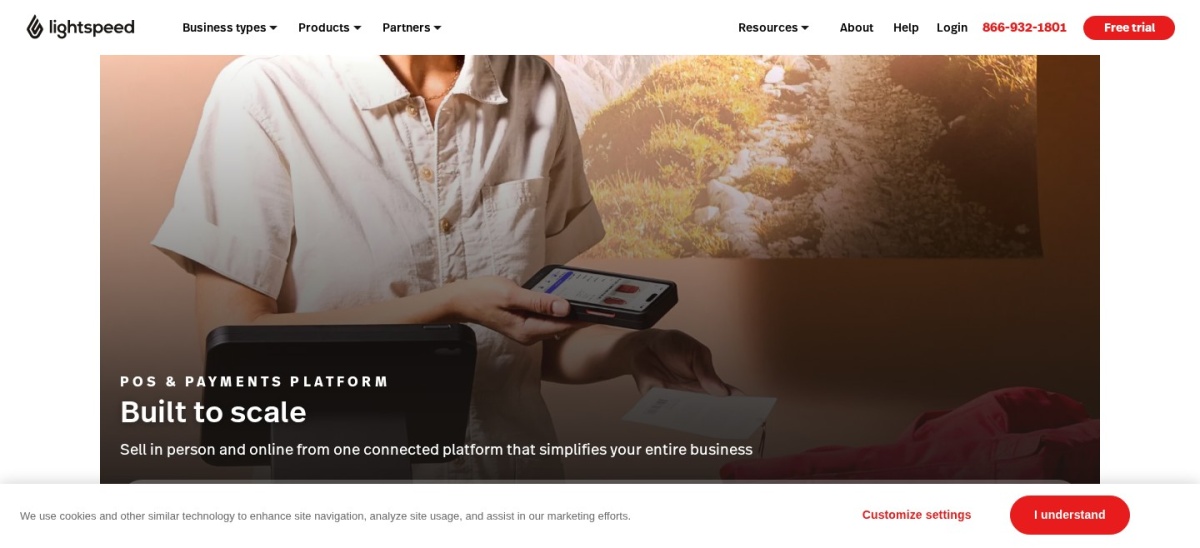
Lightspeed Retail is a retail POS built around stock control, with size and colour variants, supplier tools, landed cost tracking and multi-location inventory. The Basic plan costs $89 a month billed yearly, or $109 month to month, and includes one register, inventory management and basic ecommerce.
The trade off is price. There is no free plan, and advanced reports, loyalty and forecasting sit on Core at $149 or Plus at $289 a month. It suits boutiques and multi-store retailers whose back-office stock work takes the most hours.
What we like
Strongest variant and multi-location stock tools here
Shopify POS is the in-person side of Shopify, so online and store stock share one catalogue. POS Lite is included with every paid Shopify plan, and POS Pro at $89 a month per location adds smart inventory management, unlimited staff, returns at any location and retail reports.
The trade off is the stacked bill. Pro sits on top of a Shopify plan that starts at $29 a month billed yearly, so one location costs at least $118 a month before card fees. It suits retailers who already sell on Shopify and want one stock count everywhere.
What we like
One shared catalogue for online and in-store stock
Pro adds inventory counts and cross-location returns
Clover is a POS and payments system from Fiserv that sells hardware and software together, from the $199 Go reader to the Station Duo countertop till. The Starter software plan is $0, Essentials at $29.95 a month adds stock tracking, an item catalogue and detailed reports, and Retail Growth at $84.95 adds returns, loyalty and gift cards.
The trade off is pricing that depends on who you buy from. Clover's own online prices are a ceiling, and banks or resellers can quote different rates and contracts. It suits shops that want a dedicated countertop device and are happy to compare dealer quotes first.
What we like
Cheapest paid plan here after PayPal POS at $29.95
Wide hardware range from pocket reader to till
Essentials adds stock tracking and shift management
Revel Systems is a cloud POS for restaurant and retail chains, with inventory management, employee management, customer records and reporting in the core system. The software plan starts at $99 a month per terminal, and professional installation costs $649 as a one-time fee.
The trade off is commitment. The $99 rate needs a 3-year agreement, at least two terminals and Revel's own card processing, so a single-terminal shop pays $198 a month before it starts. It suits chains that need the same stock and reporting view across many sites.
Toast is a POS built for restaurants and food retail, running on its own Android hardware with ordering, kitchen screens and reporting. Toast Retail software starts at $90 a month, while the restaurant Point of Sale plan costs $69 a month for the first terminal, with extra terminals at $50 a month each.
The trade off is focus. Toast is strongest at food service, and deeper inventory tools come through its custom Build Your Own packages rather than the entry plan. It suits cafes and food shops that sell at a counter and need kitchen and order tools beside the till.
PayPal POS is the current name for Zettle, a free app for iOS and Android with optional card readers. There is no monthly fee, and in-person cards cost 2.29% plus 9 cents, the lowest card rate in this list, while keyed-in cards cost 3.49% plus 9 cents.
The trade off is depth. Stock tools are basic beside Square or Lightspeed, there is no offline mode, and you cannot bring another card processor. It suits market stalls, pop-ups and sellers who already take PayPal and trade only a few days a month.
Free plans cover taking payments and a simple item list. Square, Clover and PayPal POS all let you start at $0 a month and pay only card fees.
Paid plans mostly add stock depth. Purchase orders, low-stock alerts, cost reports and multi-location counts sit behind the monthly fee.
If you run out of a bestseller twice in one month, the lost sales usually cost more than a $49 or $89 plan. Count that before you pick the free tier.
How we chose
We started from the best-known retail POS systems with published pricing and a public G2 rating, then kept those that combine checkout with stock control.
Prices come from each vendor's pricing page or G2 pricing data, checked on 26 November 2026. Ratings and review counts come from G2 on the same day. Where a vendor shows a sale or a switch offer, the list shows the regular price.
We left out systems with no published starting price and no public rating. No vendor paid for a place, and we do not claim to have used these tools ourselves.
How to choose POS and inventory management software
Start with how you sell today, then match the stock tools to that shape.
Count your locations and registers. Per-location fees such as Shopify Pro at $89 and Revel at $99 multiply fast, while Square and Clover charge per location too.
List the stock jobs you do weekly. If you reorder from suppliers, you need purchase orders; if you only need counts, a free plan may be enough.
Work out the card-rate break-even. A lower rate on a paid plan only wins above a certain monthly volume, so compare the fee plus the rate, not the fee alone.
Check the hardware and contract first. Toast and Clover lock you to their hardware, and Revel needs a 3-year term, so read those terms before you buy devices.
FAQ
What is the best POS and inventory management software?
Square is the best pick for most small retailers. Its free plan covers checkout and stock, Plus adds purchase orders for $49 a month, and it is rated 4.6 out of 5 from 1,228 G2 reviews.
Which POS system has the best inventory management?
Lightspeed Retail has the deepest stock tools in this list, with size and colour variants, supplier tools and multi-location tracking. Square Plus and Shopify POS Pro are strong cheaper options for single shops.
Is there a free POS system with inventory management?
Yes. Square, Clover and PayPal POS all offer a free plan with basic stock tools. Full features such as purchase orders and low-stock alerts usually need a paid plan.
How much does POS software cost per month?
Entry prices here run from $0 on PayPal POS and Square Free to $29.95 on Clover, $49 on Square Plus, $89 on Lightspeed and Shopify Pro, $90 on Toast Retail and $99 on Revel.
Does Shopify POS include inventory management?
Yes, with limits. POS Lite includes basic stock with every paid Shopify plan, and POS Pro at $89 a month per location adds smart inventory management, stock counts and retail reports.
Can I use a POS system without a monthly fee?
Yes. PayPal POS charges no monthly fee and takes 2.29% plus 9 cents per in-person sale. Square Free and Clover Starter are also $0 a month, with card fees on every sale.
What is the cheapest POS for a small shop?
PayPal POS is cheapest if you sell a few days a month, since it has no monthly fee. For daily trading, Clover Essentials at $29.95 a month or Square Plus at $49 are the cheapest paid plans with real stock tools.
SaaS SEO and WordPress specialist with about 8 years of experience. Rakib compares WordPress plugins, themes, hosting and software using public pricing, documentation and user reviews. See how we rank.