WLWPLegible EditorsLast verified 23 Nov 2026How we rank10 min read
★ Short answer
Uscreen is the best OTT platform for most creators, with memberships, live streaming and community from $49 a month and a 4.7/5 G2 rating. Pick Dacast for low-cost live and VOD delivery at $39 a month, or Muvi for full white-label TV apps at a published price.
How we make this list: we compare pricing pages, product documentation and public user reviews, then re-check every price before each update. No product paid for a place. Disclosure.
Uscreen leads with a 4.7/5 G2 rating and the most complete membership stack, from $49 a month.
Dacast is the cheapest published entry point at $39 a month, billed annually, with 2.4 TB of bandwidth a year.
Muvi is the only platform here with TV apps at a published price: Professional costs $1,499 a month.
Zype streaming starts at $500 a month, but its app plans start at $2,000 a month on annual terms.
Brightcove and JW Player publish no prices, so budget for a sales quote before you shortlist them.
What to check before you pick an OTT platform
An OTT platform turns a video library into a branded streaming service, with its own website and apps, subscriptions and payments. The buyer is not choosing a video host. They are choosing the storefront, the billing and the apps their audience opens every day.
Start with devices. A web-only plan is fine for a small course or channel, but Roku, Fire TV, Apple TV and Samsung TV apps usually sit on a higher plan or a custom quote. Check which screens the plan you can afford actually covers.
Then check the fee model. Some platforms charge a flat monthly price, some add a fee per subscriber, and some take a cut of one-time sales. A $49 plan with a $1.99 fee per subscriber costs far more than $49 once the audience grows.
Monetization matters too. Most platforms in this list support subscriptions, rentals and ads, but the paywall, the ad tools and DRM often sit on higher tiers. Our guide on creating a membership site in WordPress shows how the billing side works when you run the membership yourself.
Uscreen is a video membership platform that turns a video library into a paid membership business. The $49 a month Starter plan covers a branded website, video catalog, native live streaming and marketing automations for up to 100 subscribers, with a 10% fee on one-time sales.
The trade off is cost at scale. Growth costs $149 a month billed annually plus $1.99 per subscriber, and mobile apps need App Essentials at $449 a month, while TV apps need the custom-priced Custom plan. It suits creators and coaches who sell subscriptions and want community and video in one place.
What we like
Highest G2 rating in this list at 4.7/5
Membership, community, live and payments in one dashboard
Starter has no per-subscriber fee for the first 100 members
Watch out for
Per-subscriber fees add up fast on Growth and above
Muvi is a white-label OTT platform that launches a branded streaming service across web, mobile and TV. The $399 a month Standard plan covers one website or app, unlimited content and subscribers, a built-in CDN and monetization through subscriptions, rentals and ads.
The trade off is the jump to TV. TV apps, DRM and the Alie recommendation engine start with Professional at $1,499 a month, and storage and bandwidth above the included units cost extra. It suits media businesses that want full device coverage at a published price.
What we like
Most complete public price list in the category
Unlimited content, subscribers and views on Standard
TV apps included on Professional with no revenue share stated
Watch out for
TV apps cost nearly four times the entry plan
Extra apps cost $299 to $499 a month each
Usage fees apply above included bandwidth and storage
Professional adds TV apps, DRM and recommendationsVisit muvi.com
03
Dacast
4.3/5on G2 (30 reviews, checked Nov 2026)
Starts at$39/mo
Best value for live and VOD delivery
Starting price$39/mo, billed annually
Bandwidth2.4 TB per year
Storage500 GB
Free trial14 days
dacast.com
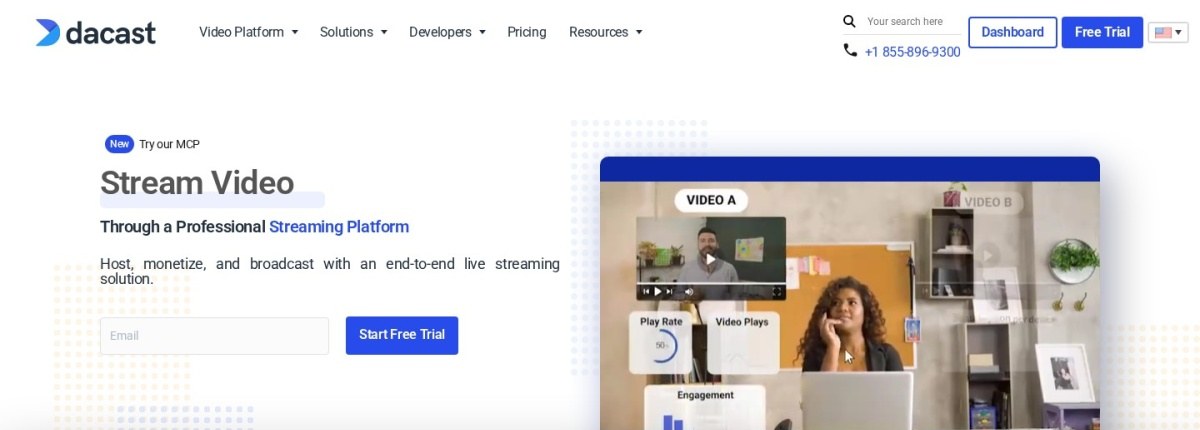
Dacast homepage, captured Nov 2026.
Dacast is a live streaming and video hosting platform for broadcast teams and event producers. The $39 a month Starter plan, billed annually, includes 2.4 TB of bandwidth a year, 500 GB of storage, live streaming, video hosting and 24/7 support.
The trade off is the paywall. Monetization through subscriptions and pay-per-view starts with the Event plan at $63 a month, and multi-CDN and China delivery are paid add-ons. It suits teams that need dependable live and on-demand delivery without per-subscriber fees.
What we like
Cheapest published entry price in this list
No per-subscriber or per-viewer fees
24/7 support on every plan
Watch out for
No paywall on the Starter plan
Reviewers report billing and auto-renewal friction
Zype is a video platform for managing a library, programming linear and FAST channels, and distributing to apps and destinations. Streaming plans start at $500 a month, and the platform covers VOD, live and playout with SVOD, TVOD and ad-supported monetization.
The trade off is price and setup. App plans start at $2,000 a month on annual terms, and reviewers report an average setup time of about three months. It suits broadcasters and publishers that need playout and distribution in one system.
What we like
Full playout and FAST channel tools built in
API-first, with SDKs and webhooks for automation
Support is praised in most reviews
Watch out for
App plans are priced for larger operations
Setup takes longer than simpler platforms
Some newer features arrive with bugs, per reviewers
App plans add branded apps on web, mobile and TVVisit zype.com
05
Castr
4.8/5on G2 (243 reviews, checked Nov 2026)
Starts at$16.67/mo
Best for multistreaming to OTT and social
Starting priceStarter, $16.67/mo billed annually
Free trial7-day trial, no free plan
Multistream30+ platforms at once
OTT appsWhite-label OTT apps, no coding
castr.com
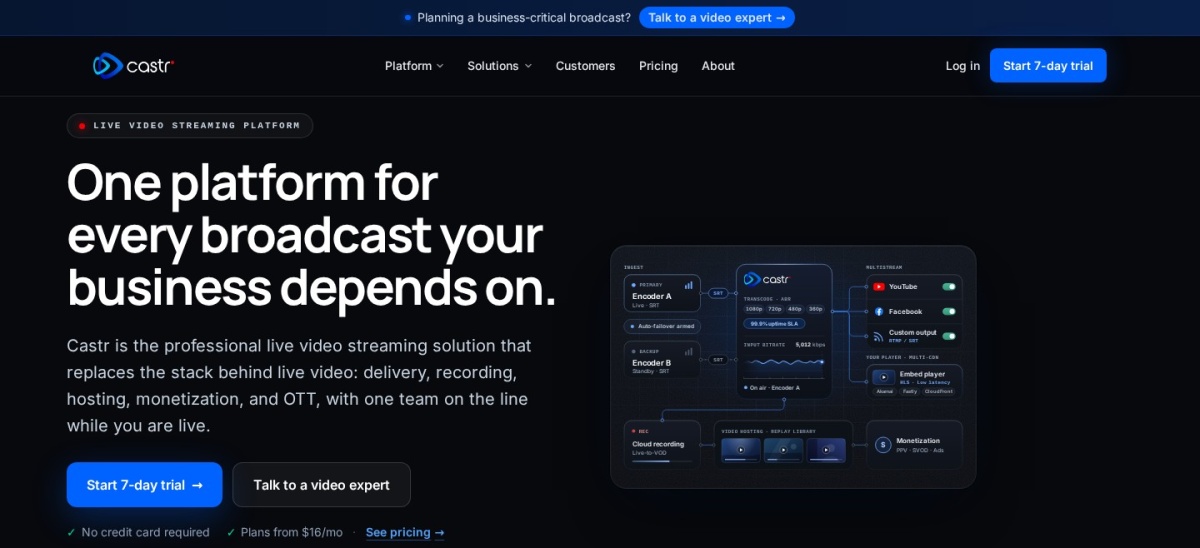
Castr homepage, captured Nov 2026.
Castr is a live streaming platform that sends one feed to more than 30 platforms at once, including YouTube, Facebook and custom OTT destinations, with a white-label OTT app builder that needs no coding. Starter costs $16.67 a month billed annually, and it holds 4.8 out of 5 on G2 from 243 reviews.
The trade off is that Castr is a streaming pipe, not a membership business: there is no built-in paywall or subscriber management like Uscreen, and OTT apps sit on the higher tiers. It suits creators who want one live feed everywhere plus their own app.
What we like
One feed to 30+ platforms at once
White-label OTT apps with no coding
4.8/5 on G2 from 243 reviews
Watch out for
No built-in memberships or paywall
OTT apps need higher tiers
No free plan, 7-day trial only
Starter $16.67/mo billed annually; $19.99 month to monthVisit castr.com
06
Wowza
4.4/5on G2 (151 reviews, checked Nov 2026)
Starts at$195/mo
Best for self-hosted streaming infrastructure
Starting price$195/mo, Streaming Engine
DeploymentSelf-hosted or cloud
ProtocolsRTMP, SRT, WebRTC, HLS
Free trialYes
wowza.com
Wowza homepage, captured Nov 2026.
Wowza is streaming infrastructure for teams that want to run the stack themselves. Wowza Streaming Engine starts at $195 a month per instance and ingests RTMP, SRT and WebRTC, then delivers HLS and MPEG-DASH to any device.
The trade off is effort. The engine needs technical setup and maintenance, and there is no built-in paywall or membership system. It suits developers and broadcast engineers who want protocol-level control over live and on-demand delivery.
Brightcove is an enterprise video platform used by major broadcasters, sports leagues and large FAST operators. It covers video hosting, live streaming, monetization and analytics, with studio-grade DRM and global multi-CDN delivery.
The trade off is price and fit. Brightcove publishes no prices, and reviewers describe pricing as steep for smaller organizations. It suits large media teams that need scale, security and broadcast-grade delivery.
JW Player, now JWP, is a video technology platform for hosting, streaming and monetizing video. It is known for a fast HTML5 player, a video CMS and analytics that track plays, completion rates and viewing by country.
The trade off is pricing clarity. JWP does not publish prices, and reviewers report package-based billing with overage charges for storage and streams. It suits publishers that want a proven player and hosting in one platform.
SVOD, TVOD and AVOD: which model fits your audience
SVOD means subscriptions: viewers pay monthly for unlimited access. It fits libraries with regular new content, such as courses, fitness or series.
TVOD means rentals and purchases: viewers pay per title. It fits films, events and one-off content where a monthly fee would not make sense.
AVOD means ads: viewers watch free and advertisers pay. It fits large free audiences and FAST channels, but it needs real volume before the revenue matters.
Most platforms in this list support all three, so the choice is about your audience, not the vendor. Start with the model your viewers already pay for elsewhere.
How we chose
We started from the OTT platforms that appear most often in 2026 comparison guides, then kept the eight with a public G2 rating and a clear product for launching a streaming service.
Prices come from each vendor's pricing page or vendor-supplied G2 pricing, checked on 23 November 2026. Ratings and review counts come from G2 on the same day. Where a vendor shows a sale, the list shows the regular price.
We left out platforms with no public rating and no published pricing details. No vendor paid for a place, and this list is based on pricing, docs and reviews, not on using the tools ourselves.
How to choose an OTT platform
Start with the devices your audience watches on, then match the plan to that list.
List the screens you must reach. Web only is cheap. Roku, Fire TV, Apple TV and Samsung TV apps usually need a higher plan, so price the plan that covers your screens, not the entry plan.
Model the real monthly cost. Add per-subscriber fees and sale fees to the base price at your current audience size, then again at twice that size. Flat pricing wins once you grow.
Check the monetization you need. If you sell subscriptions, confirm the billing and dunning tools. If you sell rentals, confirm the paywall sits on your plan and not two tiers up.
Use the trial to check the apps. Upload real content, check playback on a phone and a TV, and confirm the analytics show what you need before you move your library.
FAQ
What is the best OTT platform?
Uscreen is the best OTT platform for most creators, with memberships, live streaming and community from $49 a month and a 4.7/5 G2 rating. Muvi is the stronger pick for full white-label TV apps, and Dacast is the cheapest way to run live and on-demand video.
How much does an OTT platform cost?
Entry prices in this list run from $16.67 a month for Castr to $500 a month for Zype streaming, with Dacast at $39, Uscreen at $49 and Muvi at $399. TV apps usually cost more, and Brightcove and JW Player quote prices per contract.
What is the cheapest OTT platform?
Dacast is the cheapest published option here at $39 a month billed annually, with 2.4 TB of bandwidth a year and no per-subscriber fees. Uscreen Starter at $49 a month is close, but it caps at 100 subscribers and charges 10% on one-time sales.
Do OTT platforms take a cut of revenue?
Some do. Uscreen takes 10% of one-time sales on Starter and 5% on higher plans, and Vimeo OTT charges $1 per subscriber. Muvi, Dacast and Zype charge flat monthly prices with no revenue share stated on their pricing pages.
Can I launch an OTT platform without coding?
Yes. Uscreen, Muvi, Dacast and Zype all offer no-code setup with templates and visual builders. Wowza is the exception: its Streaming Engine is built for developers and needs technical setup.
Which OTT platform is best for live streaming?
Dacast is the best value for live events, with live streaming, recording and simulcast from $39 a month. Castr is the cheapest route to multistreaming at $16.67 a month, while Brightcove suits large live events at enterprise scale.