EMnify is the best IoT connectivity platform for most teams, rated 4.9 out of 5 on G2 from 93 reviews, with multi-carrier SIMs and a free 60-day trial. Pick 1NCE for the cheapest flat rate at $14 for 10 years, and Hologram if you want transparent self-serve pricing.
How we make this list: we compare pricing pages, product documentation and public user reviews, then re-check every price before each update. No product paid for a place. Disclosure.
EMnify has the highest G2 rating in this list: 4.9 out of 5 from 93 reviews.
1NCE charges $14 once per SIM for 10 years, 500 MB and 250 SMS, with no monthly fee.
Hologram is the only self-serve option with a flat published rate: $0.03 per MB plus $1 per SIM a month.
Soracom publishes its fees, but plan names and data rates change by region, so read the schedule for your countries.
Five of the nine platforms publish no prices at all, so most enterprise fleets still need a quote.
Particle is the only pick with a free plan that covers 100 devices.
What an IoT connectivity platform should cover
An IoT connectivity platform connects devices to the internet over cellular networks and manages the SIMs behind them. It handles activation, data usage, billing and troubleshooting from one dashboard instead of one carrier contract per country.
Most platforms sell multi-carrier SIMs or eSIMs that can switch networks over the air. That matters when devices cross borders or when one carrier has poor signal where the device sits.
Pricing is the hardest part to compare. Some charge per megabyte, some per SIM per month, and some sell a flat rate for years. If your devices send data to WordPress, our guide on creating a custom REST API endpoint shows how to receive it.
Coverage, security and support decide most purchases. Check which countries and networks each plan covers, whether the platform offers private networking, and what support hours the base price includes.
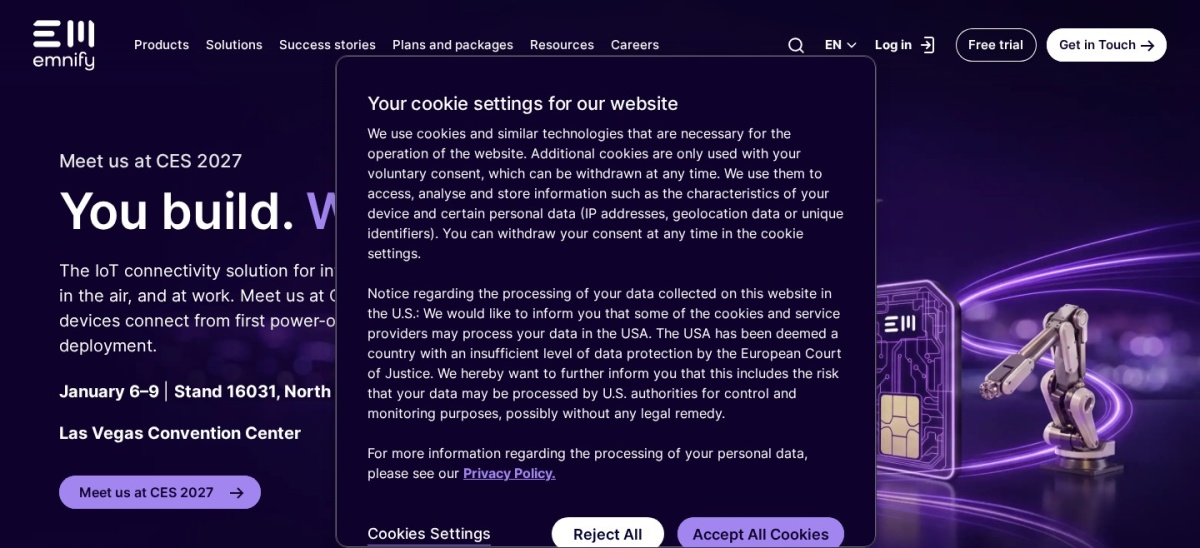
EMnify is a cloud-based IoT connectivity platform built around its multi-carrier SuperNetwork SIM and eSIM. One SIM connects across networks in many countries, and the portal and API manage activation, data usage and billing. New users get a free test kit with three SIM cards and a 60-day trial of the platform.
The trade off is price. EMnify publishes no rates, so the cost of a deployment only comes from a sales quote, which makes early budgeting hard. It suits teams that run fleets on AWS and want private network integration and multi-carrier coverage from one provider.
What we like
Highest G2 rating in this list at 4.9 from 93 reviews
Free test kit with 3 SIMs and a 60-day trial
Multi-carrier SIM and eSIM with cloud portal and API
Watch out for
No published rates; pricing is quote-only
Support tiers differ by package; 24/7 support costs more
Paid packages add support tiers and platform featuresVisit emnify.com
02
Aeris
4.9/5on G2 (10 reviews, checked Nov 2026)
PricingCustom/yr
Best for security-led IoT fleets
PlatformAeris IoT Connectivity Management
SIM controlCentral dashboard and API
SecurityReal-time threat monitoring
PricingQuote only
aeris.com
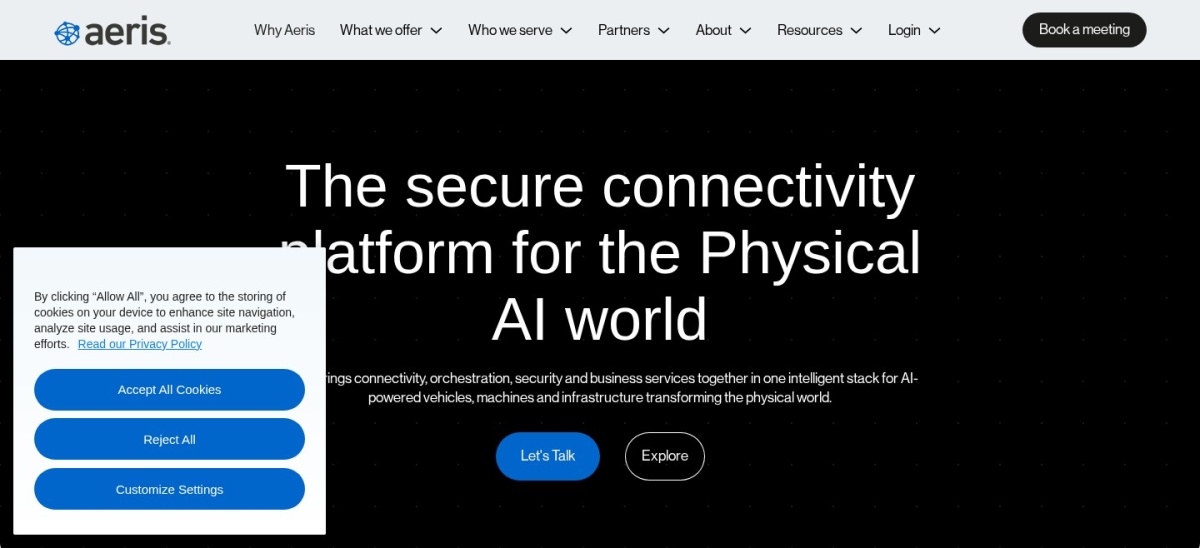
Aeris homepage, captured Nov 2026.
Aeris is a managed IoT connectivity service with a central platform for SIMs, data usage and device health. Its dashboard shows connection status in real time, and APIs connect the platform to internal tools. Security monitoring watches traffic for threats and helps with compliance reporting.
The trade off is price. Aeris publishes no rates and sells through quotes, so small teams cannot budget from the website alone. It suits fleets that need tight security monitoring and a managed service rather than a self-serve SIM shop.
What we like
4.9 out of 5 on G2
Central dashboard with real-time SIM and usage views
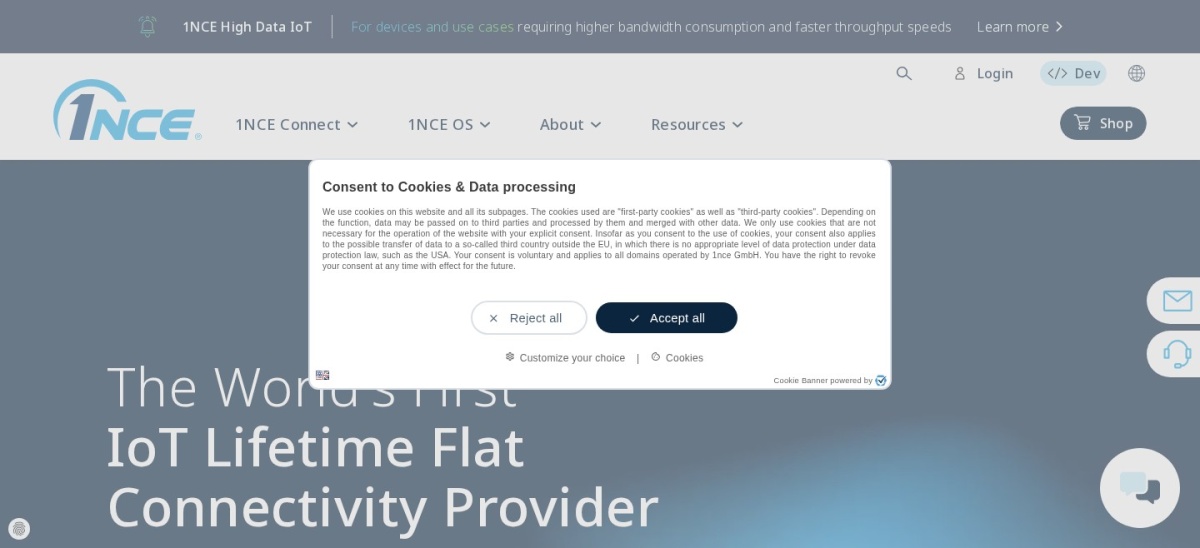
1NCE is a Tier-1 IoT carrier that sells one flat rate for low-data devices. The IoT Lifetime Flat costs $14 once and covers 10 years, 500 MB of data and 250 SMS per SIM, with no monthly fee. Its connectivity platform is included for managing SIMs and topping up data.
The trade off is data volume. The 500 MB allowance suits sensors and trackers, but cameras and other high-data devices need the separate High Data IoT plans, which are billed monthly. It suits large fleets of low-data devices where one payment per SIM keeps costs simple.
What we like
One payment of $14 covers 10 years per SIM
500 MB and 250 SMS included
No monthly fees
Watch out for
Flat rate fits low-data devices only
Top-ups cost the same flat fee per 500 MB
Top-ups add 500 MB and 250 SMS for the same flat feeVisit 1nce.com
04
floLIVE
4.7/5on G2 (6 reviews, checked Nov 2026)
PricingCustom/yr
Best for own-core global coverage
SIMMulti-IMSI SIM and eSIM
NetworkOwn cloud-native core
PricingUsage-based, quote
ManagementConnectivity platform
flolive.com
floLIVE homepage, captured Nov 2026.
floLIVE is a cloud-native IoT connectivity provider that runs its own core network. Its multi-IMSI SIMs switch between carriers, and local points of presence keep traffic close to the device. The platform shows signaling events and lets teams lock a SIM to a carrier and country.
The trade off is price. floLIVE publishes no rates and prices deployments by quote, so buyers must talk to sales before they can compare costs. It suits enterprises that want their own core network, local breakout and tight control over which carrier each device uses.
What we like
Own cloud-native core network
Multi-IMSI SIMs with local breakout
4.7 out of 5 on G2
Watch out for
No published pricing
G2 reviewers note new features can ship with early bugs
Soracom is a cloud-first IoT connectivity platform from the KDDI group. Its Air SIMs work on global, regional and US plans, and its console and API manage SIMs, groups and data routing. Platform services can send device data straight to cloud functions or storage.
The trade off is complexity. Plan names, data rates and fees differ by region, and the low-data plan charges $0.50 per MB, so a bill needs a close read. It suits software teams that already work in the cloud and want connectivity that behaves like another cloud service.
Hologram is a self-serve IoT connectivity platform for developers and small fleets. Its Hyper eUICC SIM works worldwide at a flat $0.03 per MB, plus $1 per SIM each month and $3 per SIM card. Test data is free, and the dashboard, API and device tools are included.
The trade off is data cost at scale. At $0.03 per MB, a device that sends tens of megabytes a month costs far more than on a pooled or flat-rate plan. It suits prototypes and small fleets that want to start in minutes with a credit card and no contract.
Particle is an edge-to-cloud IoT platform that sells hardware, connectivity and cloud together. Its modules and EtherSIM connect devices across more than 350 carriers, and the cloud handles over-the-air updates, data routing and fleet management. The free plan covers 100 devices and 100,000 data operations a month.
The trade off is price. The paid Basic plan costs $299 a month per block of 100 devices, so a fleet just over 100 devices pays for two blocks. It suits hardware teams that want modules, SIMs and cloud from one vendor instead of assembling the stack themselves.
What we like
Free plan covers 100 devices
Hardware, SIM and cloud from one vendor
Over-the-air updates included
Watch out for
Basic plan jumps to $299 a month per 100-device block
Free plan limits pause device traffic once the monthly allowance is used
Eseye is a managed IoT connectivity provider built around its Infinity platform and AnyNet eSIM. The eSIM can switch networks over the air, and the platform manages SIMs, data and device onboarding. Eseye was named a Visionary in the 2024 Gartner Magic Quadrant for managed IoT connectivity.
The trade off is price. Eseye publishes no rates, so costs come from a quote, and the platform is aimed at larger deployments rather than small trials. It suits enterprises with devices in many countries that need multi-network coverage and a managed service.
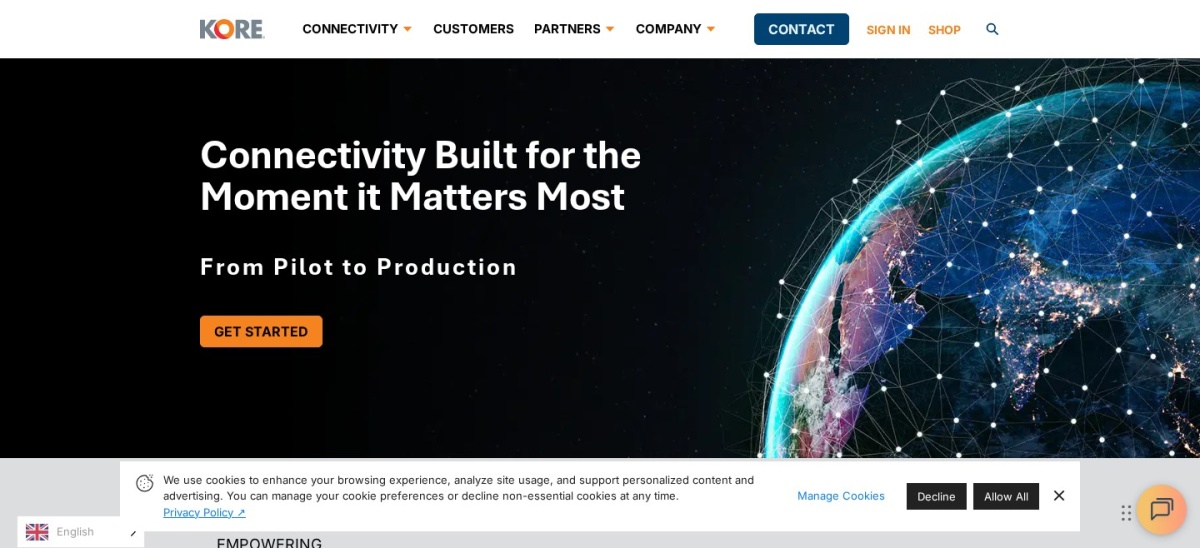
KORE is a global IoT connectivity provider with more than 20 million active connections. Its OmniSIM eSIM and KORE One platform cover multi-carrier connectivity in over 200 countries and territories, with managed services for deployment and support. KORE was named a Leader in the 2021 Gartner Magic Quadrant.
The trade off is price. KORE publishes no rates, and its managed services are priced for enterprise fleets, so small teams should expect a sales process. It suits large fleets in health, fleet and industrial work that need one provider across many regions.
A flat rate suits devices that send a steady trickle of data, such as sensors, meters and trackers. One payment covers years, so the cost per device is easy to forecast.
Pay-as-you-go suits fleets where usage varies a lot between devices. You pay for what each SIM uses, but a chatty device can push the bill up fast.
Pooled plans sit between the two. A shared data allowance across the fleet smooths out heavy and light users, but only some vendors offer pooling, and most quote it.
How we chose
We started from the established IoT connectivity providers named in Gartner's managed IoT connectivity research and G2's IoT categories, then kept the nine with a public rating and a live product.
Prices come from each vendor's pricing page or fee schedule, checked on 25 November 2026. Ratings come from G2 and Gartner Peer Insights on the same day. Where a vendor shows no price, the list says so instead of guessing.
We left out carriers that sell only local plans and tools with no public rating. No vendor paid for a place, and we do not claim to have used these tools ourselves.
How to choose an IoT connectivity platform
Start with how much data each device sends in a month, then match the pricing model to that number.
Work out the data per device. Check the average megabytes each device sends monthly. Low-data sensors fit a flat rate; high-data devices need pooled or per-MB pricing.
Check coverage for every deployment country. A plan that covers one region may not cover another. Confirm each network and the data rate for each country before you buy.
Compare the full bill, not the headline rate. Add SIM fees, SMS charges and support costs. See how to avoid enormous network payloads to keep data use down.
Trial before you commit the fleet. Order a few SIMs and run them where the devices will live. A short trial shows real signal strength and real costs.
FAQ
What is the best IoT connectivity platform?
EMnify is the best pick for most teams. It has the highest G2 rating in this list at 4.9 out of 5 from 93 reviews, with multi-carrier SIMs, eSIM support and a free 60-day trial with three test SIMs.
How much does IoT connectivity cost?
It varies widely. Hologram charges $0.03 per MB plus $1 per SIM a month, 1NCE charges $14 once for 10 years, and Soracom's low-data plan starts at $0.40 a month. Five of the nine platforms in this list publish no prices.
What is the cheapest IoT connectivity platform?
1NCE is the cheapest for low-data devices: $14 once per SIM covers 10 years, 500 MB and 250 SMS, with no monthly fee. It only fits devices that send small amounts of data.
Do IoT SIMs work in other countries?
Most do. Multi-carrier SIMs and eSIMs connect to partner networks in many countries, but coverage and data rates differ by plan and country, so check the coverage list for each place your devices will run.
What is the difference between a SIM and an eSIM for IoT?
A SIM is a physical card, while an eSIM is built into the device and can switch carrier profiles over the air. An eSIM makes it easier to change networks without visiting the device.
Can I manage IoT SIMs myself?
Yes, most platforms include a portal and API for activation, data limits, alerts and billing. Hologram and Soracom are the most self-serve, while KORE, Eseye and Aeris lean toward managed service.
SaaS SEO and WordPress specialist with about 8 years of experience. Rakib compares WordPress plugins, themes, hosting and software using public pricing, documentation and user reviews. See how we rank.