Best Investor Portal Software in 2026: 9 Tools Compared
WLWPLegible EditorsLast verified 23 Nov 2026How we rank14 min read
★ Short answer
Juniper Square is the best investor portal software for most private markets GPs, pairing a branded portal with fund administration for 2,300+ firms. Choose Agora for a published starting price, or InvestNext for real estate syndicators on a budget.
How we make this list: we compare pricing pages, product documentation and public user reviews, then re-check every price before each update. No product paid for a place. Disclosure.
Juniper Square leads for private markets GPs: a branded portal plus fund administration, rated 4.7 out of 5 on G2 from 106 reviews.
Agora pairs the largest review base in this list, 318 G2 reviews at 4.8 out of 5, with a published price: Essential from $749 a month.
InvestNext is the cheapest published entry point here, with Fundraising at $299 a month and a 4.6 out of 5 G2 rating from 286 reviews.
Cash Flow Portal pairs a 5.0 out of 5 G2 rating with a published Syndication Suite from $699 a month and unlimited deals.
Six of the nine tools publish no price at all, so expect a sales call and a quote based on funds, equity or investor count.
What an investor portal should cover
An investor portal is the front door between a fund or syndication and its investors. At minimum it gives LPs on-demand access to statements, K-1s, performance figures and documents.
The best platforms go further: fundraising workflows, capital calls, distribution waterfalls, accreditation and KYC checks, a CRM and reporting that replaces spreadsheets.
Two buyer groups share this search term. Institutional GPs need a portal that sits on fund accounting, while real estate syndicators need fundraising, distributions and K-1 sharing for individual investors.
Pricing is the hardest part of this market. Only three of the nine tools below publish a starting price, and the rest quote by fund size, equity under management or investor count.
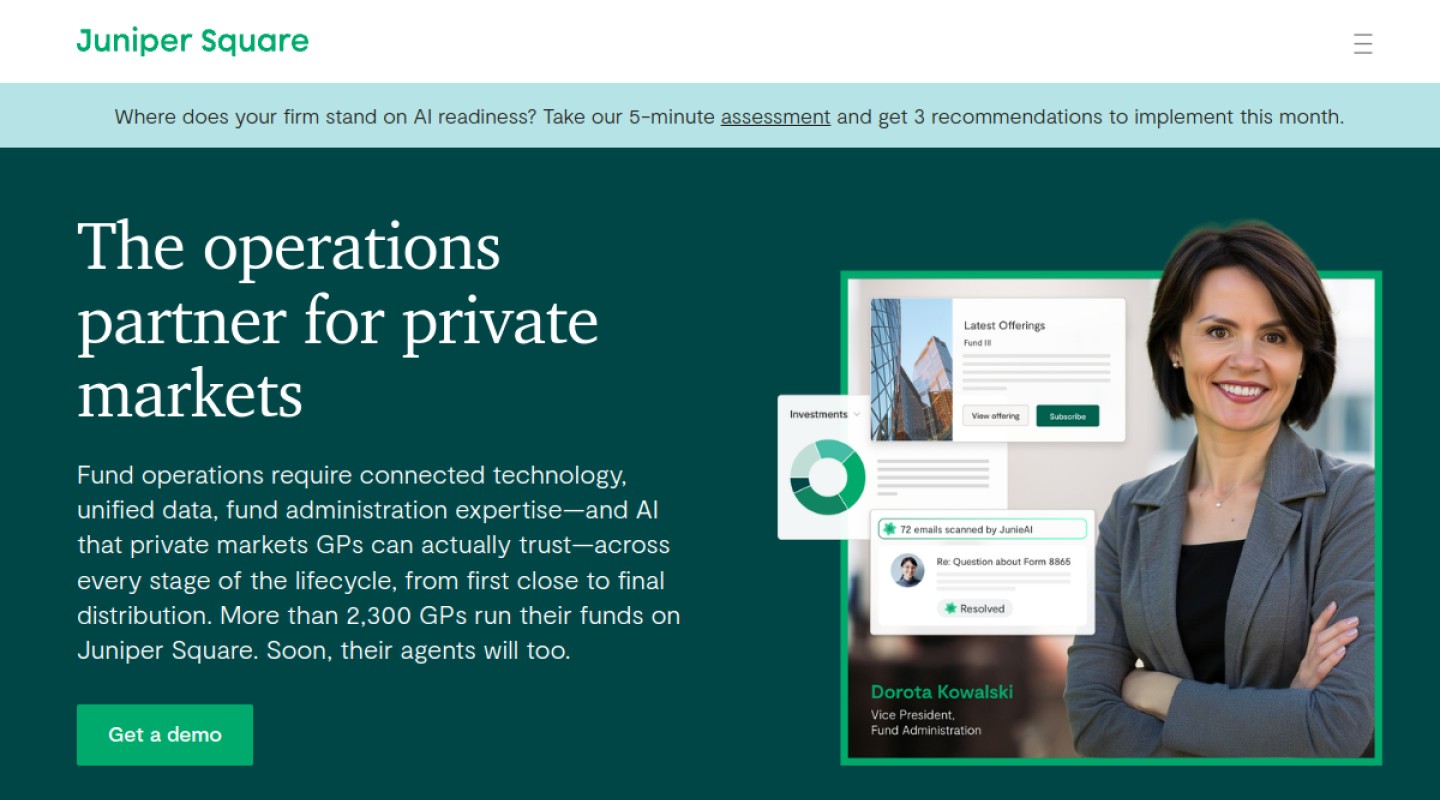
Juniper Square is the operations partner for private markets GPs, pairing a branded investor portal with fund administration run by its own accountants. More than $1 trillion in LP capital runs through the platform, which covers fundraising, digital subscriptions, AML/KYC checks, data rooms and reporting on one data model.
The trade off is price and process. Juniper Square publishes no price, so every deal is a custom quote, and implementation is a project rather than a self-serve signup. It suits established PE, real estate and private credit firms that want one operations backbone.
What we like
Portal plus fund administration in one vendor
Rated 4.7 out of 5 from 106 G2 reviews
Digital subscriptions with AML/KYC built in
Used by 2,300+ GPs with $1T+ in LP capital
Watch out for
No published price, quote only
Built for institutional funds, not small syndicators
Implementation takes time for large investor lists
Agora is a real estate investment management platform with a white-label investor portal, CRM, fundraising tools, distributions and K-1 reporting in one system. The Essential plan starts at $749 a month, and Agora reports 1,400+ customers and a 4.8 out of 5 G2 rating from 318 reviews.
The trade off is focus and scale. Agora serves commercial real estate only, and the price rises with equity under management, so larger firms pay more than the entry figure. It suits real estate sponsors who want a published starting price and strong support.
What we like
Highest review count in this list at 318 G2 reviews
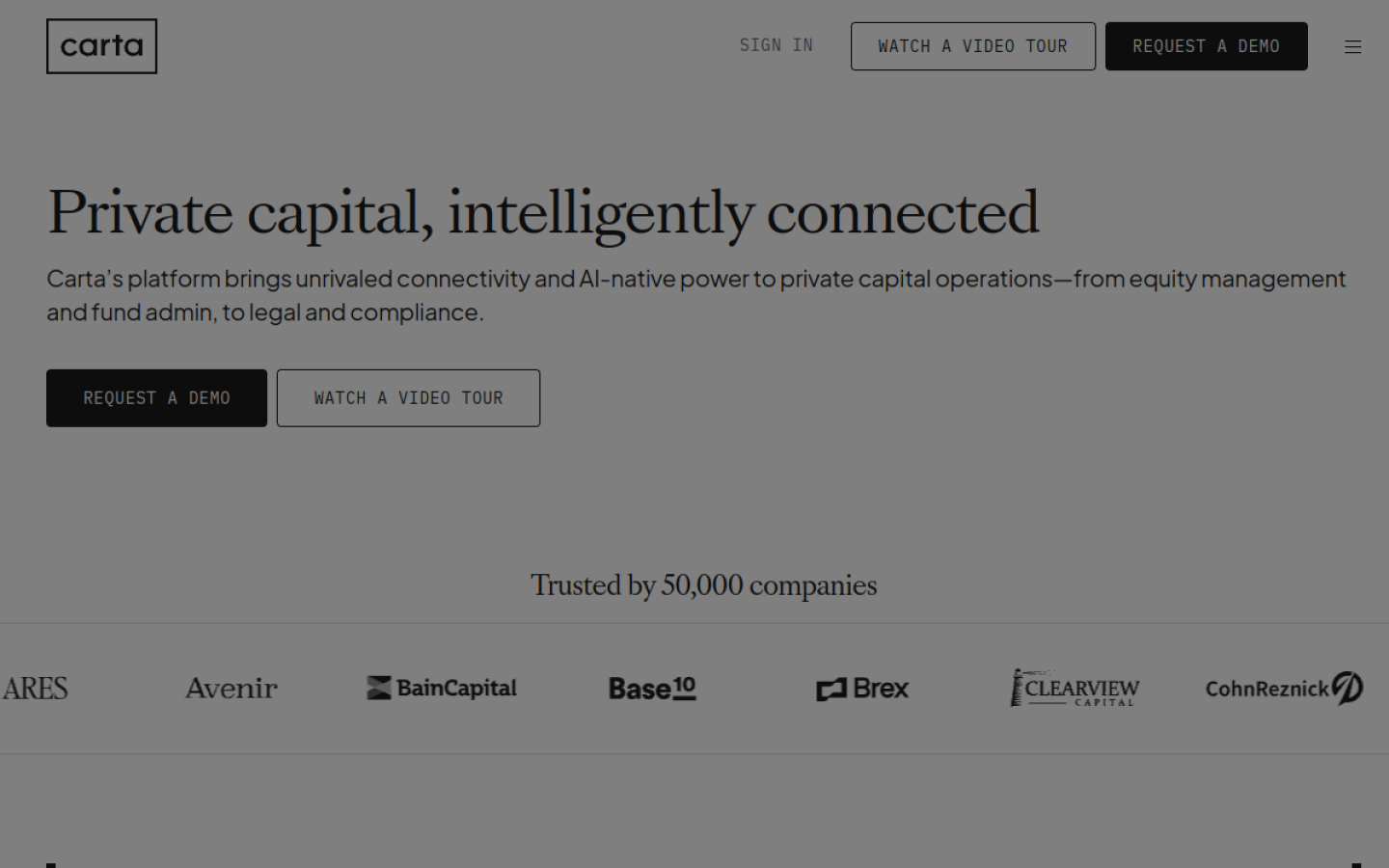
Carta is a private capital platform that connects equity management, fund administration and investor relations on one set of data. Carta says it serves 50,000 companies and funds, including more than 9,000 funds and SPVs, so funds already running portfolio company equity on Carta can extend the same system to LPs.
The trade off is breadth and price. Carta publishes no fund pricing, and the platform covers far more than a portal, which can be more than a small fund needs. It suits venture and PE funds that want cap tables, fund admin and LP workflows connected.
InvestNext is built for real estate capital raisers, with a white-label investor portal, CRM, guided subscriptions, KYC/AML checks and automated distribution waterfalls. The Fundraising plan is a flat $299 a month, and the platform is rated 4.6 out of 5 on G2 from 286 reviews.
The trade off is that the entry plan is fundraising only. Full back-office automation, distributions and reporting need All-In-One from $499 a month, and every plan starts with a 12-month initial agreement. It suits syndicators who want modern fundraising without enterprise pricing.
What we like
Cheapest published entry price in this list
Point-and-click distribution waterfalls with ACH
Integrated accreditation and KYC/AML checks
Rated 4.6 out of 5 from 286 G2 reviews
Watch out for
Distributions need the $499 a month All-In-One plan
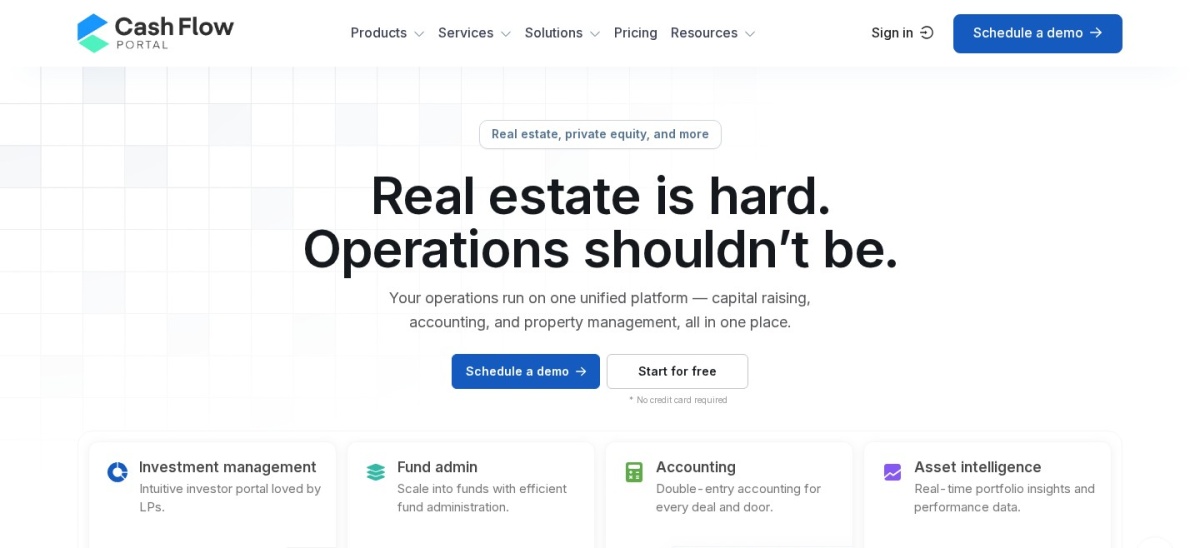
Cash Flow Portal is a syndication suite that bundles investment management, CRM, property management, AI underwriting, accounting and banking around its investor portal. The Syndication Suite starts at $699 a month with unlimited deals, and the platform holds a 5.0 out of 5 G2 rating from 148 reviews.
The trade off is that the headline price is only the software. Bookkeeping, K-1s and distributions as a service sit in the Fund Admin Suite, priced through sales, and white-glove migration carries a one-time fee. It suits sponsors running many deals who want operations and investor relations in one login.
What we like
Perfect 5.0 out of 5 G2 rating from 148 reviews
Unlimited deals on the entry suite
Widest feature set here, including banking
MCP access for connecting AI tools
Watch out for
Fund Admin Suite price is not published
Migration carries a one-time fee, amount not shown
SyndicationPro is a real estate syndication platform built by syndicators, with a digital private placement memorandum, integrated e-signatures, ACH distributions and a CRM for nurturing investor leads. It is rated 5.0 out of 5 on Capterra from 15 reviews, and investors can fund directly from self-directed IRAs via Equity Trust.
The trade off is thin public proof. The Capterra sample is only 15 reviews, G2 has just 2, and pricing is quote-only, based on equity under management. It suits small to mid-size sponsors who want the fundraising workflow handled in one system.
Altvia is a GP engagement platform built natively on Salesforce, covering fundraising, investor relations and deal sourcing with portals, automated reporting, distributions and capital calls. Altvia reports 120,000+ portal users, and 98% of its clients rank it their top firm software.
The trade off is the Salesforce foundation. Firms get 4,000+ integrations, but they also take on Salesforce licensing complexity and enterprise pricing with no published figures. It suits PE and VC firms already committed to Salesforce.
Allvue is an institutional suite for alternative asset managers, joining fund accounting, investment accounting, credit front office and investor relations on one AI-powered platform. Allvue reports more than $8.5 trillion in assets and 21,000 funds managed on the platform.
The trade off is scale and complexity. Allvue is an enterprise sale with implementation effort and no published pricing, so it fits managers whose portal must sit on real fund accounting rather than beside it. Smaller firms will find the platform more than they need.
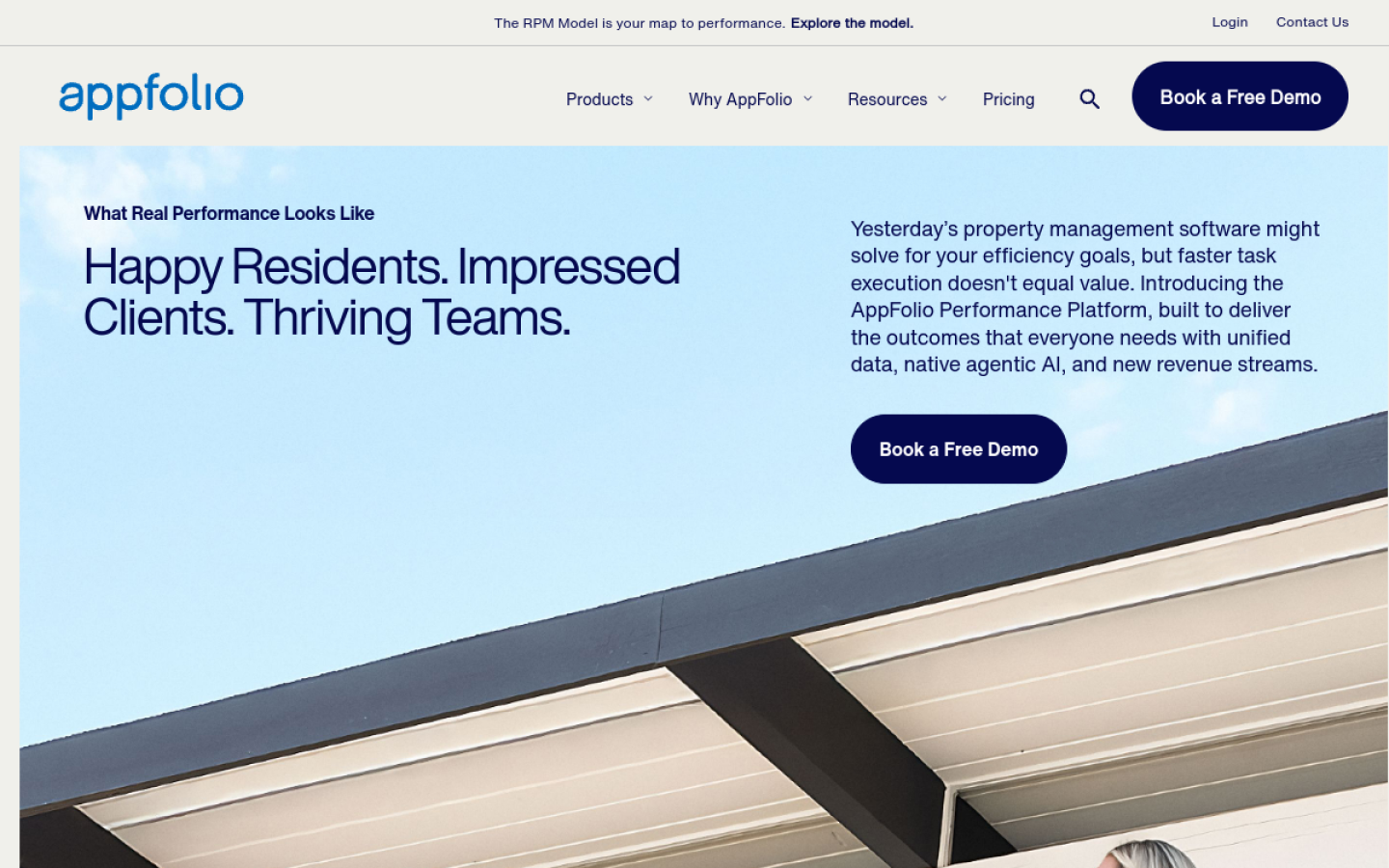
AppFolio Investment Manager homepage, captured Nov 2026.
AppFolio Investment Manager gives real estate sponsors an investor portal with real-time investment data, downloadable K-1s, performance metrics and ACH contributions, plus an optional mobile app. The back office covers fundraising workflows, e-signatures and automated waterfalls, and it is rated 4.5 out of 5 on G2 from 180 reviews.
The trade off is price and fit. AppFolio publishes no price, and third-party listings put the Core plan from $650 a month, so confirm the quote before budgeting. It suits firms already running AppFolio Property Manager, where one vendor covers operations and investor relations.
Six of the nine tools here publish no price. Juniper Square, Carta, SyndicationPro, Altvia, Allvue and AppFolio all sell through a sales call, with the quote shaped by funds, equity under management or investor count.
Get the billing basis in writing. Ask whether the fee follows assets, equity, investors, entities or users, and what the next step up costs when your book grows.
Ask what sits outside the quote. Implementation, data migration, fund administration and K-1 preparation are often separate lines, and some vendors start billing during implementation.
How we chose
We started from the investor portal platforms with real review bases on G2 or Capterra, covering both meanings of the term: institutional LP portals for private funds and syndication portals for real estate sponsors.
Prices and ratings were checked on 23 November 2026. Ratings come from G2, except SyndicationPro, where Capterra has the larger sample at 15 reviews against 2 on G2. Where a vendor publishes no price, the list says so instead of repeating a third-party estimate as fact.
We left out tools with no investor portal of their own, such as pure CRM or data-room products. No vendor paid for a place, and we do not claim hands-on testing for this list.
How to choose investor portal software
Start with who your investors are, then match the portal to their size and your reporting duties.
Decide which buyer group you are in. Institutional GPs need a portal on fund accounting, while syndicators need fundraising, distributions and K-1s. The two groups rarely share a shortlist.
Check whether fund admin is included. Juniper Square, Carta and Allvue pair software with administration or accounting. If you keep your own CPA, a software-only tool such as InvestNext may fit better.
Price the whole first year, not the headline. Add implementation, migration, per-payment fees and fund admin to the monthly figure. Compare payment options in our WooCommerce Payments vs Stripe guide to see how payment fees vary by provider.
Ask investors to try the portal before you sign. A portal only works if LPs use it. Get a demo login for two or three investors and check statements, documents and K-1 downloads on their own devices.
FAQ
What is the best investor portal software?
Juniper Square is the best pick for most private markets GPs, pairing a branded portal with fund administration for 2,300+ firms. Agora is the best option with a published price, and InvestNext is the best value for real estate syndicators.
How much does investor portal software cost?
Published entry prices here run from $299 a month for InvestNext Fundraising to $749 a month for Agora Essential. Six of the nine tools publish no price, so expect a custom quote based on funds, equity or investor count.
What is the difference between Juniper Square and Carta?
Juniper Square is built around fund operations and administration for private markets GPs, while Carta starts from cap table management and adds fund admin and LP reporting. Funds already on Carta for equity often stay with Carta; GPs wanting an operations partner pick Juniper Square.
Do investor portals handle K-1s and distributions?
Most do. The portals here share K-1s and tax documents with investors, and several automate distribution waterfalls and ACH payments. Fund administration, where a vendor prepares the K-1s, is a separate service on some platforms.
Can small syndicators use these tools?
Yes. InvestNext starts at $299 a month, Cash Flow Portal at $699 a month with unlimited deals, and SyndicationPro prices by equity under management. Juniper Square, Allvue and Altvia are built for larger firms and price accordingly.
Is there a free investor portal?
No tool in this list offers a free plan. Entry prices start at $299 a month, and most vendors quote by fund size. Some offer a demo or a trial of the portal before you commit.