Best Insurance Analytics Software in 2026: 8 Tools Compared
WLWPLegible EditorsLast verified 23 Nov 2026How we rank12 min read
★ Short answer
Guidewire Analytics is the best insurance analytics software for carriers already running Guidewire, with predictive scores inside underwriting and claims. Pick Duck Creek Insights if you run Duck Creek, SAS Viya for enterprise modeling, Tableau for visual reporting from $15 a user a month, and Shift Technology or FRISS for fraud detection without replacing a core system.
How we make this list: we compare pricing pages, product documentation and public user reviews, then re-check every price before each update. No product paid for a place. Disclosure.
Guidewire Analytics is the best pick for Guidewire carriers, with predictive models that deploy straight into underwriting and claims workflows.
Duck Creek Insights gives Duck Creek carriers a unified view of policy, claims and billing data on the Clarity data foundation.
SAS Viya is the modeling platform in this list, with a 4.3 out of 5 G2 rating from 821 reviews and governance controls regulators expect.
Tableau is the only tool here with a published price: Viewer at $15 a user a month billed annually, Creator at $75.
Shift Technology and FRISS fight fraud without a core replacement, and Tractable automates damage assessment from photos for auto and property claims.
Pricing, underwriting, claims and fraud are different jobs
Insurance analytics software turns policy, claims, billing and external data into analysis for underwriting, pricing, fraud detection and operations. It splits into pricing and underwriting, claims and fraud, and general business reporting, and few tools cover all three equally well.
Core-system analytics from Guidewire and Duck Creek suit carriers already running those platforms, while SAS Viya and Tableau suit teams with their own data stack. Fraud and claims specialists such as Shift Technology, FRISS and Tractable fit carriers that need targeted models without replacing a core system.
Almost nothing in this category publishes a price. Guidewire, Duck Creek, SAS Viya, Shift, FRISS, Tractable and Verisk all sell on custom annual quotes, so implementation, data cleanup and integration often cost as much as the license. Tableau is the exception, with Viewer pricing at $15 a user a month billed annually.
Analytics should support human underwriting and claims decisions, not replace them, especially where regulation and fairness checks apply. Keep a human in the loop for adverse decisions, keep records of model inputs and reasons, and test models for bias across protected groups before wide use.
Insurance analytics software for photo-based damage assessment
Quote/yr
No free plan
4.4/5
Price ladder: cheapest paid plan per year
List prices, USD, checked Nov 2026
GuidewireQuote
Duck CreekQuote
SAS ViyaQuote
ShiftQuote
VeriskQuote
FRISSQuote
TractableQuote
Tableau$180
The 8 best insurance analytics software tools
01
Guidewire Analytics
4.2/5on G2 (108 reviews, checked Nov 2026)
PricingQuote/yr
Best insurance analytics software for Guidewire carriers
ModelsNeural networks, decision trees, GLM, GAM
DeploymentAPI into underwriting and claims
Core fitPolicyCenter, BillingCenter, ClaimCenter
Paid planQuote-only
guidewire.com
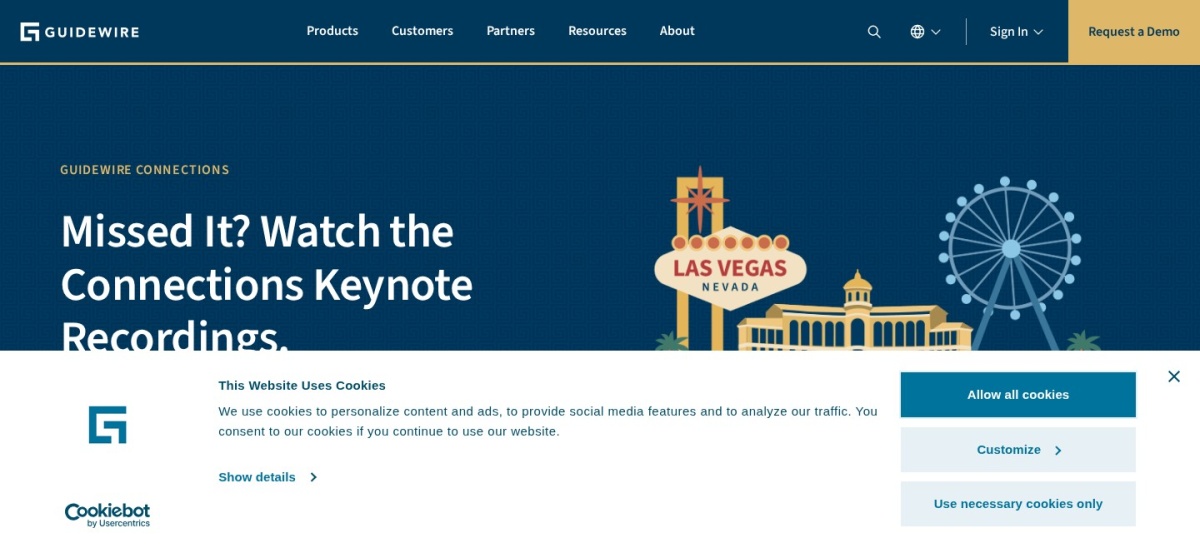
Guidewire Analytics homepage, captured Nov 2026.
Guidewire Analytics suits carriers that already run PolicyCenter, BillingCenter, or ClaimCenter and want analytics close to that operational data. Guidewire Predict builds predictive models, neural networks, decision trees, GLM and GAM, or imports models your team built in R or Python, then deploys them through an API into underwriting and claims, and it holds a 4.2 out of 5 G2 rating from 108 reviews.
The trade off is scope and price. A carrier that does not run Guidewire gains little from a tool built around its data model, and pricing is quoted, with implementation timelines often running into months when historical data needs cleaning. Guidewire is a strong shortlist pick for Guidewire shops, and a poor first pick for everyone else.
What we like
Built for Guidewire policy, billing, and claims data
Benchmark and prediction features for existing users
Shared data model across modules
Watch out for
Quote-only pricing
Weakest value outside Guidewire
Implementation depends on data quality in core systems
Priced as part of a Guidewire deal, against direct written premiumVisit guidewire.com
02
Duck Creek Insights
4.6/5on G2 (130 reviews, checked Nov 2026)
PricingQuote/yr
Best insurance analytics software for Duck Creek carriers
Data foundationClarity
CoveragePolicy, claims, billing
DashboardsShared across departments
Paid planQuote-only
duckcreek.com
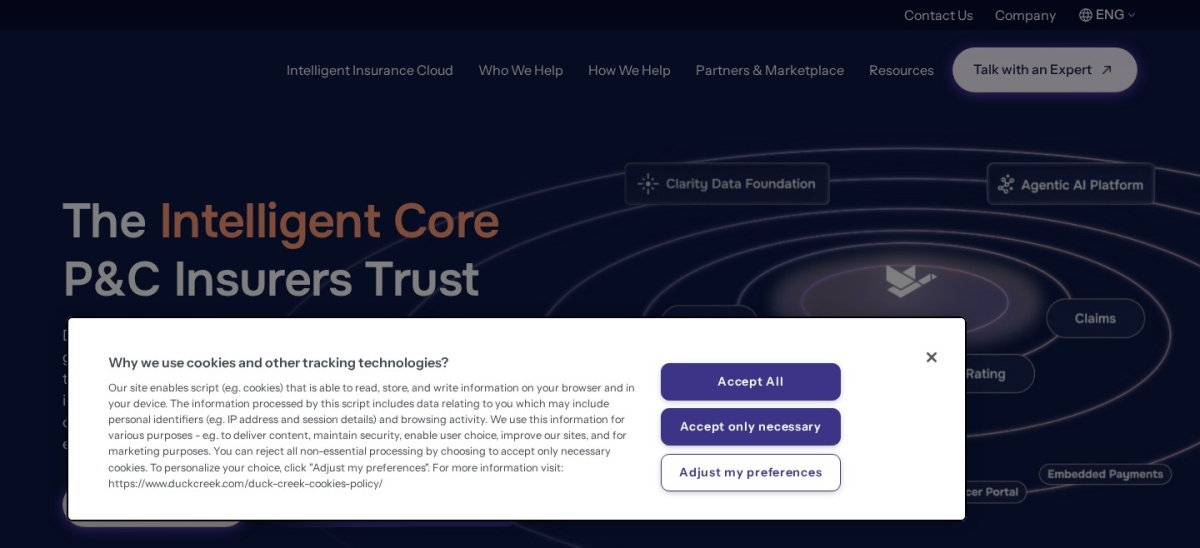
Duck Creek Insights homepage, captured Nov 2026.
Duck Creek Insights, built on the Clarity data foundation, gives Duck Creek carriers a unified view of policy, claims, and billing data for reporting and analysis. Teams can track loss trends, claims handling, and portfolio mix without building a warehouse from scratch, and dashboards can be shared across underwriting, claims, and finance, and it holds a 4.6 out of 5 G2 rating from 130 reviews.
The trade off is data readiness and scope. A data foundation still needs clean, consistent source data, and carriers with custom fields, legacy migrations, or partial Duck Creek adoption should expect a longer setup. Pricing is quoted by scope, so a small carrier should ask early what is included in the base price.
Best insurance analytics software for enterprise modeling teams
ModelingPricing, reserving, risk
GovernanceVersioning, validation, audit
ScaleLarge portfolios
Paid planQuote-only
sas.com
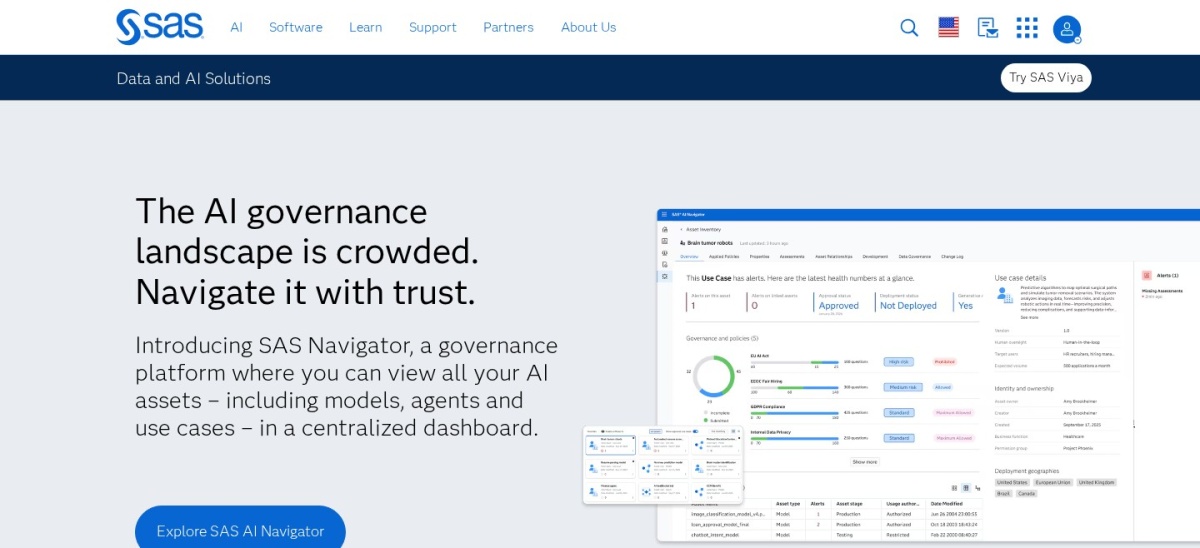
SAS Viya homepage, captured Nov 2026.
SAS Viya is the modeling platform in this list, not just a dashboard tool. Actuaries and data scientists can build, test, and govern pricing, reserving, and risk models on large portfolios, with controls for versioning, validation, and audit that regulators and internal reviewers expect, and it holds a 4.3 out of 5 G2 rating from 821 reviews.
The trade off is skill and time. SAS Viya assumes a team that can build and maintain models, and a carrier without that team will need consultants or a long hiring plan. It also takes longer to deliver a first business dashboard than Tableau or a core-system analytics module.
What we like
Deep statistical and machine learning modeling
Strong governance and audit trails
Handles large, complex portfolios
Watch out for
Quote-only enterprise pricing
Needs skilled data staff
Longer implementation than dashboard tools
Largest G2 review base in this list at 821 reviewsVisit sas.com
04
Tableau
4.4/5on G2 (3,787 reviews, checked Nov 2026)
Starts at$15/mo
Best insurance analytics software for visual reporting
Viewer$15/user/mo annual
Creator$75/user/mo annual
Free trialYes
Paid planViewer, $15/user/mo
tableau.com
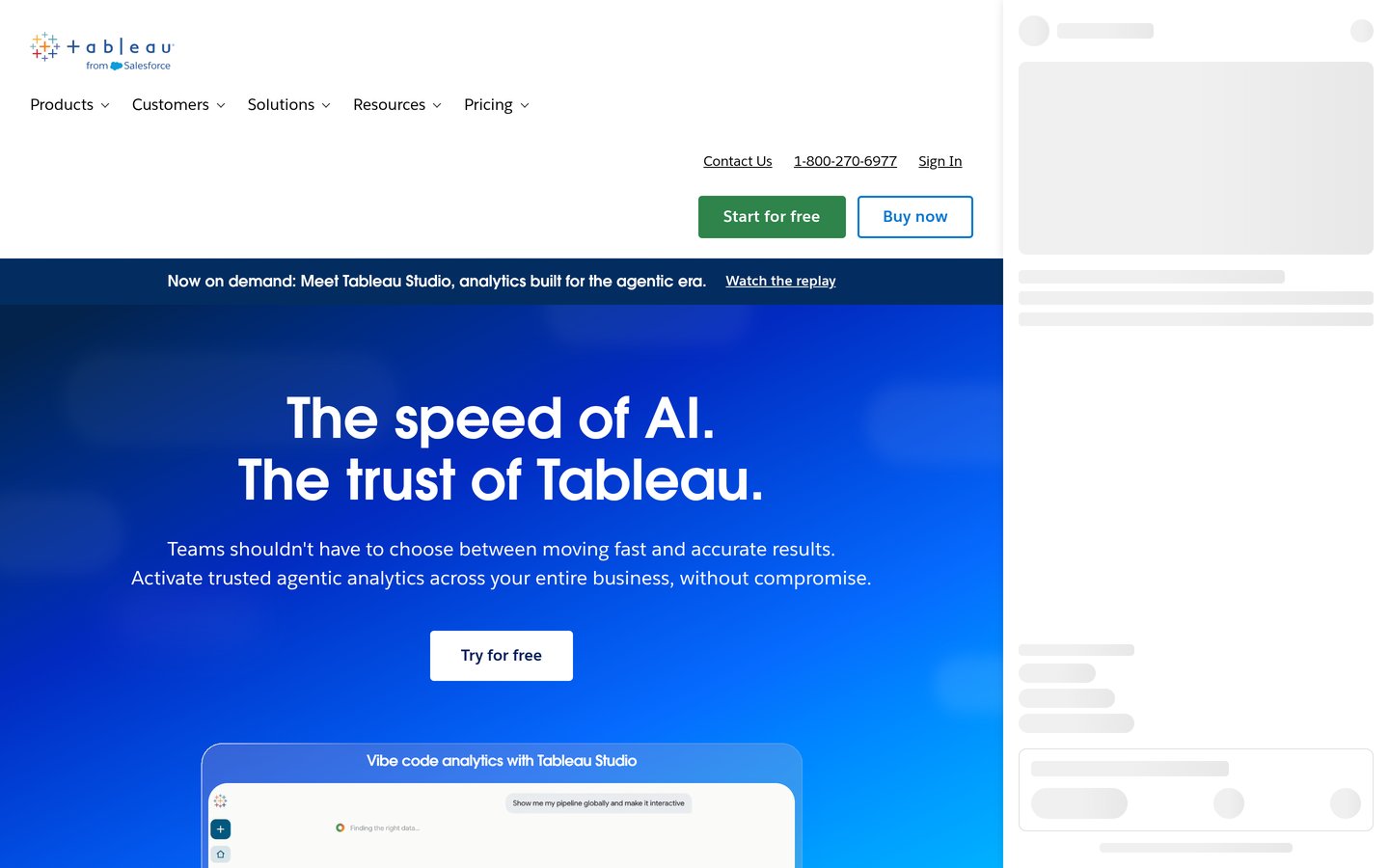
Tableau homepage, captured Nov 2026.
Tableau is the general analytics tool that insurance teams use when they need flexible dashboards across claims, underwriting, sales, and finance. Analysts can connect to warehouses, core extracts, and spreadsheets, then build loss ratio views, claims cycle views, and agency performance views that managers can filter themselves, and it holds a 4.4 out of 5 G2 rating from 3,787 reviews.
The trade off is data dependence. Tableau does not solve insurance data problems by itself: it visualizes whatever data it is given, so a carrier with messy claims coding or split policy systems still needs data work before dashboards become trustworthy. It also lacks insurance-specific models for pricing or fraud.
Best insurance analytics software for claims fraud and automation
CoverageApplication fraud to subrogation
ScoringReal-time, explainable
Carriers120+ insurers in 30+ countries
Paid planQuote-only
shift-technology.com
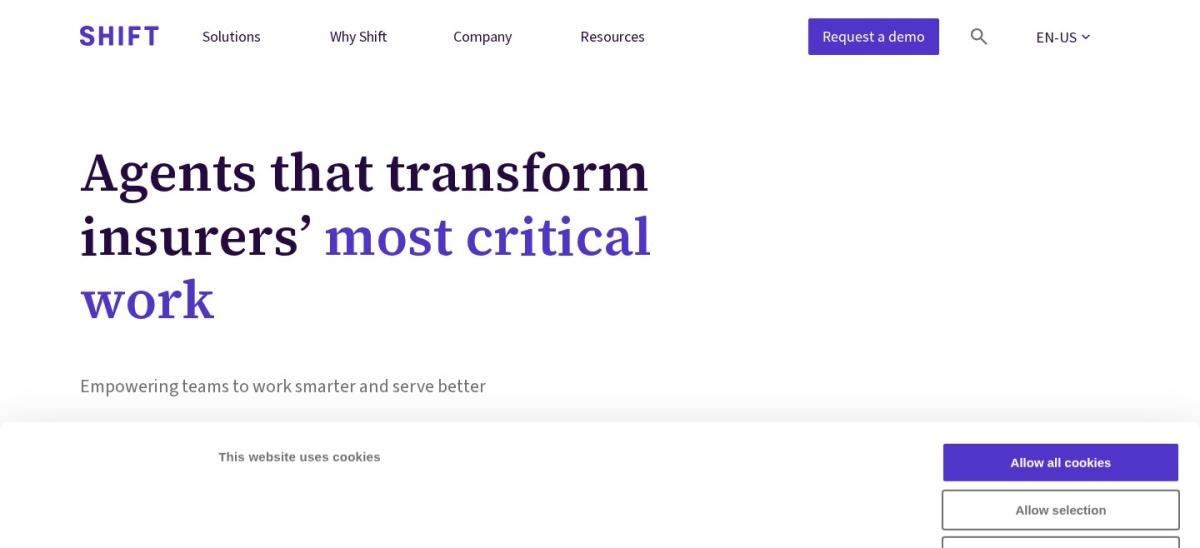
Shift Technology homepage, captured Nov 2026.
Shift Technology applies AI across the whole policy lifecycle, from application fraud to claims fraud, document checks, network detection, subrogation and liability. Its models score claims and applications in real time and explain each alert, so investigators get evidence they can act on rather than a bare number, and it holds a 4.6 out of 5 G2 rating from 10 reviews.
The trade off is tuning and scope. Fraud patterns differ by line, region, and product, so a model that works for auto claims may need real adjustment for property or health lines. Shift's own analysis puts the payoff at $60,000 stopped per 1,000 property claims analyzed, and $43,000 per 1,000 auto claims.
What we like
Focused fraud and claims automation models
Explainable alerts with evidence for investigators
Best insurance analytics software for industry-wide claims data
DataISO loss costs, A-PLUS prior loss
ProductsXactimate, AIR, FireLine
PricingPer-seat and per-transaction
Paid planQuote-only
verisk.com
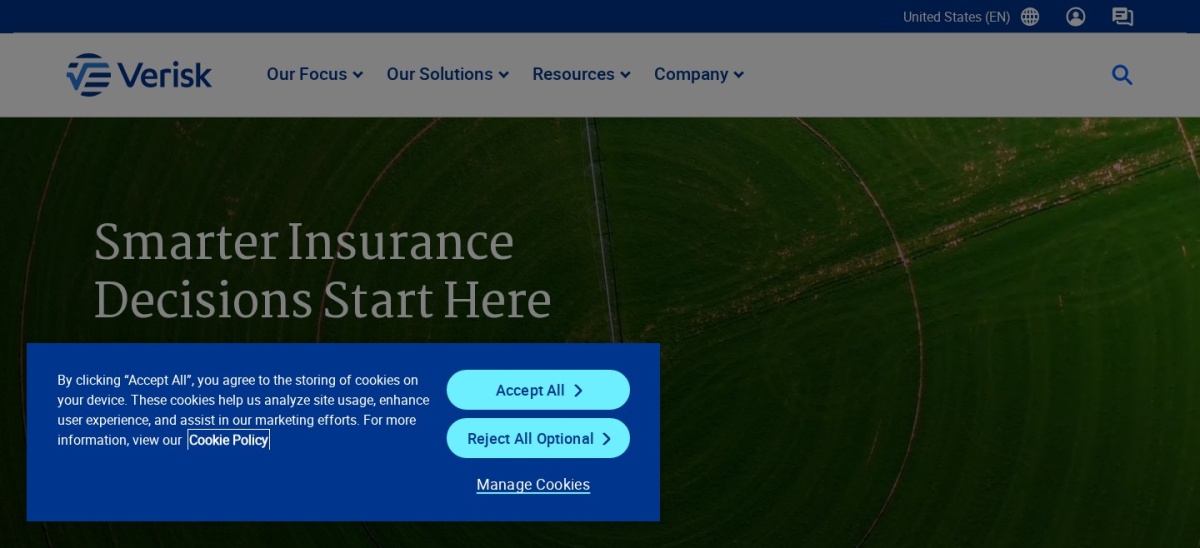
Verisk homepage, captured Nov 2026.
Verisk is a data analytics and risk assessment firm that provides advanced services to the global insurance industry. Its ISO data is the foundation for rating and classification in most US P&C lines, and its underwriting products include loss cost data, risk classification tools, property inspection reports, and predictive models for pricing and selection, and it holds a 4.1 out of 5 G2 rating from 42 reviews.
The trade off is breadth and pricing. Verisk sells many products across many lines, so a carrier buys modules rather than one platform, and per-seat and per-transaction pricing varies by module, with typical annual spend from $50,000 to $500,000 or more depending on modules and volume.
What we like
ISO loss cost data underpins most US P&C rating
Industry-wide prior-loss data for fraud scoring
Catastrophe modeling with AIR
Watch out for
Quote-only pricing, per-seat and per-transaction
Many modules to assemble, not one platform
Typical spend $50,000 to $500,000+ a year
Xactimate Professional $350 a month or $2,690 a yearVisit verisk.com
07
FRISS
4.4/5on Capterra (7 reviews, checked Nov 2026)
PricingQuote/yr
Best insurance analytics software for real-time fraud scores
ScoringReal-time, at decision point
DeploymentModular, by line
ComplianceGDPR, SOC 2, ISO 27001
Paid planQuote-only
friss.com
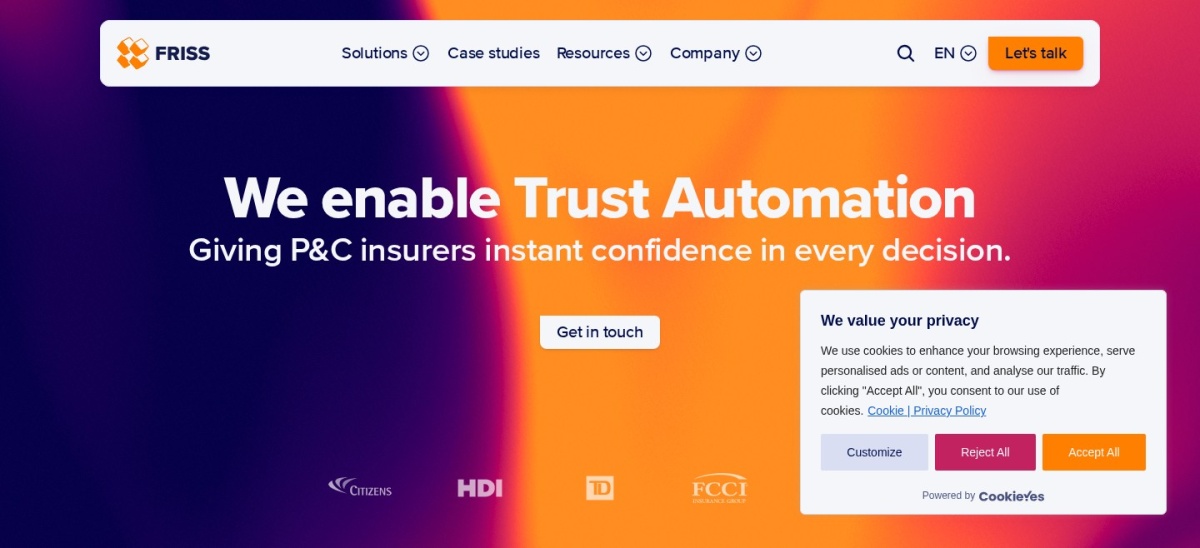
FRISS homepage, captured Nov 2026.
FRISS gives underwriters and claims teams a fraud and risk score at the moment of decision, rather than a report reviewed weeks later. That timing matters, because a score delivered after a policy is bound or a claim is paid has far less value. The platform is modular, so a carrier can start with one line or one decision point, and it holds a 4.4 out of 5 Capterra rating from 7 reviews.
The trade off is calibration and integration. Scores must be tuned to the carrier's portfolio, appetite, and local fraud patterns, and the platform must connect cleanly to policy and claims workflows to avoid extra manual steps. FRISS is not a general reporting tool, so carriers that also need pricing models or executive dashboards will pair it with another tool in this list.
What we like
Real-time fraud and risk scores at underwriting and claims
Best insurance analytics software for photo-based damage assessment
MethodComputer vision on photos and video
LinesAuto and property
DeploymentMobile, web, API
Paid planQuote-only
tractable.ai
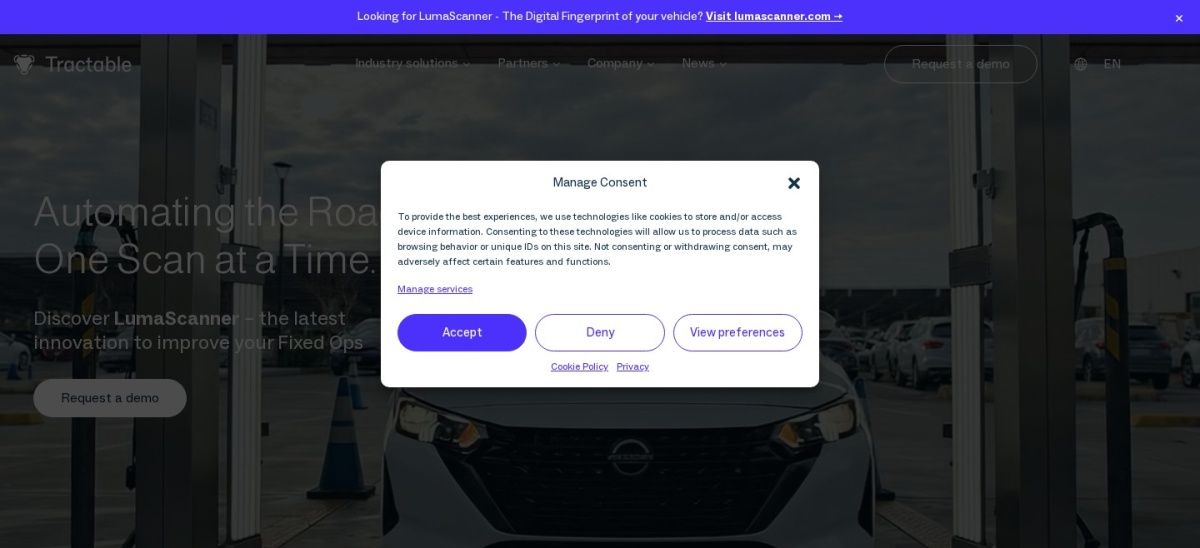
Tractable homepage, captured Nov 2026.
Tractable is an AI-powered visual assessment platform for damage appraisal and claims processing. Auto and property insurers use computer vision on photos and videos of vehicle and property damage to assess severity, flag fraud, and speed up estimates, and it holds a 4.4 out of 5 G2 rating from 55 reviews.
The trade off is scope. Tractable covers damage assessment deeply and little else, so a carrier still needs pricing models, fraud scoring and reporting from other tools. It suits high-volume claims teams that want evidence-to-decision automation from photos and claim artifacts.
What we like
Computer vision damage detection from photos
Speeds up auto and property estimates
Flags fraud from visual evidence
Watch out for
Quote-only pricing
Damage assessment only, not pricing or reporting
Needs photo and video evidence quality
Processes over 50% of motor damage claims at top 10 Spanish car insurersVisit tractable.ai
Why almost nothing here has a price
Seven of the eight tools in this list sell on custom annual quotes. Guidewire prices core cloud subscriptions against direct written premium on multi-year contracts, and Duck Creek, SAS Viya, Shift, Verisk, FRISS and Tractable all scope pricing per carrier.
Third-party benchmarks for a full Guidewire InsuranceSuite at a roughly $5 billion premium carrier cite about $3.2 million to $8.4 million in annual recurring cloud spend after go-live, before implementation. Treat those as estimates, not quotes.
Tableau is the only published price in the list: Viewer $15 a user a month billed annually for broad sharing, Creator $75 for full authoring. Budget implementation and data cleanup separately for every tool here.
How we chose
We started from the analytics platforms carriers actually run, then kept the eight that serve P&C insurers today with a clear insurance use in core analytics, pricing, fraud or reporting.
Prices come from vendor pricing pages and roundups that read vendor pages in October and November 2026, checked again on 23 November 2026. Only Tableau publishes a price: Viewer $15 and Creator $75 a user a month billed annually. Guidewire, Duck Creek, SAS Viya, Shift, Verisk, FRISS and Tractable are all quote-only. Ratings and review counts come from G2 and Capterra, as reported in October and November 2026.
Akur8 and Earnix were left out because they have no usable G2, Capterra or Trustpilot rating: Akur8 has zero G2 reviews, and Earnix has no published G2 rating. No vendor paid for a place, and this list is based on pricing, docs and reviews, not on using the tools ourselves.
How to choose insurance analytics software
Start with the job — pricing, fraud or reporting — then check what core system you already run.
Name the job first. Pricing teams need Earnix-style rating tools or Akur8; fraud teams need Shift or FRISS; reporting teams need Tableau or SAS Viya. Few tools cover all three jobs well.
Check your core system. Guidewire Analytics suits carriers running PolicyCenter, BillingCenter or ClaimCenter, and Duck Creek Insights suits Duck Creek carriers. A carrier on another core gains little from either.
Ask what the quote includes. Most enterprise tools in this list are sold on quote, so ask early what is included in the base price and what counts as a separate implementation or data service.
Ask how models are validated. Ask how long a first production use case takes, what data cleanup the vendor expects, how often models are retrained, and what happens when a score is challenged. Ask for a reference carrier in the same line and size.
FAQ
What is the best insurance analytics software?
Guidewire Analytics is the best pick for carriers already running Guidewire, because its predictive models deploy straight into underwriting and claims workflows. Duck Creek Insights is the better pick when you are replacing the core system too, and SAS Viya leads for enterprise modeling teams.
How much does insurance analytics software cost?
Almost none of the vendors publishes a price. Guidewire, Duck Creek, SAS Viya, Shift, Verisk, FRISS and Tractable all sell on custom annual quotes. Tableau is the exception, with Viewer at $15 a user a month and Creator at $75, billed annually.
What is insurance analytics software used for?
It turns policy, claims, billing and external data into analysis for underwriting, pricing, fraud detection and operations. Some tools are built into core insurance platforms, while others are specialist models or general dashboards applied to insurance data.
Which insurance analytics tool is best for fraud detection?
Shift Technology and FRISS are the focused fraud picks. Shift applies AI across the whole policy lifecycle with explainable alerts, while FRISS gives underwriters and claims teams a fraud and risk score at the moment of decision. Tractable adds photo-based damage assessment for auto and property claims.
Is Tableau good for insurance analytics?
Tableau is the right pick for reporting breadth: flexible dashboards across claims, underwriting, sales and finance, with Viewer pricing at $15 a user a month. It is the wrong pick as a standalone underwriting engine, since it lacks insurance-specific models for pricing or fraud.
Do I need to replace my core system to use insurance analytics?
No. Shift Technology, FRISS and Tractable sit alongside existing claims systems and feed decisions back into the workflows adjusters already use. Guidewire Analytics and Duck Creek Insights only pay off if you already run those core systems.