Teramind is the best insider threat management software for most teams, with session recording, behavior rules and DLP in one console, rated 4.6 out of 5 on G2 from 185 reviews. Pick Microsoft Purview if you run Microsoft 365, and Proofpoint for large enterprise investigation teams.
How we make this list: we compare pricing pages, product documentation and public user reviews, then re-check every price before each update. No product paid for a place. Disclosure.
Teramind leads with the deepest monitoring: screen recording, keystroke logging and DLP from $14 a seat a month, rated 4.6 out of 5 on G2.
Only 3 of the 9 tools publish prices. Teramind starts at $14, Veriato at $18 and Microsoft Purview at $12 a user a month; the rest are quote-only.
Microsoft Purview is the cheapest route for Microsoft 365 shops, since insider risk management is included in the $12 Purview Suite and in E5.
Proofpoint and Varonis are the enterprise picks, but both are quote-only and take months to roll out: G2 reports 3 months for Proofpoint and 4 for Varonis.
Syteca has the highest G2 rating at 4.7 out of 5, but from only 23 reviews, and its pricing page shows no numbers at all.
What insider threat management software should cover
Insider threats come from staff, contractors and departing employees, not just outside attackers. The risk is someone with valid access copying files, emailing data out or misusing a privileged account.
A good tool should watch what users do with sensitive data, score the risk of each person and give investigators evidence they can act on. That means activity logs, file movement tracking and alerts when behavior drifts from normal.
Session recording is the strongest evidence, but also the most intrusive. Our guide on running a WordPress security audit shows the same trade-off in miniature: more visibility helps investigations, but staff need to know what is monitored.
Pricing is mostly quote-only in this niche. Only Teramind, Veriato and Microsoft Purview publish a starting price, so expect a sales call and a per-user quote from the rest.
The 9 best insider threat management software tools
01
Teramind
4.6/5on G2 (185 reviews, checked Nov 2026)
Starts at$14/mo
Best insider threat management software overall
Session recordingYes, continuous
Behavior rulesAlert, block or lock out
DLP includedYes, on DLP plan
Starting priceStarter, $14/seat/mo
teramind.co
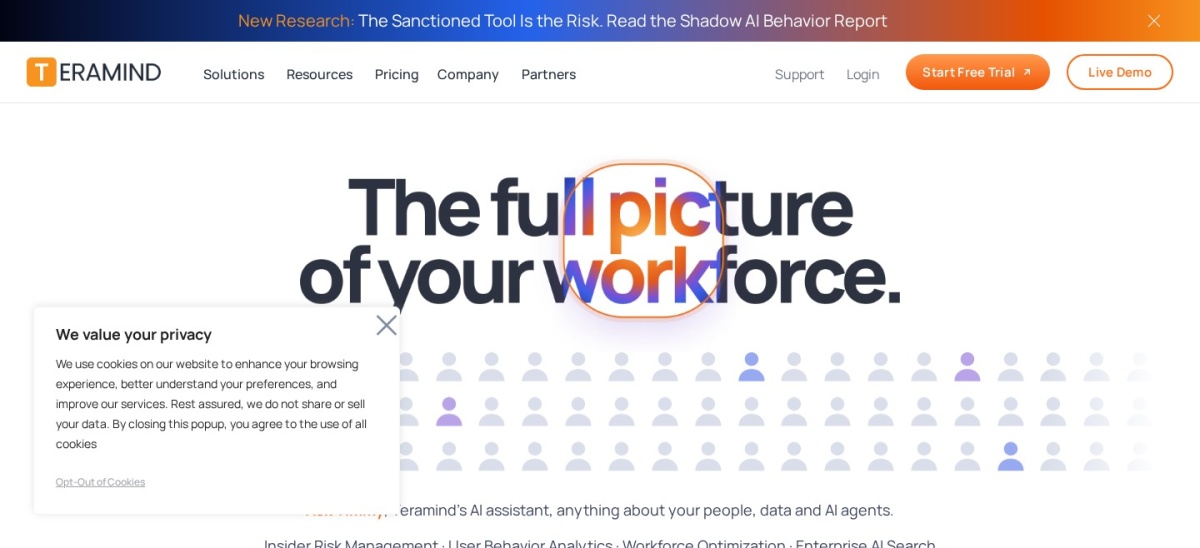
Teramind homepage, captured Nov 2026.
Teramind is the deepest monitoring platform in this list, combining screen recording, keystroke logging, email and file transfer watching with behavior rules and DLP in one console. It deploys in the cloud, on premise or in a private cloud, and the Starter plan costs $14 a seat a month billed yearly, with a 5-seat minimum.
The trade off is intrusiveness and cost at scale. Continuous recording and keystroke logging need a clear staff policy, and full DLP costs $32 a seat a month billed yearly. It suits regulated teams that need forensic evidence of who moved what data and when.
What we like
Deepest monitoring: recording, keystrokes, file and email tracking
Only tool here with published tiered pricing from $14
Rules can alert, block or lock a user out in real time
Highest review count in this list at 185 G2 reviews
Watch out for
Continuous recording needs careful staff communication
Full DLP sits on the $32 a seat a month plan
5-seat minimum on every plan
UAM adds UEBA and forensics at $28; DLP adds blocking at $32Visit teramind.co
02
Proofpoint Insider Threat Management
4.3/5on G2 (48 reviews, checked Nov 2026)
PricingCustom/yr
Best for enterprise investigation teams
Session recordingYes, risk-triggered
Risk scoringYes, human risk
Data maskingYes, threshold-based
Starting priceQuote-only
proofpoint.com
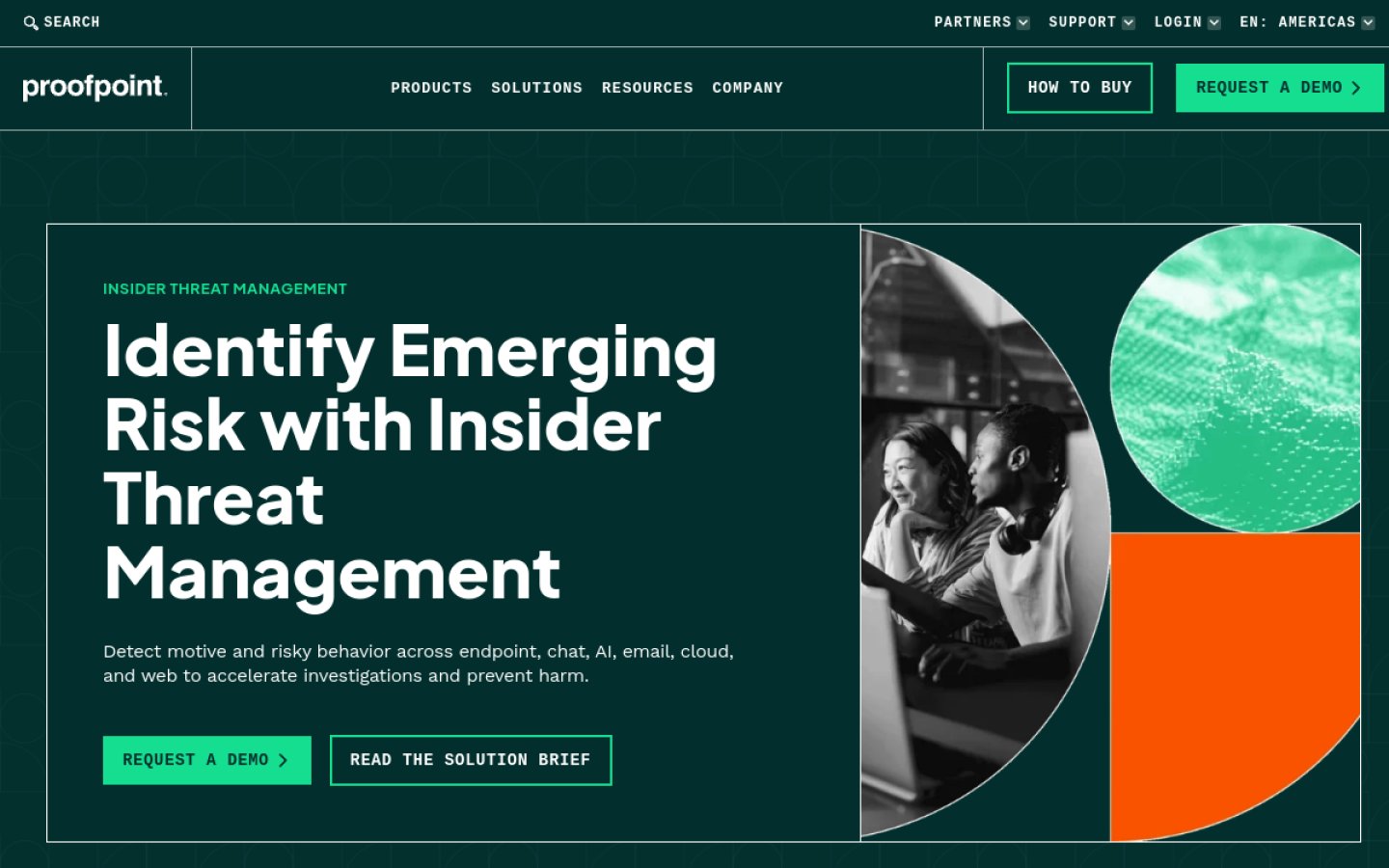
Proofpoint Insider Threat Management homepage, captured Nov 2026.
Proofpoint Insider Threat Management is built on the ObserveIT lineage and takes an evidence-first approach for large organisations. It scores human risk and records user sessions when risk triggers fire, producing video-grade evidence tied into Proofpoint email security and DLP, with data masking until a threshold justifies unmasking.
The trade off is time and price. G2 reports an average implementation of 3 months, and pricing is quote-only with no published starting point. It suits large teams with a dedicated insider risk program, especially those already running Proofpoint products.
What we like
Risk-triggered recording gives evidence without watching everyone
Strong fit inside an existing Proofpoint security stack
Data masking protects staff privacy until risk justifies a look
Watch out for
Quote-only pricing with no published starting price
Average implementation takes about 3 months
Overkill for small teams without a dedicated program
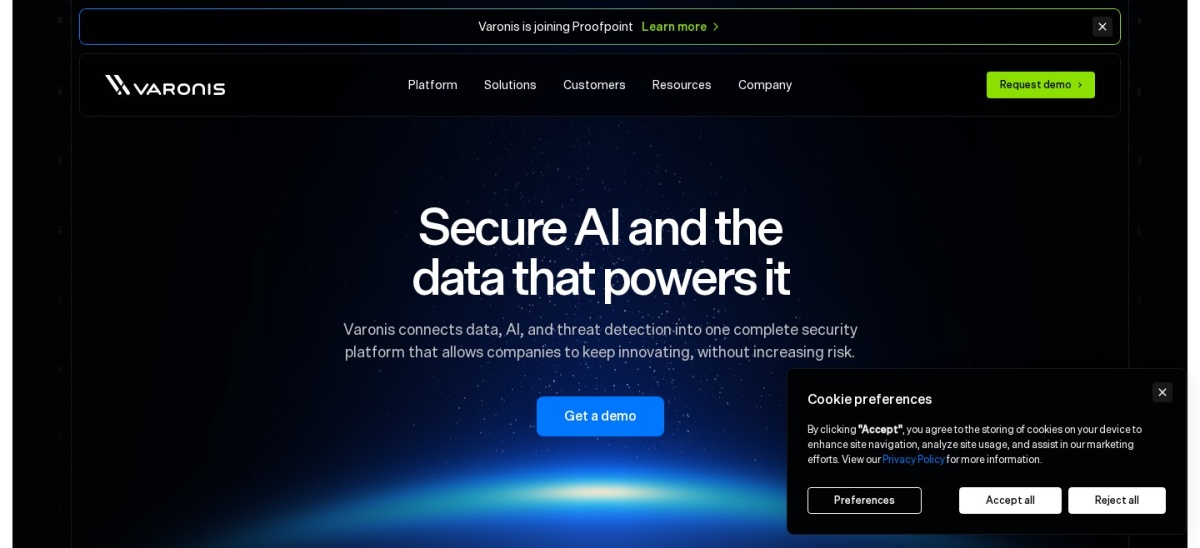
Varonis Data Security Platform homepage, captured Nov 2026.
Varonis Data Security Platform is a data-centric tool that watches the data instead of the person. It discovers sensitive files, maps who can access them, flags abnormal access and can automatically fix overexposed permissions, across on-premise file servers, Microsoft 365 and cloud apps. Reviewers rate it 4.6 out of 5 on G2 from 96 reviews.
The trade off is rollout effort. G2 reports an average implementation of about 4 months, pricing is quote-only, and reviewers note a learning curve in the early weeks. It suits teams whose main insider risk is overexposed data rather than watched keystrokes.
What we like
Finds sensitive data and overexposed permissions automatically
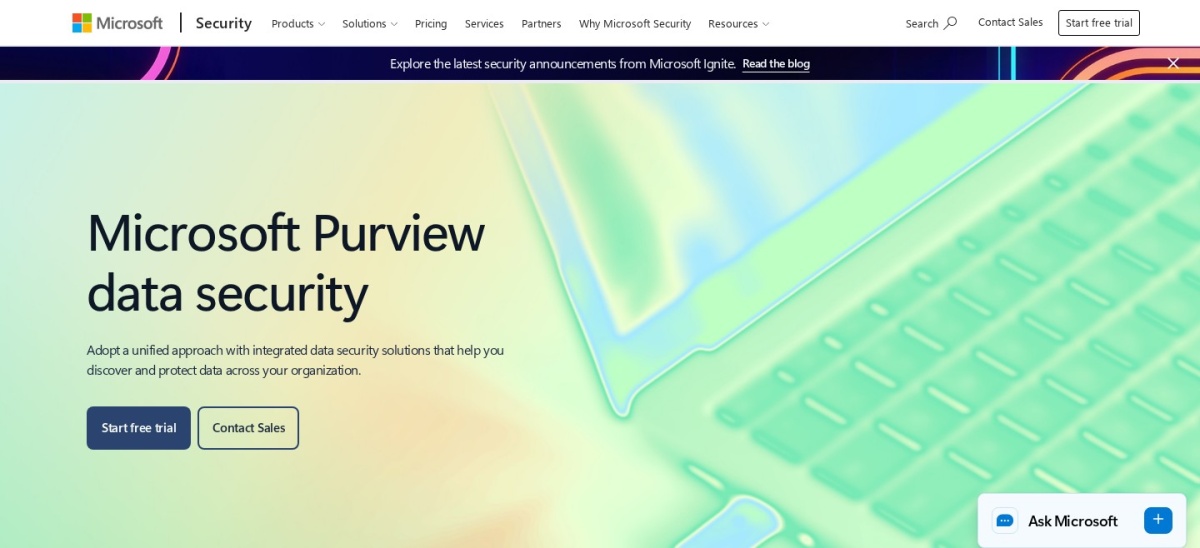
Microsoft Purview Insider Risk Management homepage, captured Nov 2026.
Microsoft Purview Insider Risk Management is the no-new-agent option for Microsoft estates. It builds risk scores from more than 100 machine-learning indicators using native Microsoft 365 and Defender signals, with identities pseudonymised by default and policy templates for data theft, leaks and code exfiltration. It is included in Microsoft 365 E5 and in the $12 a user a month Purview Suite.
The trade off is reach. Visibility ends at the edge of the Microsoft estate, so activity outside Microsoft 365 and managed endpoints is thin, and the pseudonymised workflow can feel slow to investigators used to direct monitoring. It suits Microsoft 365 shops that want insider risk without another agent.
What we like
No new agent: uses native Microsoft 365 and Defender signals
Cheapest entry here for E5 shops, where it is included
Pseudonymised by default, which helps staff trust
Policy templates cover data theft, leaks and code theft
Watch out for
Thin visibility outside the Microsoft estate
Only 16 G2 reviews, the smallest base in this list
Licensing is complex across E3, E5 and Suite add-ons
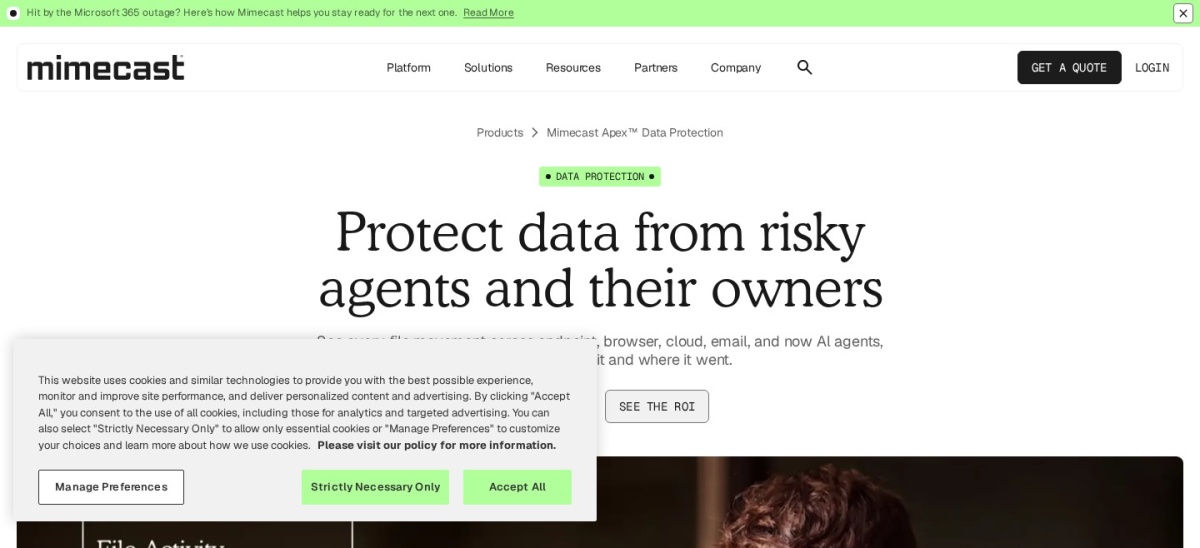
Mimecast Incydr is a file-focused tool, formerly Code42 Incydr, that watches the data instead of the person. It tracks file movement across endpoints, cloud drives, email, browser uploads and personal accounts, scoring exfiltration risk from the file value and destination, with no policy authoring needed to start. Its departing-employee watchlist flags staff who move files as they leave.
The trade off is prevention. Reviewers say detection is strong but native blocking is weaker than a full DLP suite, and setup needs tuning to cut false positives. It suits teams that want fast visibility into where files go, without weeks of policy writing.
What we like
Useful visibility from day one with no policy writing
Risk scoring surfaces the most important events first
Watch out for
Blocking controls are weaker than a full DLP suite
Alert tuning takes time to cut false positives
Quote-only pricing with no published starting price
Paid plans are custom-quoted; blocking is limited vs full DLPVisit mimecast.com
06
Syteca
4.7/5on G2 (23 reviews, checked Nov 2026)
PricingCustom/yr
Best for privileged user monitoring
Session recordingYes, with playback
Privileged access controlYes, built in
DeploymentCloud or on-premise
Starting priceQuote-only
syteca.com
Syteca homepage, captured Nov 2026.
Syteca is a combined access and monitoring tool, formerly Ekran System, that puts privileged access management and user activity monitoring in one console. It records sessions, controls who can reach critical servers, manages shared credentials and alerts on suspicious activity, with a lightweight agent that reviewers say is quick to deploy. It holds the highest G2 rating here at 4.7 out of 5.
The trade off is the thin review base of only 23 G2 reviews, and pricing is quote-only with no numbers on the vendor pricing page. It suits mid-market teams that need to watch privileged users and third-party access as well as regular staff.
What we like
Highest G2 rating in this list at 4.7 out of 5
PAM and monitoring in one console, not two products
Lightweight agent with fast setup, per reviewers
Covers employees, privileged users and third parties
Watch out for
Only 23 G2 reviews, the second-smallest base here
Quote-only pricing with no published starting price
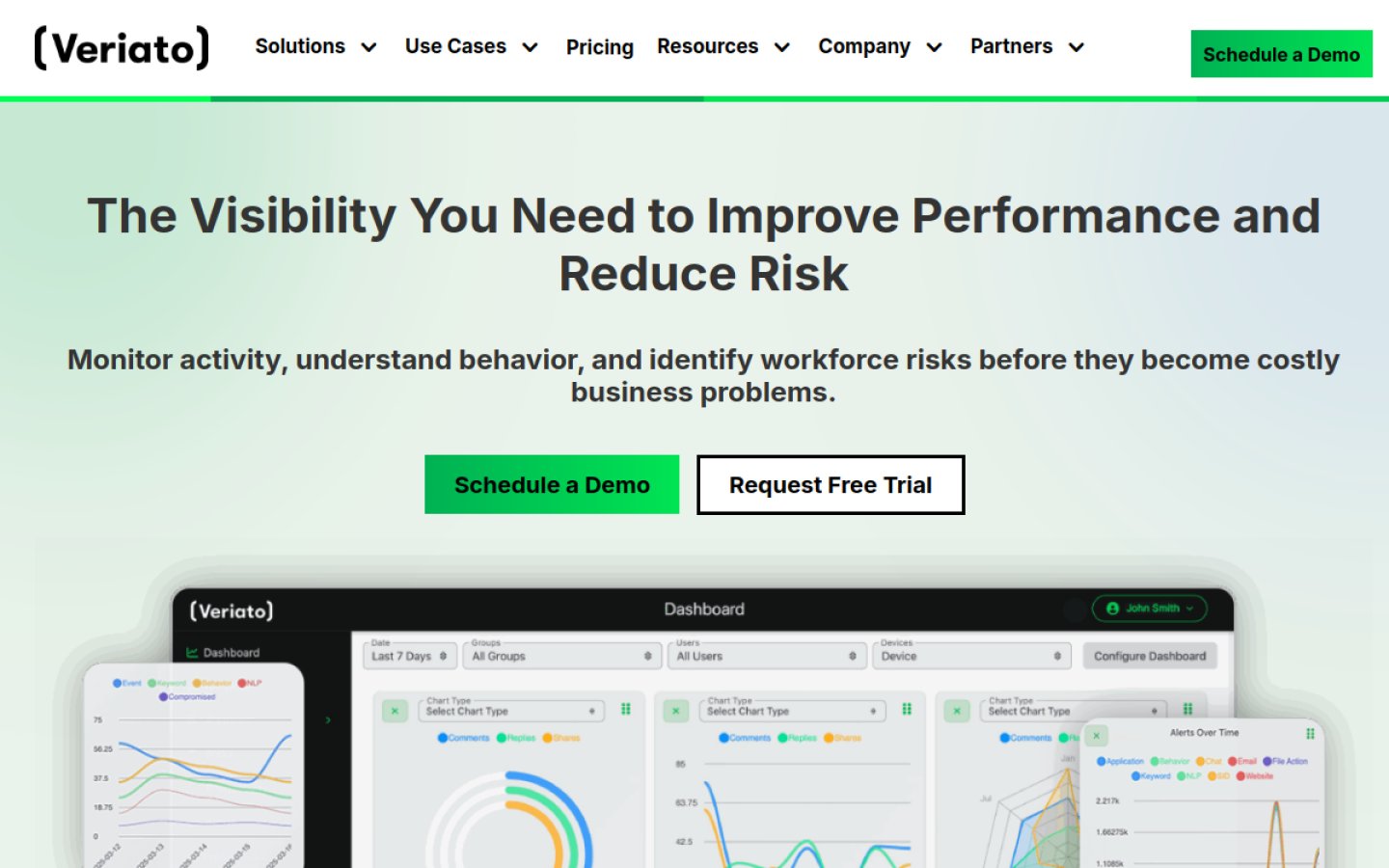
Veriato is the veteran of this niche, tracing back to SpectorSoft in 1998. Its UAM plan costs $18 a user a month billed yearly with a 5-user minimum, and one licence covers all of an employee's devices. The IRM tier adds AI-driven risk scoring with behavior baselining and sentiment analysis, tracking more than 130 behavioral signals in real time.
The trade off is access to the advanced tier. IRM is quote-only with a 20-user minimum, and the trial lasts only 7 days. It suits mid-size firms in finance, healthcare and government that need forensic detail without enterprise pricing.
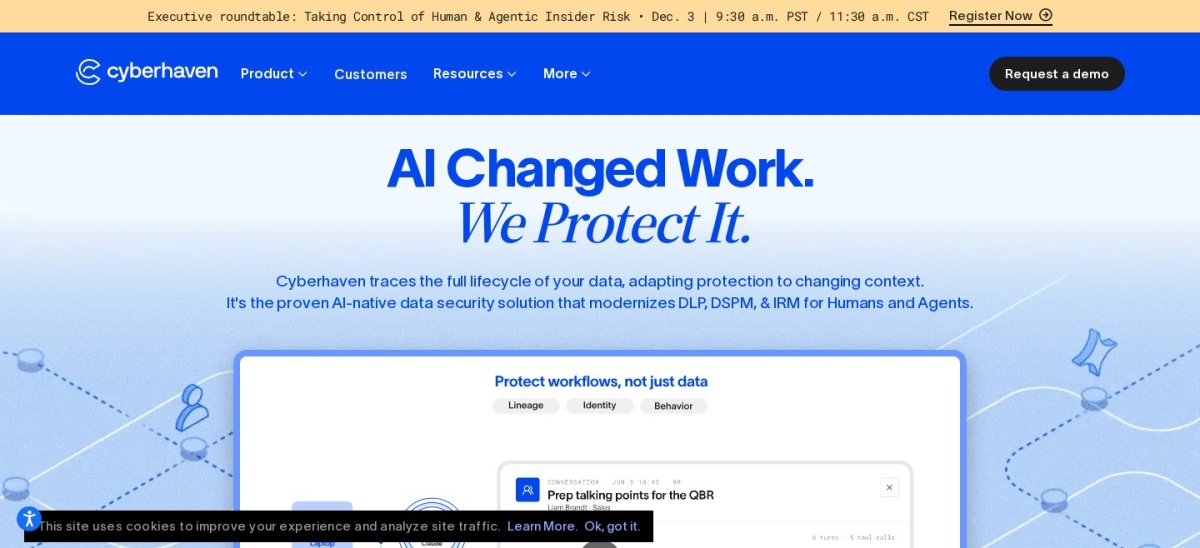
Cyberhaven is built around data lineage: it traces where a file came from before it left, so teams can see the full journey of sensitive data across endpoints, cloud apps and AI tools. User risk scoring is included without an extra subscription, and reviewers rate it 4.5 out of 5 on G2. G2 reports an average implementation of 2 months.
The trade off is maturity. Only 19 G2 reviews back the rating, reviewers note Linux coverage lags Windows and Mac, and pricing is quote-only. It suits teams protecting intellectual property and source code, where knowing a file's origin matters most.
What we like
Data lineage shows where a file came from, not just where it went
User risk scoring included at no extra cost
Covers data sent to generative AI tools
Reviewers praise the clear, visual interface
Watch out for
Only 19 G2 reviews, a small base for a 4.5 rating
Linux coverage lags behind Windows and Mac
Quote-only pricing with no published starting price
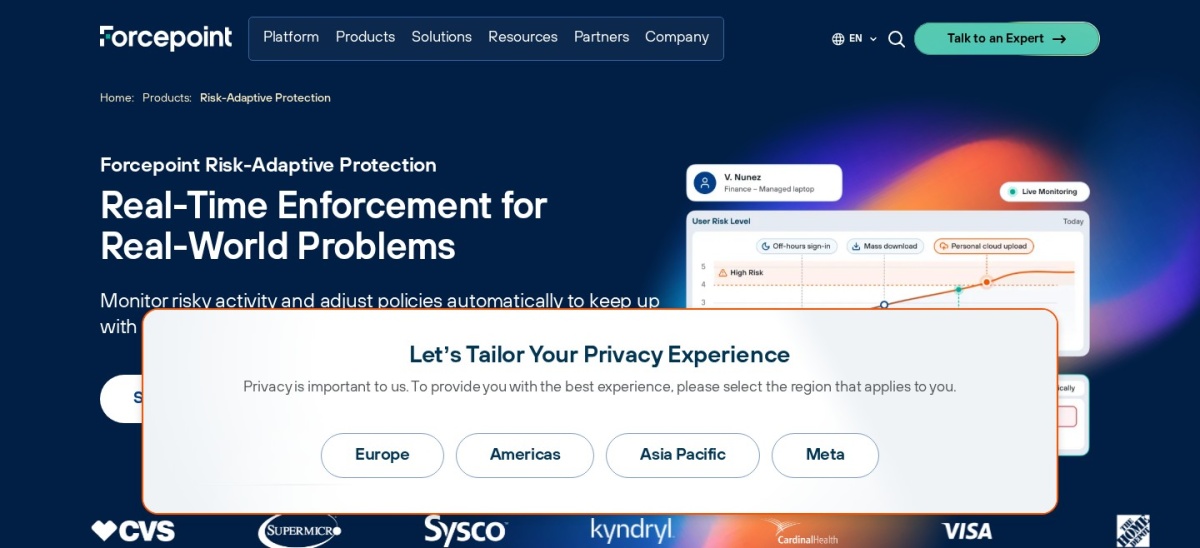
Forcepoint Insider Threat homepage, captured Nov 2026.
Forcepoint Insider Threat is a DLP-led tool that links insider risk detection directly to data loss prevention. It scores users in real time and tightens DLP enforcement as risk rises, so a risky user can be blocked from uploading sensitive files while a trusted user keeps working. It covers endpoint, email, web and cloud channels in one platform.
The trade off is that the standalone product listing no longer exists on G2, so the 4.2 rating and 104 reviews come from the wider Forcepoint Data Security Cloud listing. Pricing is quote-only. It suits large teams that already run Forcepoint DLP and want risk controls on top.
What we like
Risk scores drive live DLP enforcement, not just alerts
Covers endpoint, email, web and cloud in one platform
Largest review base in this list at 104 G2 reviews
Strong fit for teams already running Forcepoint DLP
Watch out for
G2 rating covers the wider Data Security Cloud suite
Quote-only pricing with no published starting price
Needs trained staff to tune policies and risk models
Monitoring vs risk scoring: two schools of insider threat tools
This list splits into two schools. Teramind, Proofpoint and Syteca record what users do, so investigators can replay a session and see exactly what happened.
DTEX-style tools and Microsoft Purview take the other route: they score behavior from metadata and keep identities hidden until risk justifies a closer look. That protects staff privacy but gives thinner evidence.
Most teams should decide this question first. If you need court-ready evidence, pick a recording tool. If staff trust and privacy law matter more, pick a scoring tool and accept lighter evidence.
How we chose
We started from the established insider threat vendors on G2, then kept the nine with a public G2 rating and review count, covering recording, data-centric and risk-scoring approaches.
Prices come from each vendor's own pricing page, checked on 25 November 2026. Ratings and review counts come from G2 on the same day. Where a vendor shows no price, the list says quote-only instead of guessing.
We left out DTEX, which has no public rating with a review count, and productivity monitors such as ActivTrak that are not insider threat tools. No vendor paid for a place, and we do not claim to have used these tools ourselves.
How to choose insider threat management software
Decide what evidence you need and what your staff will accept, then match the tool to that answer.
Pick your evidence model first. Choose session recording for court-ready proof, or risk scoring from metadata if staff privacy matters more. The two models rarely mix well in one tool.
Check what you already own. Microsoft 365 E5 shops already have Purview insider risk, and Forcepoint DLP users can add risk controls without a new platform.
Ask for the real entry price. Six of these nine tools are quote-only. Get a written per-user quote for your headcount, and ask what the minimum seat count is before you commit.
Run a short pilot with real alerts. Use the trial to see alert volume and false positives on your own staff. If the trial is only 7 days, ask the vendor to extend it before you sign.
FAQ
What is the best insider threat management software?
Teramind is the best pick for most teams. It combines session recording, behavior rules and DLP in one console, publishes pricing from $14 a seat a month, and is rated 4.6 out of 5 on G2 from 185 reviews.
How much does insider threat management software cost?
Only three tools here publish prices: Teramind from $14, Veriato from $18 and Microsoft Purview from $12 a user a month. Proofpoint, Varonis, Incydr, Syteca, Cyberhaven and Forcepoint are all quote-only, so expect a per-user price from sales.
Do employees know they are being monitored?
That depends on the tool and your policy. Recording tools such as Teramind and Veriato capture screens and keystrokes, so staff should be told. Scoring tools such as Microsoft Purview keep identities hidden until risk justifies a closer look.
Is Microsoft Purview enough for insider risk?
It is enough for Microsoft 365 shops that want risk scoring without a new agent. It sees Microsoft 365 and Defender signals well, but activity outside the Microsoft estate is thin, so teams with mixed systems often pair it with a recording tool.
What is the difference between insider threat software and DLP?
DLP stops sensitive data leaving through defined channels. Insider threat software adds the human side: it watches user behavior, scores risk per person and gives investigators a timeline of what someone did before data moved.
Which tool is best for catching a departing employee stealing files?
Mimecast Incydr is built for that case, with a departing-employee watchlist and file movement tracking across endpoints, cloud drives and email. Teramind is the stronger pick if you also want screen recordings as evidence.
SaaS SEO and WordPress specialist with about 8 years of experience. Rakib compares WordPress plugins, themes, hosting and software using public pricing, documentation and user reviews. See how we rank.