Best Identity Resolution Software in 2026: 9 Tools Compared
WLWPLegible EditorsLast verified 23 Nov 2026How we rank11 min read
★ Short answer
LiveRamp is the best identity resolution software for most enterprise teams, built on its RampID identifier for cookieless ad identity. Pick FullContact for an API-first identity graph, or Twilio Segment if you want a free tier and a published price.
How we make this list: we compare pricing pages, product documentation and public user reviews, then re-check every price before each update. No product paid for a place. Disclosure.
LiveRamp is the standard for cookieless ad identity, built on RampID, but it sells by custom quote with a 4-month average setup.
FullContact is the most accessible identity API, with a published $499-a-month Enrich bundle and billing only on matches.
Amperity is the pick for large consumer brands that need AI-led stitching inside a full customer data platform.
Twilio Segment is the only tool here with a free tier and a published paid plan, at $120 a month for the Team plan.
Seven of the nine tools sell by custom quote, so budget for a sales conversation before you see a price.
What identity resolution software does
Identity resolution links scattered records about the same person into one profile. An email from a form, a phone number from support and a device ID from an ad click all point to one customer.
The core test is the match: how often the tool links two identifiers correctly, and how often it links two different people by mistake. A high match rate with sloppy matching is worse than a lower rate you can trust.
Privacy rules shape every choice here. The tool should record consent, limit what it shares with each destination and let people opt out. Our guide on GDPR compliance for WordPress explains the consent basics that apply to any site collecting personal data.
Most of these tools are enterprise platforms sold by quote. Only FullContact and Twilio Segment publish a starting price, so treat the rest as a shortlist to take into sales calls, not a price comparison.
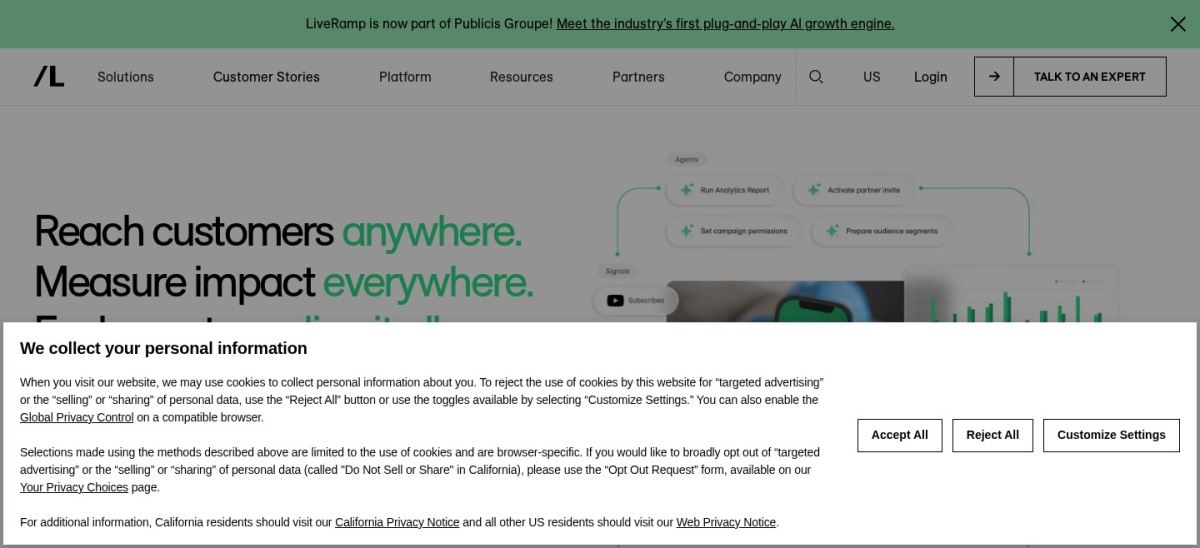
LiveRamp is a data collaboration platform built around RampID, a persistent identifier that links the same customer across devices, channels and media partners without third-party cookies. It onboards first-party data, matches it to its identity graph and activates audiences with publishers and ad platforms.
The trade off is price and setup. LiveRamp sells by custom quote, G2 reviewers cite high fixed costs and expensive overages, and G2 lists an average implementation time of 4 months. It suits large advertisers, retailers and publishers that need cookieless identity at scale.
What we like
RampID is the most widely used cookieless identifier
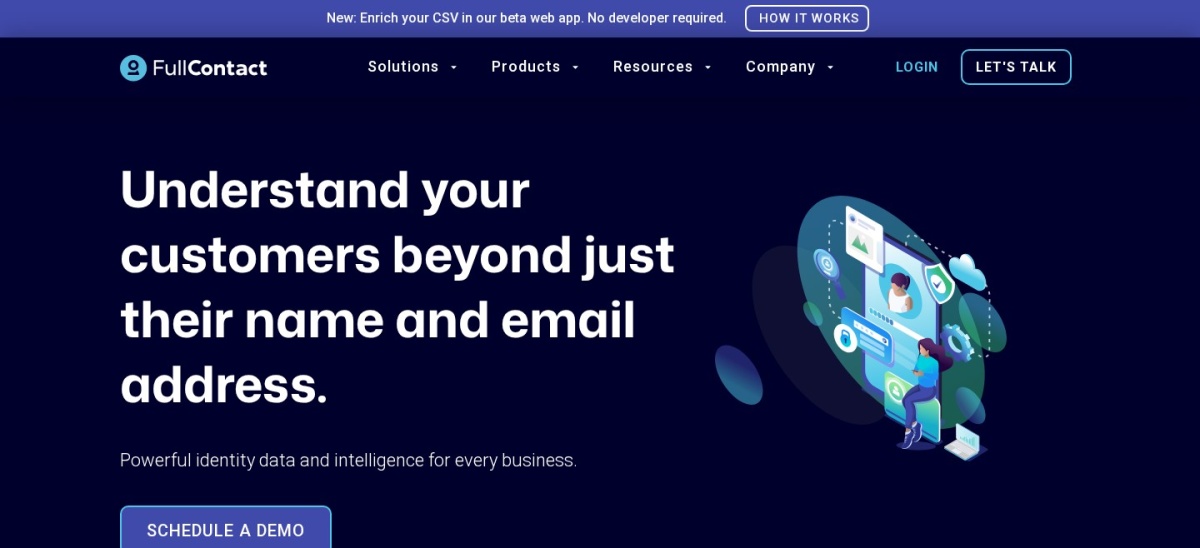
FullContact is an identity resolution API built on its Person-Centered Graph, which maps emails, phone numbers and device IDs to one person profile. Its Enrich API returns demographic and firmographic details for each match, and it charges only on successful matches.
The trade off is the match rate and the price. G2 reviewers report match rates near 50%, so half of lookups can return nothing, and the published Enrich bundle costs $499 a month for 5,000 demographic matches. It suits marketing and data teams that need person-level resolution through an API.
What we like
Published price, unlike most tools on this list
Pay only on matches, not on lookups
More than 900 demographic and firmographic details per match
Amperity is a customer data platform whose Stitch identity management unifies messy customer records from every source into one profile. That profile feeds segments, predictive models and activation to ad and marketing tools.
The trade off is cost and effort. Amperity sells by custom quote, G2 reviewers describe pricing as a barrier, and G2 lists an average implementation time of 7 months. It suits large consumer brands with messy data that need AI-led stitching inside a full CDP.
What we like
Strongest AI-led stitching for messy data
Identity, segments and predictions in one platform
Reviewers praise its analytics expertise and data accuracy
Tealium is a customer data hub built around AudienceStream, which unifies web, app, CRM and paid-media data into real-time customer profiles. It lists more than 1,300 pre-built connectors for collecting data and sending audiences to marketing tools.
The trade off is complexity. Tealium sells by custom quote, and G2 reviewers praise its real-time unification but warn of a steep learning curve, with an average implementation time of 4 months. It suits enterprise teams that want tag management, identity and activation in one hub.
Twilio Segment is a customer data platform that collects events from websites and apps and routes them to analytics and marketing tools. Its Unify feature builds unified profiles from those events, and its free Developer tier covers 1,000 monthly tracked users.
The trade off is that identity costs more than the entry price. The Team plan is $120 a month for up to 10,000 monthly tracked users, but Unify and Protocols sit on the custom-priced Business tier. It suits product and growth teams already collecting events with Segment.
What we like
Only tool here with a free tier and a published price
Largest review base on this list, 566 G2 reviews
More than 700 pre-built destinations
Watch out for
Identity resolution needs the custom Business tier
Free tier allows only 2 sources
Costs rise fast with event volume, per G2 reviewers
mParticle, now Rokt mParticle, is a customer data platform with real-time identity at its core. Its IDSync rules engine links anonymous and known identifiers into one profile, and features such as Match Boost aim to raise ad-platform match rates.
The trade off is price. mParticle sells by custom quote, and G2 reviewers warn that pricing can be high for startups and small businesses. It suits consumer apps and retailers that want real-time identity tied directly to paid-media audiences.
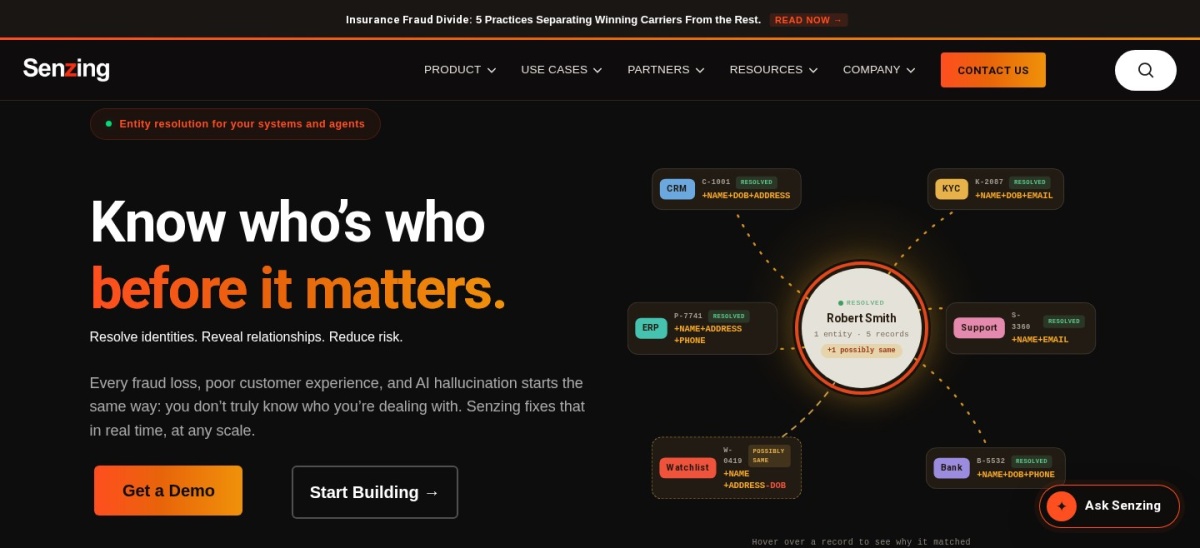
Senzing is an entity resolution engine, an SDK that runs inside your own systems and works out which records across CRM, support and other data refer to the same person or company. It is built for data and risk teams rather than marketers.
The trade off is that it is a developer tool, not a marketing platform. Senzing sells by custom quote with a free evaluation, and there is no marketer-friendly interface or built-in activation. It suits teams that need accurate matching inside their own stack.
What we like
Highest G2 rating on this list at 4.9 out of 5
Runs inside your own systems, so data stays put
Built for entity resolution, not as a side feature
Treasure Data is a customer data platform that unifies customer records into profiles and activates them across marketing channels. Its identity resolution sits inside a wider platform with segmentation, journeys and analytics.
The trade off is price and complexity. Treasure Data sells by custom quote, and G2 reviewers note that pricing can be complex and rise with add-ons. It suits enterprise teams that want identity plus a full CDP with strong integrations.
What we like
Identity, segments and journeys in one platform
Rated 4.5 out of 5 from 165 G2 reviews
Strong ease-of-use mentions on G2
Watch out for
No published price; every deal is a custom quote
Pricing can rise with add-ons, per G2
Enterprise focus, so small teams pay for depth they skip
Experian is a customer data platform built on its Customer Data Engine, which unifies customer data and adds identity resolution, segmentation and personalisation. Its data depth comes from its long history as a consumer data bureau.
The trade off is cost, setup and a thin review base. Experian sells by custom quote, G2 reviewers call it pricey with a complex setup, and its G2 page shows only 5 reviews. It suits regulated industries that value verified bureau data over a large review base.
What we like
Deepest verified consumer data on this list
Identity, segmentation and personalisation in one place
Identity resolution answers one question: which records belong to the same person. A customer data platform does that and then stores the profile, segments it and sends it to marketing tools.
If you already have a CDP, check what its identity feature covers before buying a separate tool. Segment, Tealium, Amperity, Treasure Data and mParticle all include identity inside the CDP.
A standalone identity tool fits when you need matching inside your own systems, as with Senzing, or through an API, as with FullContact. LiveRamp fits when the end goal is media activation rather than a stored profile.
How we chose
We started from the identity resolution tools most often listed in G2 identity and CDP categories, then kept nine established vendors with a live product and public reviews.
Prices come from the vendors' published pricing, checked on 23 November 2026. Ratings and review counts come from G2 on the same day. Where a vendor shows no price, the list shows a custom quote rather than a guess.
We left out tools with no usable G2 rating or no live identity product. No vendor paid for a place, and we do not claim to have used these tools ourselves for this list.
How to choose identity resolution software
Start with where the matched profile will be used, then work back to the tool that fits that job.
Decide the end use first. Media activation points to LiveRamp or mParticle, an API points to FullContact or Senzing, and a stored profile points to a CDP such as Amperity or Tealium.
Ask for a match-rate test on your own data. Vendor match rates vary by data quality, so run a sample file through a trial or evaluation before signing a contract.
Check consent and opt-out handling. The tool should record consent, limit sharing per destination and support deletion requests, not just store identifiers.
Get the full first-year cost in writing. Seven of these nine tools sell by quote, so ask for implementation, overages and add-ons in the same figure.
FAQ
What is the best identity resolution software?
LiveRamp is the best pick for most enterprise teams, built on its RampID identifier for cookieless ad identity. FullContact is the best API-first option, and Twilio Segment is the best choice if you want a free tier and a published price.
How much does identity resolution software cost?
Most tools sell by custom quote, so there is no standard price. The published exceptions are FullContact at $499 a month for an Enrich bundle and Twilio Segment Team at $120 a month, with identity features on its custom Business tier.
What is the difference between identity resolution and a CDP?
Identity resolution links records about the same person into one profile. A CDP does that and also stores the profile, segments it and sends it to marketing tools. Several tools on this list, such as Amperity and Tealium, are CDPs with identity built in.
Do I need a developer to use identity resolution software?
It depends on the tool. Senzing is an SDK that needs developers, and FullContact is an API. LiveRamp, Amperity and Tealium are platforms with vendor onboarding, but all of them need data work to set up.
Is identity resolution legal under privacy rules?
It can be, if consent is recorded, sharing is limited per destination and people can opt out or ask for deletion. Rules vary by region, so check the tool's consent and deletion features against the rules that apply to your audience.
Can small businesses use identity resolution software?
Most of these tools are priced for enterprises. Twilio Segment has a free tier for up to 1,000 monthly tracked users, and FullContact publishes a $499-a-month bundle, so those two are the realistic starting points for smaller teams.