Aleph is the best FP&A software for most mid-market teams, rated 4.9 out of 5 on G2 from 153 reviews, with spreadsheet-native modelling on live data and AI variance checks. Pick Drivetrain for AI-assisted planning or Fathom for low-cost three-way forecasting from $59 a month.
How we make this list: we compare pricing pages, product documentation and public user reviews, then re-check every price before each update. No product paid for a place. Disclosure.
Aleph leads the list at 4.9 out of 5 on G2, the highest rating here, with spreadsheet models on live data.
Seven of the nine tools are quote-only, so expect a sales call; only Fathom publishes a starting price, at $59 a month.
Fathom is the cheapest entry at $59 a month, while Jedox starts at $160 per user per month.
Aleph, Datarails and Cube keep Excel as the front end; Pigment and Abacum move planning to a visual or AI-led canvas.
Workday Adaptive Planning is the enterprise pick, with the largest review base at 409 G2 reviews and about 5 months to implement.
What FP&A software should do
FP&A software turns a finance team's drivers into a plan. Headcount, pricing, churn and hiring feed the profit and loss, balance sheet and cash flow, and scenarios show what happens when an assumption changes.
The best tools keep the plan live. Actuals should flow in from the ledger, payroll and CRM without a monthly rebuild, so the forecast always reflects the latest numbers.
Spreadsheet links matter more than feature lists. If your team builds in Excel, a tool that keeps Excel as the front end will be adopted faster than one that forces a new canvas, and AI assistants now draft forecasts and explain variances on top of either.
Price transparency is rare in this market. Most vendors price by quote, so the honest comparison is between the two tools that publish prices and the reported deal ranges of the rest. Our guide on budgeting for a WordPress website shows the same plan-versus-actual thinking on a smaller scale.
Check three things before you pay: which accounting systems it syncs with, whether consolidation and close are included or paid add-ons, and how long setup takes. A cheap plan that needs manual imports can cost more in staff time than a pricier one that syncs.
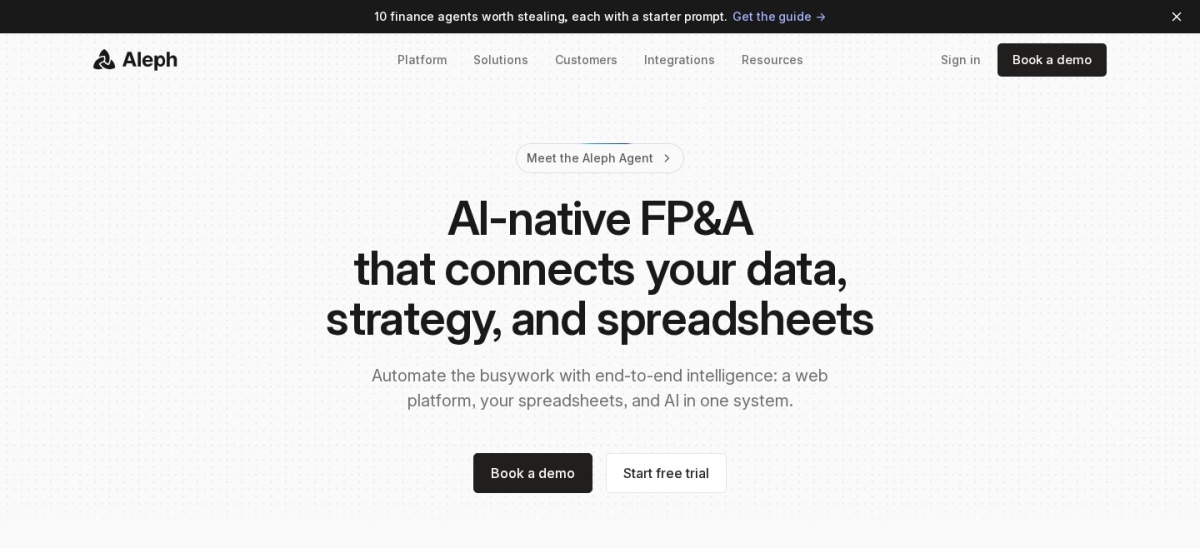
Aleph is an AI-native FP&A platform that keeps finance teams working in Excel and Google Sheets while it syncs live data underneath. Its two-way spreadsheet add-ins connect to more than 150 systems, including NetSuite, Salesforce and Snowflake, and its AI scan spots and explains variances in seconds.
The trade off is price. Aleph publishes no prices, so the first real number arrives after a sales call, and G2 reports about a month to implement. It suits mid-market finance teams that want spreadsheet modelling on live, governed data without a long build.
What we like
Highest G2 rating in this list, 4.9 out of 5
Two-way Excel and Google Sheets add-ins
150+ no-code connectors
AI variance explanations built in
Watch out for
No published pricing
Excel setup can be fiddly, per G2 reviewers
Some reviewers report slow loads on large models
Paid plans are custom quotes; ask for a demo on your own dataVisit getaleph.com
02
Drivetrain
4.8/5on G2 (65 reviews, checked Nov 2026)
PricingCustom/yr
Best for AI-assisted planning
Cheapest paidCustom quote
Integrations800+ systems
AI planningDrive AI suite
ImplementationAbout 3 months
drivetrain.ai
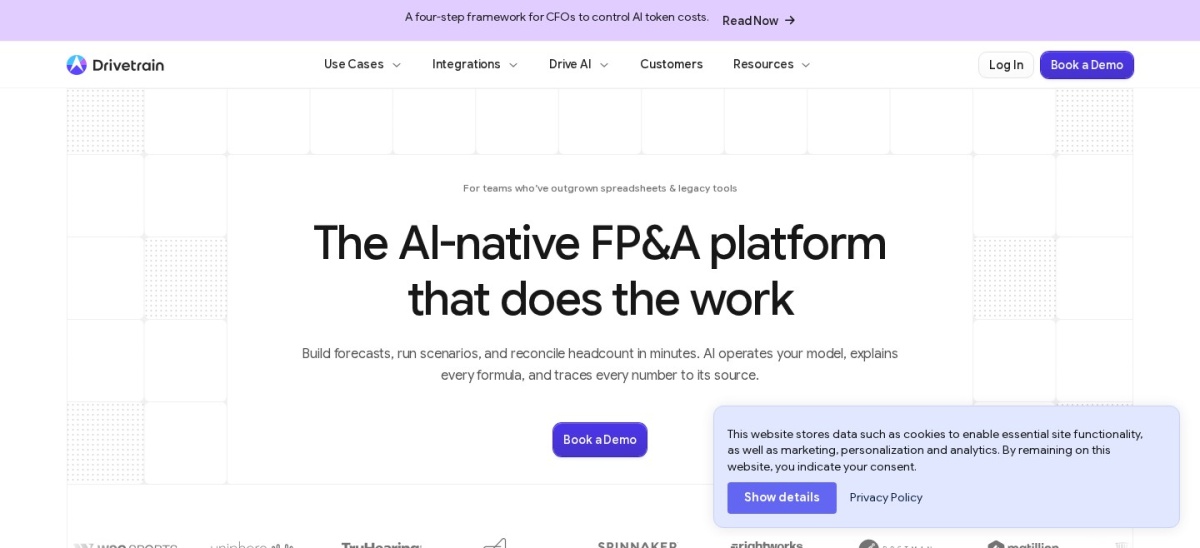
Drivetrain homepage, captured Nov 2026.
Drivetrain is an AI-native planning platform built for mid-market finance teams that want forecasts without a long build. Its Drive AI suite generates baseline models, answers planning questions in plain language and flags anomalies, and it connects to more than 800 business systems.
The trade off is price and maturity. Pricing is quote-only with no published starting price, and the company was founded in 2021, so it has a shorter track record than older planning vendors. It suits growing companies that want fast, AI-assisted planning and can wait for a sales quote.
What we like
Second-highest G2 rating in this list at 4.8 out of 5
AI model builder, analyst and anomaly detection built in
800-plus integrations for actuals and headcount data
Fastest ROI in its class at about 7 months on G2
Watch out for
Quote-only pricing with no published starting price
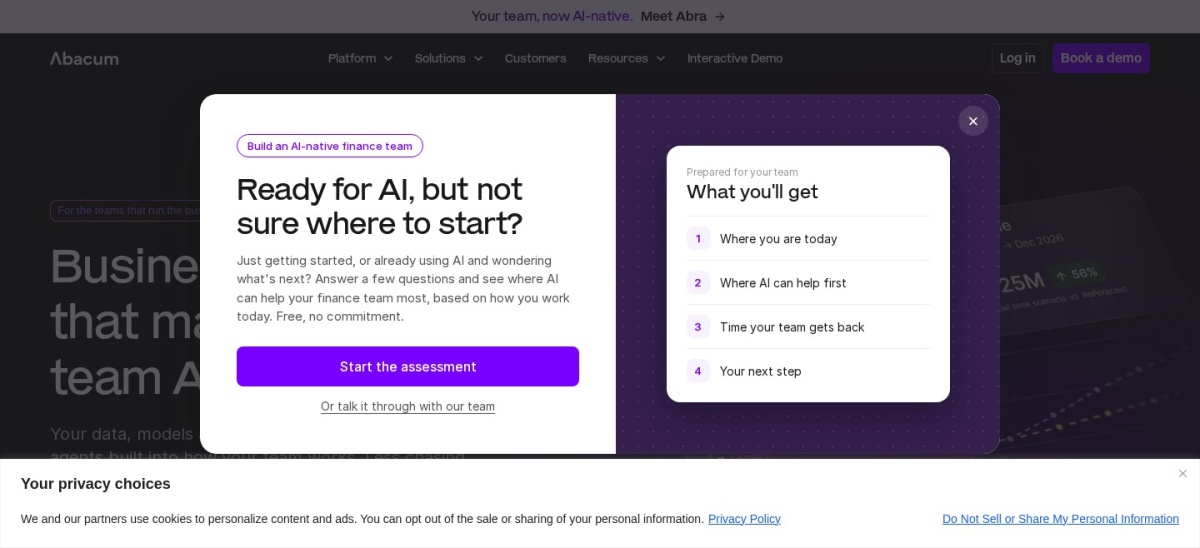
Abacum is an AI-native FP&A platform built for SaaS and high-growth finance teams. It offers driver-based models, headcount planning and AI forecasting, with expert onboarding and support included, and it is rated 4.7 out of 5 on G2 from 173 reviews.
The trade off is price and scope. Abacum publishes no prices, its pricing page redirects to the homepage, and it does no financial consolidation, so statutory reporting needs another tool. It suits mid-market SaaS teams that want collaborative planning without enterprise overhead.
What we like
Rated 4.7 out of 5 on G2
Purpose-built for SaaS metrics and drivers
Self-service setup with support included
AI forecasting and anomaly detection
Watch out for
No published pricing at all
No consolidation or statutory reporting
Some reviewers report a steep learning curve
Custom quote only; consolidation needs a separate toolVisit abacum.ai
04
Datarails
4.6/5on G2 (371 reviews, checked Nov 2026)
PricingCustom/yr
Best Excel-native planning for finance teams
Works inExcel and PowerPoint
Integrations600+ connectors
AI helpFP&A Genius assistant
Paid planCustom quote
datarails.com
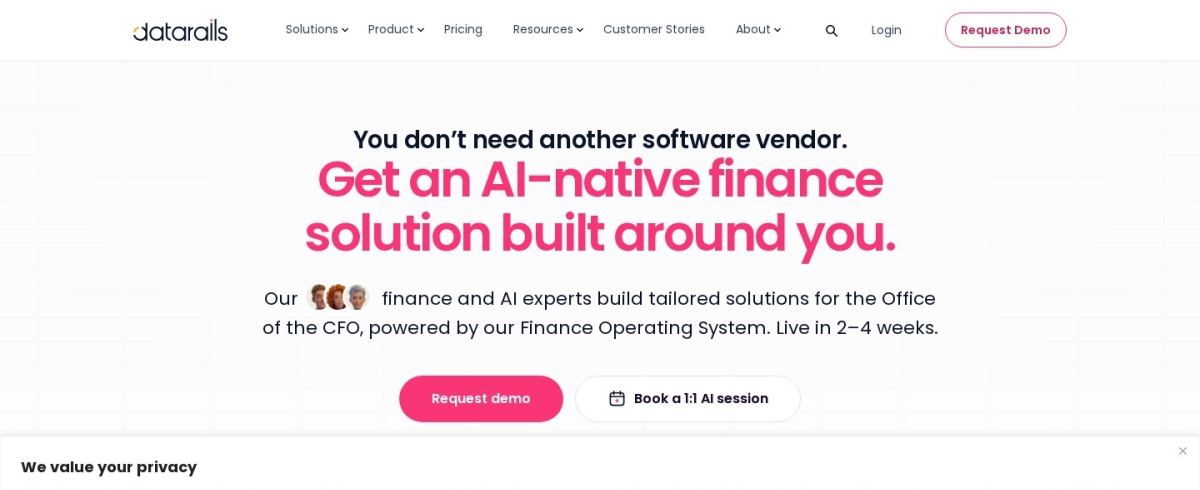
Datarails homepage, captured Nov 2026.
Datarails is an Excel-native FP&A platform that keeps models in Excel while a central database feeds them live actuals. It connects to more than 600 systems, turns data into board-ready Excel and PowerPoint packs, and adds an AI assistant, FP&A Genius, plus a month-end close add-on.
The trade off is price. Datarails is quote-only, with typical annual deals reported around $24,000 to $60,000, and implementation takes about 4 to 8 weeks. It suits finance teams that refuse to leave Excel but need governed, consolidated numbers.
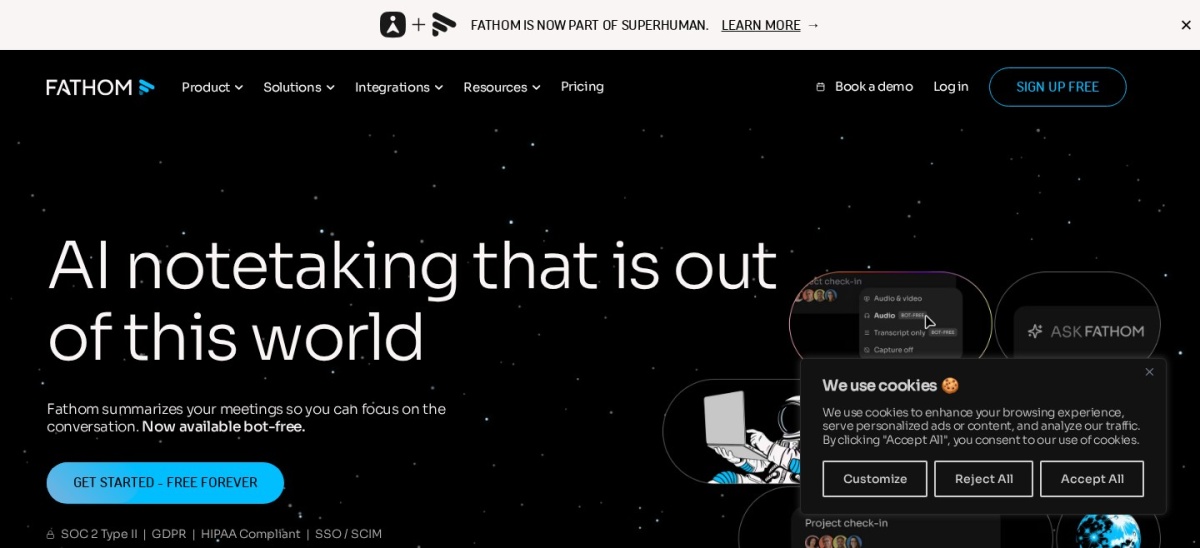
Fathom is a reporting and forecasting tool for small businesses and their accountants, built on top of Xero and QuickBooks. Pro starts at $59 a month per company and covers three-way forecasting across profit and loss, balance sheet and cash flow, plus custom KPIs.
The trade off is scope. Fathom forecasts well but does not run payroll or full FP&A workflows, and pricing is per company, so costs rise with each entity added. It suits accountants and small finance teams that want clear forecasts without enterprise software.
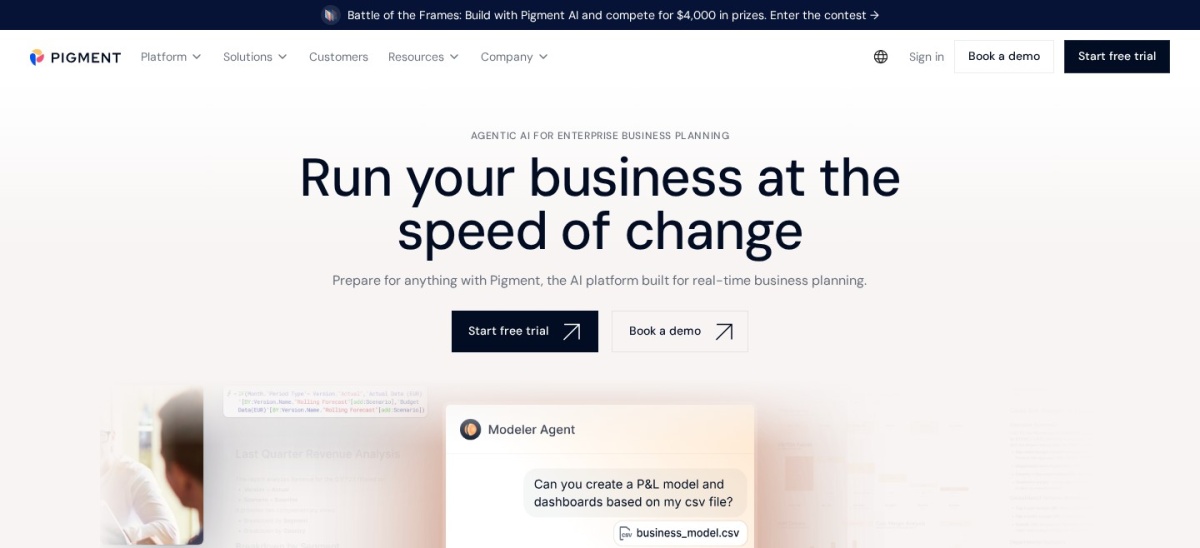
Pigment is a visual planning platform for scale-ups that have outgrown spreadsheets. Teams build models on a canvas, connect finance, sales and operations data, and run scenarios in real time, and its Analyst and Modeler agents draft analysis and build models from plain-language prompts.
The trade off is price and maturity. Pricing is quote-only, with median yearly deals reported around $74,000, and some of its AI agents were still in preview during 2026. It suits growing companies that want modern visual planning without enterprise-suite complexity.
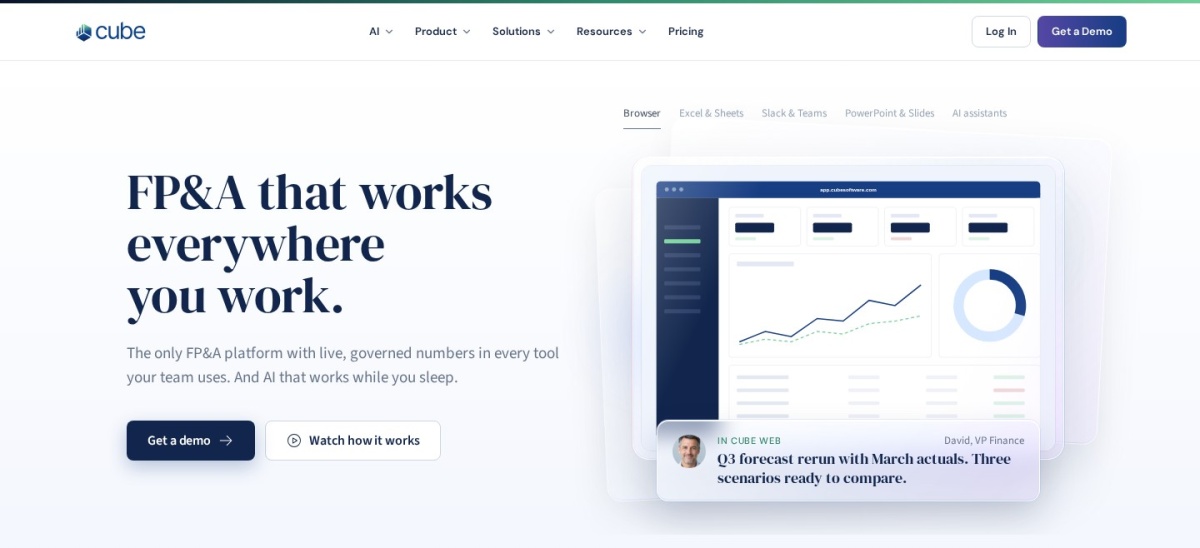
Cube is a spreadsheet-native FP&A platform, so models stay in Excel and Google Sheets while a governed data layer feeds them. It adds an AI suite, FP&Agent, for plain-language questions, variance checks and forecasting, and plans are priced by legal-entity count.
The trade off is price. Cube moved to quote-only pricing in 2026, with Bronze, Silver and Gold tiers and no published figures, so budgeting needs a sales call. It suits mid-market teams that want spreadsheet modelling with governed data and a quick rollout.
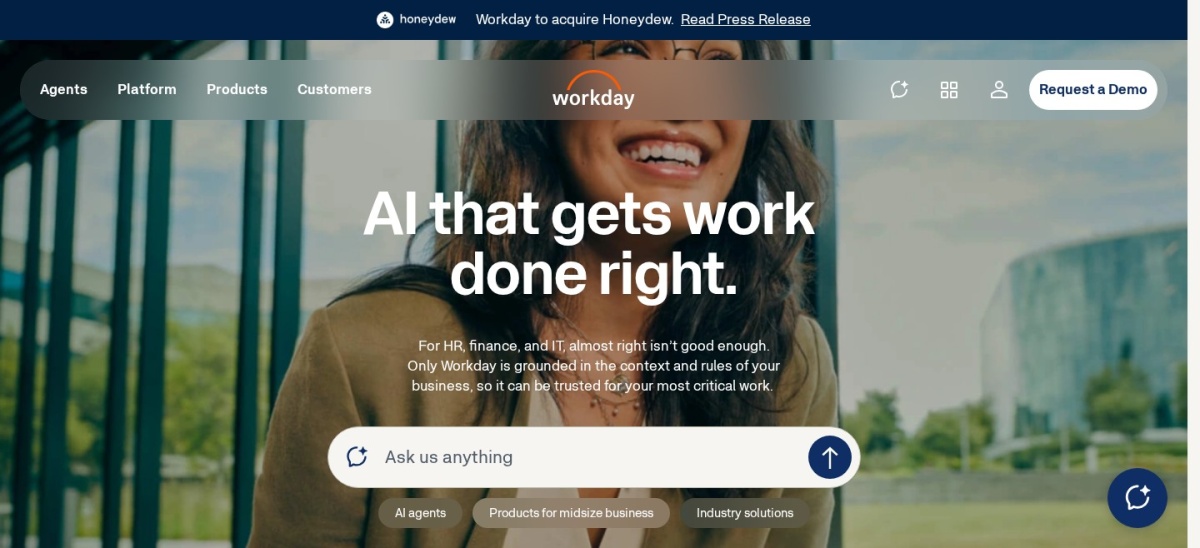
Workday Adaptive Planning homepage, captured Nov 2026.
Workday Adaptive Planning is the enterprise FP&A platform from Workday, built for large finance teams that plan across departments. It covers budgeting, forecasting, workforce planning and reporting in one model, with real-time collaboration and dashboards, and it connects to Workday financials and other source systems.
The trade off is time and cost. Pricing is quote-only with no published starting price, and G2 reports implementation takes about 5 months. It suits large teams that need governed, company-wide planning and already run Workday.
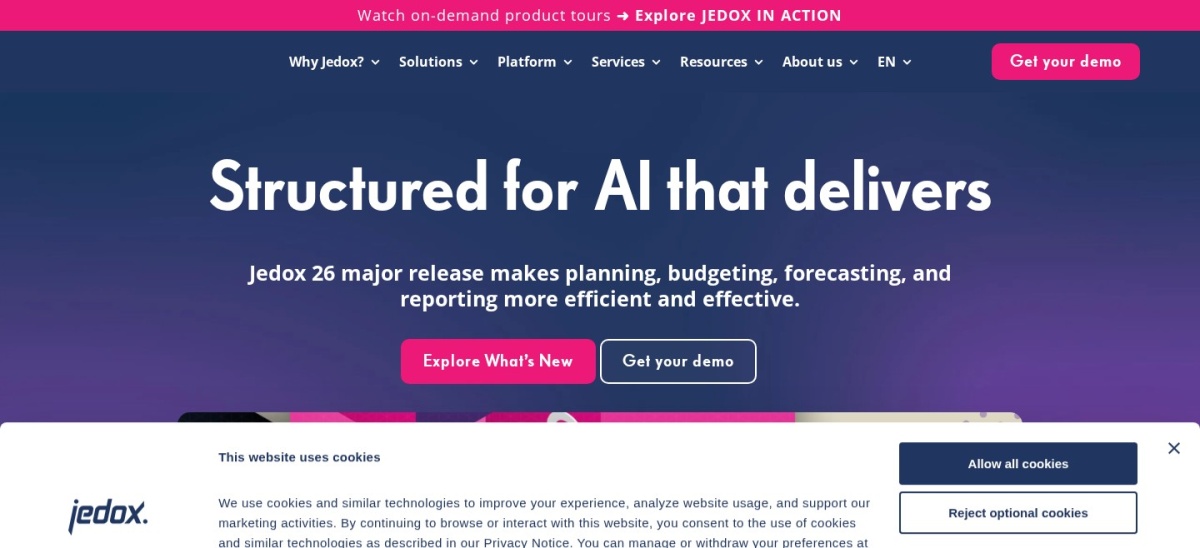
Jedox is a planning platform built on a multi-cube OLAP model with driver-based logic, spreads, allocations and parallel versions for plan, forecast and simulation. Basic costs $160 per user per month, per G2, and packaged solutions cover integrated planning, HR, ESG and consolidation.
The trade off is cost per seat. At $160 per user per month, a large team pays far more than a flat-rate tool, and reviewers report slow performance on large datasets and complex reports. It suits mid-market and enterprise teams that need flexible, Excel-like modelling with real consolidation.
What we like
Rated 4.3 out of 5 on G2 from 188 reviews
Flexible multi-cube modelling
Consolidation with IFRS, HGB and US GAAP
Free trial available
Watch out for
Per-user price adds up fast
Slow on large datasets, per reviewers
Learning curve for new users
Higher tiers add premium support and more capacityVisit jedox.com
Quote-only pricing: what to expect
Seven of the nine tools in this list do not publish prices. That is normal in this market: vendors price by users, entities and integrations.
Ask for the full first-year cost, including implementation and support, before you compare two quotes. Implementation commonly runs 4 to 16 weeks across these tools, and Workday Adaptive Planning averages about 5 months.
If you need a number before a sales call, Fathom is the only tool here with a published starting price, at $59 a month. Jedox lists $160 per user per month on G2, though its own page is quote-only.
How we chose
We started from the FP&A platforms most often named in 2026 buyer guides, then kept nine established tools that cover spreadsheet-native planning, visual planning, AI-led planning and enterprise connected planning.
Prices come from vendor pricing pages and published rate cards checked on 26 November 2026. Fathom publishes a starting price, and Jedox's $160 per user per month comes from G2, as its own page is quote-only; the other seven are quote-only, so this list shows Custom and notes reported deal ranges where buyer data exists. Ratings come from G2 on the same date.
We left out tools with no current standalone product page, including Mosaic, whose site now redirects to its acquirer. No vendor paid for a place, and we do not claim to have used these tools ourselves.
How to choose FP&A software
Start with where your team already models, then check the price and the close before you buy.
Decide where the model lives. If your team will not leave Excel, pick Aleph, Datarails or Cube. If you want a visual canvas, look at Pigment instead.
List your drivers before you demo. Headcount, pricing, churn and hiring plans are the inputs that matter. A tool that cannot model your drivers will not help, whatever its feature list says.
Get the full first-year cost in writing. License, implementation and support are often quoted separately. Quote-only tools need a written breakdown before you can compare them fairly.
Check the close, not just the forecast. A model is only useful if actuals flow in. Ask how the tool pulls ledger data and how long the monthly close takes once it is live.
FAQ
What is the best FP&A software?
Aleph is the best pick for most teams. It keeps models in Excel and Google Sheets, adds a governed data layer with live actuals, and is rated 4.9 out of 5 on G2 from 153 reviews.
How much does FP&A software cost?
It varies widely. Fathom publishes Pro at $59 a month, and G2 lists Jedox Basic at $160 per user per month. The other tools here are quote-only, with reported yearly deals ranging from about $24,000 for Datarails to about $110,000 or more for enterprise platforms.
Do I need to leave Excel to use FP&A software?
No. Aleph, Datarails and Cube keep Excel, and Google Sheets for Aleph and Cube, as the modelling surface and add governance underneath. Pigment and Abacum replace the spreadsheet with a visual or AI-led planning canvas.
Which FP&A tool is best for a small finance team?
Fathom fits small teams best: published pricing from $59 a month, three-way forecasting and a free trial. Aleph is the other strong small-team pick if you want to stay in spreadsheets.
What is the difference between FP&A software and financial modelling software?
Financial modelling is the core job: building forecasts and scenarios from drivers. FP&A software adds the surrounding workflow, such as consolidation, close management and board reporting, around the same models.
Can FP&A software replace spreadsheets entirely?
It can, but most teams keep spreadsheets for ad-hoc work. The value of these tools is governance: one shared model, live actuals, version control and an audit trail that a folder of spreadsheet files cannot give you.
SaaS SEO and WordPress specialist with about 8 years of experience. Rakib compares WordPress plugins, themes, hosting and software using public pricing, documentation and user reviews. See how we rank.