Best FP&A Software for Startups in 2026: 9 Tools Compared
WLWPLegible EditorsLast verified 23 Nov 2026How we rank14 min read
★ Short answer
Jirav is the best FP&A software for most startups, with driver-based budgets and forecasts from $10,000 a year and a 4.7 out of 5 G2 rating. Pick Aleph if your team lives in Excel, or Float if cash forecasting is the job.
How we make this list: we compare pricing pages, product documentation and public user reviews, then re-check every price before each update. No product paid for a place. Disclosure.
Jirav is the top pick with published pricing: Starter costs $10,000 a year, Pro $15,000 a year.
Aleph holds the highest G2 rating in this list at 4.9 out of 5 from 153 reviews.
Four of the nine tools publish no price, so expect a sales call before you see a number.
Float is the cheapest paid start at $105 a month on annual billing, with a 14-day free trial.
Causal is the only tool with a free plan, and its paid plan starts at $250 a month.
What startup FP&A software should do
A startup outgrows plain spreadsheets when the model gets passed between founders, finance and the board. Versions drift, formulas break, and nobody trusts the runway number.
Good FP&A software keeps one live model fed by actuals from your accounting system. Look for driver-based planning, rolling forecasts, scenario comparison and a clear cash runway view.
Pricing splits the market in two. Five tools here publish a price, from $59 a month to $10,000 a year, while four quote only. Our guide on budgeting for a WordPress website covers the same discipline of setting a budget before you spend.
Most of these tools connect to QuickBooks or Xero, and several add NetSuite, Stripe, Salesforce or HR data. If your books live somewhere else, check the integration list before the demo.
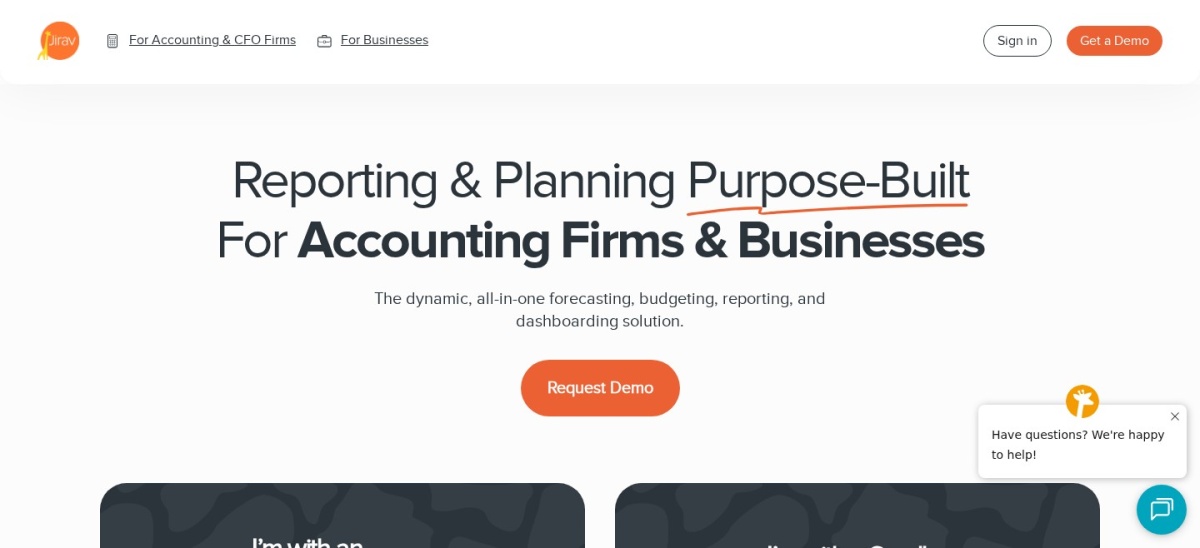
Jirav is a cloud FP&A platform built for startups and small finance teams. It connects accounting data, builds driver-based budgets and rolling forecasts, and turns them into board-ready reports and dashboards, with up to 24 months of data on the Starter plan.
The trade off is the entry price. Starter costs $10,000 a year for company-level planning with 2 admins, and departmental budgeting needs Pro at $15,000 a year. It suits startups with a first finance hire who need a real plan, not another spreadsheet.
What we like
Published pricing, rare in this category
Driver-based budgets, forecasts and scenarios
Board-ready report templates included
Rated 4.7 out of 5 on G2 from 195 reviews
Watch out for
Starter covers company-level planning only
$10,000 a year is steep for a pre-revenue team
No free plan
Pro adds departmental budgeting and longer modelsVisit jirav.com
02
Aleph
4.9/5on G2 (153 reviews, checked Nov 2026)
PricingCustom/yr
Best for planning in Excel and Sheets
PricingQuote only
Spreadsheet add-insExcel and Google Sheets
Integrations150+ connectors
Free trialYes
getaleph.com
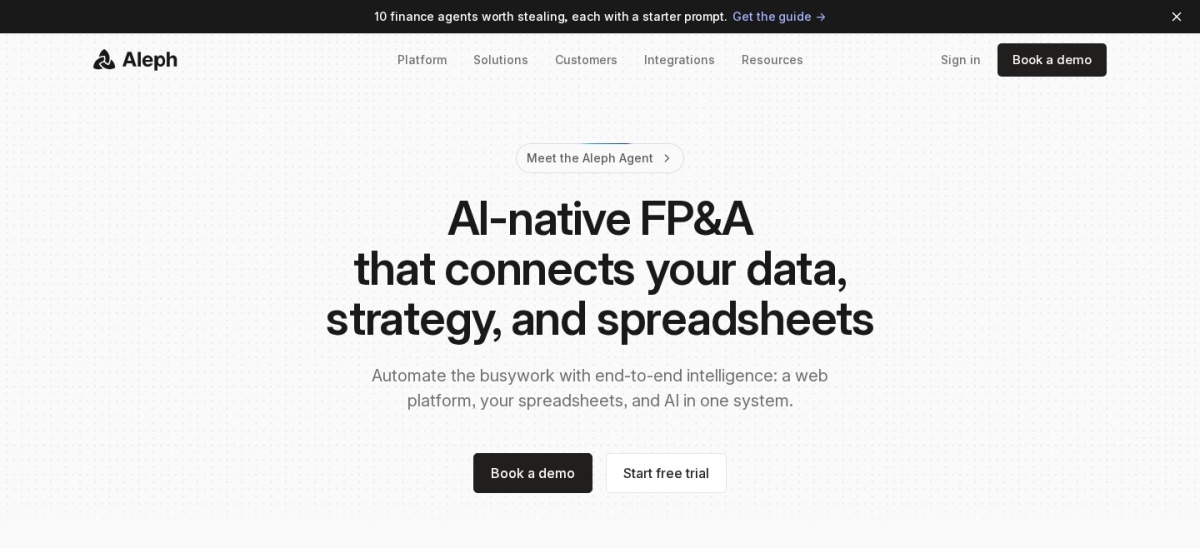
Aleph homepage, captured Nov 2026.
Aleph is an AI-native FP&A platform that keeps planning inside Excel and Google Sheets. Live actuals flow from your ERP, CRM and HRIS into the sheets through 150+ connectors, and AI Scan flags forecast variances. G2 reviewers rate it 4.9 out of 5 from 153 reviews.
The trade off is pricing. Aleph publishes no price, and every deal is a custom quote after a demo, with Essentials and Premium tiers. It suits Series A to pre-IPO teams that refuse to leave their spreadsheets but need live data behind them.
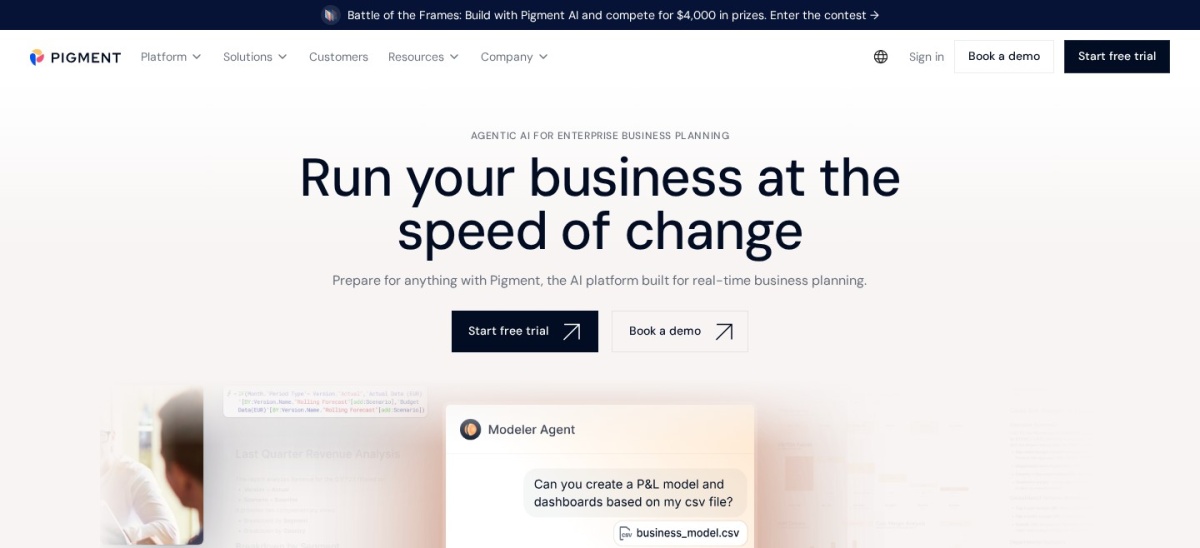
Pigment is a modern planning platform for growth-stage and mid-market teams. It offers flexible multi-dimensional models, scenario planning and agentic AI that builds models and dashboards, with customers including Unilever, Siemens, Klarna and Figma. G2 reviewers rate it 4.6 out of 5 from 125 reviews.
The trade off is scale and cost. Pigment publishes no price, entry deals start near $30,000 a year by third-party estimates, and G2 reports about 4 months to implement. It suits startups that have outgrown spreadsheets and expect headcount and planning complexity to keep growing.
Abacum is an AI-native business planning platform for SaaS and high-growth teams. It connects ERP, CRM, HRIS and warehouse data into one place for budgeting, forecasting, headcount and revenue planning, and its Abra agent answers questions, builds models and drafts board packs. G2 reviewers rate it 4.7 out of 5 from 173 reviews.
The trade off is pricing and depth. Abacum publishes no price, with a third-party median near $37,000 a year, and it does no multi-entity consolidation. It suits SaaS startups that want collaborative planning with AI help and no outside consultants.
4.5/5on Capterra (1,621 reviews, checked Nov 2026)
Starts at$105/mo
Best for cash flow forecasting
Cheapest planEssentials, $105/mo annual
Cash forecast13 weeks rolling
Forecast horizonUp to 36 months
Free trial14 days
floatapp.com
Float homepage, captured Nov 2026.
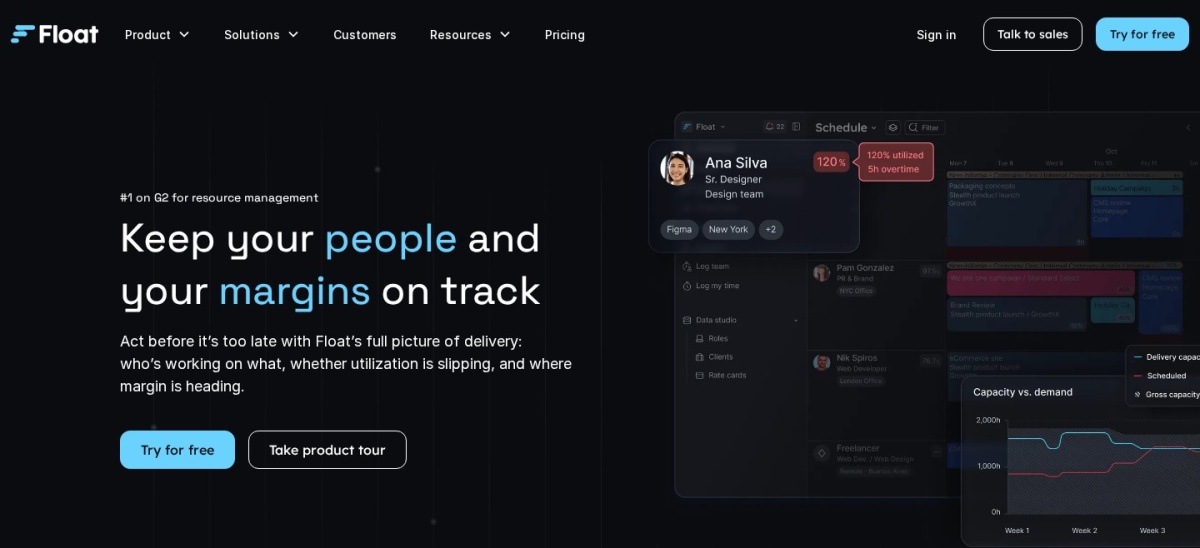
Float is a cash flow forecasting tool for teams that run Xero or QuickBooks Online. It pulls reconciled transactions daily and turns them into a 13-week rolling forecast plus monthly views up to three years out, with unlimited users on every plan. Capterra reviewers rate it 4.5 out of 5 from 1,621 reviews.
The trade off is scope. Float forecasts cash, it does not do full FP&A planning, headcount or departmental budgets, and the Essentials plan costs $105 a month on annual billing. It suits early startups whose main question is how long the cash lasts.
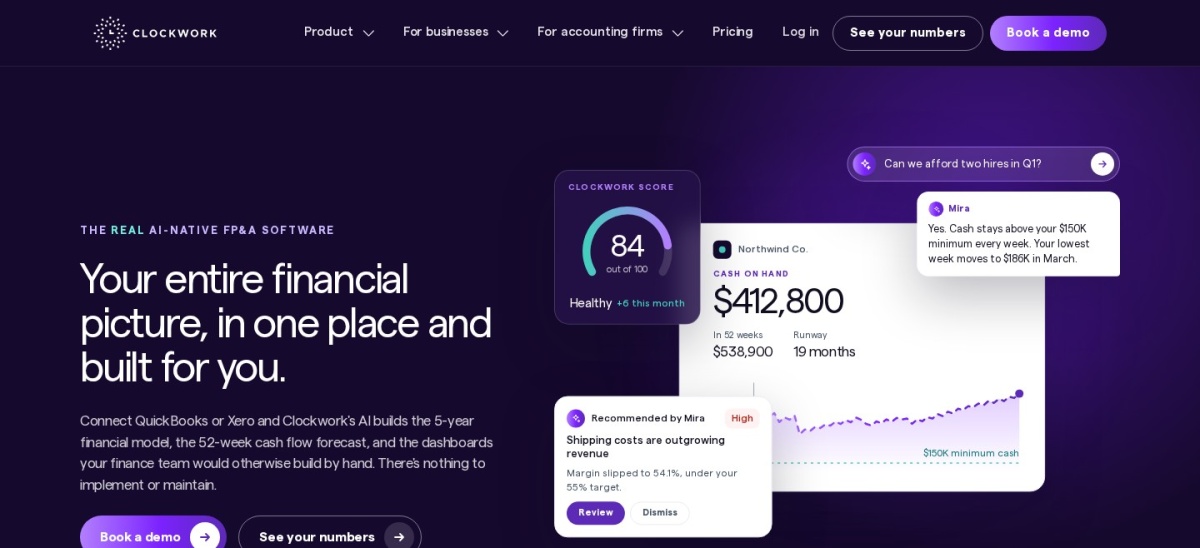
Clockwork is an FP&A platform for businesses on QuickBooks or Xero. Connect your books and it builds a 52-week cash flow forecast, a five-year three-statement model and live dashboards in about five minutes, with Mira, an AI analyst that answers plain-English questions about the numbers. G2 reviewers rate it 4.9 out of 5 from 47 reviews.
The trade off is the ledger limit. Clockwork works with QuickBooks and Xero only, with no NetSuite or Sage Intacct connection, and business plans start at $719 a month on annual billing. It suits small businesses that want a forecast built for them, not a model to build.
What we like
Forecast and model built in about five minutes
Mira AI analyst answers questions in plain English
Fathom is a reporting and analysis platform for small businesses and the accountants who serve them. It turns accounting data into branded management reports, KPI dashboards and three-way cash flow forecasts, with multi-currency consolidations and eliminations. G2 reviewers rate it 4.6 out of 5 from 176 reviews.
The trade off is planning depth. Fathom reports and forecasts well, but it is not a driver-based planning platform, and the $59 a month Pro plan covers one company. It suits startups that need clear monthly reports for founders, lenders or investors.
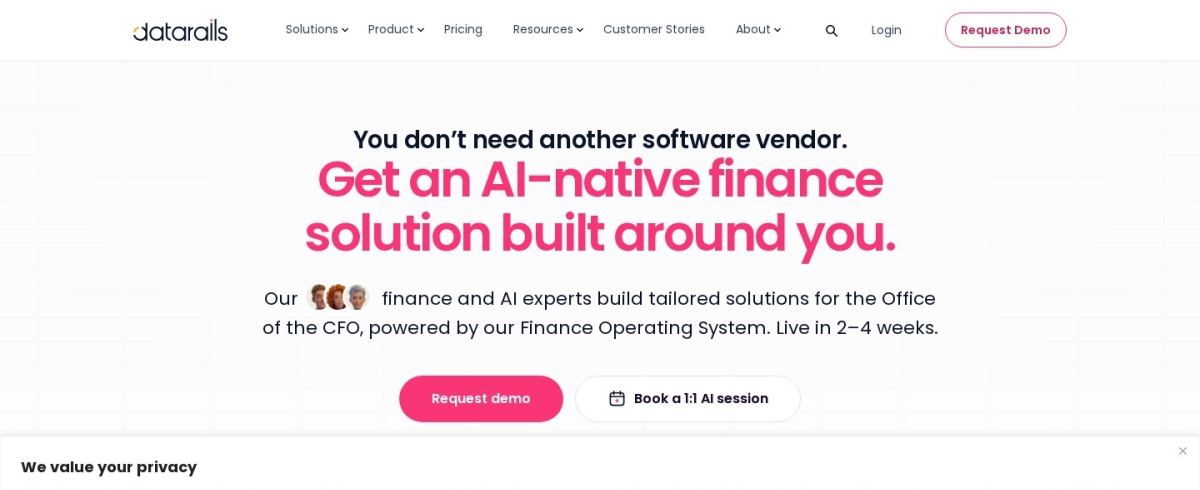
Datarails is an Excel-native FP&A platform that keeps Excel as the working tool and feeds it from a central database. It builds P&L, balance sheet and cash flow packs for Excel, PDF and PowerPoint, consolidates entities with currency translation and eliminations, and adds AI agents and storyboards. G2 reviewers rate it 4.6 out of 5 from 392 reviews.
The trade off is price and setup. Datarails publishes no price, third-party estimates start near $24,000 a year, and the entry Professional plan covers 2 users and 1 integration. It suits finance teams that build the monthly pack in Excel and want it fed from mapped ledger data.
Causal is a browser-based modeling tool for seed and Series A teams. You build models with named variables instead of spreadsheet cell references, connect QuickBooks, Xero, Stripe or Salesforce, and share interactive dashboards that update when assumptions change. GetApp reviewers rate it 4.8 out of 5 from 18 reviews.
The trade off is its future. Causal was acquired by Lucanet in 2024 and now sits inside its platform, and one source reports startup pricing was phased out, though G2 still lists a free plan and a $250 a month Startup plan. It suits founders who need a clean runway model before buying a full platform.
Four of the nine tools publish no price. That is normal for FP&A software, but it means the first number you see is the one you negotiate.
Ask every vendor the same three questions: the annual subscription for your user count, the one-off implementation fee, and the price in year two. Implementation and renewal uplifts are where the real cost hides.
Third-party estimates put entry contracts near $24,000 a year for Datarails and $30,000 for Pigment. Treat those as rough guides, not quotes, and get the number in writing before you shortlist.
How we chose
We started from FP&A tools aimed at startups and small finance teams, then kept nine with an established product, a public rating base and a clear startup use case.
Prices come from each vendor's pricing page or a dated read of it, checked on 23 November 2026. Ratings come from G2, Capterra or GetApp on the same day. Where a vendor publishes no price, the list says so instead of repeating a third-party estimate as fact.
We left out Finmark, whose standalone product ended on 1 April 2026, Cube, whose pricing page no longer publishes prices, Mosaic, which now ships only inside HiBob, and Runway Financial, whose homepage could not be confirmed. No vendor paid for a place, and we do not claim hands-on testing for this list.
How to choose FP&A software for your startup
Match the tool to the size of the job, not the size of the vendor's customer list.
Start from your accounting system. If you run QuickBooks or Xero, Float, Clockwork and Fathom connect in minutes. NetSuite or multi-entity books point to Aleph, Pigment or Datarails instead.
Decide how much model you need. A runway and cash forecast is enough before Series A, and Causal or Float covers it. Departmental budgets and headcount planning need Jirav, Abacum or Pigment.
Ask for the full first-year cost. Get the subscription, implementation fee and year-two price in writing. Quote-only tools can look cheap until the implementation quote arrives.
Run your own numbers in the trial. Use the free trial or demo with your own books, not the vendor's sample data. If the forecast does not build in the first session, it will not get easier later.
FAQ
What is the best FP&A software for startups?
Jirav is the best pick for most startups. It combines driver-based budgets, rolling forecasts and board-ready reports from $10,000 a year, and it is rated 4.7 out of 5 on G2 from 195 reviews.
How much does FP&A software cost for a startup?
Published prices in this list run from $59 a month for Fathom to $10,000 a year for Jirav Starter. Four of the nine tools publish no price, and third-party estimates put their entry contracts near $24,000 to $30,000 a year.
Is there a free FP&A tool for startups?
Causal is the only tool here with a free plan, and its paid Startup plan costs $250 a month. The free plan covers basic models only, without automated actuals sync, so most teams outgrow it quickly.
Do I need FP&A software or is a spreadsheet enough?
A spreadsheet works until the model is shared, versions drift and the runway number stops being trusted. FP&A software earns its keep when actuals, forecasts and scenarios must stay in one live model.
What is the difference between FP&A software and accounting software?
Accounting software records what happened, and it keeps the books, invoices and tax records in order. FP&A software plans what happens next, with budgets, forecasts, scenarios and runway views built on top of those actuals.
Which FP&A tool is best for QuickBooks or Xero?
Clockwork builds a full forecast and five-year model from QuickBooks or Xero in about five minutes, and Float adds a trusted rolling cash forecast. Both offer 14-day trials with no credit card.