Datarails is the best financial forecasting software for most finance teams, with a 4.6 out of 5 G2 rating from 396 reviews and planning that stays in Excel. Jirav is the best value pick with published pricing from $10,000 a year, while Anaplan suits large enterprises that need connected planning.
How we make this list: we compare pricing pages, product documentation and public user reviews, then re-check every price before each update. No product paid for a place. Disclosure.
Datarails leads with a 4.6/5 G2 rating from 396 reviews and Excel-native planning that goes live in 2–4 weeks.
Jirav is the only tool here with published list pricing: Starter from $10,000 a year and Pro at $15,000 a year.
Anaplan, Planful, Cube, Vena, Prophix One and Pigment all sell on custom quotes, so budget for a sales call.
Fathom is the cheapest entry point at $59 a month for one company, with three-way cash flow forecasting.
Cube is the fastest to implement at about 2 months, against 4–5 months for most rivals in this list.
What financial forecasting software should do
A forecast is only useful if it updates when the actuals change. Good forecasting software pulls live numbers from your accounting system, rebuilds the forecast without retyping, and shows the variance against the plan in the same view.
The tools in this list fall into two groups. Datarails, Cube and Vena keep Excel or Google Sheets as the working surface, while Anaplan, Planful, Prophix One and Pigment move planning into a governed web platform.
Price is the hardest thing to compare here. Seven of the nine tools publish no price at all, so the list shows Custom where the vendor quotes per deal. Our guide on budgeting for a WordPress website shows the same discipline: set the budget first, then shortlist tools that fit it.
Implementation time matters as much as the licence. Cube averages about 2 months to go live, most rivals take 4–5 months, and Anaplan averages 6 months, so a tool that looks cheap can cost a quarter of planning time.
Datarails is an FP&A platform that keeps Excel as the front end while adding a governed database behind it. The Professional plan covers unlimited dashboards, reporting and planning for 2 users with 1 integration, and the vendor states teams go live in 2–4 weeks.
The trade off is price. Datarails publishes no prices, so every plan is a custom quote, and G2 reviewers report an average implementation of 4 months. It suits mid-market finance teams that want to keep their Excel models and stop emailing spreadsheet versions around.
What we like
Keeps Excel as the working surface
Unlimited dashboards, reporting and planning on every plan
AI agents and storyboards included on plans
Watch out for
No published prices; every deal is a quote
G2 reports a 4-month average implementation
Smallest plan covers only 2 users and 1 integration
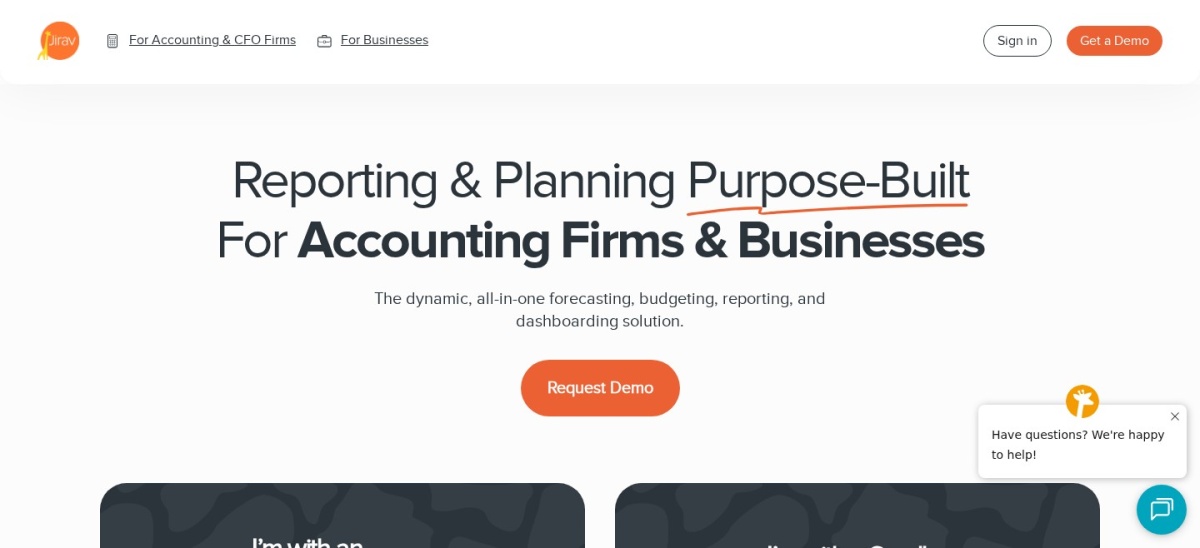
Jirav is a cloud FP&A tool built for small businesses and accounting firms, with driver-based forecasting, rolling forecasts and board-ready reports. The Starter plan covers company-level planning with up to 24 months of data, 2 admins, 3 dashboards and 3 report packages.
The trade off is scale. Starter covers company-level planning only, and departmental budgeting needs Pro at $15,000 a year, while G2 lists a $20,000 Success Safari edition. It suits small finance teams and fractional CFOs who want published pricing and fast onboarding.
What we like
Only tool here with published list pricing
Driver-based three-statement modelling
G2 rates its support 9.7 out of 10
Watch out for
Starter is company-level planning only
No free plan or free trial
Learning curve for advanced models, per G2 reviewers
Pro adds departmental budgeting at $15,000 a yearVisit jirav.com
03
Anaplan
4.6/5on G2 (462 reviews, checked Nov 2026)
PricingCustom/yr
Best for enterprise connected planning
G2 rating4.6/5, 462 reviews
PricingCustom quote
Free trialNo
PlanningConnected, multi-dimensional
anaplan.com
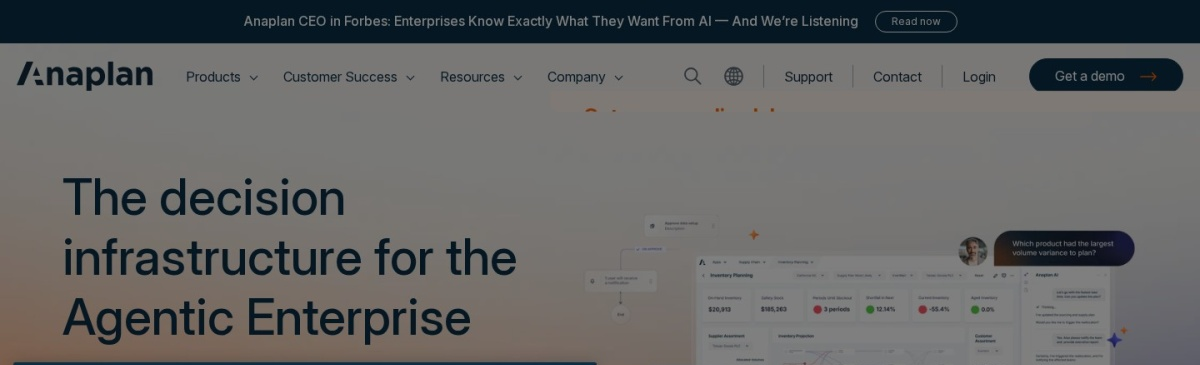
Anaplan homepage, captured Nov 2026.
Anaplan is a cloud planning platform that connects finance, sales, workforce and supply chain plans on one model, so a change in one plan flows through the rest. Its Advanced tier adds the Optimizer, Predictive Insights and the Polaris calculation engine for large planning models.
The trade off is cost and complexity. Anaplan publishes no prices, G2 reviewers call it expensive for smaller teams, and implementation averages 6 months. It suits large enterprises that plan across departments and can fund a long rollout.
What we like
One model links finance, sales and workforce plans
Predictive Insights and Optimizer on the Advanced tier
Ease of use is its most-mentioned strength on G2
Watch out for
No published prices; quote only
6-month average implementation, per G2
Expensive for mid-market and small teams, per reviewers
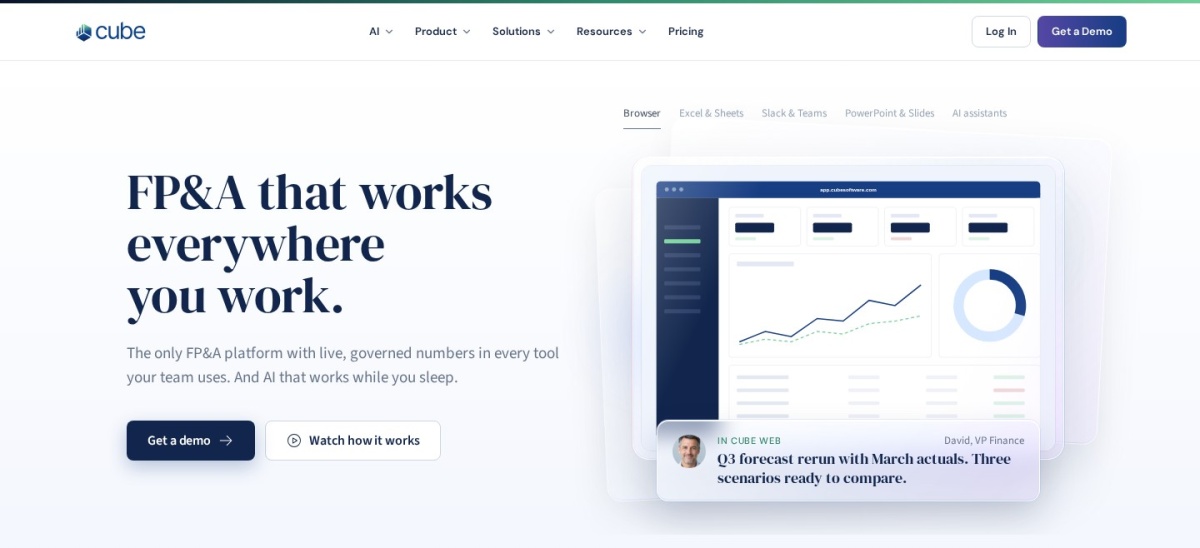
Cube is a spreadsheet-native FP&A platform that syncs live numbers into Excel and Google Sheets, so teams plan where they already work. Every plan includes unlimited users, unlimited dimensions and unlimited dashboards, and G2 reports a 2-month average implementation.
The trade off is pricing transparency. Cube removed list prices from its site in 2026 and now quotes Bronze, Silver and Gold tiers per company. It suits mid-market teams that want governed spreadsheet planning without leaving Excel or Sheets.
What we like
Works in Excel, Google Sheets and the web
Unlimited users on every plan
Fastest implementation in this list, about 2 months
Watch out for
No published prices since 2026
AI features are still evolving, per G2 reviewers
Removing list prices worries some reviewers about renewal pricing
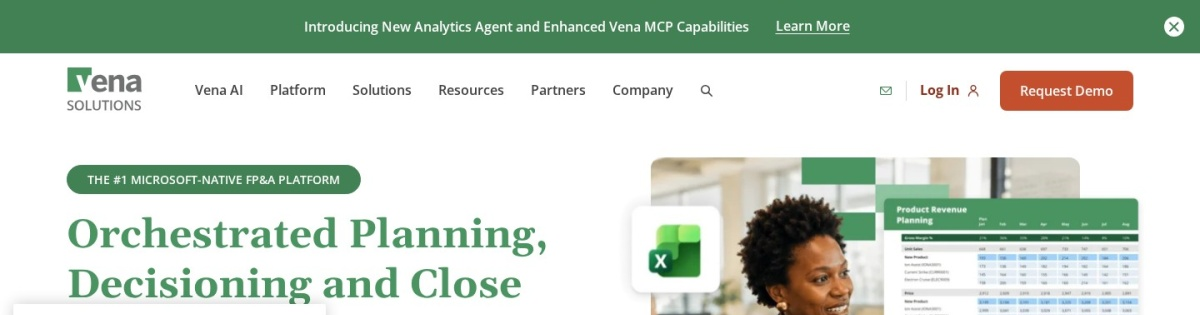
Vena is an FP&A platform that runs inside Microsoft Excel, adding version control, workflows and a central database to the spreadsheets teams already use. Its two editions are Professional and Complete, and G2 lists 12 integrations including Excel, Power BI and NetSuite.
The trade off is implementation time. Vena publishes no prices, G2 reports a 5-month average implementation, and reviewers note slow performance when many users plan at once. It suits mid-market teams that want governed Excel planning with strong audit trails.
What we like
Works inside Excel, so adoption is fast
Central database with audit trails and permissions
Complete adds Insights, a sandbox and premium support
Fathom is a reporting and forecasting tool for businesses and accounting firms, with three-way cash flow forecasting, custom KPIs and management reports. The Pro plan starts at $59 a month for one company and includes a 14-day free trial with no credit card required.
The trade off is depth. Fathom is a reporting and analysis tool rather than a full planning suite, and its price rises with each company you connect. It suits small businesses and firms that need clear forecasts and board-ready reports without an enterprise platform.
Prophix One is a financial performance management platform that combines budgeting, planning, forecasting, financial consolidation and reporting in one system. Planning is the base module, with close management, consolidation and account reconciliation available as added modules.
The trade off is that Prophix publishes no prices, so the cost depends on which modules you buy, and G2 reviewers report a 4-month average implementation. It suits upper mid-market teams that want planning, close and consolidation from one vendor.
Planful is a financial performance management platform for budgeting, forecasting, consolidation, reporting and scenario planning. It handles multi-entity consolidation with eliminations and minority interest next to rolling forecasts, without running a full enterprise suite.
The trade off is cost and effort. Planful publishes no prices, G2 reports a 5-month average implementation, and reviewers note a learning curve for advanced features. It suits upper mid-market teams that need consolidation and planning together.
What we like
Consolidation and planning on one platform
Strong reporting and automation, per reviewers
Scenario planning and rolling forecasts included
Watch out for
No published prices; quote only
Learning curve for advanced use, per reviewers
Implementation is a multi-month project
Modules for FP&A, consolidation and reporting are priced separatelyVisit planful.com
09
Pigment
4.6/5on G2 (125 reviews, checked Nov 2026)
PricingCustom/yr
Best modern planning for growing teams
G2 rating4.6/5, 125 reviews
PricingCustom quote
Free trialYes
Go-live timeAbout 4 months
pigment.com
Pigment homepage, captured Nov 2026.
Pigment is a business planning platform for budgeting, forecasting and reporting, with real-time collaboration and scenario planning on a modern interface. Reviewers praise its flexibility and ease of use, and G2 reports a 4-month average implementation.
The trade off is the learning curve. Pigment publishes no prices, and reviewers say its formula language and modelling concepts take time to learn without consulting help. It suits growing finance teams that want a modern platform and can invest in onboarding.
Enterprise FP&A vendors price by users, entities, modules and implementation scope, so a single list price would mislead more than it helps. That is why Datarails, Anaplan, Cube, Vena, Prophix One, Planful and Pigment all sell on custom quotes.
Only Jirav and Fathom publish prices. Jirav lists Starter at $10,000 a year and Pro at $15,000 a year, while Fathom starts at $59 a month for one company.
Treat any third-party price for a quote-only tool as an estimate, not a list price. Ask the vendor for the licence, the implementation cost and the renewal terms in writing before you compare totals.
How we chose
We started from the established FP&A platforms that G2 lists for financial forecasting, then kept nine with solid review counts and current products.
Prices come from each vendor's pricing page, checked on 25 November 2026. Ratings and review counts come from G2 on the same day. Where a vendor shows no price, the list shows Custom and says so.
We left out tools that are no longer sold on their own, such as Finmark, and Mosaic, which now ships inside HiBob. No vendor paid for a place, and we do not claim hands-on testing for this list.
How to choose financial forecasting software
Start with your planning horizon and the spreadsheets your team already trusts, then shortlist two tools.
Decide how far ahead you forecast. A 12-month rolling forecast needs less modelling power than multi-year driver-based plans with departments.
Check the spreadsheet question first. If your team lives in Excel, Datarails, Cube or Vena keep that workflow. If you want to leave spreadsheets behind, look at Pigment or Anaplan.
Ask for a written quote before you demo. Seven of these nine tools publish no price. Get the quote, the implementation cost and the renewal terms in writing.
Run one forecast cycle on a trial. Fathom, Prophix One and Pigment offer free trials. Test with your own data before you sign.
FAQ
What is the best financial forecasting software?
Datarails is the best pick for most finance teams, with a 4.6 out of 5 G2 rating from 396 reviews and Excel-native planning. Jirav is the best value option with published pricing, and Anaplan is the strongest choice for large enterprises.
How much does financial forecasting software cost?
Only two tools here publish prices: Jirav starts at $10,000 a year and Fathom starts at $59 a month for one company. The other seven sell on custom quotes, so expect a sales call and an implementation fee on top of the licence.
Is there free financial forecasting software?
None of the nine tools in this list has a free plan. Fathom, Prophix One and Pigment offer free trials, and Jirav and Fathom publish their entry prices, so you can compare costs before talking to sales.
What is the difference between forecasting and budgeting software?
Budgeting sets a fixed plan for a period, usually a year, while forecasting updates the expected outcome as actuals arrive. Most tools in this list do both, with rolling forecasts that refresh monthly or quarterly.
Do I still need Excel with forecasting software?
Not always, but most teams keep it. Datarails, Cube and Vena run inside Excel or Google Sheets, while Anaplan, Planful and Pigment replace spreadsheets with a governed platform and export to Excel for reports.
How long does it take to set up forecasting software?
Cube averages about 2 months to go live, while Datarails, Prophix One and Pigment average about 4 months and Vena and Planful about 5 months. Anaplan averages 6 months, so plan the rollout around your next budget cycle.
SaaS SEO and WordPress specialist with about 8 years of experience. Rakib compares WordPress plugins, themes, hosting and software using public pricing, documentation and user reviews. See how we rank.