Cube is the best financial analysis software for most teams, keeping planning in Excel and Google Sheets on one governed data layer, rated 4.5 out of 5 on G2 with unlimited users on every plan. Pick Fathom from $59 a month for low-cost reporting, or Jirav from $10,000 a year for published-price forecasting.
How we make this list: we compare pricing pages, product documentation and public user reviews, then re-check every price before each update. No product paid for a place. Disclosure.
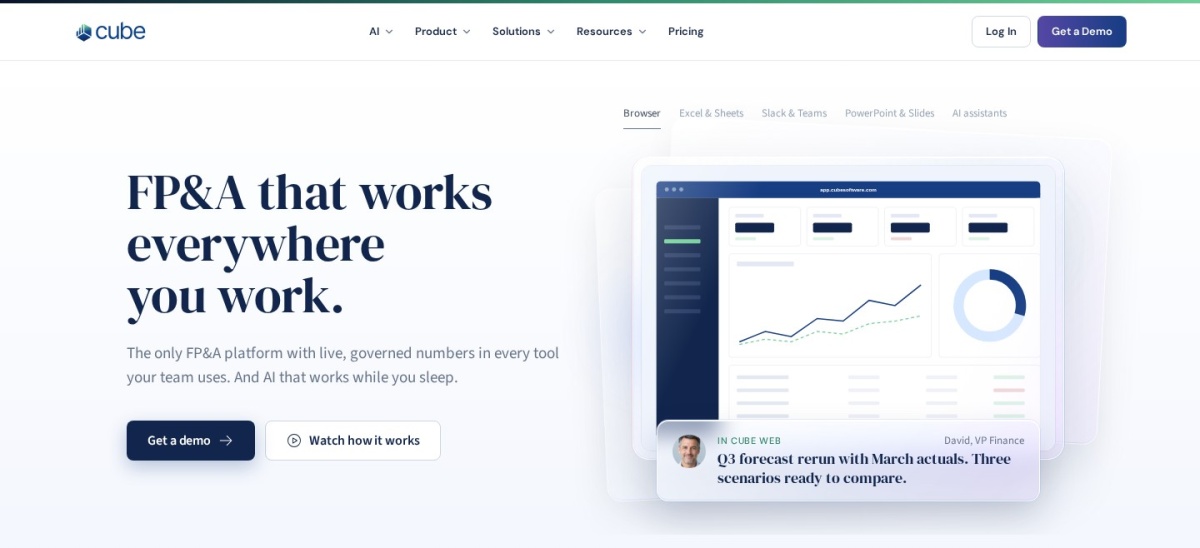
Cube leads for spreadsheet-native analysis: Excel and Sheets stay the working surface, with unlimited users on every plan.
Only Fathom ($59/mo) and Jirav ($10,000/yr) publish prices; the other seven are quote-only, so budget from third-party ranges.
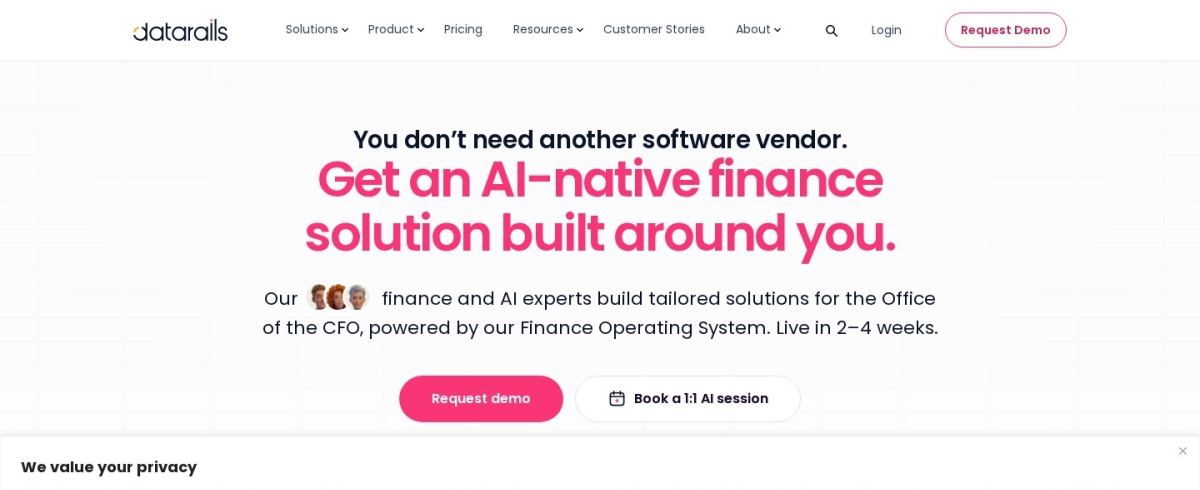
Datarails is the strongest Excel-first reporting pick, rated 4.6/5 on G2 from 395 reviews, with 600+ integrations.
Abacum and Jirav share the highest rating in the list at 4.7/5 on G2, but Abacum has no consolidation module.
Planful is the pick when consolidation matters as much as planning; Pigment is the modern-interface alternative.
What financial analysis software should cover
Financial analysis software turns closed books into answers: why revenue moved, which departments overspent, and what the next quarter looks like. The best tools connect the ledger, the CRM and headcount data, then keep one version of the numbers.
Most tools in this category fall into two camps. Excel-native platforms such as Cube, Datarails and Vena keep spreadsheets as the working surface and add governance around them. Web-first platforms such as Pigment and Abacum rebuild planning in the browser, which suits teams that want to leave spreadsheets behind.
Pricing is the hardest part of this market. Only two of the nine tools here publish a price, and the rest quote per company, so the price ladder below shows Custom for most entries. Treat third-party estimates as ranges, not quotes, and set a budget before you buy: our guide on budgeting for a WordPress website shows how to set a budget line by line.
Ratings come from G2, checked on 25 November 2026. A 4.7 from 173 reviews means something different from a 4.3 from 489, so read the review count beside every rating before comparing scores.
Cube is a spreadsheet-native FP&A platform that keeps planning and analysis in Excel and Google Sheets while the numbers sit in one governed layer. It syncs actuals from the ERP, explains variances to the transaction, and refreshes board decks when the numbers change, with AI agents included in every plan.
The trade off is price and scope. Cube publishes no list prices since moving to quote-only Bronze, Silver and Gold tiers, and the retired Go plan once started at $1,500 a month, so small teams should expect an enterprise-style quote. It suits mid-market finance teams that plan in spreadsheets and want one governed source of truth.
What we like
Works inside Excel and Google Sheets
Unlimited users, dimensions and dashboards on all plans
AI answers trace back to the source transaction
G2 category leader in FP&A, including ease of use and setup
Watch out for
No published list price; every plan is a custom quote
Implementation fees sit on top of the subscription
Spreadsheet-first design is less help for teams that want a web-first model
Datarails is an Excel-native FP&A platform that turns existing spreadsheets into governed reports, budgets and forecasts. It connects the ERP, CRM, HRIS, banks and spreadsheets through 600+ integrations, and its entry Professional tier covers 2 users and 1 integration with unlimited dashboards and reporting.
The trade off is cost and setup. Datarails publishes no list prices, third-party estimates put annual subscriptions from about $24,000, and G2 reviewers report an average implementation of 4 months. It suits mid-market finance teams that refuse to leave Excel but need automation around it.
What we like
Keeps Excel as the working surface
600+ integrations across ERP, CRM and HRIS
Strong reporting and consolidation depth
In-house team handles integration
Watch out for
No published pricing; quotes only
Report writing can be complex, per G2 reviewers
Pricey for smaller companies, per G2 reviewers
Premium adds planning; Expert adds a close, cash or spend moduleVisit datarails.com
03
Vena
4.5/5on G2 (483 reviews, checked Nov 2026)
PricingCustom/yr
Best Excel-native planning for mid-market
Excel-nativeYes
PlansProfessional, Complete
ImplementationAbout 5 months (G2)
MicrosoftNative Excel and 365 platform
venasolutions.com
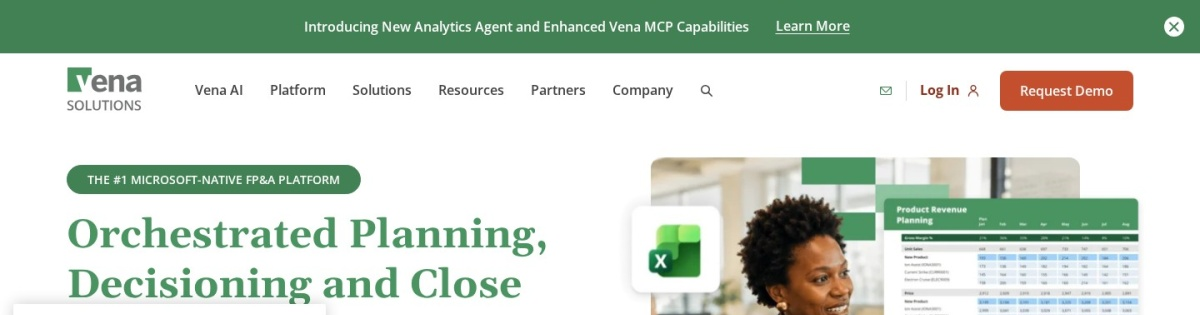
Vena homepage, captured Nov 2026.
Vena is an Excel-native FP&A platform that adds governance, workflows and reporting to the spreadsheets finance teams already use. It covers budgeting, forecasting, consolidation and close, with two plans, Professional and Complete, and a dedicated customer success manager on both.
The trade off is time and cost. Vena publishes no prices, third-party transaction data puts the median subscription near $27,000 a year, and G2 reports an average implementation of 5 months. It suits mid-market teams that want planning inside Microsoft Excel rather than a new modelling tool.
What we like
Familiar Excel interface, fast to adopt
Planning, consolidation and close in one platform
Strong workflow and status tracking
Vena Copilot included in the Professional plan
Watch out for
No published pricing; quotes only
Performance can lag during peak planning cycles, per reviewers
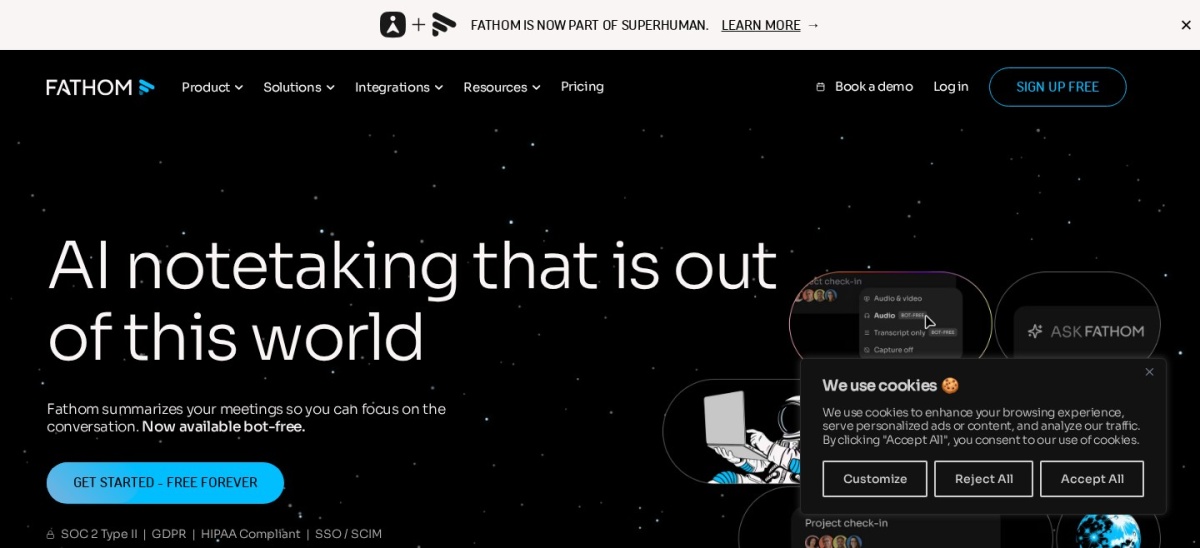
Fathom is a reporting and analysis tool that turns accounting data into management reports, KPIs, cash flow forecasts and consolidations. The Pro Starter plan costs $59 a month for one company, with unlimited users, and Silver covers 10 companies for $315 a month.
The trade off is depth. Fathom is built for reporting and three-way cash flow forecasting, not full enterprise planning, and each extra company adds $59 a month on Starter. It suits small businesses, accounting firms and advisors who report across several companies.
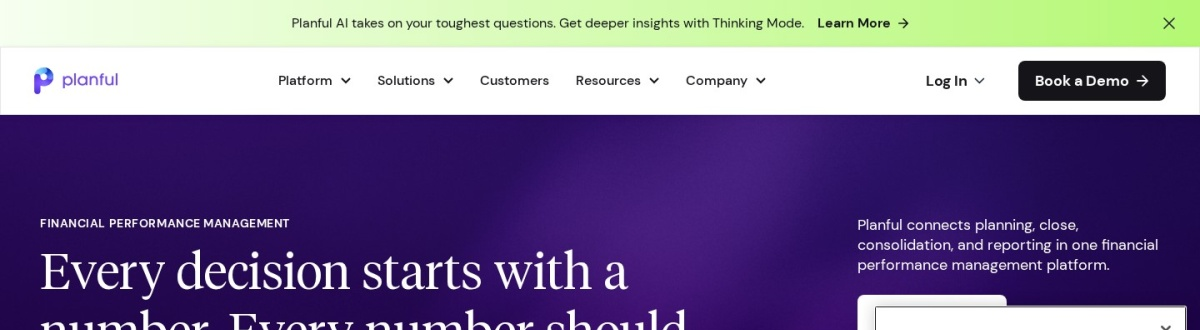
Planful is a financial performance management platform that combines budgeting, forecasting, consolidation and reporting on one data model. It handles multi-entity consolidation with eliminations and minority interest next to rolling forecasts, and G2 rates it 4.3 out of 5 from 489 reviews.
The trade off is scale and cost. Planful publishes no prices, third-party estimates put entry deployments near $15,000 to $50,000 a year, and implementation typically runs 8 to 12 weeks. It suits upper mid-market teams that need close, consolidation and planning together.
What-if scenarios3 on Essentials, unlimited on Pro
Implementation2-4 months
Free trialNo (G2)
pigment.com
Pigment homepage, captured Nov 2026.
Pigment is a modern, AI-native planning platform for integrated business planning, with multi-dimensional models, dashboards and scenario planning. Its Essentials tier covers core model building and three what-if scenarios, while Professional adds unlimited scenarios, monthly snapshots and a 12-month audit trail.
The trade off is price at scale. Pigment publishes no list prices, third-party estimates put entry deals near $30,000 to $50,000 a year, and costs rise with seats. It suits mid-market teams that want Anaplan-style modelling with a modern interface and faster rollout.
What we like
Modern interface with strong adoption
Fast implementation, 2-4 months
Strong scenario planning and flexibility
High support scores on G2
Watch out for
No published pricing; quotes only
Excel and Sheets transfer is a weak point, per G2 reviewers
Consolidation depth is limited
Enterprise adds a sandbox, unlimited connectors and premium supportVisit pigment.com
07
Abacum
4.7/5on G2 (173 reviews, checked Nov 2026)
PricingCustom/yr
Best AI-native FP&A for SaaS teams
ImplementationAbout 3 months (G2)
PaybackAbout 12 months (G2)
FocusSaaS and recurring revenue
ConsolidationNo, FP&A only
abacum.io
Abacum homepage, captured Nov 2026.
Abacum is an AI-native planning platform built for mid-market SaaS and high-growth companies. It combines driver-based models, collaborative planning and stakeholder reporting, with G2 reviewers reporting a 3-month average implementation and a 12-month payback.
The trade off is scope. Abacum does no financial consolidation, intercompany eliminations or statutory reporting, and complex models can be slow with a steep learning curve, per G2 reviewers. It suits SaaS finance teams that plan headcount and revenue in one place.
What we like
Purpose-built for SaaS metrics and models
Fast, self-service implementation
Strong ease of use and support scores
Collaborative planning for non-finance teams
Watch out for
No consolidation or statutory reporting
Reporting customisation is weaker than expected, per reviewers
Integration coverage drops outside the modern SaaS stack
Paid plans include dedicated implementation supportVisit abacum.io
08
Jirav
4.7/5on G2 (195 reviews, checked Nov 2026)
Starts at$10,000/yr
Best published price for growing firms
Starter$10,000/yr
Pro$15,000/yr
FocusForecasting, budgeting, reporting
Rating4.7/5 on G2 (195 reviews)
jirav.com
Jirav homepage, captured Nov 2026.
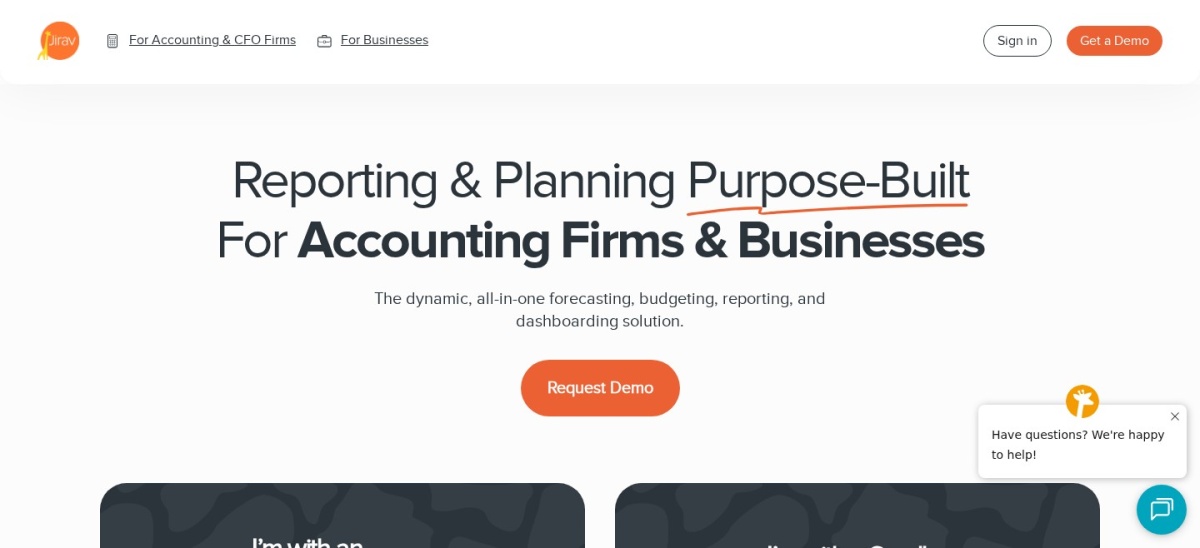
Jirav is a forecasting, budgeting and reporting platform built for accounting firms and growing businesses. Its Starter plan costs $10,000 a year, with Pro at $15,000 a year, and it builds forecasts from live accounting data rather than static spreadsheets.
The trade off is breadth. Jirav is priced for firms that need reliable forecasts and board-ready reports, not for enterprise consolidation, and $10,000 a year is steep for a very small team. It suits firms that want a known annual price before the sales call.
What we like
Published annual pricing, rare in this category
Builds forecasts from live books
Built for accounting firms and their clients
Rated 4.7 out of 5 on G2
Watch out for
No free plan and no entry tier under $10,000 a year
Less depth than enterprise planning suites
Best fit is firms and growing businesses, not large enterprises
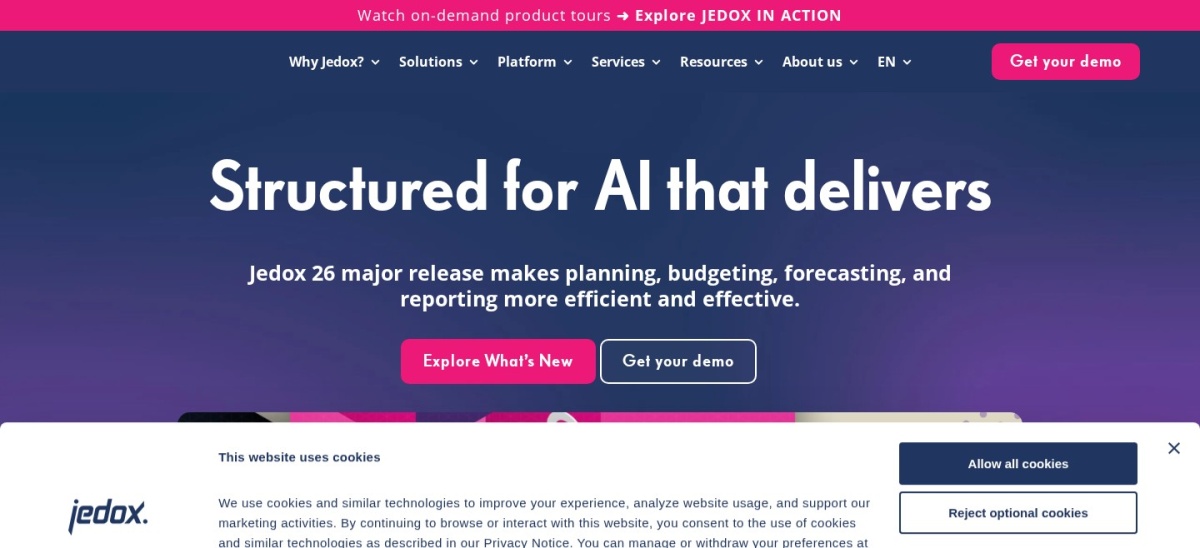
Jedox is an OLAP-based planning platform for budgeting, forecasting and reporting, with a native Excel 365 add-in. It runs multi-cube models with driver-based logic, spreads, allocations and parallel versions for plan, forecast and simulation.
The trade off is transparency and learning curve. Jedox publishes no list prices on its own subscriptions page, and G2 reviewers note that complex models need significant training. It suits mid-market teams that want Excel-native planning without enterprise-suite cost.
What we like
Native Excel 365 add-in
Mature OLAP engine for large models
Strong support scores on G2
Faster implementation than legacy suites
Watch out for
No published list price on its own site
Complex models need significant training, per reviewers
Slow performance on large datasets, per G2 reviewers
Seven of the nine tools here sell by quote, and only Fathom and Jirav publish a starting price. Vendors price by users, entities, modules and implementation scope, so a list price would mislead more than it helps.
Cube is the clearest example of the shift. It once published Go at $1,500 a month and Pro at $2,800, but its pricing page now lists Bronze, Silver and Gold tiers with no dollar figures. Treat older prices you see quoted elsewhere as retired.
Ask for three numbers before signing: the annual subscription, the one-time implementation fee, and the renewal uplift. G2 reviewers report average implementations of 3 to 5 months across this list, so the first-year cost is usually far above the subscription alone.
How we chose
We started from the FP&A and financial analysis tools with the largest G2 review bases and the clearest analysis features, then kept nine that cover spreadsheet-native planning, web-first planning and low-cost reporting.
Prices come from each vendor's pricing page, checked on 25 November 2026; where a vendor publishes no price, the list shows Custom and the text gives the best third-party range. Ratings and review counts come from G2 on the same day.
We left out tools whose standalone product is no longer sold on its own site, and tools with no public rating. No vendor paid for a place, and we do not claim hands-on testing for this list.
How to choose financial analysis software
Start with where your team already plans, then check what the quote really includes.
Decide Excel-native or web-first. If your models live in Excel, Cube, Datarails or Vena keep them there. If you want to leave spreadsheets behind, look at Pigment or Abacum instead.
Count the companies and users first. Fathom charges per company and Cube includes unlimited users, so the same team can pay very different amounts. Get the quote in writing with user and company counts stated.
Check what implementation costs. G2 reviewers report 3 to 5 months to implement most tools here. Ask whether training and data migration are included in the first-year price.
Match the tool to the analysis you run. Fathom fits variance reporting and cash flow forecasts. Planful fits consolidation beside planning. Do not buy an enterprise suite for a monthly management pack.
FAQ
What is the best financial analysis software?
Cube is the best pick for most teams. It keeps planning and analysis in Excel and Google Sheets on one governed data layer, is rated 4.5 out of 5 on G2, and includes unlimited users on every plan.
Why do most financial analysis tools hide their prices?
Most vendors price by users, entities, modules and implementation scope, so a single list price would not fit every buyer. Only Fathom and Jirav publish starting prices in this list; the rest quote per company, so ask for the subscription, implementation fee and renewal uplift in writing.
What is the cheapest financial analysis software?
Fathom is the cheapest published price here at $59 a month for one company, with a 14-day free trial. Jirav is the next published price at $10,000 a year. The other seven tools are quote-only, and third-party estimates put most of them well above $10,000 a year.
Is Excel enough for financial analysis?
Excel works for small teams with simple models, but version chaos and broken links grow with every department. Excel-native tools such as Cube, Datarails and Vena keep the spreadsheet interface and add one governed data layer, audit trails and shared forecasts.
What is the difference between financial analysis and FP&A software?
They overlap heavily. Financial analysis covers reporting, variance analysis and forecasting on closed books, while FP&A adds budgeting and forward planning. Most tools in this list do both, so pick by the analysis you run rather than the label.
Which tool is best for SaaS companies?
Abacum is built for SaaS metrics, headcount planning and recurring revenue, and is rated 4.7 out of 5 on G2. Cube is the alternative if your SaaS models live in spreadsheets and you want unlimited users.
SaaS SEO and WordPress specialist with about 8 years of experience. Rakib compares WordPress plugins, themes, hosting and software using public pricing, documentation and user reviews. See how we rank.