Best External Audit Software in 2026: 9 Tools Compared
WLWPLegible EditorsLast verified 23 Nov 2026How we rank12 min read
★ Short answer
Optro is the best external audit software for most enterprise teams, rated 4.6 out of 5 from 1,672 G2 reviews, with connected audit, risk and compliance modules. Audit firms should look at Fieldguide instead, and smaller teams preparing for SOC 2 should start with Drata or Vanta.
How we make this list: we compare pricing pages, product documentation and public user reviews, then re-check every price before each update. No product paid for a place. Disclosure.
Optro leads the enterprise shortlist at 4.6 out of 5 from 1,672 G2 reviews, with audit, risk and compliance sharing one data model.
Workiva is the pick when SOX controls and SEC reporting must link to the same numbers, rated 4.5 from 2,269 reviews.
Drata has the highest rating here at 4.7 from 1,337 reviews, and its Foundation plan lists at $15,000 a year.
Seven of the nine tools publish no prices at all, so budget for a negotiated annual quote and get renewal terms in writing.
Fieldguide is built for audit firms, but its 4.4 rating rests on only 10 G2 reviews, so weigh the reference customers more than the score.
What external audit software should cover
External audit work splits two ways. A company facing an audit needs controls, evidence and workpapers ready before the auditors arrive. An audit firm needs to run many client engagements at once, keep methodology consistent and stop chasing documents by email.
The tools below cover both seats. Enterprise platforms such as Optro and Workiva serve the company side, while Fieldguide, Suralink and Caseware serve firms. Drata, Vanta and Hyperproof serve teams preparing for SOC 2 or ISO 27001, where the audit is the finish line for a sale.
Look for evidence that stays linked to the control it supports, so a request from an auditor can be answered from one place. Our guide on GDPR compliance for WordPress shows the same idea on a smaller scale: records tied to the rule they prove.
Price is the weak spot in this market. Only three tools publish any starting price, and two of those figures come from marketplace listings rather than the vendor's own pricing page. Treat every number below as a starting point for a quote, not a final bill.
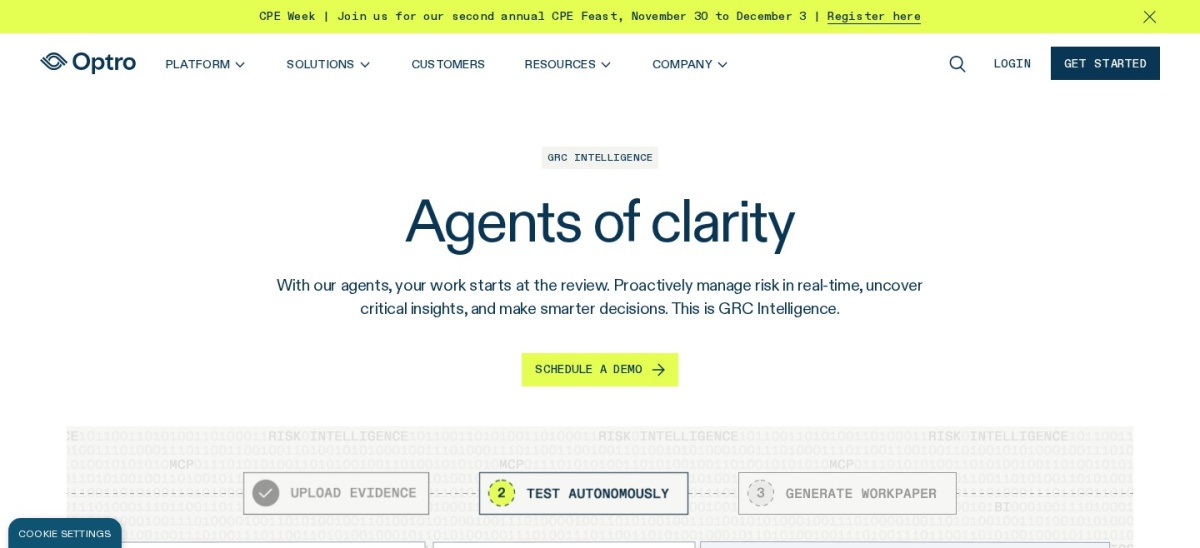
Optro is the new name for AuditBoard, rebranded in March 2026, and it remains the reference platform for enterprise audit and SOX work. Audit, risk and compliance modules share one data model, so a control tested once flows through every view without re-entry, and AI agents now start work at the review stage.
The trade off is cost and weight. Pricing is custom and licensed per module, and reviewers note the bill grows as modules are added, with go-live most often taking three to six months. It suits public companies and large enterprises running SOX, not small teams buying their first audit tool.
What we like
Connected workpapers across audit, risk and compliance
Rated 4.6 out of 5 from 1,672 G2 reviews
AI agents assist review and control testing
The platform external auditors already know
Watch out for
Custom, per-module pricing with no published starting price
Needs a dedicated administrator to get full value
Heavier than small teams need
Modules are quoted per module, so scope before the demoVisit optro.ai
02
Workiva
4.5/5on G2 (2,269 reviews, checked Nov 2026)
PricingCustom/yr
Best for SOX and financial reporting
G2 rating4.5/5 (2,269 reviews)
Starting priceCustom quote
Core strengthSOX, SEC reporting, audit
Integrations25 listed on G2
workiva.com
Workiva homepage, captured Nov 2026.
Workiva is a cloud platform that links SOX controls, audit workpapers and financial reports to the same data. Change a number once and it updates everywhere, with a full audit trail, which is why public companies run both reporting and controls work on it. The vendor counts more than 6,700 companies as customers.
The trade off is breadth. Workiva sells to large, often public companies, and implementation takes planning, with go-live most often in one to three months. It suits teams that need reporting and audit on one platform, while audit-only buyers may pay for breadth they never use.
What we like
Linked data ties controls, workpapers and reports together
Drata is a compliance automation platform that collects evidence, monitors controls continuously and gives auditors their own workspace. The Foundation plan lists at $15,000 a year for companies with 1 to 50 full-time employees and covers one framework, such as SOC 2 or ISO 27001. It holds the highest G2 rating in this list.
The trade off is that the list price is only the start. Each extra framework lists at $7,500 a year, and the audit itself is sold separately, so a multi-framework program costs far more than Foundation. It suits engineering-led teams adding frameworks over time.
What we like
Highest G2 rating here, 4.7 from 1,337 reviews
Auditor workspace built in
Top G2 support score at 9.5 out of 10
Continuous control monitoring
Watch out for
Extra frameworks add $7,500 a year each
The external audit itself is sold separately
Foundation covers only one framework
Foundation lists at $15,000 a year; frameworks cost extraVisit drata.com
04
Vanta
4.6/5on G2 (2,703 reviews, checked Nov 2026)
Starts at$14,000/yr
Best for a first SOC 2 audit
G2 rating4.6/5 (2,703 reviews)
Starting price$14,000/yr, Essentials
Integrations400+
Entry size1-20 employees
vanta.com
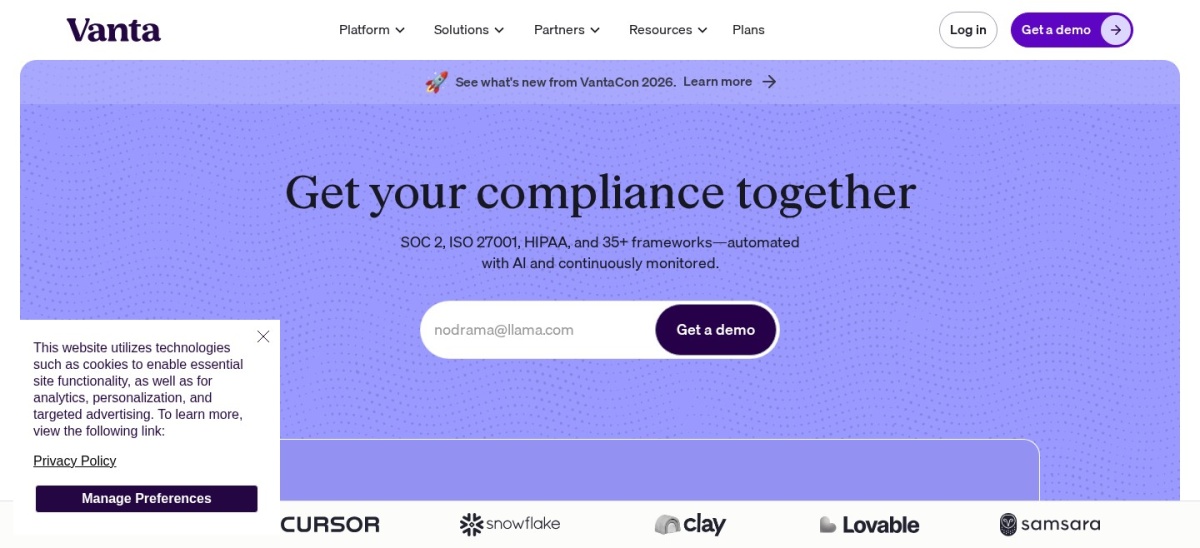
Vanta homepage, captured Nov 2026.
Vanta is a trust management platform that automates SOC 2 with continuous tests and one of the widest integration catalogs in this list, at more than 400. The Essentials plan lists at $14,000 a year for teams of 1 to 20 employees, covers one framework and includes a Trust Center. Auditors know its evidence exports well.
The trade off is that Essentials is a starting point. Each extra framework and module adds to the bill, and reported first-year costs land near $20,000, the median buyer spend reported by Vendr. It suits cloud-native startups racing to close a first SOC 2 for enterprise sales.
What we like
Largest review base here, 2,703 G2 reviews
400+ integrations pull evidence automatically
Trust Center included in Essentials
Auditors are familiar with its exports
Watch out for
Extra frameworks push the bill well past $14,000
The audit itself is sold separately
Pricing scales with headcount
Essentials lists at $14,000 a year for 1-20 staffVisit vanta.com
05
Fieldguide
4.4/5on G2 (10 reviews, checked Nov 2026)
PricingCustom/yr
Best for audit firms
G2 rating4.4/5 (10 reviews)
Starting priceCustom quote
Built forCPA and advisory firms
AI agentsRun on firm methodology
fieldguide.io
Fieldguide homepage, captured Nov 2026.
Fieldguide is the first tool here built for the other side of the desk: the CPA and advisory firm running audits for clients. Its AI agents plan, test and document work on the firm's own methodology, and a client portal runs evidence requests. The vendor reports more than half of the top 100 firms use it.
The trade off is evidence depth. The 4.4 rating rests on only 10 G2 reviews, all from 2021 and 2022, so reference customers matter more than the score. It suits firms standardising audit delivery, not corporate internal audit teams.
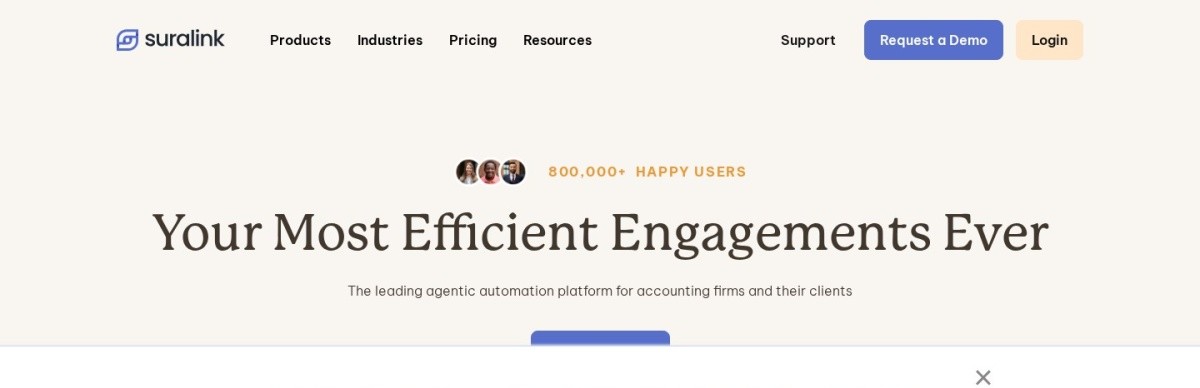
Suralink is a request-management platform that attacks the most painful part of an audit: the document request list. Firms request documents and e-signatures, clients upload through a portal, and both sides track status on live dashboards. The vendor reports more than 1,200 firms, 800,000 users and 2 million engagements.
The trade off is scope. Suralink is a collaboration platform with audit features, not an audit execution platform, so testing and workpaper depth are lighter than Fieldguide or Caseware. It suits firms whose bottleneck is client readiness and the endless email chase.
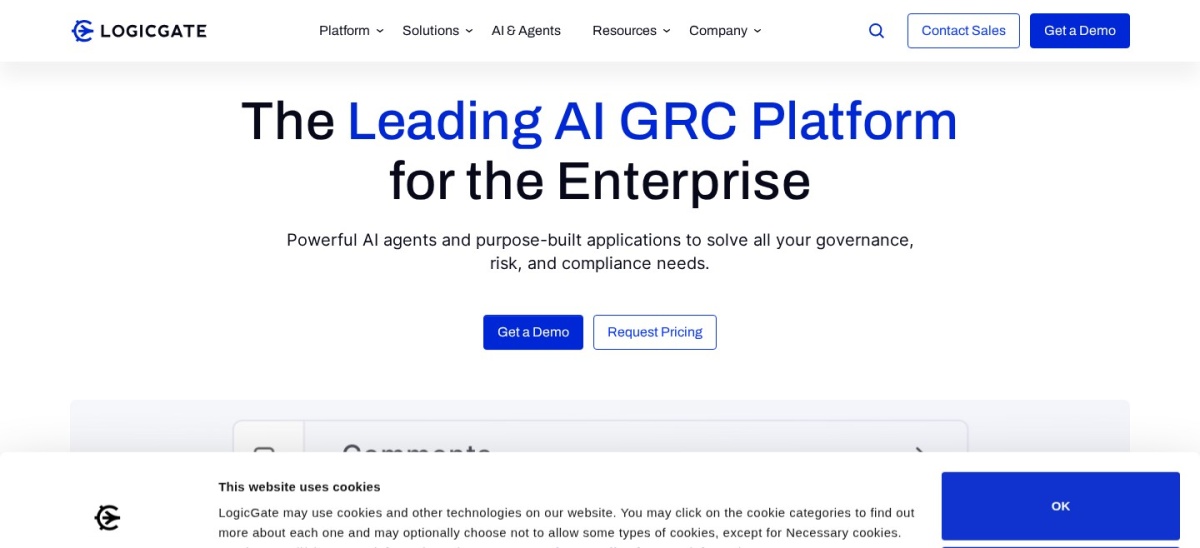
LogicGate is the configurability play in this list. Instead of fixed audit modules, teams build and adapt applications on its no-code Risk Cloud platform, backed by a graph database that maps how controls, risks, assets and regulations connect. The vendor reports more than 20,000 active users.
The trade off is ownership. A configurable platform rewards teams that know their processes and punishes teams that want a prescriptive audit program out of the box. It suits teams with unusual GRC needs, while buyers who want the vendor to define SOX should look at Optro or Workiva.
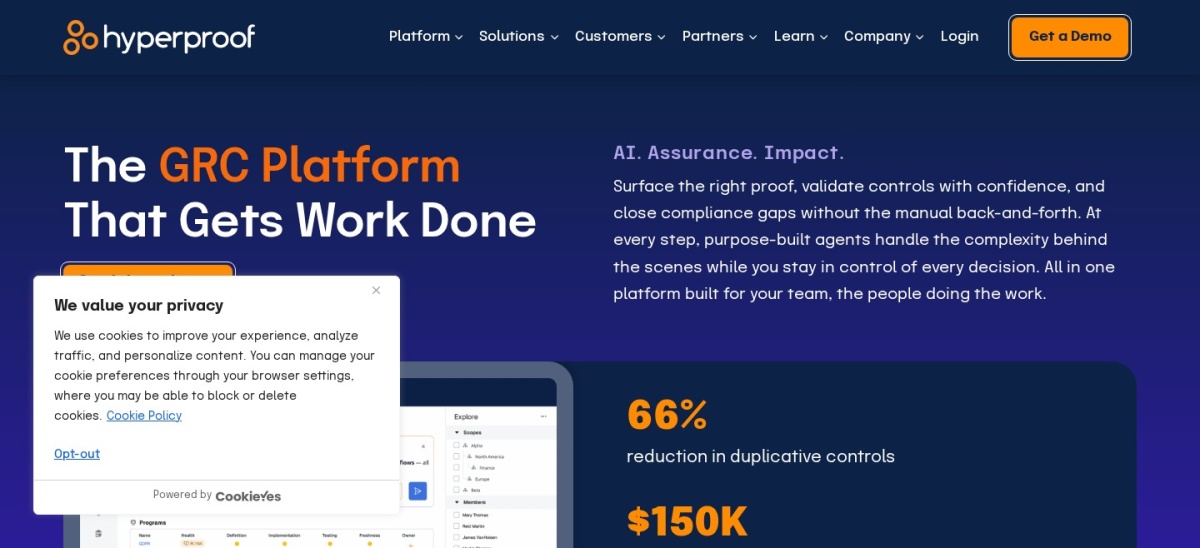
Hyperproof is a compliance-led platform that comes at auditing from the compliance side. Map controls once, reuse them across SOC 2, ISO 27001 and HIPAA, and automate evidence collection through its integrations. Its Basic plan is listed at $12,000 a year, the lowest published starting price in this list, supplied by the vendor to G2.
The trade off is audit depth. The compliance-first design means pure internal-audit workflows are secondary, and some evidence collection is still manual. It suits security and compliance teams that also run internal audits, with a FedRAMP-authorized edition for government-facing work.
What we like
Lowest published starting price here at $12,000 a year
Caseware is the incumbent of the audit profession, with more than 35 years of depth and 23,000 organizations and 475,000 users across 130 countries, per the vendor. Its Verity AI layer runs agents for data ingestion, risk suggestions, controls testing and disclosure checklists inside the firm's methodology.
The trade off is that it carries the lowest rating here, 4.0 out of 5 from 70 G2 reviews, and the platform breadth takes implementation effort. It suits firms already on Caseware Working Papers, where the upgrade path is natural, more than firms switching from a modern challenger.
Corporate audit teams vs audit firms: buy for your seat
A company facing an external audit and a firm running one buy different software. The company needs controls and evidence ready before auditors arrive. The firm needs engagement management, methodology and client collaboration across dozens of audits at once.
Mixing them up is the classic mistake. A corporate team does not need engagement management, and a firm does not need a SOX controls library. Write down which seat you sit in before shortlisting.
The third seat is the compliance team preparing for SOC 2 or ISO 27001. Their audit is the finish line for a sale, so evidence automation and auditor familiarity matter more than workpaper depth. That is the Drata, Vanta and Hyperproof buyer.
How we chose
We started from the audit management and GRC categories on G2, then kept tools with a real audit workflow: workpapers or evidence, controls testing, issue tracking and auditor collaboration. Firm platforms, enterprise GRC platforms and compliance automation tools all made the cut because external audit buyers sit in all three seats.
Prices come from each vendor's pricing page, checked on 23 November 2026. Seven of the nine tools publish no prices, so they show as custom quotes. Vanta, Drata and Hyperproof publish starting prices only through marketplace listings or review profiles, not on their own pricing pages, and the list says so wherever that applies. Ratings and review counts come from G2 on the same day.
We left out tools with no public rating and tools built only for internal use, such as Diligent, which showed no G2 rating in our research. No vendor paid for a place, and we do not claim hands-on testing for this list.
How to choose external audit software
Start with which seat you sit in, then match the tool to that seat before comparing features.
Work out which seat you are in. A company facing audit, a firm running audits, or a team preparing for SOC 2 each need a different shortlist. Pick the wrong seat and every feature comparison after it is wasted.
Ask for the full quote in writing. Get per-user and per-module pricing, implementation scope, training and renewal terms. Seven of these nine tools publish no prices, so the quote is the only number that counts.
Check auditor familiarity. Ask your external auditors which tools their teams already use. Familiar evidence exports and auditor workspaces cut weeks off fieldwork.
Run a reference check, not just a demo. Ask for two reference customers in your industry and one that churned. The demo shows the best version of the product; references show the real one.
FAQ
What is the best external audit software?
Optro is the best pick for most enterprise teams, rated 4.6 out of 5 from 1,672 G2 reviews, with audit, risk and compliance sharing one platform. Audit firms should look at Fieldguide, and teams preparing for SOC 2 should start with Drata or Vanta.
How much does external audit software cost?
Most vendors do not publish prices, so expect a negotiated annual quote, often in five or six figures for enterprise platforms. The only published starting prices here are Hyperproof at $12,000 a year, Vanta at $14,000 and Drata at $15,000, and the audit itself is usually sold separately.
Can audit software replace external auditors?
No. These platforms make audits faster and better documented, but they do not provide the independent opinion an external audit delivers. What they replace is the spreadsheet chaos around the audit: scattered workpapers, email evidence requests and untracked issues.
What is the difference between internal and external audit software?
Internal audit software serves a company's own audit team and audit committee, with SOX testing and issue tracking. External audit software serves firms running client engagements, or companies preparing evidence for their auditors. Many platforms cover both, but few do both equally well.
Which tool is best for a first SOC 2 audit?
Vanta is the common pick for a first SOC 2, with Essentials listing at $14,000 a year and the widest integration catalog. Drata is the alternative for engineering-led teams, rated 4.7 out of 5, with Foundation listing at $15,000 a year.
Do I need audit software if my firm is small?
Usually not the enterprise tools here. A small firm can run engagements on Fieldguide or Suralink, which are built for firm work, while a small company chasing SOC 2 can start with Vanta or Drata. A dedicated audit function or SOX duty is the point where the bigger platforms earn their cost.