Best Enterprise Resource Planning Software in 2026: 9 Tools Compared
WLWPLegible EditorsLast verified 23 Nov 2026How we rank13 min read
★ Short answer
Oracle NetSuite is the best enterprise resource planning software for most growing companies, with finance, inventory, orders and CRM in one cloud system and a 4.1 out of 5 G2 rating from 4,581 reviews. Pick Business Central if your team runs on Microsoft 365, or Odoo if you want the lowest priced full ERP at $31.10 per user a month.
How we make this list: we compare pricing pages, product documentation and public user reviews, then re-check every price before each update. No product paid for a place. Disclosure.
NetSuite is the broadest cloud ERP here, with finance, inventory, orders, CRM and e-commerce in one system.
Business Central Essentials costs $80 per user a month, up from $70 in November 2025, and Premium is $110.
Odoo is the only tool with a free plan and the cheapest paid tier, at $31.10 per user a month on Standard.
SAP Cloud ERP and Acumatica share the highest G2 rating in this list at 4.4 out of 5.
Six of the nine tools publish no prices, so budget for a quote and for implementation on top of the licence.
What enterprise resource planning software should cover
Enterprise resource planning software joins finance, inventory, orders, purchasing and reporting in one system, so teams stop retyping the same data between tools.
The right pick depends on size. Small teams need simple pricing and a fast start, while larger firms need multi-entity accounting, manufacturing and deep permissions.
Pricing is the hardest part to compare. Only Odoo and Business Central publish list prices; the rest quote per deal. Our guide on ecommerce platform market share shows how crowded the wider business software market is.
Implementation usually costs more than the first year of licences. Ask every vendor for the implementation scope, the renewal cap and the cost of each add-on module in writing.
The 9 best enterprise resource planning software tools
01
Oracle NetSuite
4.1/5on G2 (4,581 reviews, checked Nov 2026)
PricingCustom/yr
Best cloud ERP overall
Cheapest paid planQuote only
Free planNo
ModulesFinance, inventory, CRM
G2 rating4.1/5, 4,581 reviews
netsuite.com
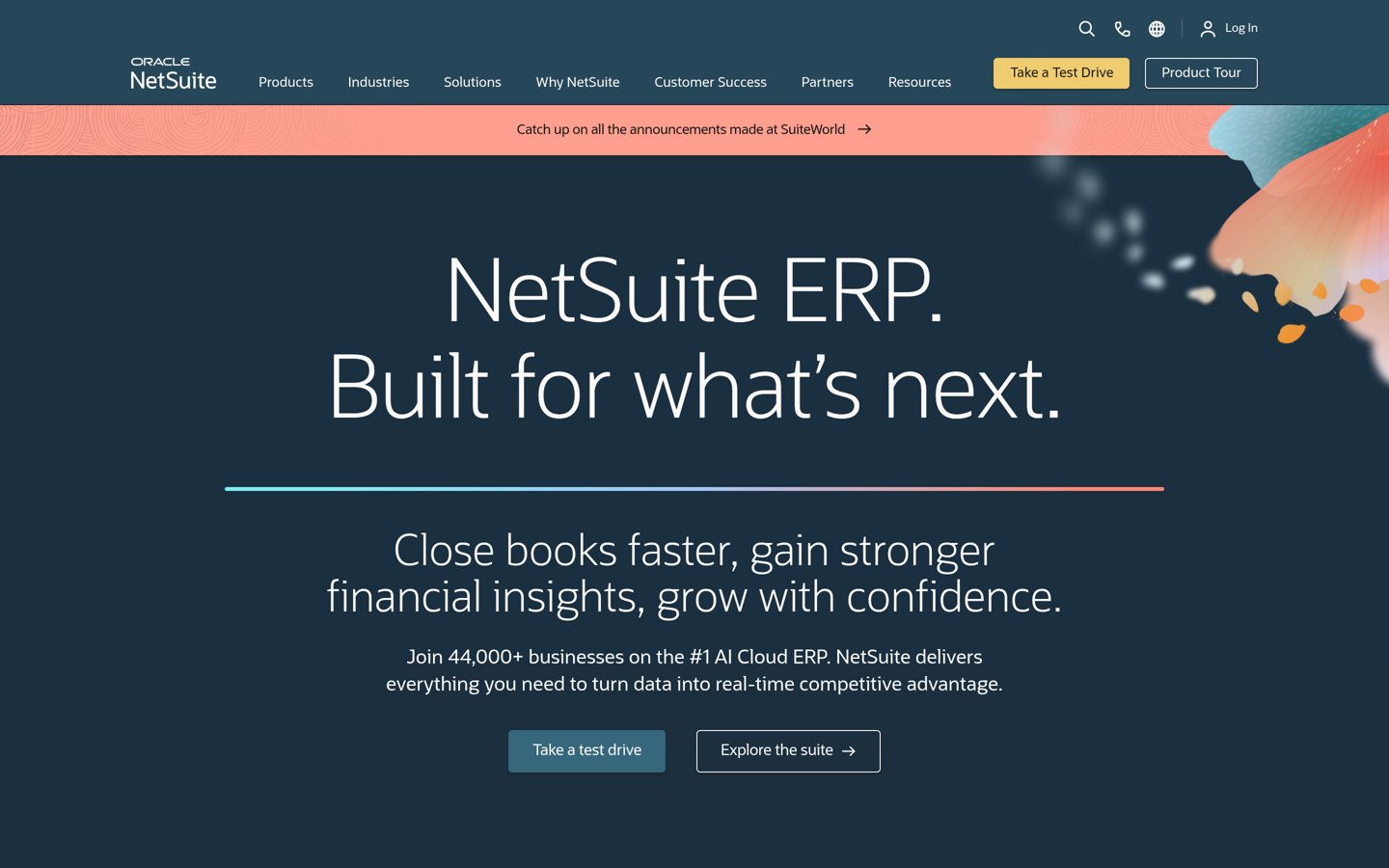
Oracle NetSuite homepage, captured Nov 2026.
Oracle NetSuite is a cloud ERP that combines accounting, inventory, order management, CRM and e-commerce in one system. It covers multi-subsidiary and multi-currency accounting out of the box, and it is rated 4.1 out of 5 on G2 from 4,581 reviews.
The trade off is price. Oracle publishes no list prices, so every subscription is quoted on modules, users and contract length, and implementation is a separate one-time cost. It suits growing companies that have outgrown basic accounting software and need one system for finance and operations.
What we like
Finance, inventory, orders and CRM in one system
Multi-subsidiary and multi-currency accounting built in
Most G2 reviews of any tool in this list
Watch out for
No published prices; every deal needs a quote
Implementation is a separate project with its own cost
Renewals can rise unless a cap is agreed in writing
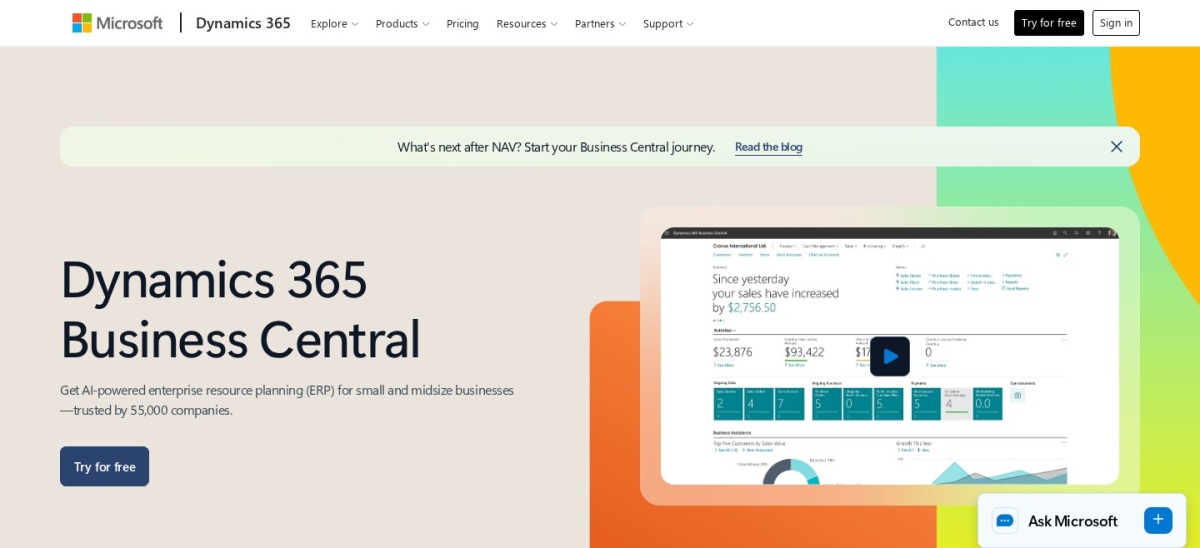
Microsoft Dynamics 365 Business Central homepage, captured Nov 2026.
Microsoft Dynamics 365 Business Central is a cloud ERP for small and mid-size firms that covers finance, sales, purchasing, inventory, projects and warehousing. Essentials costs $80 per user a month on yearly billing, and a 30-day trial is available. It is rated 4.0 out of 5 on G2 from 918 reviews.
The trade off is the price rise. Essentials was $70 per user a month until Microsoft raised it to $80 on 1 November 2025, and Premium is $110. It suits teams already on Microsoft 365 that want finance and operations in the same stack.
What we like
Published list prices, unlike most ERPs here
Deep ties to Microsoft 365, Excel and Power BI
Premium adds manufacturing and service management
Watch out for
Essentials price rose from $70 to $80 in November 2025
Odoo is a modular ERP with apps for accounting, inventory, sales, CRM, manufacturing and HR that share one database. One App Free covers a single app for unlimited users, and Standard unlocks every app at $31.10 per user a month on yearly billing. It is rated 4.2 out of 5 on G2 from 372 reviews.
The trade off is the first-year price. New customers pay $24.90 per user a month for the first 12 months, then the price rises to $31.10, and custom code needs the $61 Custom plan. It suits small teams that want to start free and add apps as they grow.
What we like
Free one-app plan with unlimited users
Lowest paid price of any full ERP here
Open-source Community edition is free to host
Watch out for
Standard blocks custom modules and the external API
First-year discount ends after 12 months
Support and setup quality varies by partner
Custom at $61/user/mo adds Studio, API and multi-companyVisit odoo.com
04
SAP Cloud ERP
4.4/5on G2 (1,119 reviews, checked Nov 2026)
PricingCustom/yr
Best for large global enterprises
Cheapest paid planQuote only
Free planNo
DeploymentCloud, public or private
G2 rating4.4/5, 1,119 reviews
sap.com
SAP Cloud ERP homepage, captured Nov 2026.
SAP Cloud ERP, formerly SAP S/4HANA Cloud, is SAP's cloud ERP for large firms, built on in-memory processing for real-time finance, procurement, manufacturing and sales. It runs standard processes across subsidiaries and countries in one system, and it is rated 4.4 out of 5 on G2 from 1,119 reviews.
The trade off is effort. G2 reviewers report an average implementation of about 8 months, and pricing is quoted per deal. It suits large enterprises that want SAP's standard processes and real-time reporting across the business.
What we like
Real-time analytics on live data
Joint-highest G2 rating in this list
Standard processes across many countries
Watch out for
Quoted pricing only, with long sales cycles
Implementation averages about 8 months on G2
Customisation is limited compared with on-premise SAP
Pricing is quoted; implementation is partner-ledVisit sap.com
05
Sage Intacct
4.3/5on G2 (4,433 reviews, checked Nov 2026)
PricingCustom/yr
Best for finance-led teams
Cheapest paid planQuote only
Free planNo
StrengthMulti-entity reporting
G2 rating4.3/5, 4,433 reviews
sageintacct.com
Sage Intacct homepage, captured Nov 2026.
Sage Intacct is a cloud financial management system for mid-size firms, nonprofits and multi-entity groups. It covers the general ledger, payables, receivables, revenue recognition and dimensional reporting, and it is rated 4.3 out of 5 on G2 from 4,433 reviews.
The trade off is scope. Sage Intacct is finance-first, so inventory, manufacturing and CRM depth come from add-ons or integrations, and pricing is quoted. It suits finance teams that need strong reporting across entities more than a full operations suite.
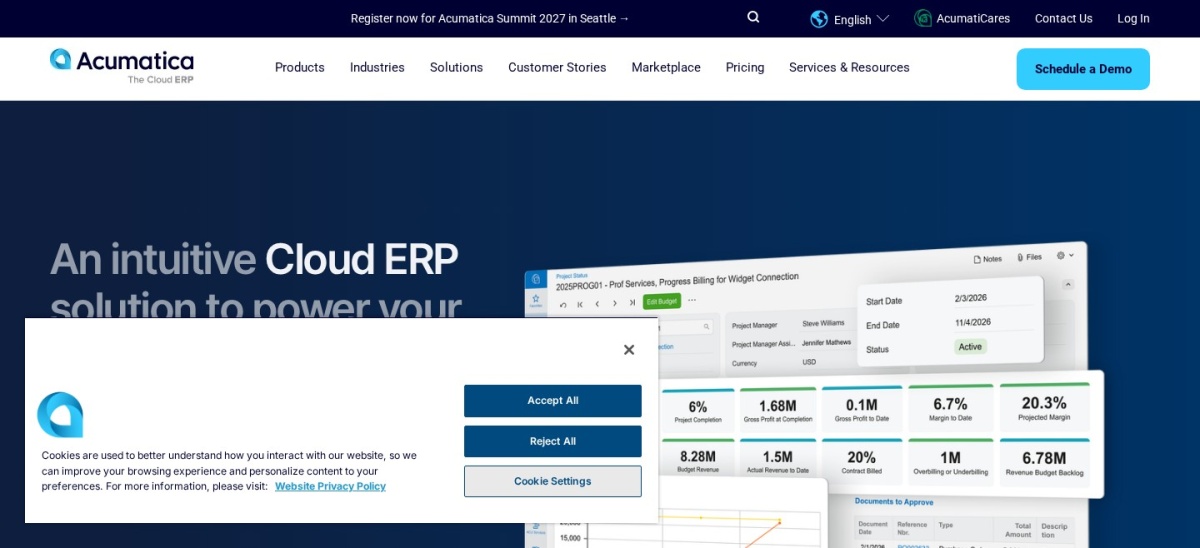
Acumatica is a cloud ERP for distribution, manufacturing, construction and retail firms. It covers finance, inventory, orders, purchasing, projects and CRM, and it charges by the computing resources used rather than by named user. It is rated 4.4 out of 5 on G2 from 2,006 reviews.
The trade off is the partner. Acumatica sells through resellers who implement and support the system, and G2 reviewers report an average implementation of about 7 months. It suits firms with many occasional users who would pay too much under per-user pricing.
What we like
No per-user fees, so occasional users cost nothing extra
Workday Financial Management homepage, captured Nov 2026.
Workday Financial Management is a cloud system for finance, planning, procurement and expenses that shares one data model with Workday HCM. It gives real-time dashboards and automation for the month-end close, and it is rated 4.2 out of 5 on G2 from 519 reviews.
The trade off is size. Workday is built for large firms, G2 reviewers report implementations of about 8 months, and pricing is quoted. It suits large organisations that want finance and HR on the same platform.
Infor CloudSuite is a set of industry-built cloud ERPs, with LN aimed at manufacturers and M3 at distributors and food producers. It covers finance, production, supply chain and warehouse work in one system, and the LN edition is rated 4.0 out of 5 on G2 from 111 reviews.
The trade off is fit. Each CloudSuite is built for a specific industry, so firms outside those industries get less value, and pricing is quoted. It suits manufacturers and distributors that want deep industry processes rather than a generic ERP.
What we like
Deep industry processes for manufacturing
InforOS connects the suite's apps
Cloud delivery with regular updates
Watch out for
Quote-only pricing
Smallest review base in this list
Reviewers note a dated interface and a steep learning curve
Epicor Kinetic is a cloud ERP for manufacturers that covers quoting, production planning, scheduling, inventory, purchasing and finance. It is built for make-to-order and mixed-mode shops and offers deep customisation through dashboards and fields. It is rated 3.9 out of 5 on G2 from 740 reviews.
The trade off is complexity. G2 reviewers report an average implementation of about 8 months and a steep learning curve, and pricing is quoted. It suits manufacturers that need to shape the ERP around their own production process.
Six of the nine tools in this list publish no prices. That is normal for ERP, but it means the first quote is a starting point, not a final number.
Ask for the licence, the modules, the user count, the implementation scope and the renewal terms in one written quote. Renewal increases are a common complaint in reviews, so ask for a cap before you sign.
Implementation is usually the larger cost. For NetSuite, partner estimates for mid-size implementation run from about $25,000 to $250,000, and the work takes months, so budget time as well as money.
How we chose
We started from the best-known cloud ERP systems for mid-size and large firms, then kept nine that cover finance, inventory, orders and reporting in one system.
Prices come from each vendor's pricing page, checked on 23 November 2026. Ratings and review counts come from G2 on the same day. Where a vendor shows a first-year discount, the list shows the regular price.
We left out tools that are accounting-only rather than full ERP, and tools sold only as on-premise software. No vendor paid for a place, and we do not claim hands-on testing for this list.
How to choose enterprise resource planning software
Start with the size of your business, then match the system to the work you actually do.
Count your users and entities. Per-user pricing punishes firms with many occasional users. Acumatica charges by resources instead, so compare the total, not the headline rate.
List the modules you need on day one. Finance, inventory, orders, manufacturing and CRM are often separate modules with separate prices. Get each one in the quote.
Ask for the full implementation cost. Licences are the smaller half of the first-year spend for most ERPs. Ask for the implementation scope in writing, with hours and a go-live date, before you sign.
Run a short trial or demo with your own data. A demo with your own products, customers and price lists shows gaps that a slide deck hides. Bring finance and operations staff to the same session.
FAQ
What is the best enterprise resource planning software?
Oracle NetSuite is the best pick for most growing companies. It combines finance, inventory, orders, CRM and e-commerce in one cloud system, and it is rated 4.1 out of 5 on G2 from 4,581 reviews.
How much does ERP software cost?
Only two tools here publish prices: Odoo Standard at $31.10 per user a month and Business Central Essentials at $80. The other seven are quoted per deal, and implementation is charged separately, so ask for the full first-year total in writing.
Is there a free ERP system?
Odoo is the only tool here with a free plan. One App Free covers a single app for unlimited users, and the open-source Community edition is free to host. The other tools offer trials or demos only.
What is the difference between ERP and accounting software?
Accounting software covers the ledger, payables, receivables and tax. ERP adds inventory, orders, purchasing, manufacturing, CRM and reporting in the same system, so data flows between teams without retyping.
How long does it take to implement an ERP?
G2 reviewers report averages of about 7 months for Acumatica and about 8 months for SAP Cloud ERP, Workday and Epicor Kinetic. Plan for months, not weeks, and expect partner help for the larger systems.
Do I need manufacturing features in an ERP?
Only if you make, assemble or repair products. Acumatica, Infor CloudSuite and Epicor Kinetic are built for that work. If you only need finance and orders, NetSuite, Sage Intacct or Business Central fit better.