Best Enterprise ETL Tools in 2026: 9 Tools Compared
WLWPLegible EditorsLast verified 23 Nov 2026How we rank12 min read
★ Short answer
Fivetran is the best enterprise ETL tool for most teams, with 700+ managed connectors, 15-minute syncs and a free plan up to 500,000 monthly active rows. Pick Airbyte for open-source control from $20 a month, or Hevo for no-code pipelines from $265 a month.
How we make this list: we compare pricing pages, product documentation and public user reviews, then re-check every price before each update. No product paid for a place. Disclosure.
Fivetran leads with 700+ managed connectors, 15-minute syncs and a free plan up to 500,000 monthly active rows.
Airbyte is the cheapest managed start at $20 a month, with a free self-hosted Core edition.
Hevo starts at $265 a month for no-code pipelines from 210+ sources, with a free plan to 1 million events.
Matillion, Informatica and Talend are quote-only at the enterprise end; Talend Starter is the only public enterprise price at $6,000 a year.
AWS Glue and Azure Data Factory are pay-as-you-go cloud services, so they suit teams already on AWS or Azure.
What to look for in an enterprise ETL tool
Enterprise ETL tools move data from apps, databases and files into a warehouse or lake, then keep it fresh on a schedule. The best ones handle schema changes and failures without daily attention from your engineers.
Start with the meter. Fivetran bills by monthly active rows, Airbyte by credits, Hevo by events and Matillion by credits, so the same workload can cost very different amounts on each tool.
Connector breadth matters most at the start. If a tool lacks a connector for a key source, your team builds and maintains a custom one. Our guide on migrating a site with Duplicator shows the same lesson for moves: plan the source list before you start.
Governance decides the enterprise shortlist. Large teams need lineage, access control and audit logs, which is where Informatica, Talend and Matillion earn their place over simpler replication tools.
Fivetran is a fully managed ELT service that moves data from more than 700 sources into a warehouse with little upkeep. The free plan covers 500,000 monthly active rows a month, and the Standard plan adds 15-minute syncs, unlimited users and dbt Core integration.
The trade off is the meter. Fivetran bills by monthly active rows per connection, with a $5 base charge on Standard connections, so high-change sources can cost more than a flat fee. It suits teams that want pipelines they rarely touch.
What we like
700+ fully managed connectors
Free plan up to 500,000 MAR a month
15-minute syncs on the Standard plan
14-day free trial on every new connection
Watch out for
Usage-based billing is hard to predict at high volumes
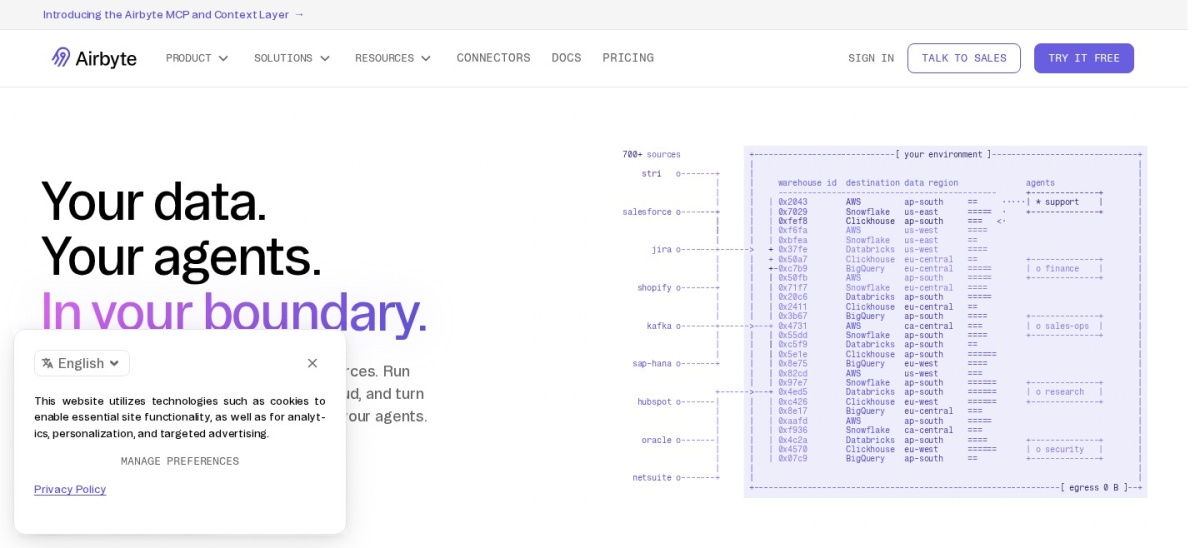
Airbyte is an open-source data movement platform with more than 700 connectors. Its free Core edition runs on your own servers, while Airbyte Cloud starts at $20 a month for 5 credits and adds hosting, upgrades and support.
The trade off is effort. Self-hosting Core means your team runs upgrades and maintenance, and Cloud syncs run hourly at most on Standard. It suits engineering teams that want control over code, deployment and connectors.
What we like
Free open-source Core with no license fee
700+ connectors, including a connector builder
Cloud starts at $20 a month
CDC included on every plan
Watch out for
Standard syncs run hourly at most
Plus starts at $189 a month, a big jump
Self-hosted Core needs your team to maintain it
Plus adds 15-minute syncs, SSO and a 24-hour support SLAVisit airbyte.com
03
Hevo Data
4.4/5on G2 (292 reviews, checked Nov 2026)
Paid from$265/mo
Best for predictable no-code pipelines
Free plan1M events a month
Starter plan$265 a month
Sync frequency1-hour scheduling
Sources210+ sources
hevodata.com
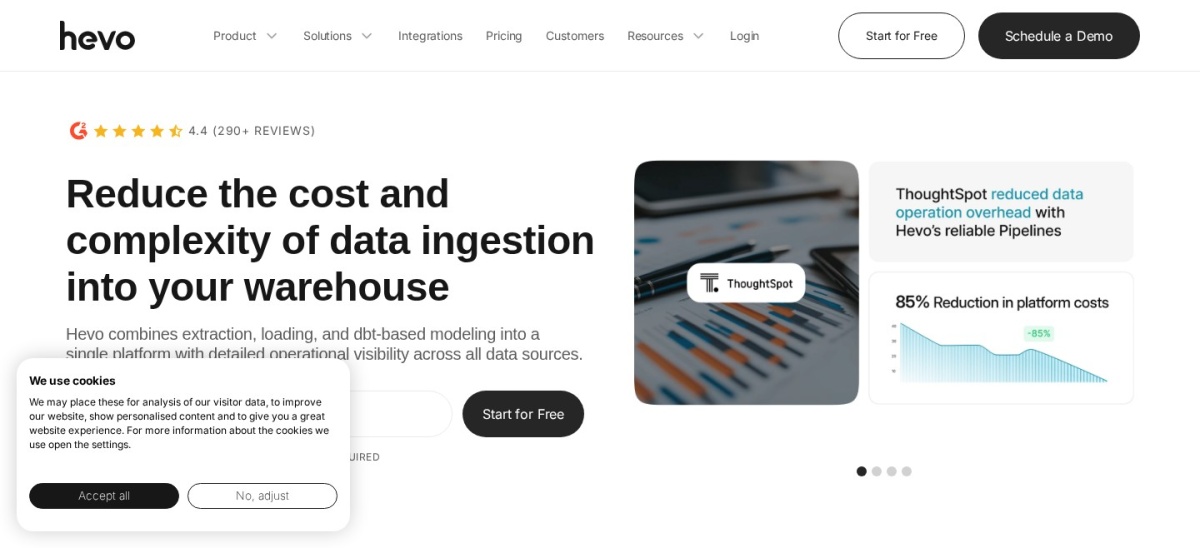
Hevo Data homepage, captured Nov 2026.
Hevo Data is a no-code ETL platform that loads data from more than 210 sources into a warehouse. Its free plan covers 1 million events a month, and the Starter plan starts at $265 a month with 1-hour scheduling, dbt integration and up to 10 users.
The trade off is speed and price. Starter syncs hourly rather than in real time, and the entry price is higher than Airbyte or Fivetran at low volumes. It suits small teams that want a fixed monthly bill and pipelines without code.
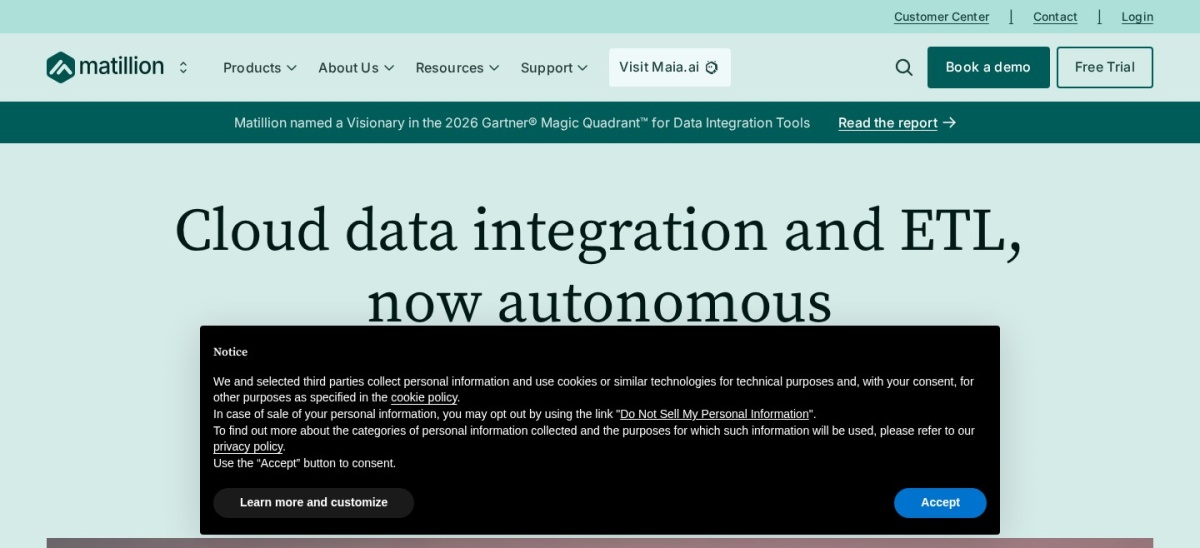
Matillion is a visual ELT platform that runs transformations inside Snowflake, Databricks, Redshift or BigQuery. Its low-code canvas mixes SQL and Python, and its Maia agents can build pipelines from prompts.
The trade off is price clarity. Matillion publishes its credit rates but no dollar price, so every edition needs a quote, and warehouse compute is billed separately. It suits teams that already live in a cloud warehouse and want transformation and orchestration in one place.
Informatica is the enterprise data management suite behind Cloud Data Integration, covering integration, quality, cataloging and mastering in one platform. It handles batch ETL and ELT across cloud and on-premises systems.
The trade off is cost and complexity. Pricing is consumption-based and quote-only, with entry pricing reported from $2,000 a month, so small teams will find it heavy. It suits large enterprises that need governance and data quality next to integration.
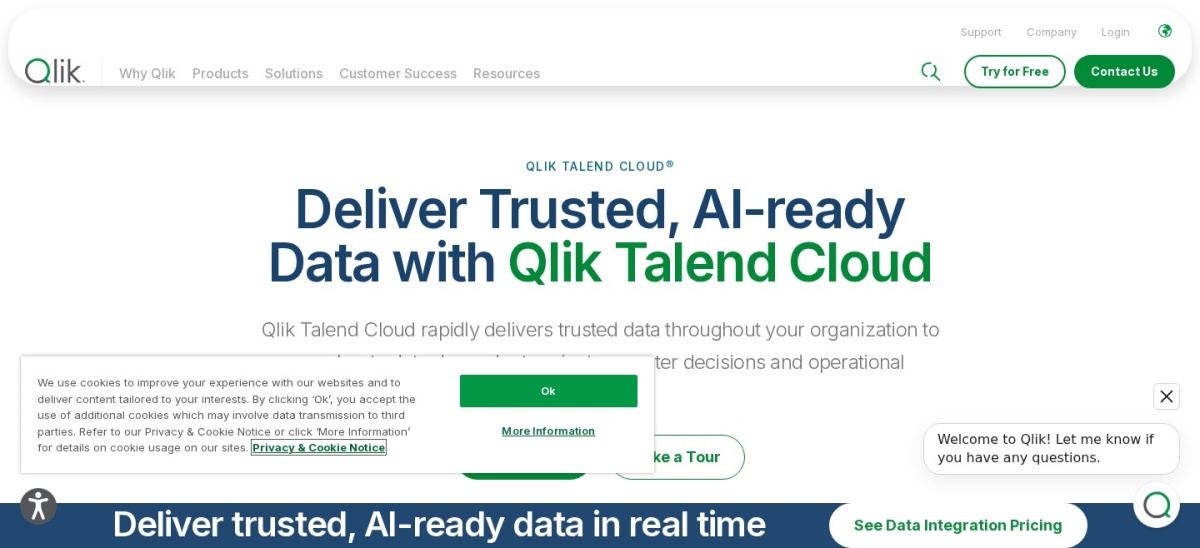
Talend is now Qlik Talend Cloud, a hybrid ETL platform with visual pipeline design, data quality and governance. It covers ETL and ELT, change data capture from Standard up, and runs in the cloud, hybrid or on-premises.
The trade off is price. Only Starter has a public price, $6,000 a year on AWS Marketplace for up to 50GB a month, and Standard, Premium and Enterprise are quote-only. It suits large teams that need quality checks and lineage beside their pipelines.
What we like
Data quality and lineage built in
Hybrid and on-premises deployment
500+ connectors
Leader in the 2026 Gartner Magic Quadrant for Data Integration
Watch out for
Only Starter has a public price
Starter syncs hourly at best
Open Studio was retired in January 2024
Premium adds data quality, stewardship and lineageVisit qlik.com
07
AWS Glue
4.3/5on G2 (202 reviews, checked Nov 2026)
PriceFree
Best serverless ETL for AWS teams
Price$0.44 per DPU-hour
Default Spark job10 DPUs
Data CatalogFirst 1M objects free
EnginesSpark, Python Shell, Ray
aws.amazon.com
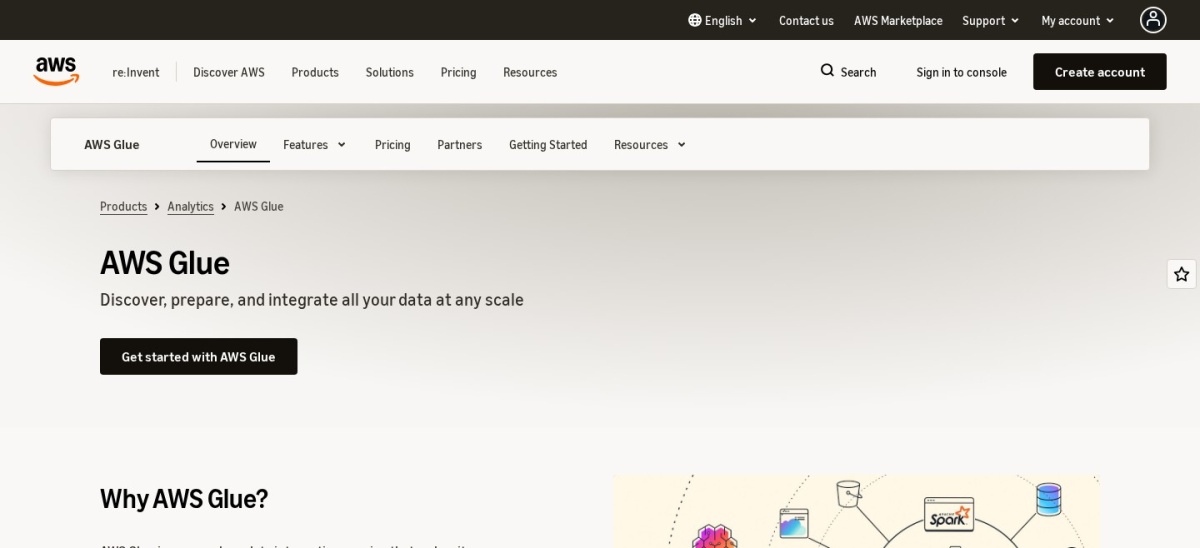
AWS Glue homepage, captured Nov 2026.
AWS Glue is a serverless ETL service that runs Spark and Python jobs without servers to manage. It includes a Data Catalog and crawlers that find your schemas, and jobs are billed per second at $0.44 per DPU-hour.
The trade off is code. Glue fits teams that write Spark or Python and already run on AWS, and costs rise with job time and DPU count. It suits AWS shops that want ETL close to S3, Redshift and Athena.
What we like
No servers to manage
$0.44 per DPU-hour, billed per second
Built-in Data Catalog and crawlers
Deep fit with S3, Redshift and Athena
Watch out for
Needs Spark or Python skills
Only makes sense inside AWS
Costs grow with long or large jobs
Extra charges apply for crawlers, DataBrew and catalog use over the free tierVisit aws.amazon.com
08
Azure Data Factory
4.6/5on G2 (101 reviews, checked Nov 2026)
PricingUsage-based/mo
Best cloud ETL for Azure teams
BillingPer activity run and DIU-hour
Free activitiesFirst 5 low-frequency a month
Data flowsMinimum 8-vCore cluster
DeploymentAzure and self-hosted runtime
azure.microsoft.com
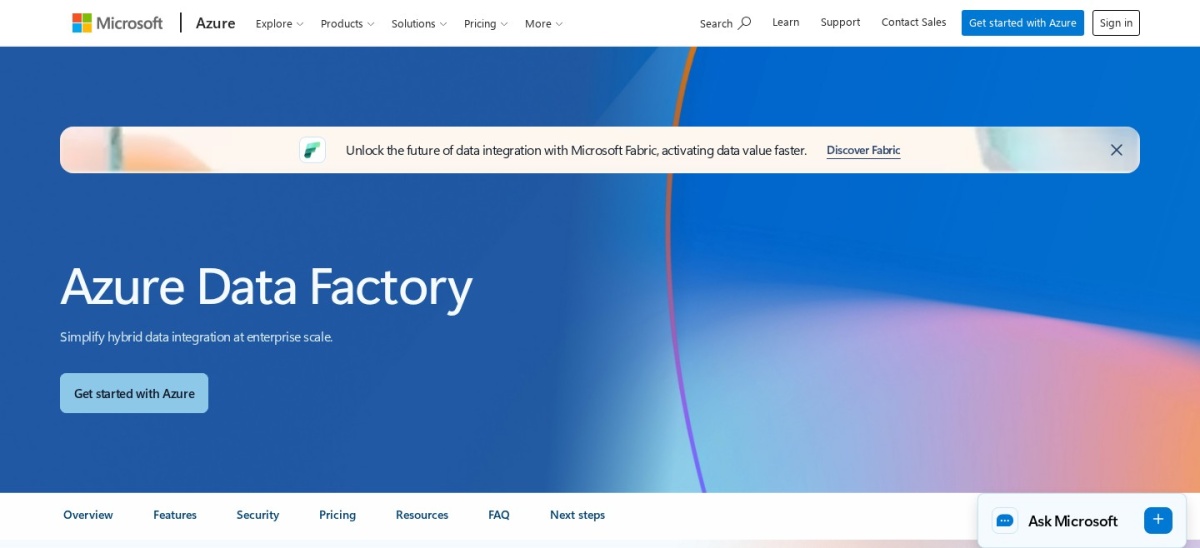
Azure Data Factory homepage, captured Nov 2026.
Azure Data Factory is Microsoft's cloud ETL service for Azure and hybrid data. Pipelines run copy, transform and orchestration activities across cloud and on-premises sources, and the first 5 low-frequency activities each month are free.
The trade off is the meter. Orchestration is charged per 1,000 runs, data movement per DIU-hour and data flows per vCore-hour, so bills need care at scale. It suits teams already running on Azure that want pipelines beside their other Microsoft services.
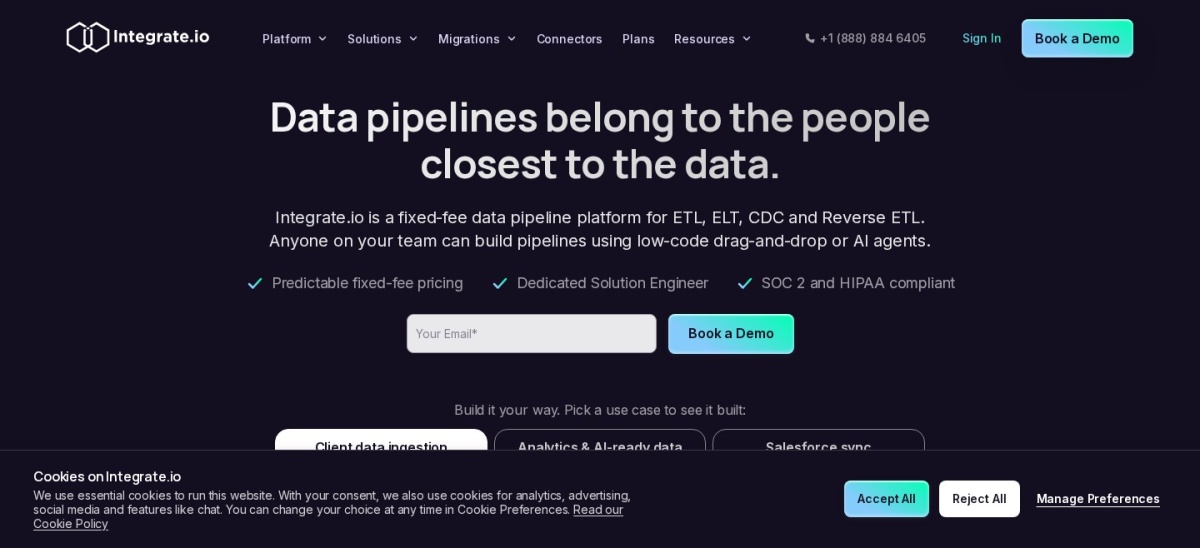
Integrate.io is a fixed-fee ETL platform that charges $1,999 a month whatever the volume. The fee covers ingestion, transformation and reverse ETL, with 200+ sources and destinations and no row or pipeline caps.
The trade off is the entry price. At $1,999 a month it costs more than usage-based tools at low volumes, and the flat fee only pays off as volume grows. It suits teams with high, steady volumes that want a bill they can predict.
Usage-based tools win at low volumes. Fivetran starts at a $5 base per connection, Airbyte at $20 a month and Hevo at $265 a month, so a small set of pipelines costs little.
Flat fees win as volume grows. Integrate.io charges $1,999 a month whatever you move, so the bill stays flat while usage-based bills climb with rows, credits or events.
Quote-only tools hide the comparison. Matillion and Informatica publish no dollar price, so ask for a quote on the same workload you priced on the other tools before you shortlist.
How we chose
We started from the enterprise ETL tools that appear most often in G2 reviews and vendor comparisons, then kept the nine with the broadest connector coverage and clear enterprise use.
Prices come from each vendor's pricing page, checked on 23 November 2026. Ratings come from G2 on the same day. Where a vendor shows no dollar price, the list says so instead of guessing one.
We left out transformation-only tools and single-cloud utilities that do not move data end to end. No vendor paid for a place, and we do not claim hands-on testing for this list.
How to choose an enterprise ETL tool
List your sources and your monthly volume first, then price the same workload on two or three tools.
Count your sources and your volume. Write down every source, how often it changes and how many rows move each month. The meter decides the bill, so guesswork here leads to surprise invoices.
Check the connector list before the demo. If a key source has no ready connector, your team builds and maintains one. Ask which connectors are fully managed and which are community-built.
Price the same workload everywhere. Run your row, credit or event counts through each vendor's pricing page. A tool that is cheapest at 1 million rows may not be cheapest at 20 million.
Confirm governance and deployment. Check lineage, access control, audit logs and where data is processed. Regulated teams need these on day one, not as an add-on later.
FAQ
What is the best enterprise ETL tool?
Fivetran is the best enterprise ETL tool for most teams. It has 700+ managed connectors, 15-minute syncs and a free plan up to 500,000 monthly active rows, and it is rated 4.3 out of 5 on G2 from 841 reviews.
What is the cheapest enterprise ETL tool?
Airbyte is the cheapest managed start at $20 a month, and its Core edition is free to self-host. Fivetran is free up to 500,000 monthly active rows, and at high volumes a flat fee such as Integrate.io at $1,999 a month can beat usage billing.
What is the difference between ETL and ELT?
ETL transforms data before it is loaded, while ELT loads raw data into the warehouse first and transforms it there. Most tools in this list work ELT-first, and several support both patterns, so check which pattern your warehouse setup needs.
Do enterprise ETL tools need code?
Most do not. Fivetran, Hevo and Integrate.io are no-code or low-code, and Matillion mixes a visual canvas with SQL and Python. AWS Glue is the main exception here: it needs Spark or Python skills to build jobs.
How much does Fivetran cost?
Fivetran is usage-based: it bills by monthly active rows per connection, with a $5 base charge on Standard connections. The free plan covers 500,000 monthly active rows, and annual contracts save up to 22% on the list price.
Which ETL tool is best for AWS or Azure?
AWS Glue is the best fit for AWS teams at $0.44 per DPU-hour, and Azure Data Factory is the best fit for Azure teams with pay-per-use activity billing. Both fit poorly outside their own cloud, so pick the one that matches where your data already lives.