Best Enterprise Accounting Software in 2026: 9 Tools Compared
WLWPLegible EditorsLast verified 23 Nov 2026How we rank13 min read
★ Short answer
NetSuite is the best enterprise accounting software for most growing companies, with unified financials, inventory and CRM and a 4.1 out of 5 G2 rating from 4,963 reviews. Pick Sage Intacct for finance-led multi-entity reporting and Xero for a low-cost cloud start.
How we make this list: we compare pricing pages, product documentation and public user reviews, then re-check every price before each update. No product paid for a place. Disclosure.
NetSuite leads with unified ERP financials and a 4.1 out of 5 G2 rating from 4,963 reviews.
Sage Intacct is the finance-led pick: dimensional reporting and native consolidation, rated 4.3 out of 5 on G2.
Acumatica charges by computing resources, not seats, so every user logs in without per-seat fees.
Business Central is the clearest published price here: $70 per user a month for Essentials.
Xero is the cheapest entry at $27 a month, with unlimited users on every plan.
Five of the nine tools publish no price at all, so budget for a written quote plus implementation.
What enterprise accounting software has to cover
Enterprise accounting starts where small-business ledgers stop. A company with several entities, currencies and approval chains needs one general ledger that consolidates them all, with intercompany entries and an audit trail an auditor can follow.
Multi-entity consolidation is the first thing to check. NetSuite, Sage Intacct, Acumatica, Workday and Oracle Fusion all consolidate subsidiaries in the system, while Xero and QuickBooks Enterprise are built for simpler, single-entity books.
Pricing is the hardest part of this market. Five of the nine tools here publish no price, and the published ones range from $27 a month for Xero Early to $625 per user a month on Oracle Fusion list pricing.
Tax handling also matters as you grow. Our guide on setting up taxes in WooCommerce shows how tax rules differ by location, and the same care applies when an ERP has to post tax across entities.
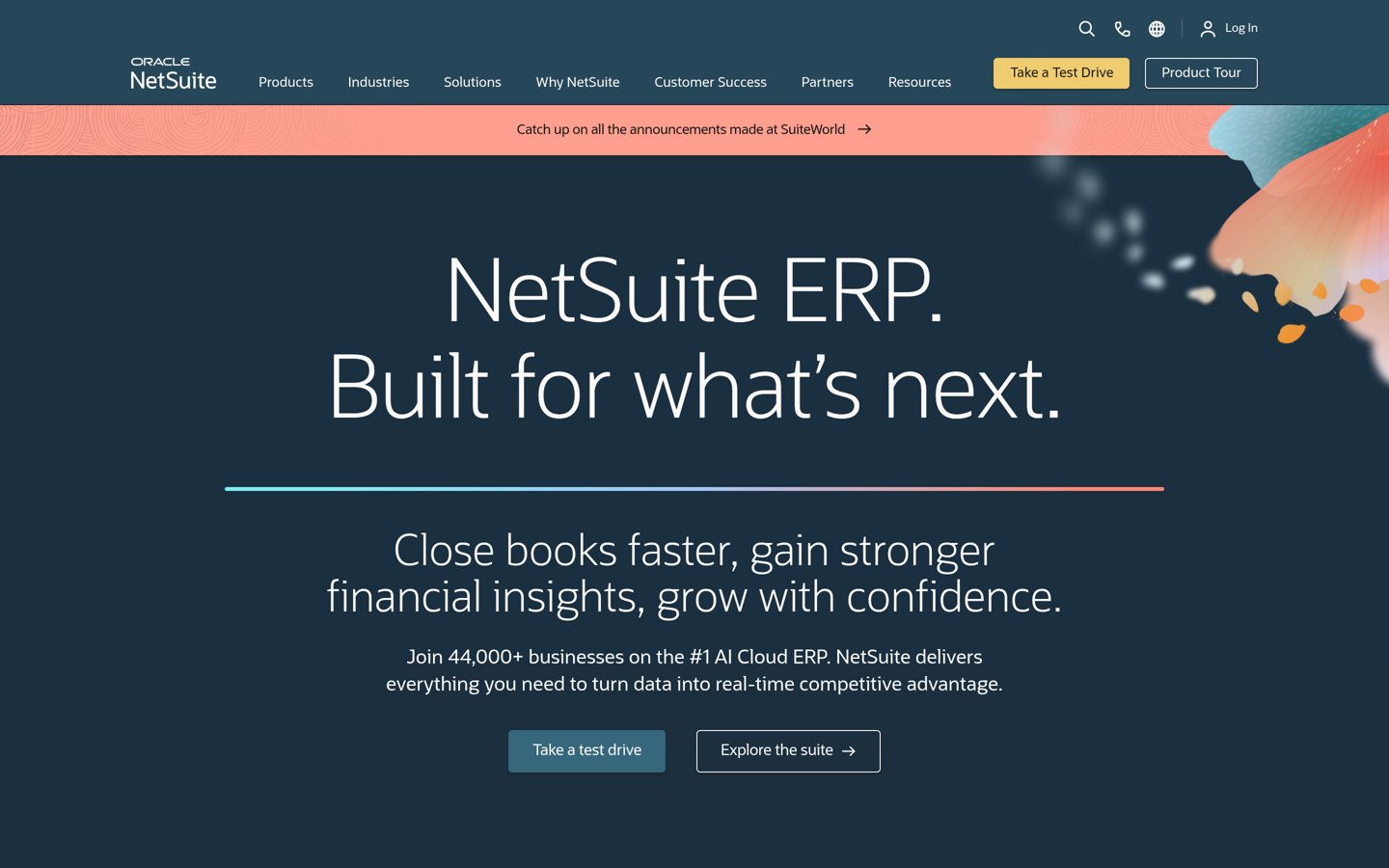
Oracle NetSuite is a cloud ERP that runs accounting, inventory, order management, CRM and HR in one system. Its OneWorld subsidiaries handle multi-entity consolidation across currencies, with automated elimination journals and period locks per subsidiary.
The trade off is price and setup. NetSuite publishes no price, and implementation usually needs a partner and several months. It suits growing companies that have outgrown QuickBooks and want one system for finance and operations.
What we like
Unified financials, inventory, CRM and HR in one system
Multi-subsidiary consolidation across currencies
Largest review base among the full ERPs here
Watch out for
No published price; every deal is a quote
Implementation usually needs a partner and months of work
Per-user fees add up as the team grows
Paid modules add planning, budgeting and advanced revenue managementVisit netsuite.com
02
Sage Intacct
4.3/5on G2 (4,521 reviews, checked Nov 2026)
PricingCustom/yr
Best for multi-entity finance teams
Entry planQuote only
Multi-entityYes, native consolidation
DimensionsDepartment, project, location
Free trialNo, demo only
sageintacct.com
Sage Intacct homepage, captured Nov 2026.
Sage Intacct is a cloud financial management platform built for finance teams, not general operations. Its dimensional reporting tags each transaction by department, location, project and customer, so reports can be cut any way the board asks without a rigid chart of accounts.
The trade off is cost and setup. Sage publishes no price, and partner estimates put entry subscriptions near $9,000 to $12,000 a year before implementation. It suits mid-size companies with several entities that need consolidation and audit trails.
What we like
Dimensional reporting without a rigid chart of accounts
Native multi-entity consolidation and inter-entity entries
Strong audit trails and approval workflows
Watch out for
No published price; quotes vary by modules and entities
Implementation often costs as much as a year of subscription
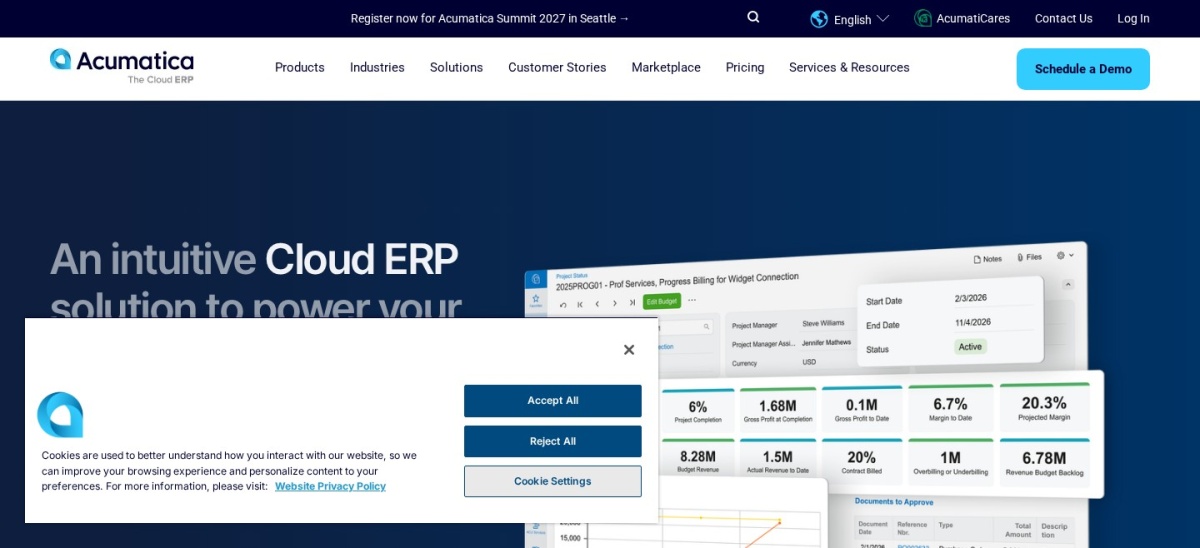
Acumatica is a cloud ERP that prices by the computing resources used, not by named users. The warehouse team, the office and the accountants can all log in without per-seat maths, and one environment holds unlimited related companies with intercompany accounting.
The trade off is that the price is still a quote. Acumatica publishes no list price, and the resource-based model needs a partner to size. It suits distribution, manufacturing and services firms that want many users in the system.
What we like
Unlimited users with no per-seat fees
Highest G2 rating in this list at 4.4 out of 5
Unlimited related companies in one environment
Watch out for
No published price; quotes need partner sizing
Smaller partner network than NetSuite or SAP
Industry editions add cost on top of the base
Paid editions add construction, distribution and manufacturing depthVisit acumatica.com
04
Microsoft Dynamics 365 Business Central
4/5on G2 (917 reviews, checked Nov 2026)
Starts at$70/user/mo
Best for Microsoft 365 teams
Entry planEssentials, $70/user/mo
Premium$100/user/mo
Team Members$8/user/mo
Free trialYes
microsoft.com
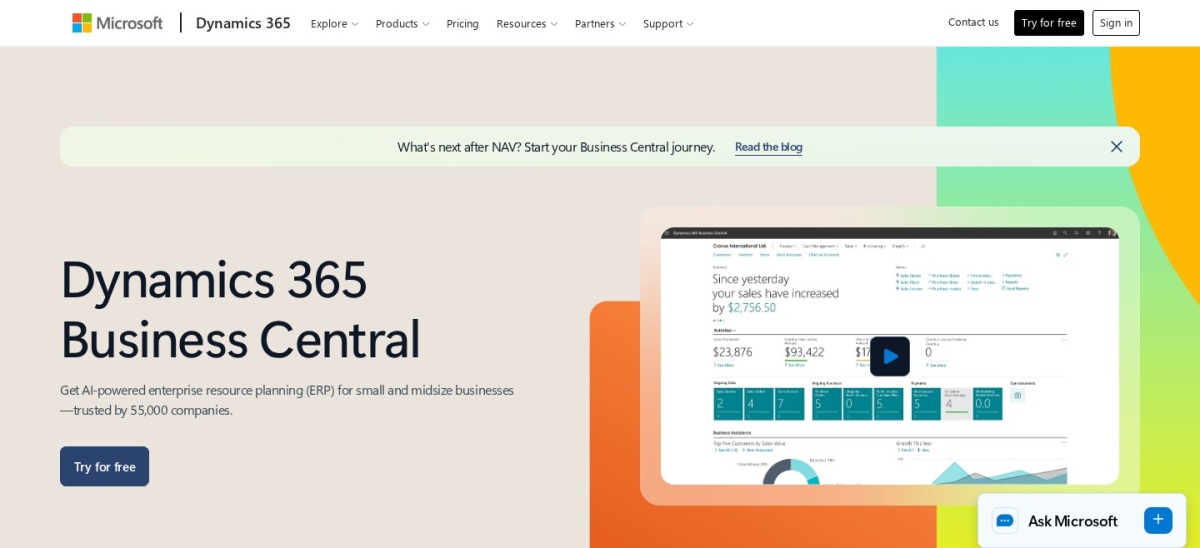
Microsoft Dynamics 365 Business Central homepage, captured Nov 2026.
Microsoft Dynamics 365 Business Central is a cloud ERP for finance, sales, purchasing, inventory and projects. Essentials at $70 per user a month covers core financials, multi-currency and job costing, and it links to Outlook, Excel, Teams and Power BI.
The trade off is per-user cost at scale. A 10-user finance team pays $700 a month before implementation, and manufacturing needs Premium at $100 per user a month. It suits companies whose staff already live in Microsoft tools.
What we like
Clear published per-user pricing
Deep links to Microsoft 365, Excel and Power BI
Covers finance, inventory, sales and projects in one system
Workday Financial Management homepage, captured Nov 2026.
Workday Financial Management is an enterprise cloud finance system with multibook, multi-entity and consolidation in the core. It pairs finance with Workday HCM, so headcount, payroll and planning sit beside the ledger instead of in a separate system.
The trade off is scale and price. Workday publishes no price and is built for large enterprises, so smaller companies will find the sales cycle and implementation heavy. It suits people-heavy enterprises already running Workday for HR.
What we like
Finance and HR on one platform
Multibook and multi-entity consolidation in the core
Close hub for faster period closes
Watch out for
No published price; enterprise quotes only
Built for large enterprises, heavy for smaller firms
Smallest review base among the large suites here
Paid add-ons cover planning, procurement and spend managementVisit workday.com
06
Oracle Fusion Cloud ERP
4/5on G2 (122 reviews, checked Nov 2026)
Starts at$625/user/mo
Best for global Oracle-stack enterprises
Entry plan$625/user/mo list price
Multi-entityMulti-ledger, ledger sets
ConsolidationBuilt-in module
Free trialNo, demo only
oracle.com
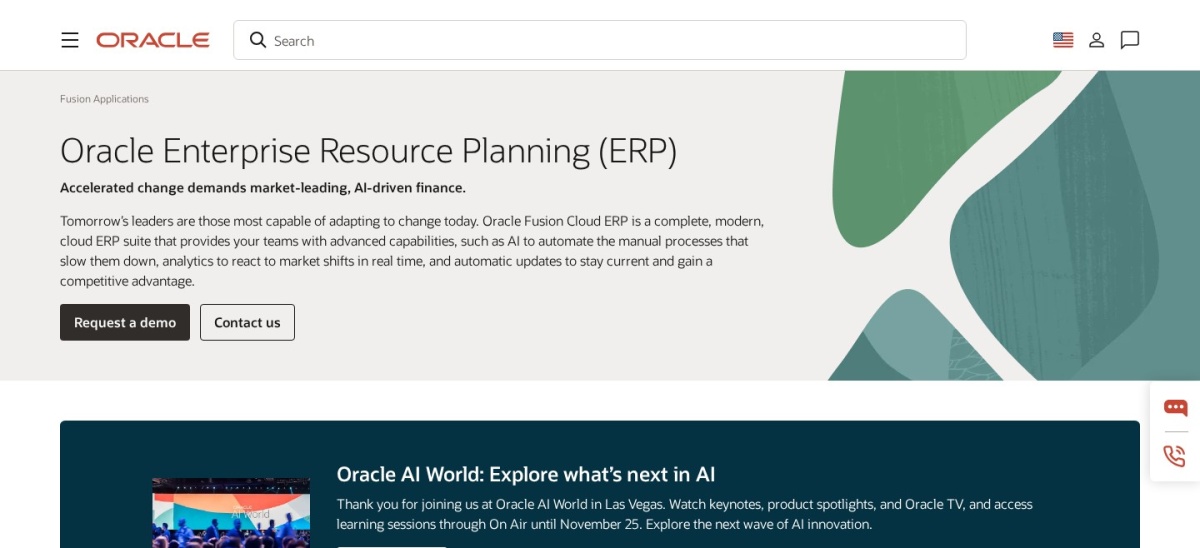
Oracle Fusion Cloud ERP homepage, captured Nov 2026.
Oracle Fusion Cloud ERP is the SaaS successor to Oracle E-Business Suite, built for global enterprises. Its multi-ledger general ledger supports ledger sets, intercompany transactions and a built-in consolidation module, with three consolidation methods inside the ledger.
The trade off is price. The published list price is $625 per named user a month, with a 10-user minimum and a 3-year standard term, and real quotes are negotiated. It suits global enterprises already invested in Oracle technology.
What we like
Multi-ledger general ledger with built-in consolidation
Three consolidation methods inside the ledger
Deep global and intercompany support
Watch out for
Highest list price in this list at $625 per user a month
Smallest G2 review base here at 122 reviews
Implementation is a large enterprise project
Quotes are negotiated; list price is the starting point, not the final priceVisit oracle.com
07
SAP Business One
4.3/5on G2 (542 reviews, checked Nov 2026)
PricingCustom/yr
Best for smaller enterprises on SAP
Entry planQuote only
DeploymentCloud or on premise
UsersPer-user licences
Free trialNo, demo only
sap.com
SAP Business One homepage, captured Nov 2026.
SAP Business One is SAP's system for smaller enterprises, covering accounting, inventory, manufacturing and CRM in one package. It runs in the cloud or on premise, which suits companies that need to keep data on their own servers.
The trade off is that it is the smallest SAP ERP. It lacks the depth of S/4HANA for very large groups, and SAP publishes no price for it. It suits smaller enterprises that want the SAP name without S/4HANA scale.
What we like
Accounting, inventory and CRM in one system
Cloud or on-premise deployment
Rated 4.3 out of 5 on G2
Watch out for
No published price; quotes come through SAP or a partner
Less depth than S/4HANA for very large groups
Partner-led setup is the norm
Add-ons cover industry packs and advanced reportingVisit sap.com
08
QuickBooks Enterprise
4.3/5on G2 (1,061 reviews, checked Nov 2026)
Starts at$2,210/yr
Best first step up from QuickBooks
Entry planGold, $2,210/yr, 1 user
Max users30 on Gold, 40 on Diamond
PayrollEnhanced Payroll in Gold
Reports200+ built-in reports
quickbooks.intuit.com
QuickBooks Enterprise homepage, captured Nov 2026.
QuickBooks Enterprise is Intuit's desktop accounting product for larger companies, with up to 30 users on Gold and 40 on Diamond. Gold at $2,210 a year for one user includes Enhanced Payroll, advanced reporting with more than 200 built-in reports and Priority Circle support.
The trade off is that it is desktop software, not a cloud ERP. There is no native multi-entity consolidation, and cloud access costs extra through hosting. It suits companies outgrowing QuickBooks Online that want to stay with Intuit.
Xero is cloud accounting for small and growing businesses, with invoicing, bills, bank reconciliation and reporting. Early at $27 a month covers 20 invoices and 5 bills a month, and every plan includes unlimited users, so the whole team can log in without seat fees.
The trade off is scope. Xero is not an ERP: there is no native multi-entity consolidation, and multi-currency needs Established at $97 a month. It suits service-heavy firms with simple structures that want low-cost cloud books.
What we like
Cheapest entry price in this list at $27 a month
Unlimited users on every plan
Highest G2 rating here at 4.4 out of 5
Watch out for
No native multi-entity consolidation
Multi-currency only on the $97 a month plan
Payroll needs a paid integration in the US
Established adds multi-currency, projects and expenses at $97 a monthVisit xero.com
Five tools publish no price: what to ask for
NetSuite, Sage Intacct, Acumatica, Workday and SAP Business One publish no price. Each quote depends on users, entities, modules and implementation, so two companies rarely pay the same amount.
Ask for the quote in writing with the subscription, the implementation fee and the renewal terms separated. Partner estimates put Sage Intacct entry subscriptions near $9,000 to $12,000 a year, and implementation often costs as much as the first year of subscription.
For the tools with published prices, the entry figure is only the start. Business Central Essentials is $70 per user a month, so a 10-user team pays $700 a month, and QuickBooks Enterprise Gold at $2,210 a year covers one user only.
Get the renewal cap in the contract. Reviewers report annual increases on several of these tools, and a cap of 3 to 5 percent a year is a common negotiating point.
How we chose
We started from the enterprise accounting systems with the largest G2 review bases and the clearest multi-entity support, then kept nine that cover the full range from cloud ERP suites to a low-cost cloud ledger.
Prices come from each vendor's pricing page, checked on 23 November 2026. Xero prices are from the official US pricing page, Business Central prices are vendor-supplied pricing, and QuickBooks Enterprise Gold is from Intuit's pricing page as checked in late October 2026. Where a vendor shows a sale, the list shows the regular price.
We left out tools with no usable review base or no enterprise accounting core. No vendor paid for a place, and we do not claim hands-on testing for this list.
How to choose enterprise accounting software
Start with how many entities you run, then work out what the quote has to include.
Count your entities and currencies. If you consolidate several companies in more than one currency, you need NetSuite, Sage Intacct, Acumatica, Workday or Oracle Fusion. A single-entity firm can use Xero or QuickBooks Enterprise.
Decide between finance-led and operations-led. Sage Intacct and Workday lead with reporting and the close. NetSuite, Acumatica and Business Central add inventory, sales and operations to the same system.
Get the full quote in writing. Ask for the subscription, implementation and renewal terms as separate lines, and check whether support, training and data migration are included.
Check the ecosystem you already use. Microsoft 365 shops fit Business Central, Oracle shops fit Fusion or NetSuite, and SAP shops fit Business One or S/4HANA.
FAQ
What is the best enterprise accounting software?
NetSuite is the best pick for most growing companies. It unifies financials, inventory, order management and CRM in one cloud ERP, and it holds a 4.1 out of 5 G2 rating from 4,963 reviews.
How much does enterprise accounting software cost?
Published prices here run from $27 a month for Xero Early to $625 per user a month on Oracle Fusion list pricing. Five tools publish no price at all, and partner estimates put Sage Intacct entry subscriptions near $9,000 to $12,000 a year.
What is the difference between NetSuite and Sage Intacct?
NetSuite is a full cloud ERP that adds inventory, CRM and HR to the ledger. Sage Intacct is finance-led, with dimensional reporting and consolidation as its core, and it suits teams that need reporting depth more than operational modules.
Is Xero enterprise accounting software?
Xero is cloud accounting, not a full ERP. It works well for single-entity firms that want low-cost books with unlimited users, but it has no native multi-entity consolidation, so groups of companies need a different tool.
Why do most enterprise tools not publish prices?
Quotes depend on users, entities, modules and implementation scope, so vendors price each deal. Ask for the subscription, implementation fee and renewal cap in writing before signing.
Which enterprise accounting tool is cheapest?
Xero is the cheapest entry here at $27 a month for Early, with unlimited users on every plan. Business Central Essentials at $70 per user a month is the cheapest full ERP with a published price.